Contents7 sections
- What the AI prompt certification actually tests
- National, accredited and registered: Korea's three credential tiers
- How to verify a Korean private qualification in five steps
- AI-POT exam format, fees and what to compare
- Hiring value, and showing prompt skills without a certificate
- Frequently asked questions
- Sources and references
If you have seen job ads or course offers in Korea mentioning an AI prompt certification, the one most people mean is AI-POT (AI Prompt Proficiency Test), run by the Korea Productivity Center (KPC). It is a registered private qualification: listed in the government's registry, but not accredited or endorsed by the state. This guide explains what that status means, how to verify any Korean credential in the official registry, what the AI-POT exam covers and how much weight it carries with employers. Facts were checked against KPC's exam page, the official registry and Korean statute on 11 November 2026, and apply to qualifications offered in South Korea.
What the AI prompt certification actually tests
A prompt is the instruction or question you type into a generative AI tool. The same model can produce very different output depending on how clearly you state the goal, context, constraints and desired format. "Prompt proficiency" is simply the skill of writing instructions that consistently get useful results. KPC's exam page describes AI-POT as a practice-based credential that assesses prompt writing for generative AI services that produce text, images, music and other content.
The name is not exclusive. In Korea, individuals, organisations and companies can register their own private qualifications, so identical or near-identical titles often exist side by side. When you look for a prompt engineering certificate in Korea, think in terms of the registration number and the managing body, not the title on the brochure.
National, accredited and registered: Korea's three credential tiers
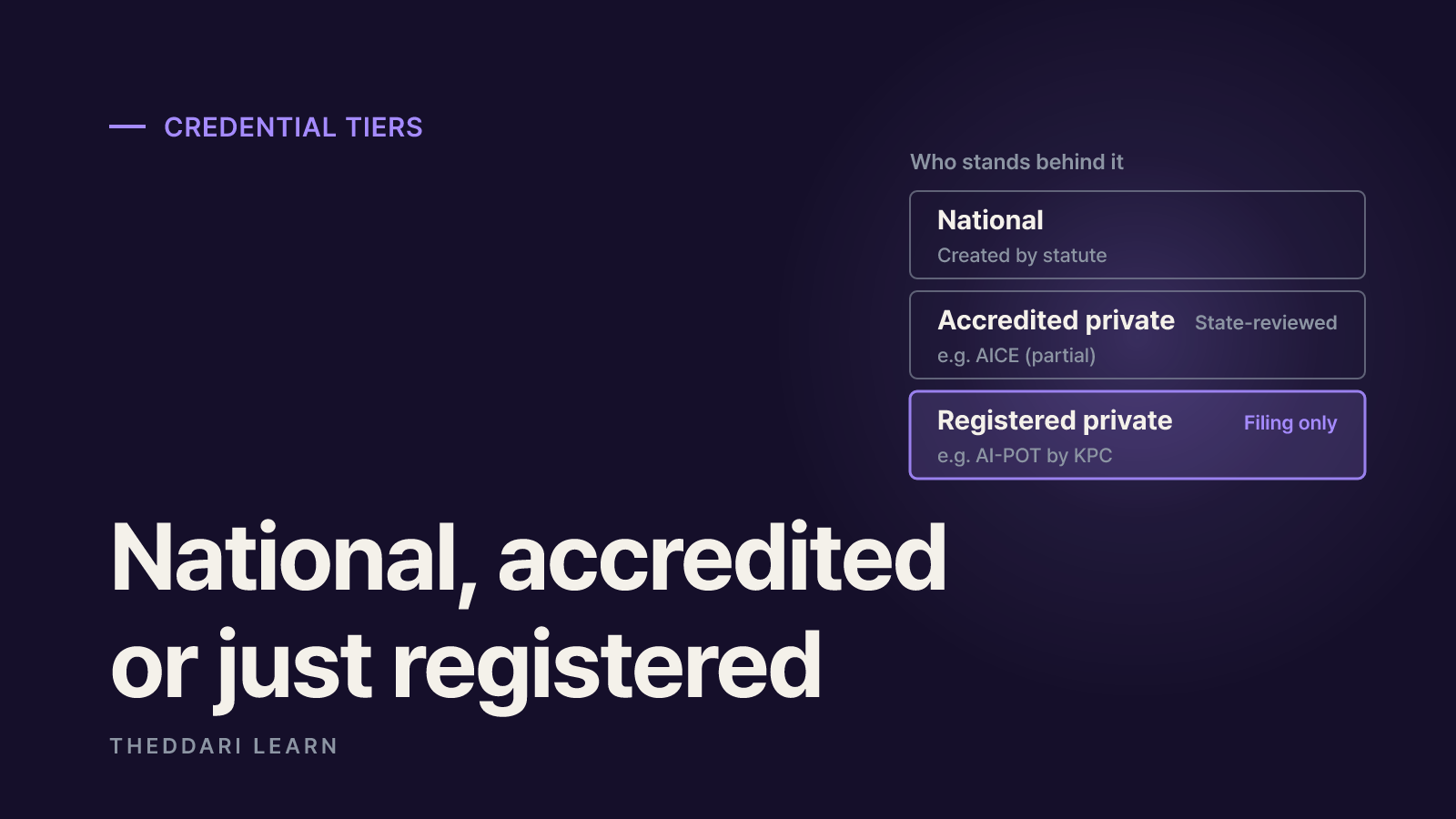
Korean qualifications fall into national qualifications created by statute and private qualifications run by anyone else. Private qualifications are further split into those that are merely registered with a supervising ministry and the smaller group the state has accredited after reviewing their quality. The official registry labels each entry as registered, accredited or partially accredited.
National qualification
- Who runs it
- Government, by law
- AI-related example (Nov 2026)
- —
- Where to check
- Q-Net and the relevant statute
Accredited private
- Who runs it
- Private body, state-accredited
- AI-related example (Nov 2026)
- AICE by KT, partially accredited (2022-004642)
- Where to check
- Registry, 'accredited' filter
Registered private
- Who runs it
- Private body, registration only
- AI-related example (Nov 2026)
- AI-POT by KPC (2024-002196)
- Where to check
- Registry, 'registered' filter
Filtering the registry for accredited qualifications returned 98 entries on 11 November 2026, among them KT's AI CERTIFICATE FOR EVERYONE (AICE), marked as partially accredited, meaning only some of its grades hold accreditation. KPC's AI-POT appeared as registered only.
Registration is common. The registry's statistics page counted 67,835 active registered qualifications from 18,793 managing bodies as of 3 November 2026. In 2026 alone, 8,080 were newly registered and 773 were withdrawn. Read "registered" as "completed the legal filing", not "quality-checked by the government".
How to verify a Korean private qualification in five steps
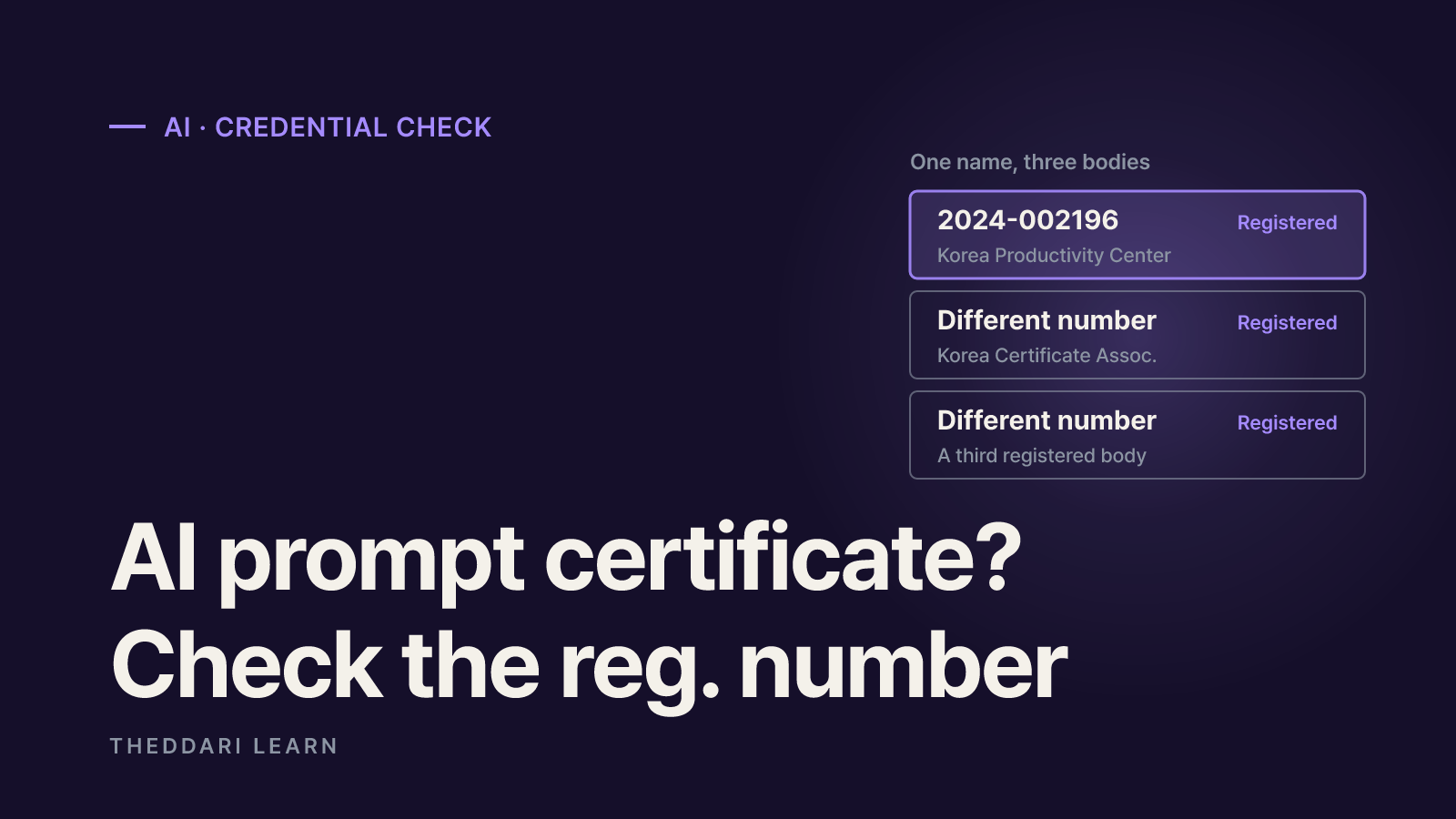
The Private Qualification Information Service (pqi.or.kr) is the official registry, operated with the Ministry of Education and the Korea Research Institute for Vocational Education and Training. The site is in Korean, but the search form is simple enough to use with browser translation. Its own search page warns that several qualifications and bodies may share the same name. A search for 프롬프트 ("prompt") on 11 November 2026 returned 77 entries, including three AI-POT registrations held by different bodies.
- 1
Copy the details from the ad or application page
Note the managing body, the registration number and whether it claims to be registered or accredited. Korean law requires qualification ads to display this information.
- 2
Search the registry by qualification name
Use the private qualification search menu. If several rows share the name, compare the managing body column.
- 3
Match the number and the body
The registration number from the ad must appear in the same row as the managing body. Same title with a different number means a different credential.
- 4
Read the type column
Registered means no state accreditation. Accredited or partially accredited means at least some grades are accredited, so confirm which grade you are sitting.
- 5
Open the detail page and the withdrawn list
Check the supervising ministry and contact details, and search the withdrawn qualifications list if the ad looks old.
Candidate and pass counts in the registry are entered by each provider. The registry notes that missing data does not indicate whether a qualification is actually running, so do not read a blank as "inactive" or a large number as a sign of quality.
Advertising rules and penalties
Article 33 of the Framework Act on Qualifications requires qualification ads to state the type of qualification, its registration or accreditation number and its operator, and prohibits advertising an unaccredited private qualification as accredited. Article 41 sets a fine of up to 30 million won (Act No. 19095, in force since 28 June 2023). An ad without a registration number, or one hinting at "national-level" status, is a reason to check again before paying.
AI-POT exam format, fees and what to compare
According to KPC's page (checked 11 November 2026), there are no eligibility requirements, both grades are computer-based tests, and the pass mark is 70 out of 100.
Questions
- Grade 1
- 40 (35 theory + 5 hands-on prompt writing)
- Grade 2
- 40 (multiple choice and short answer)
Duration
- Grade 1
- 60 min (40 theory, then 20 practical)
- Grade 2
- 60 min
Subjects
- Grade 1
- AI theory, generative AI theory, prompt techniques and application, workplace use and ethics
- Grade 2
- Foundation level of the same areas
Fee
- Grade 1
- 68,000 won
- Grade 2
- 38,000 won
Pass mark
- Grade 1
- 70 points
- Grade 2
- 70 points
Fees include VAT, with a separate 1,000 won payment processing charge. Grade 2 has no hands-on section, so if you want to be tested on actual prompt writing, try KPC's CBT practice test to see what Grade 1's five practical items look like.
When comparing a prompt engineering certificate from another provider, line them up on the same criteria: registration number and tier, the share of practical tasks, total cost including courses, textbooks and certificate issuance, the refund policy, and whether the syllabus is tied to one AI product. Generative AI interfaces change quickly, so an exam built on principles such as stating goals, context and output format will age better than one that tests where a menu sits in a specific version.
Hiring value, and showing prompt skills without a certificate
Korean law does not give registered private qualifications any hiring weight. Whether a certificate counts is up to each employer, and you can only predict its effect when a posting names it. Even then, check that the name and registration number match the credential you hold; a same-name certificate from another body may not be accepted.
What interviewers usually want to know is how well you solve real work problems with AI. A certificate signals that you studied the basics; a body of work shows you can apply them. These materials tend to persuade regardless of whether you hold a credential:
- Case notes: the problem, your first prompt, why you revised it and the final output.
- Verification log: how you caught errors or hallucinations and checked sources.
- Reusable templates: prompt structures for recurring tasks such as summarising reports or cleaning data, with their limits.
- Safety judgement: the rules you set to keep personal data and confidential material out of AI tools.
Following AI industry chatter helps you see which tools and techniques people actually use. Theddari's AI Telegram trends and blog trends pages show tools and keywords that are frequently mentioned; confirm any feature in the vendor's official documentation before building a portfolio piece around it.
 theddari.comTrendsBlog PostsSummarized Naver blog posts
In short: verify the registration number and managing body in the official registry, confirm whether the credential is registered or accredited, compare practical content, total cost and refunds, and check whether your target employers actually ask for it. Use a certificate to structure your learning, and pair it with documented work that shows what you can do with AI.