IonQ vs Rigetti: Quantum Tech, Earnings and Cash-Burn Risks
Compare IonQ's trapped-ion and Rigetti's superconducting tech, Q3 2026 revenue, losses and cash, and the dilution risks to check in earnings.
Contents7 sections
Key takeaways
- IonQ builds trapped-ion quantum computers controlled by lasers; Rigetti builds superconducting circuit chips cooled near absolute zero.
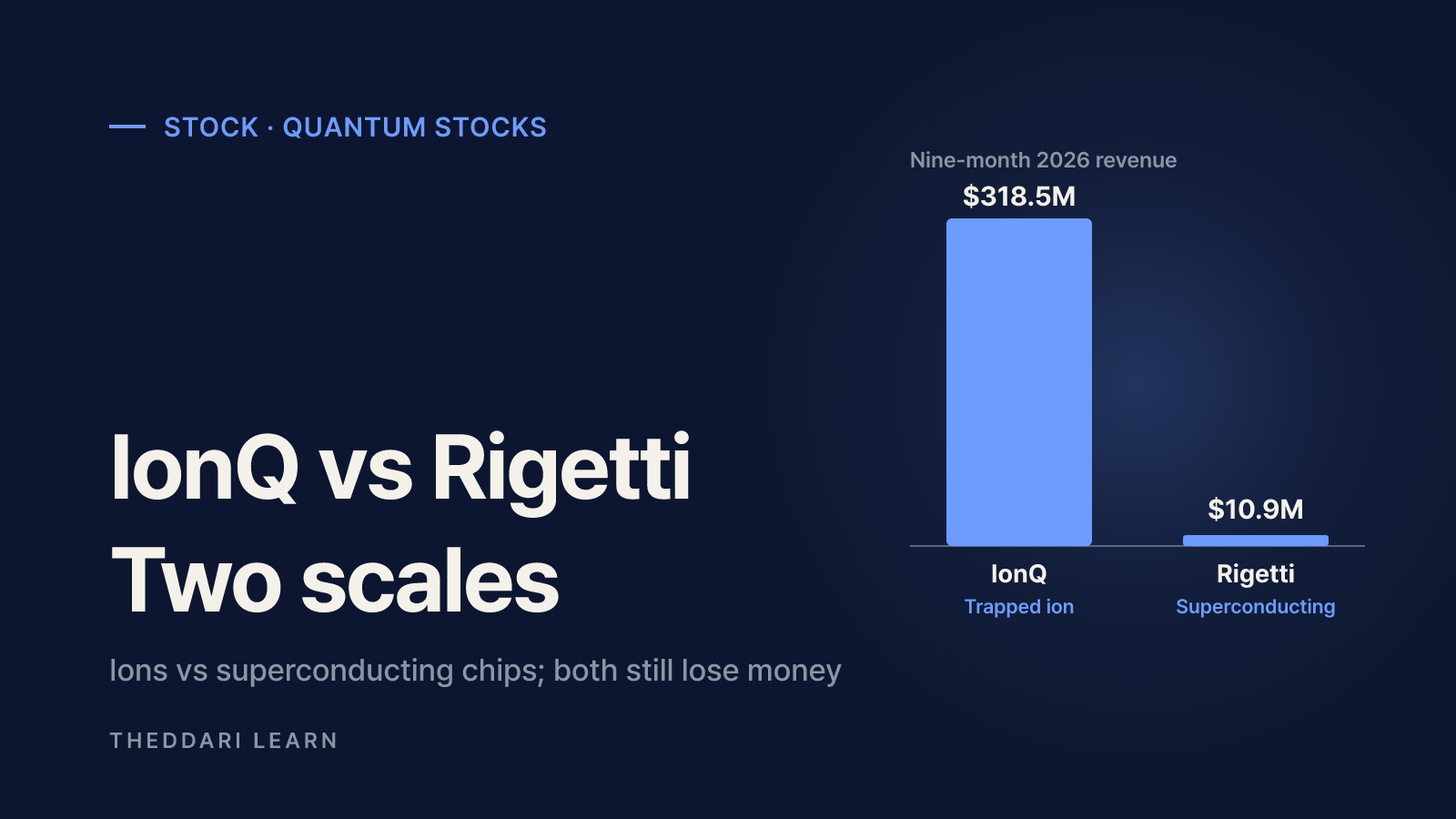
- For the first nine months of 2026, IonQ reported $318.5 million of revenue and Rigetti $10.9 million, but about half of IonQ's Q3 revenue came from its SkyWater foundry segment.
- Both companies posted operating losses in Q3 2026; non-cash warrant gains made their bottom lines look far better than operations.
- IonQ closed a roughly $2.0 billion equity offering on October 16, 2026, while Rigetti held $497.1 million of cash and investments with no debt.
- On earnings day, focus on revenue mix, operating cash flow, share count and whether contract values are firm.
IonQ vs Rigetti is really a comparison of two different bets. IonQ (NYSE: IONQ) uses trapped ions held in a vacuum and controlled with lasers, while Rigetti (Nasdaq: RGTI) builds superconducting chips cooled to near absolute zero. As of November 2026, their third-quarter filings show a huge gap in scale: IonQ reported $318.5 million of revenue for the first nine months of 2026, Rigetti $10.9 million. Yet both still lose money from operations, and both reported bottom lines distorted by non-cash warrant gains. This guide walks through the technology, the Q3 2026 numbers for the quarter ended September 30, the cash-burn and dilution picture, and a checklist for the next earnings release.
IonQ vs Rigetti technology: trapped ions versus superconducting qubits
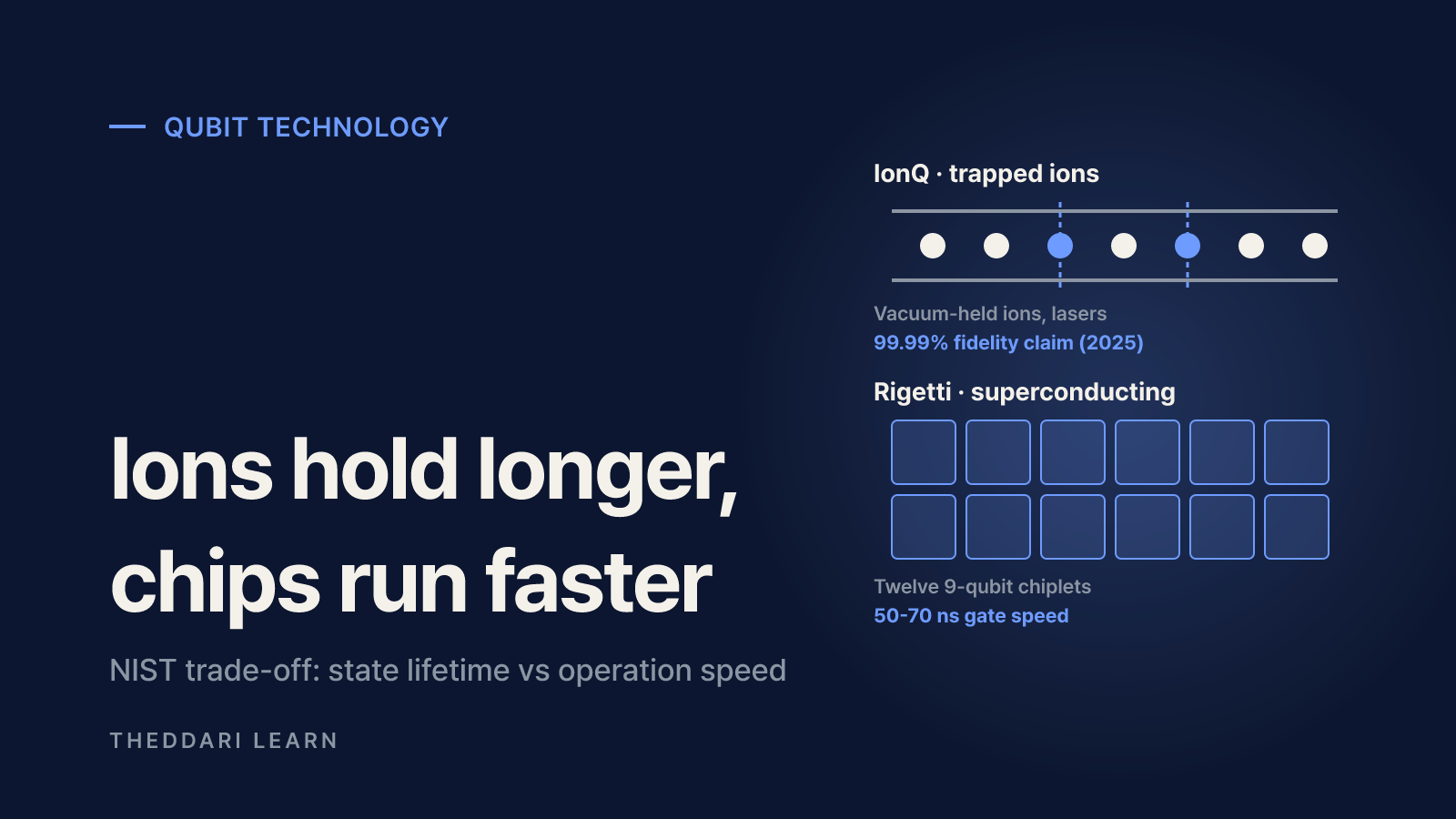
The U.S. National Institute of Standards and Technology offers a neutral primer in its Quantum Computing Explained page. Trapped-ion qubits are charged atoms suspended by electric or magnetic fields inside a vacuum chamber and manipulated with lasers. NIST notes that they can sustain quantum superpositions for a long time but are relatively sluggish at computing. Superconducting qubits are tiny circuits on a chip cooled close to absolute zero. They compute quickly and can be made with existing chip-manufacturing techniques, but their quantum states are more fragile and shorter-lived.
No architecture has been proven the winner. NIST says even the best machines today make an error roughly once in every thousand operations, and that early quantum advantage demonstrations have not yet proved truly useful. That context matters for investors: the valuations of quantum computing stocks rest heavily on future commercialization rather than on today's revenue.
IonQ: trapped ions plus an acquisition-built platform
In its November 5, 2026 earnings release, IonQ said it achieved 99.99% two-qubit gate fidelity in 2025. It also said it was the only trapped-ion company advanced to Stage C of DARPA's Quantum Benchmarking Initiative, with a potential program value of up to $300 million, and that NVIDIA will install a Superion 256 system at its quantum research center. IonQ now describes itself as a platform spanning computing, networking, sensing, security and a semiconductor foundry acquired with SkyWater, so it is no longer a pure quantum hardware story.
Rigetti: superconducting chiplets and an in-house fab
Rigetti's November 10, 2026 release reported 99.5% median two-qubit gate fidelity on its Cepheus-1-108Q, a system built from twelve 9-qubit chiplets. The company cites gate speeds of 50 to 70 nanoseconds and claims that is about 10,000 times faster than trapped-ion systems. It designs and makes its chips in its own Fab-1 facility. Next targets: a 300-plus-qubit system with about 99.7% median fidelity by mid-2028, and roughly 1,000 qubits at about 99.9% fidelity within about three years.
Qubit type
- IonQ (IONQ)
- Trapped ions in a vacuum, laser control
- Rigetti (RGTI)
- Superconducting circuits on cryogenic chips
NIST general trade-off
- IonQ (IONQ)
- Long-lived states, slower operations
- Rigetti (RGTI)
- Fast operations, shorter-lived states
Company performance claim
- IonQ (IONQ)
- 99.99% two-qubit fidelity announced for 2025
- Rigetti (RGTI)
- 99.5% median on 108 qubits; 50-70 ns gates
Business scope
- IonQ (IONQ)
- Computing, networking, sensing, security, foundry
- Rigetti (RGTI)
- On-premises systems, QPUs, cloud access
Next milestone
- IonQ (IONQ)
- DARPA Stage C (up to $300M potential)
- Rigetti (RGTI)
- 300+ qubits at about 99.7% by mid-2028
Fidelity figures depend on whether they are best-case or median results and how many qubits were measured. Do not treat 99.99% versus 99.5% as a direct technology ranking.
Q3 2026 earnings side by side
The table below restates figures from each company's Q3 2026 press release on a consistent basis. All amounts are in U.S. dollars and rounded.
Quarterly revenue
- IonQ
- $173.8M (up 336% year over year)
- Rigetti
- $1.4M (vs. $1.9M a year earlier)
Nine-month revenue
- IonQ
- $318.5M
- Rigetti
- $10.9M
Loss from operations
- IonQ
- $433.1M
- Rigetti
- $33.2M
GAAP net result
- IonQ
- Net income of $564.0M attributable to IonQ
- Rigetti
- Net loss of $3.1M
Company-adjusted metric
- IonQ
- Adjusted EBITDA loss of $133.6M
- Rigetti
- Non-GAAP net loss of $20.5M
Cash and investments (Sep 30)
- IonQ
- $1.7B; $3.7B pro forma for October offering
- Rigetti
- $497.1M, no debt
2026 revenue outlook
- IonQ
- $505M to $515M
- Rigetti
- About $20M, assuming Q4 C-DAC acceptance
IonQ's growth includes acquisitions. Of its Q3 revenue, the IonQ Platform segment contributed $90.3 million and the SkyWater Foundry Services segment $83.5 million, meaning nearly half came from contract chip manufacturing. Remaining performance obligations, or signed contract value not yet recognized, more than doubled to $1.2 billion, but IonQ's own definition includes unfunded portions of government contracts where money has not yet been appropriated.
Rigetti's revenue base is tiny and lumpy. Management says recognition is tied to a small number of system deliveries and acceptance milestones. Q3 gross profit was $857,000, roughly 61% of revenue, but research and development alone cost $25.5 million that quarter. Hitting the roughly $20 million full-year outlook implies about $9 million in Q4 by simple subtraction, and the company explicitly conditions it on customer acceptance of the C-DAC system.
Why reported profits can mislead: warrant accounting
The most confusing line for many readers is net income. IonQ lost $433.1 million from operations in Q3 2026, yet booked an $896.2 million gain from the change in fair value of warrant liabilities, producing $564.0 million of net income attributable to IonQ. A year earlier, an $881.8 million warrant loss pushed the quarterly net loss above $1 billion. Rigetti shows the same pattern on a smaller scale: a $33.2 million operating loss shrank to a $3.1 million net loss after a $25.3 million warrant gain and interest income.
Warrants give holders the right to buy shares at a set price. When the stock falls, the liability shrinks and the company records a gain; when the stock rises, it records a loss. No cash changes hands, so look at these measures instead:
- Loss from operations, after cost of revenue, R&D, sales, administrative costs and depreciation.
- Operating cash flow: IonQ used $570.3 million and Rigetti $49.1 million in operations during the first nine months of 2026.
- Stock-based compensation: $417.3 million at IonQ and $20.9 million at Rigetti over nine months. It is non-cash but adds shares over time.
- Company-adjusted figures such as adjusted EBITDA or non-GAAP net loss, read together with their definitions.
Cash burn and dilution risk
IonQ's cash, cash equivalents and short- and long-term investments fell from about $3.34 billion at the end of 2025 to about $1.66 billion at September 30, 2026. Over that period, operations used $570.3 million and acquisitions consumed $926.2 million of net cash. The roughly $2.0 billion equity offering that closed on October 16, 2026 lifted the company's pro forma cash and investments to $3.7 billion. Basic weighted-average shares in Q3 were 388.6 million, about 32% more than the 294.5 million a year earlier, and that count does not yet include the October offering.
Rigetti's cash and investments declined from $589.8 million at the end of 2025 to $497.1 million at September 30, 2026, a drop of about $92.7 million in nine months, or roughly $30.9 million per quarter. That reflects $49.1 million of operating cash outflow plus $42.6 million of capital spending, which was about three times the prior-year level. Rigetti did not sell stock through its at-the-market program in the first nine months of 2026, but it raised $346.7 million that way in the same period of 2025. Shares outstanding rose about 3.4%, from 331.3 million to 342.7 million.
Government support can also involve equity. In September 2026, Rigetti signed an agreement with the U.S. Department of Commerce for up to $100 million under the CHIPS Act, and the Department received a minority, non-controlling stake as a condition. Rigetti also carried $53.1 million of current warrant liabilities at quarter-end, which could add shares if exercised. Remember that maximum award sizes and potential program values are not booked revenue.
Raising equity is not automatically a bad sign. A large cash cushion buys time for research, but more shares split the same business. Compare revenue growth with share-count growth over several quarters.
What to check in the next IONQ and RGTI earnings report
- 1
Split the revenue
For IonQ, separate the IonQ Platform segment from SkyWater foundry revenue to see organic quantum growth. For Rigetti, identify which system deliveries or government programs drove revenue and whether customer acceptance is complete.
- 2
Look past net income
Record loss from operations, operating cash flow and capital spending. Tracking how much cash disappears each quarter is the starting point for judging when new funding may be needed.
- 3
Track share count and financing
Compare weighted-average and outstanding shares and remaining warrants with the prior quarter. Offerings and ATM programs show up in SEC EDGAR filings such as 8-Ks and prospectus supplements.
- 4
Separate firm and potential contract value
Maximum awards, potential program values and options differ from firm revenue. Check whether backlog includes unfunded amounts and whether options have been exercised.
- 5
Score the roadmap
Log whether self-declared milestones, such as Rigetti's mid-2028 target of 300-plus qubits at about 99.7% or IonQ's DARPA progress and system deliveries, stay on schedule.
Earnings dates for U.S. stocks can be checked on the theddari earnings calendar; both companies report after the U.S. close, which for readers in Asia means early morning the next day. The stock Telegram trend board helps you follow how news and chatter spread after a release. These tools organize information and do not forecast prices.

In short, IonQ has scaled revenue quickly through acquisitions and refilled its balance sheet with a large stock sale, while Rigetti is pursuing superconducting chip milestones on a small revenue base with no debt. Neither earns an operating profit yet, so both stocks can move sharply on technical news and financing announcements. Putting the same four items in one table each quarter, namely revenue mix, cash burn, share count and contract certainty, makes it easier to see past headline profits and press-release superlatives.
Frequently asked questions
Is trapped-ion or superconducting quantum computing better?
Did IonQ become profitable in Q3 2026?
Why is Rigetti's quarterly revenue so uneven?
Why do quantum computing stocks keep issuing shares?
Sources and references
Related articles
 Stocks
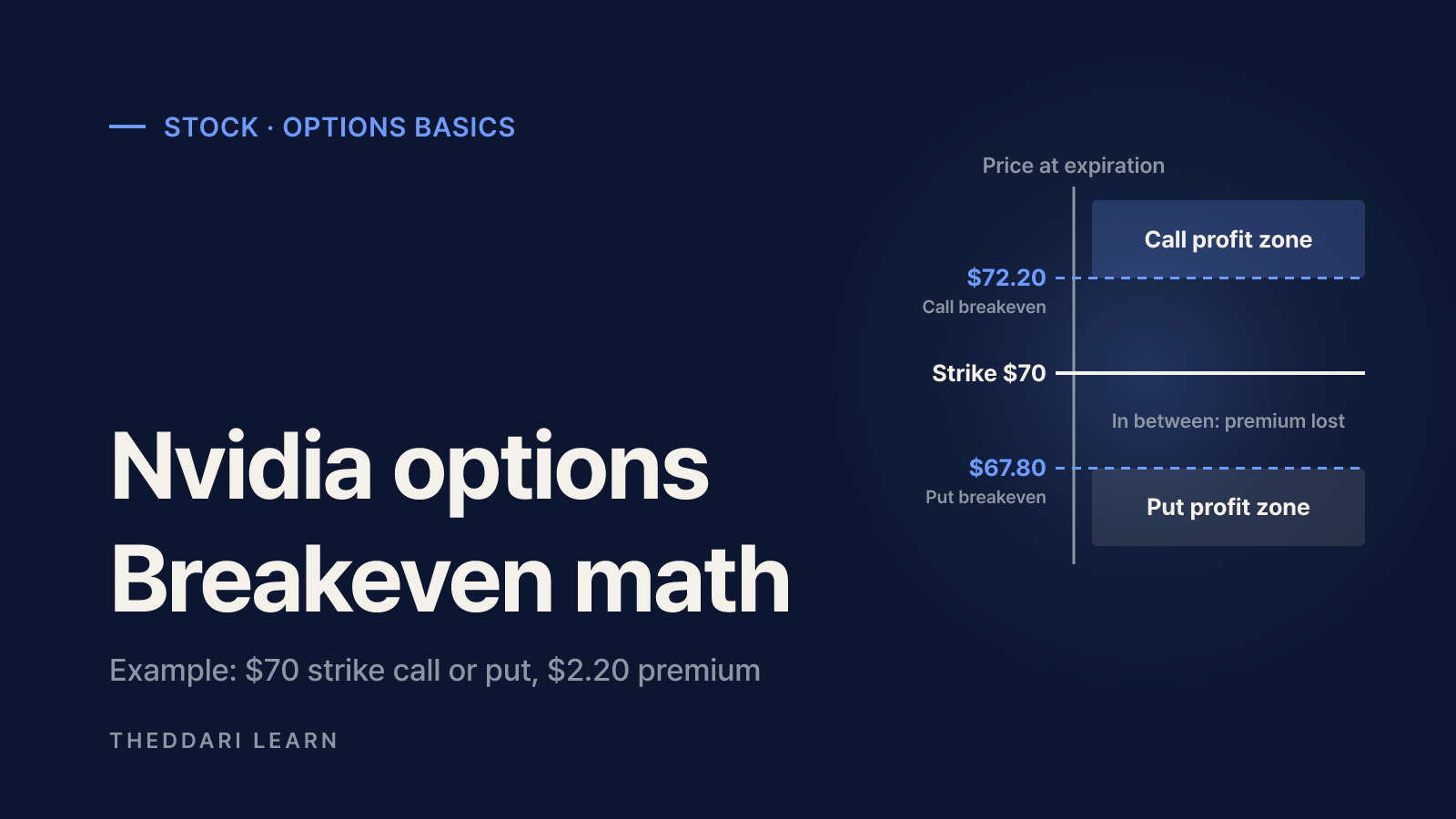
Nvidia Options Explained: Calls, Puts and Big Stock Moves
Why Nvidia calls and puts can swing far more than the stock itself: intrinsic value, time value and implied volatility explained, plus the training and tax rules Korean residents face before trading US stock options.
 Stocks
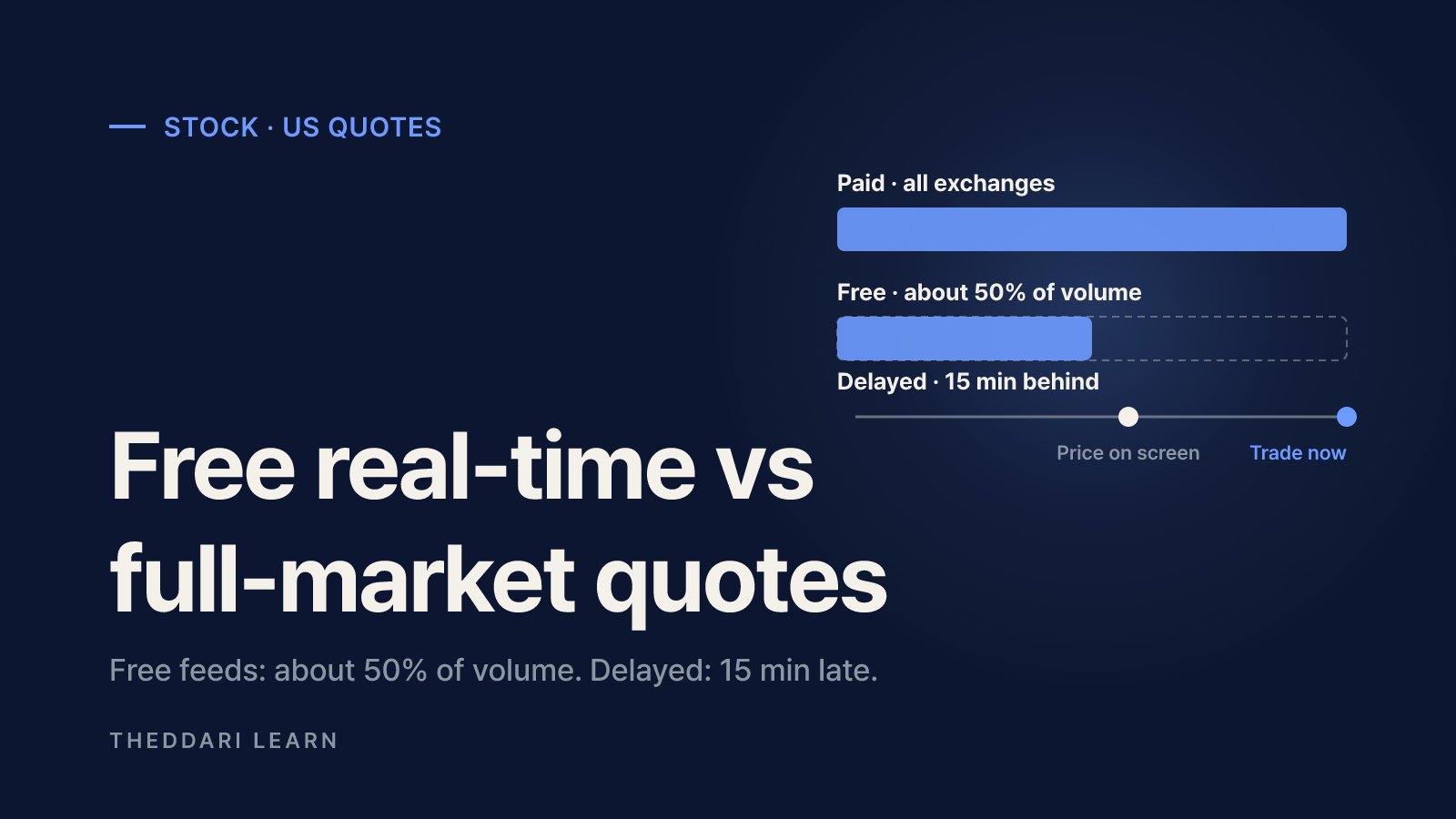
Real-Time US Stock Quotes for Free: Delayed vs Live Prices
Free 'real-time' US stock prices usually come from Nasdaq venues plus FINRA-reported trades, not the whole market. Learn how to spot delayed quotes, read a site's delay table, and decide when paid full-market data is worth it.
 Stocks
AI PCB Stocks: Substrates vs Server Boards, Traps to Avoid
Not every circuit board company gets the same slice of AI server spending. Here is how the substrate and PCB supply chain breaks down, and the filings-based metrics that expose AI stock traps, as of November 2026.