How to Invest in Indian Stocks as a Foreigner: ETFs vs ADRs
Compare India ETFs, US-listed ADRs and India's June 2026 direct route for foreign individuals: costs, tax for Korean residents and currency risks.
Contents9 sections
- Three ways to invest in Indian stocks from abroad
- US-listed India ETFs: what INDA holds and costs
- India ADRs: buying single companies in dollars
- India's June 2026 rule change for foreign individuals
- Tax example: how Korean residents are taxed
- Risks to check before you buy
- A simple checklist
- Frequently asked questions
- Sources and references
Key takeaways
- Most foreign individuals invest in Indian stocks through an India ETF or a US-listed ADR rather than buying shares on the NSE directly.
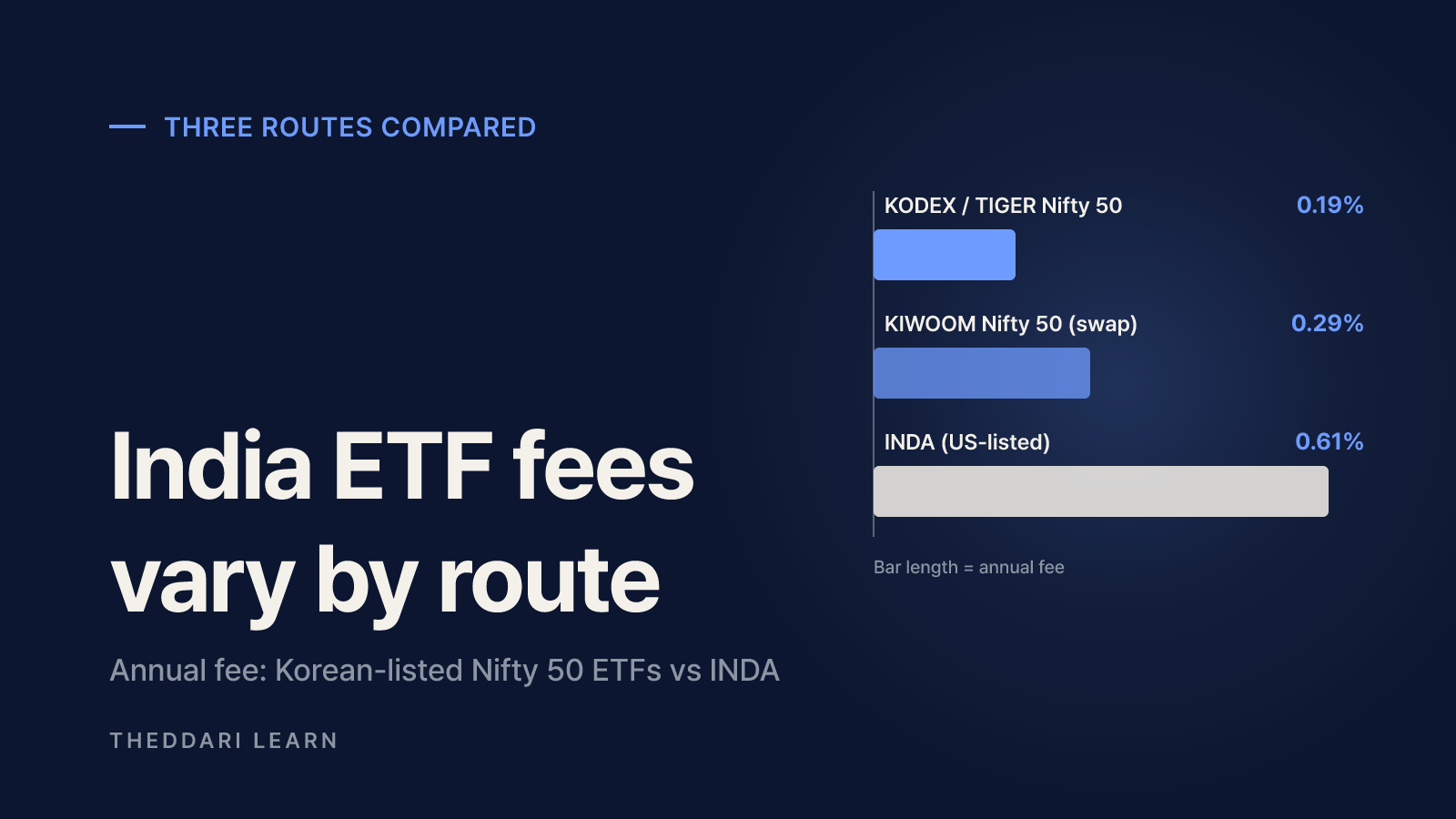
- INDA, a widely held US-listed India ETF, charges 0.61% a year and held 165 stocks on October 27, 2026; Korean-listed Nifty 50 ETFs charge 0.19% to 0.29%.
- Since June 2026, India lets any individual resident outside India buy listed Indian shares, but it requires a repatriable rupee account with an Indian bank and ongoing reporting.
- Indian ADRs (INFY, WIT, HDB, IBN, RDY) trade in dollars and can sit at a premium to the local share price; HDFC Bank's ADR was about 3.60% above parity on October 16, 2026.
- Currency is the swing factor: unhedged India funds expose you to the rupee and to your home currency at the same time.
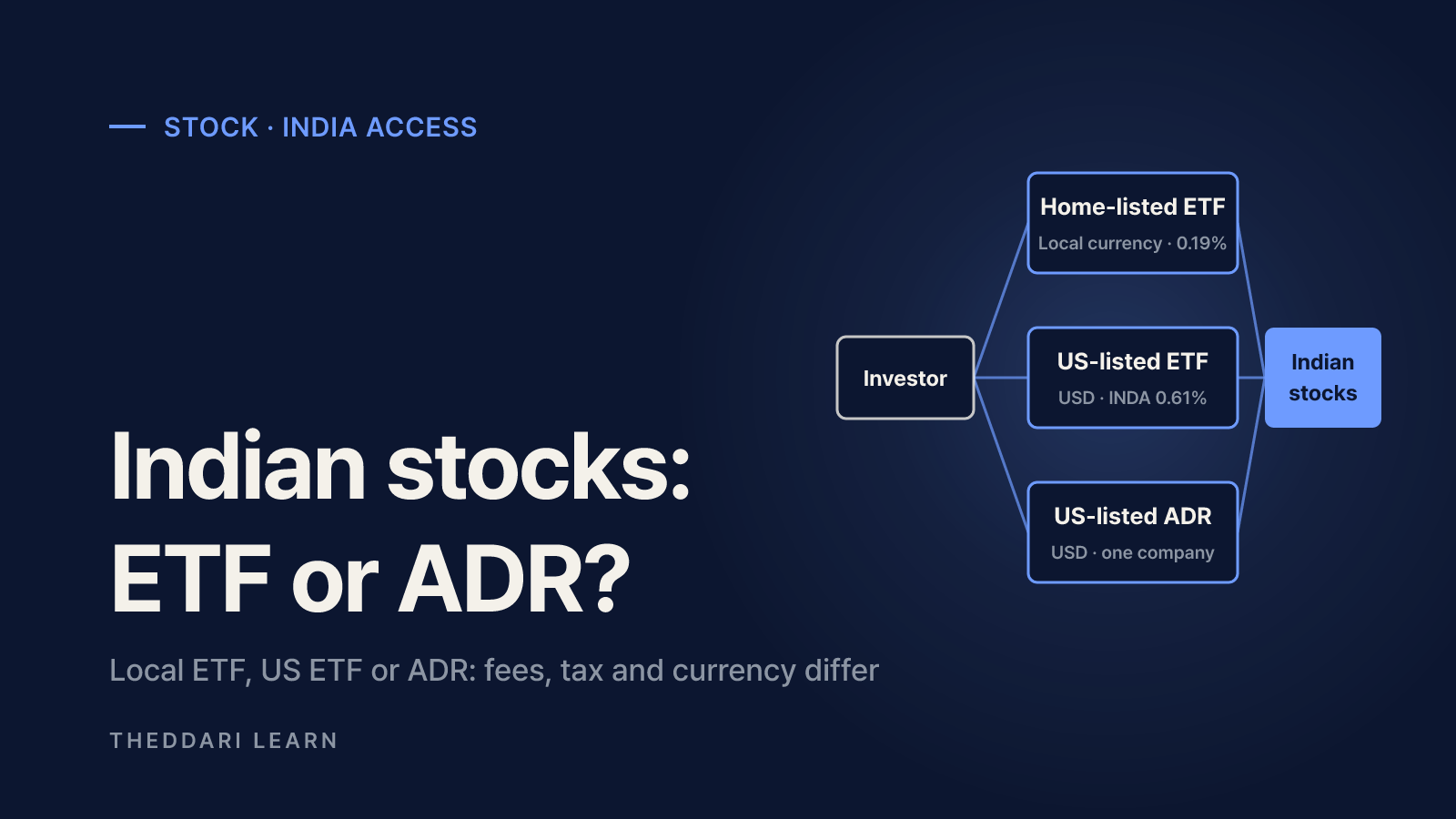
If you live outside India and want to invest in Indian stocks, you have three practical routes as of October 2026: an India ETF listed in your home market, a US-listed India ETF such as INDA, or an American Depositary Receipt (ADR) of a single Indian company such as Infosys or HDFC Bank. A fourth route, buying shares on the NSE or BSE yourself, opened to all non-resident foreign individuals in June 2026, but it still involves an Indian bank account and local paperwork.
This guide compares the routes on what you actually own, fees, currency exposure and tax. The tax section uses Korean residents as a worked example because that is where this comparison started; investors in other countries should check their own rules. Figures were checked against fund, regulator and tax-agency pages in October 2026 and can change.
Three ways to invest in Indian stocks from abroad
Example
- Home-listed India ETF (Korea example)
- KODEX India Nifty50, TIGER India Nifty50
- US-listed India ETF
- iShares MSCI India ETF (INDA)
- US-listed ADR
- Infosys (INFY), HDFC Bank (HDB), ICICI Bank (IBN)
What you own
- Home-listed India ETF (Korea example)
- A basket tracking the Nifty 50
- US-listed India ETF
- A basket tracking MSCI India (165 stocks on Oct 27, 2026)
- US-listed ADR
- One company
Annual fee
- Home-listed India ETF (Korea example)
- 0.19% to 0.29% (Nifty 50 funds)
- US-listed India ETF
- 0.61%
- US-listed ADR
- No fund fee; depositary custody fee
Currency of trade
- Home-listed India ETF (Korea example)
- Korean won
- US-listed India ETF
- US dollar
- US-listed ADR
- US dollar
Main currency risk
- Home-listed India ETF (Korea example)
- Rupee vs won, unhedged
- US-listed India ETF
- Rupee vs dollar, plus dollar vs your currency
- US-listed ADR
- Rupee vs dollar, plus dollar vs your currency
The first decision is not which ticker to buy but how much concentration you want. A Nifty 50 or MSCI India fund spreads money across dozens or hundreds of companies; an ADR ties your result to one company's earnings, governance and news flow.
US-listed India ETFs: what INDA holds and costs
The iShares MSCI India ETF (INDA) tracks the MSCI India Index, which covers large and mid-cap Indian companies. According to the fund page, its expense ratio is 0.61%, it held 165 stocks on October 27, 2026, and net assets were about $5.75 billion on October 28, 2026. Financials were the largest sector at 29.77%, and the portfolio's price-to-earnings ratio was 21.40. Year to date through October 27, 2026, its NAV total return was -13.43%.
- Hidden tax drag: iShares notes that INDA's return can differ from its benchmark because of accrued Indian capital gains taxes inside the fund that the index does not reflect.
- Little or no income: the fund paid $0 in June 2025, December 2025 and June 2026, so it suits investors seeking market exposure rather than cash flow.
- Sector tilt: with nearly 30% in financials, Indian bank earnings and interest rates matter a lot for the fund.
Investors in Korea have cheaper home-market options. According to a comparison compiled from fund documents on October 6-7, 2026, KODEX India Nifty50 and TIGER India Nifty50 both charge 0.19% (total costs of 0.2714% and 0.32%), while the swap-based KIWOOM India Nifty50 (synthetic) charges 0.29%. These funds are not currency hedged: from July 7 to October 6, 2026, INDA fell 5.3% in dollars, yet the Korean-listed funds fell 17.6% to 20.4% in won because the won strengthened 12.1% against the dollar over the same period.
India ADRs: buying single companies in dollars
An ADR is a dollar-denominated certificate issued by a US depositary bank that holds the underlying foreign shares. The SEC's investor bulletin explains that one ADR can represent one share, several shares or a fraction of a share, and that depositary banks charge custody fees, often deducted from dividends; its example is $20 to $50 per 1,000 ADRs.
Infosys
- Ticker
- INFY
- Exchange
- NYSE
- Local shares per ADR
- 1
Wipro
- Ticker
- WIT
- Exchange
- NYSE
- Local shares per ADR
- 1
HDFC Bank
- Ticker
- HDB
- Exchange
- NYSE
- Local shares per ADR
- 3
ICICI Bank
- Ticker
- IBN
- Exchange
- NYSE
- Local shares per ADR
- 2
Dr. Reddy's
- Ticker
- RDY
- Exchange
- NYSE
- Local shares per ADR
- 1
Ratios above come from an October 2026 Indian ADR list that cites SEC filings. The same analysis calculated that HDFC Bank's ADR closed about 3.60% above its NSE price on October 16, 2026. Because India's foreign-ownership limits restrict how many new ADRs can be created, a premium can persist, which means you may pay more than the local market price. Also note that some India-linked US stocks, such as MakeMyTrip, are foreign-incorporated ordinary shares, not ADRs.
ADR prices often move sharply around quarterly results. You can see upcoming report dates for Infosys, Wipro and the banks on the earnings calendar.
India's June 2026 rule change for foreign individuals
Until mid-2026, buying shares directly on Indian exchanges was mainly open to Non-Resident Indians (NRIs) and Overseas Citizens of India (OCIs); other foreigners generally needed to go through Foreign Portfolio Investor registration. According to the RBI circular of June 15, 2026, amendments notified on June 12, 2026 now allow all individuals resident outside India to invest in equity of listed Indian companies on a recognised stock exchange.
- Limits: per The Economic Times, one individual can hold less than 10% of a listed company, and all such individuals combined up to 24% (previously 10%).
- Account: an authorised dealer bank in India may open a repatriable rupee account for you; reporting and limit monitoring follow the NRI process.
- Breaches: holdings above 10% must be sold within five trading days, or the whole stake is reclassified as foreign direct investment.
- Land-border rule: prior government approval applies where control would pass to, or the beneficial owner is a citizen of, a country sharing a land border with India.
The report said the change was part of steps announced in June to reverse capital outflows and support a weak rupee, which closed near 95 per dollar at the time. That context matters: rules introduced under pressure can be adjusted again.
Tax example: how Korean residents are taxed
Tax depends on where you live. For Korean tax residents, the split is clear. Korean-listed India ETFs are taxed as dividend income at 15.4% on gains and distributions, based on the smaller of the increase in the fund's tax base price and the actual gain. US-listed ETFs and ADRs count as foreign stocks: according to the National Tax Service, gains are taxed at 20% (local income tax is separate) after an annual 2.5 million won deduction shared with taxable domestic stock gains, and you file in May of the following year. Losses can offset gains within the same year but cannot be carried forward.
If you live elsewhere, check how your country treats foreign ETFs and ADR dividends, and whether Indian withholding tax can be credited.
Risks to check before you buy
- Two layers of currency: rupee against the dollar, then dollar against your home currency. A stronger home currency can erase gains in Indian shares.
- Valuation: INDA's P/E was 21.40 on October 27, 2026. Compare it with India's own history and other emerging markets before assuming it is cheap or expensive.
- Bank concentration: financials are about 30% of INDA, so credit cycles and interest rates drive a large share of returns.
- Structure costs: swap counterparty risk in synthetic ETFs, ADR custody fees and premiums, and capital gains tax accrued inside US funds all reduce what you keep.
- Policy shifts: India's foreign-investment rules changed in June 2026 and can change again.
Central bank decisions and inflation releases that move the rupee and the dollar are listed on the economic calendar; it shows dates, not direction. To see what retail traders are discussing about Indian markets, the stock Telegram trends page can help, but treat channel opinions as leads to verify.
A simple checklist
- 1
Choose your exposure
Whole market (Nifty 50 or MSCI India), a sector or group, or one company.
- 2
Match the account
Home-market brokerage or retirement account for local ETFs; an overseas brokerage account for US-listed ETFs and ADRs.
- 3
Compare full costs
Expense ratio plus other fund costs, bid-ask spread, premium or discount, and ADR custody fees.
- 4
Model tax and currency
Estimate after-tax results if your home currency rises or falls 5% to 10% against the dollar and rupee.
In short: a home-listed Nifty 50 ETF is the simplest way to hold the Indian stock market in your own currency, INDA gives broader dollar-based exposure at a higher fee, and ADRs suit investors who want a specific company. Whichever route you pick, currency, sector concentration and tax will shape your result as much as the Indian market itself.
Frequently asked questions
Can a foreigner buy Indian stocks directly on the NSE?
What is the best ETF to invest in India?
Do Indian ADRs pay dividends?
Why do Indian ADR prices differ from NSE prices?
Does INDA pay a distribution?
Sources and references
- 1RBI A.P. (DIR Series) Circular No. 14: Liberalisation of Foreign Portfolio Investment (June 15, 2026)(opens in a new tab)www.rbi.org.in
- 2The Economic Times: Portfolio investment scheme now open to PROIs (June 15, 2026)(opens in a new tab)economictimes.indiatimes.com
- 3iShares MSCI India ETF (INDA) product page(opens in a new tab)www.ishares.com
- 4Investor.gov (SEC): Investor Bulletin: American Depositary Receipts(opens in a new tab)www.investor.gov
- 5Platizio Global: Indian ADR List 2026(opens in a new tab)platizioglobal.com
- 6VUEDOT: Korean-listed India ETF comparison (checked October 7, 2026)(opens in a new tab)stock.vuedot.co.kr
- 7National Tax Service of Korea: 2025 capital gains tax filing notice (May 4, 2026)(opens in a new tab)www.nts.go.kr
Related articles
 Stocks
Samsung Special Dividend: Record Date, Ex-Date and Tax
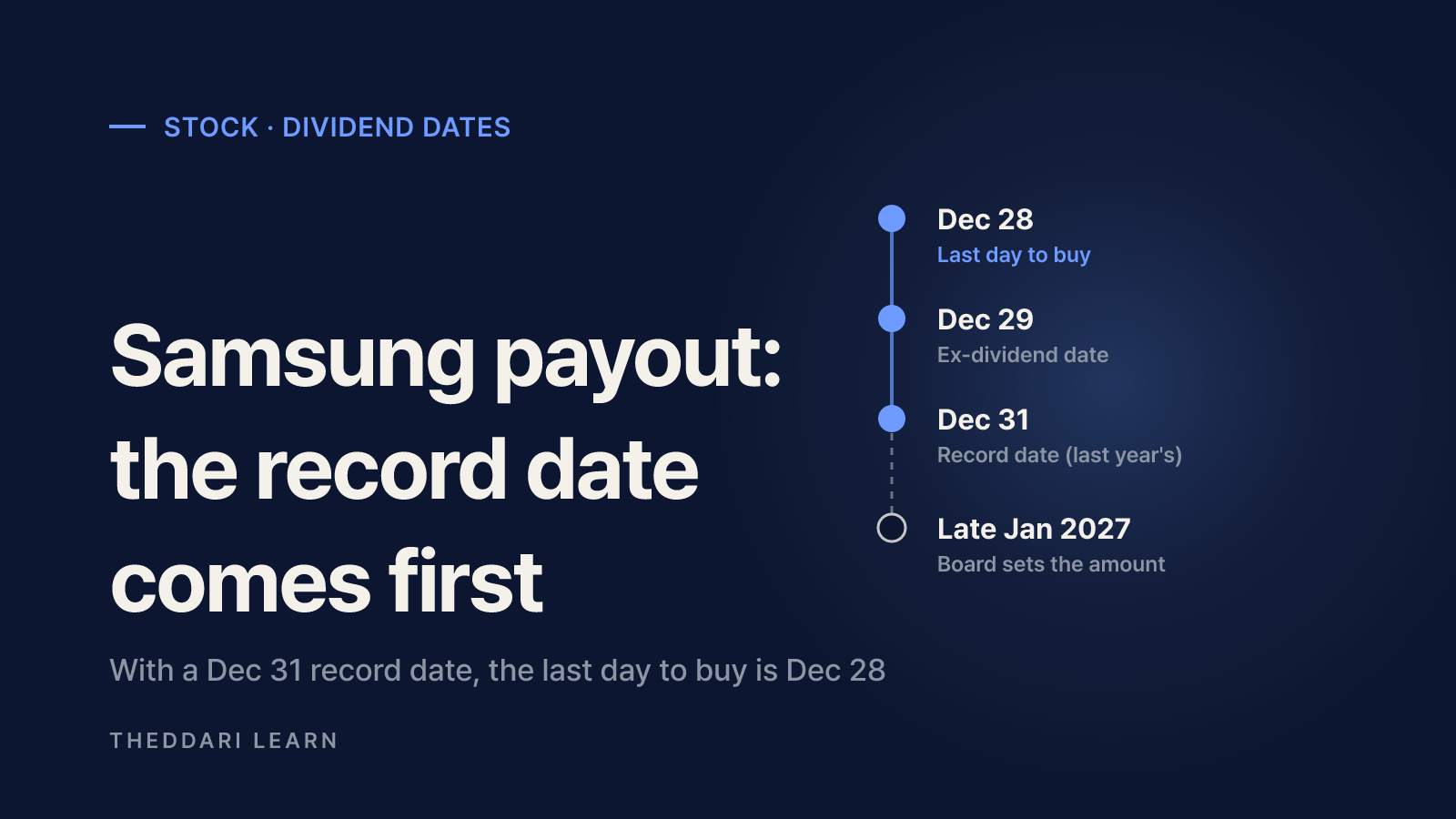
Samsung confirmed a KRW 4,601 per-share Q3 2026 dividend, but the next payout will only be set by its board in late January 2027. Here is how record dates, ex-dates and Korean withholding tax work.
 Stocks
Baidu AI Hype Warning: Metrics for China AI Stock Investors
At the APEC CEO Summit in Shenzhen on Nov. 17, 2026, Baidu's Robin Li and Xiaomi's Lei Jun said few companies are making money from AI yet. Here is how to test that claim against Baidu's own Q3 numbers.
 Stocks
Pre-Market Trading and After-Hours Moves, Explained
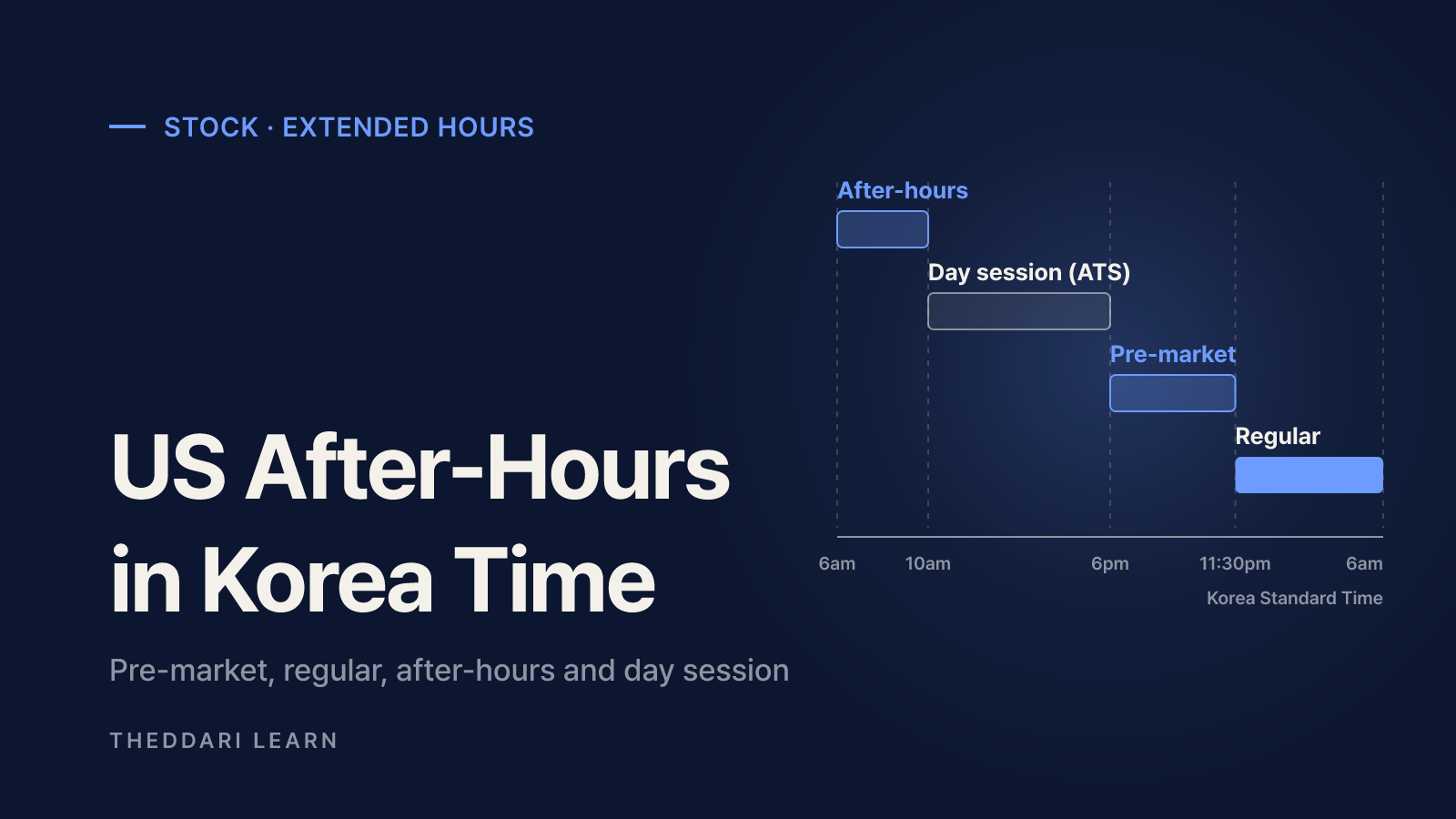
An after-hours drop is usually measured against the last official close, set by a small number of trades. Learn the session times, how to read the move, and what changes for investors trading US stocks from Korea.