Contents9 sections
- What the IMF said about an AI stock crash
- Four amplifiers that could turn a selloff into a system problem
- How an AI correction could spread to the real economy
- Why bond yields and cyber risk make it worse
- Who is most exposed
- What investors can monitor
- Limits of the report
- Frequently asked questions
- Sources and references
The IMF's AI stock crash warning boils down to this: if AI investment and profits turn out weaker or shorter-lived than markets expect, AI-related asset prices could correct sharply, and rising leverage, concentrated holdings and circular financing could carry that shock into the wider financial system and the real economy. The International Monetary Fund made the case in its October 2026 Global Financial Stability Report, released on October 13, 2026 at the Annual Meetings in Bangkok. This guide, current as of October 2026, explains what the report actually says, how the risk could spread, and which indicators investors can watch.
The report's own word is correction, not crash. The IMF did not forecast timing or magnitude; it described vulnerabilities that could make any downturn more damaging.
What the IMF said about an AI stock crash
Chapter 1 of the report is titled Beneath the Resilience: Rising Risks, Unresolved Vulnerabilities. Its core message is that markets have held up thanks to solid growth and strong corporate earnings, but financial stability risks remain elevated. The IMF identified three salient risks that could trigger a sharp tightening of financial conditions and market turmoil:
- An AI-related asset correction, driven by weaker or less durable AI investment and profitability and amplified by rising leverage and concentrated exposures.
- A sharp rise in sovereign bond yields, caused by resurgent inflation or fiscal worries, with broad repercussions across markets.
- Cyber threats, which grow as finance becomes more digital and interconnected.
As the Guardian reported, the report warns that the consequences of an AI correction could be global. Athanasios Vamvakidis, deputy director of the IMF's Monetary and Capital Markets Department, said the rest of the world's exposure to US assets, particularly AI, is the highest it has ever been. Today that exposure supports the global economy through wealth effects; in a correction it could have broad implications. The IMF also cited growing evidence that rolling out AI may not require investment on the scale hyperscalers are pursuing, and that the economic gains may be smaller than hoped. Those two doubts are the heart of the AI bubble debate.
Four amplifiers that could turn a selloff into a system problem
Stock corrections happen all the time. What worries the IMF is the plumbing that could turn an AI selloff into a financial stability event.
Concentration in a few mega-caps
Per the Guardian's summary of the IMF analysis, the Magnificent Seven (Alphabet, Amazon, Apple, Meta, Microsoft, Nvidia and Tesla) make up more than 35% of the S&P 500, up from 12% a decade ago, and their combined market value has risen by more than 50% in two years. For anyone in an S&P 500 index fund, a 401(k) target-date fund or a broad global ETF, that means diversification is thinner than the fund count suggests.
Hyperscaler debt
AI data center spending is increasingly funded with borrowed money. According to CNBC, the report shows hyperscalers' share of global investment-grade bond issuance climbing to about 10% from less than 1% in 2024. That issuance competes with government bonds for investor cash, linking AI sentiment to credit markets.
Circular financing deals
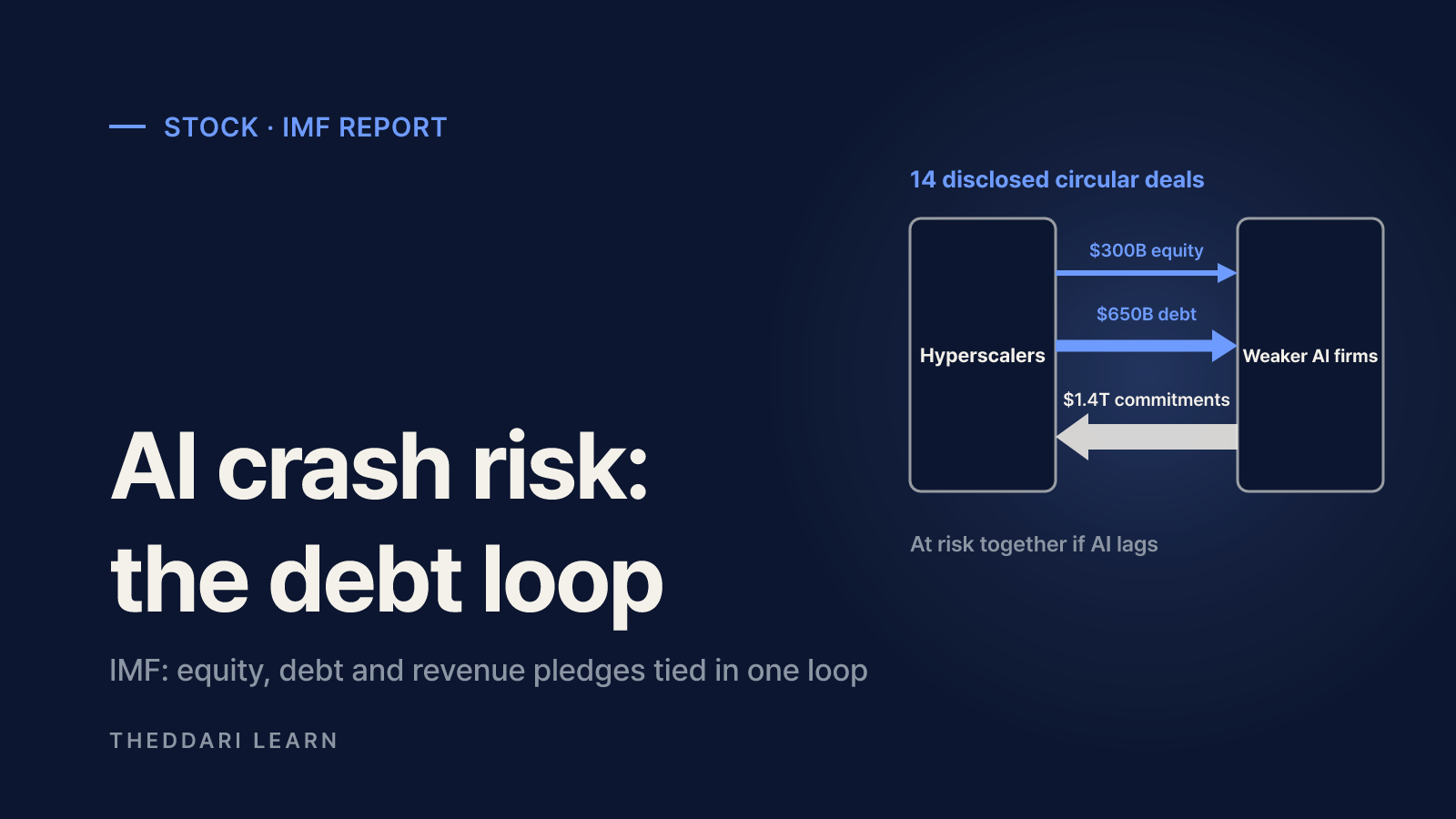
The IMF reviewed 14 publicly disclosed deals since 2023 in which roughly $300 billion of equity, led by hyperscalers, went into financially weaker AI firms, alongside $650 billion of debt. In return, investors secured $1.4 trillion in future revenue commitments for cloud services or chips. Jason Wu, an assistant director at the IMF, called the downside a potential triple whammy: equity stakes lose value, debt becomes hard to service and promised revenue fails to arrive, all at once.
Hedge fund and retail leverage
The Guardian notes the IMF also flagged hedge fund positioning in the sector and retail investors borrowing to buy AI stocks. In a downturn, that leverage raises the odds of forced selling and volatility spikes. Chapter 2 of the report adds context: hedge funds now hold about $13 trillion in assets, more than three times their 2013 level, and in stress their leverage, crowded trades and investor redemptions can trigger synchronized deleveraging with spillovers to prime brokers.
Concentration
- Figure cited
- Magnificent Seven above 35% of S&P 500 (12% a decade ago)
- Why it matters
- Index investors share the same shock
Hyperscaler bonds
- Figure cited
- About 10% of global IG issuance (under 1% in 2024)
- Why it matters
- Links AI to credit and sovereign bond demand
Circular deals
- Figure cited
- 14 deals: ~$300B equity + $650B debt vs $1.4T revenue commitments
- Why it matters
- Equity, debt and revenue can fail together
Hedge funds
- Figure cited
- About $13T in assets, over 3x 2013
- Why it matters
- Margin calls and forced selling
How an AI correction could spread to the real economy
The IMF says a reassessment of AI profitability could sharply reduce investment, trigger equity market corrections and tighten financial conditions, with global spillovers. Step by step, the chain looks like this:
- 1
Expectations reset
Evidence builds that AI revenue will not justify capital spending, or that cheaper models can deliver similar results.
- 2
Equities reprice
AI-linked shares fall, and because of concentration, broad indexes fall with them. Household and pension wealth shrinks.
- 3
Leverage amplifies
Margin calls hit leveraged traders, hedge funds and leveraged ETFs, forcing sales and lifting volatility.
- 4
Credit feels it
Investors question hyperscaler bonds, private credit loans and the revenue promised in circular deals.
- 5
Real economy slows
Data center buildouts are cut, financial conditions tighten and slower growth spreads across borders.
Why bond yields and cyber risk make it worse
The three risks interact. CNBC reports the IMF warned that a sharp rise in sovereign yields would mark down asset values through higher discount rates, including AI-related assets, and erode the value of government bonds posted as collateral. Hedge funds' share of US Treasuries rose to about 9% in 2025 from about 4% in 2022, leaving that market susceptible to a disorderly unwind. So a rate shock could set off an AI correction, and an AI correction could add strain to bond markets. The IMF also lists liquidity mismatches at insurers and pension funds, leverage in private credit, pockets of weak banks and thinner buffers in some emerging markets as vulnerabilities that could turn market stress into systemic events.
Who is most exposed
According to the Guardian, the IMF sees Asian markets as the most exposed after the United States, given their place in the AI chip and hardware supply chain, while the UK and euro area may be somewhat more insulated. That insulation does not cover individual investors: anyone holding US stocks or US-heavy funds takes the hit directly. The report does not assess individual countries' household portfolios in detail, so check your own holdings rather than assuming your home market protects you.
What investors can monitor
- Fund concentration: look at the top-10 weights of your index funds and ETFs and how much is AI-linked.
- Your own leverage: margin loans and leveraged ETFs are exactly the forced-selling channel the IMF describes.
- Earnings and capex guidance: watch what hyperscalers and AI chipmakers say about capital spending and AI revenue.
- Rates and inflation data: CPI, jobs reports and long-term Treasury yields feed directly into the second IMF risk.

Use the earnings calendar to see when major AI companies report, and the economic calendar to track inflation and employment releases that move yields. Knowing the dates does not predict outcomes, but it helps you anticipate days when volatility may rise.
Limits of the report
Keep three caveats in mind. First, the IMF describes risks, not a forecast; the same report says markets are supported by solid growth and earnings. Second, the circular financing totals cover only 14 publicly disclosed deals, so private arrangements are missing. Third, some figures here, such as the Magnificent Seven share, come via press coverage, so check the report's charts for exact definitions. The bottom line: the IMF's concern is less about AI shares falling and more about how concentration, debt, circular deals and hedge fund leverage could turn a correction into a system-wide shock. For individual investors, knowing your exposure and borrowing matters more than guessing the timing.