Derive Crypto Explained: DRV Token, Options Exchange, Risks
What is Derive, formerly Lyra Finance? How its V3 on-chain options and perps exchange settles trades, what the DRV token does, and the risks to check first.
Contents8 sections
- What is Derive crypto, and why is it trending?
- How Derive V3 works: off-chain matching, Ethereum verification
- How Derive options and perps settle
- The DRV token: utility, buybacks and supply
- Risks to check before using Derive
- A practical checklist before trading on Derive
- Frequently asked questions
- Sources and references
Key takeaways
- Derive is the rebranded Lyra Finance, which launched in August 2021 with a single ETH options market and now offers options, perpetuals and spot trading.
- Its V3 architecture, live since October 2026, keeps order matching off-chain and verifies zero-knowledge proofs of margin and settlement on Ethereum.
- All Derive options are European-style and cash-settled in USDC; perpetuals settle PnL and funding whenever a position changes.
- DRV is used for governance, staking rewards and fee discounts. Fee-funded buybacks exist, but a 500 million DRV mint in October 2025 raised total supply to 1.5 billion.
- Accounts below maintenance margin are liquidated by auction, and if a risk universe's Security Module runs dry, solvent accounts in that universe can share the loss.
Derive crypto refers to two things: Derive, a decentralized exchange for options and perpetual futures, and DRV, its governance token. Derive is the project formerly known as Lyra Finance. Since its V3 upgrade in October 2026, it matches orders off-chain at centralized-exchange speed while proving margin and settlement calculations to Ethereum with zero-knowledge proofs. This guide reflects official documentation and announcements available as of November 24, 2026. It explains how the exchange works, what DRV does and does not give holders, and which risks deserve attention before you deposit funds. It does not forecast the DRV price.
What is Derive crypto, and why is it trending?
According to Derive's own blog, Lyra launched in August 2021 with one ETH options market and two expiries. Today the same team runs Derive, which offers crypto options, perpetuals and spot markets from one account. The token changed as well: LYRA and stkLYRA holders could migrate 1:1 into DRV, and the official token documentation lists total supply at 1.5 billion DRV.
Derive appeared near the top of CoinGecko's trending list on November 23, 2026. That same day, Derive announced on-chain options on Anthropic, Nvidia, WTI crude oil, the S&P 500, the Nasdaq-100 and gold, which it groups as real-world asset (RWA) markets. A week earlier its blog announced that institutional desks could trade Derive markets through the CoinRoutes terminal. Trending lists reflect search and page-view interest, so these announcements are plausible context rather than a confirmed cause. Attention spikes also attract copycat tokens and phishing links.
Derive's own example for the RWA launch: keep ETH as collateral and buy a Nvidia call and put at the same strike to take a view on how far the stock moves around earnings. The price risk of the ETH collateral does not go away.
How Derive V3 works: off-chain matching, Ethereum verification
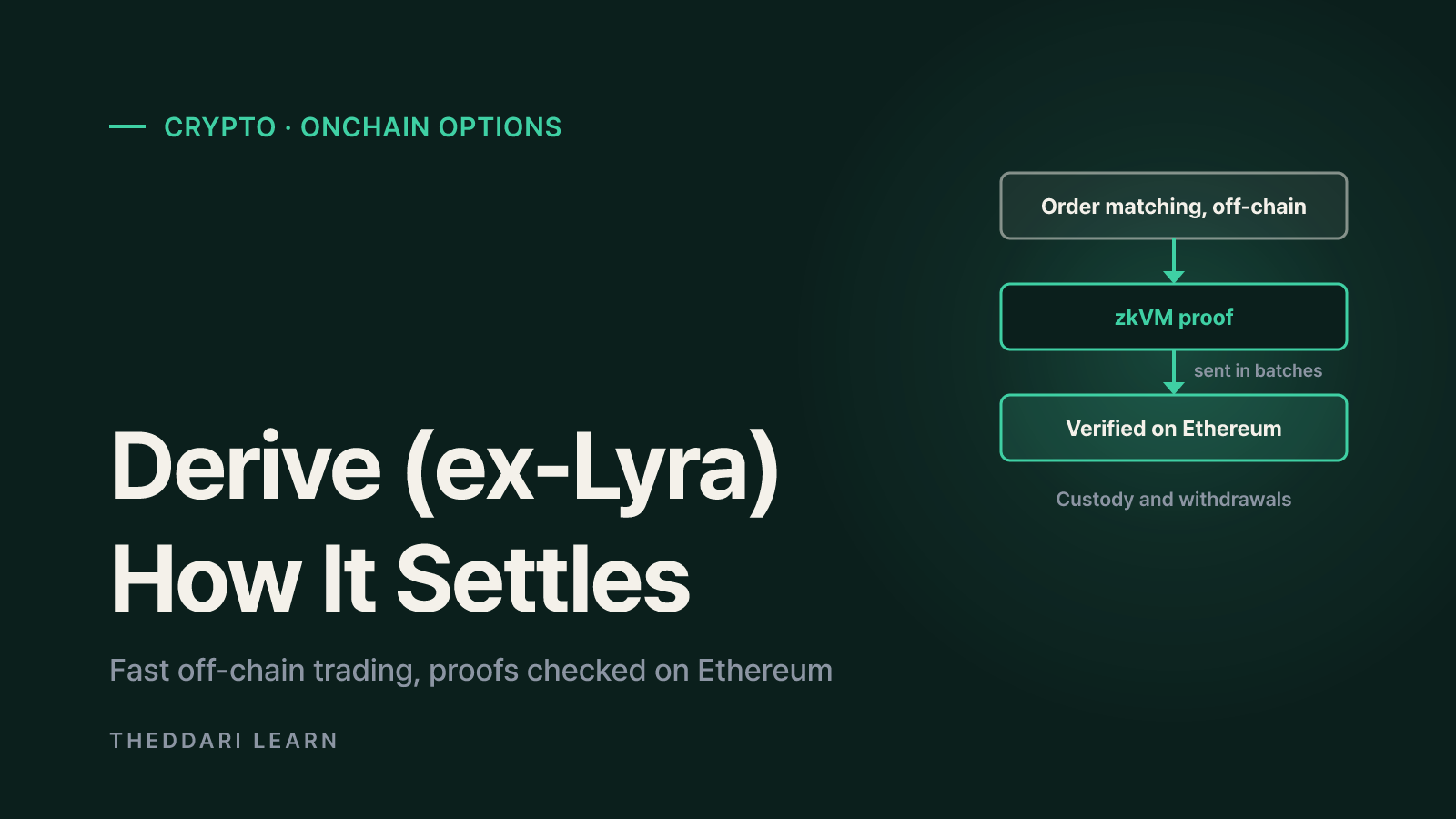
The V3 announcement explains that Derive replaced its previous Derive Chain, an Ethereum rollup, with a zero-knowledge exchange design. Order matching stays off-chain with sub-millisecond latency. The margin, pricing and settlement logic was rewritten in Rust and runs inside a zero-knowledge virtual machine. Each batch of updates produces a proof that is submitted to Ethereum, where contracts hold collateral, verify proofs and process withdrawals.
The developer documentation adds detail. Protocol rules are proven with the SP1 Hypercube zkVM, and each batch is verified on Ethereum L1 with a PLONK SNARK. Withdrawals pay out once their batch is verified, subject to withdrawal rate limits. State changes are published to Celestia so third parties can reconstruct the exchange state, and an escape hatch lets another operator continue settlement if Derive leaves a withdrawal unprocessed beyond a timeout.
Order matching
- Where it runs
- Off-chain, run by Derive
- What it means for users
- Fast, but depends on the operator's infrastructure
Margin and settlement math
- Where it runs
- zkVM, then proven
- What it means for users
- Rule-following is checked by proofs
Proof checks and custody
- Where it runs
- Ethereum L1 contracts
- What it means for users
- Smart contract and upgrade-control risk remain
State data
- Where it runs
- Published to Celestia
- What it means for users
- Adds reliance on a data availability layer
Withdrawals
- Where it runs
- Paid after L1 verification
- What it means for users
- Rate limits can slow large exits
This design is faster than settling every trade on-chain, but it is not operator-free. If the matching engine stops, placing new orders becomes difficult, and emergency and governance controls are defined in a separate V3 proposal. The escape hatch is a recovery path, not insurance against trading losses.
How Derive options and perps settle
Per the settlement docs, every Derive option is European-style and cash-settled in USDC. Crypto options expire at 08:00 UTC and settle to a 30-minute time-weighted average of Derive's spot index. Nvidia options settle to a 2-minute TWAP ending at the 4:00 p.m. ET close. S&P 500 and Nasdaq-100 options settle to the daily settlement price of an assigned futures contract, and WTI options follow the assigned crude oil future.
Inside the settlement window, an option is marked to a blend of the forward price and the average already recorded, so its delta shrinks as expiry nears. Derive calls this delta decay, and it can change margin requirements for portfolio-margin accounts and for short options. Perpetuals have no expiry; unrealized PnL and funding are settled whenever you adjust the position.
Risk universes and margin
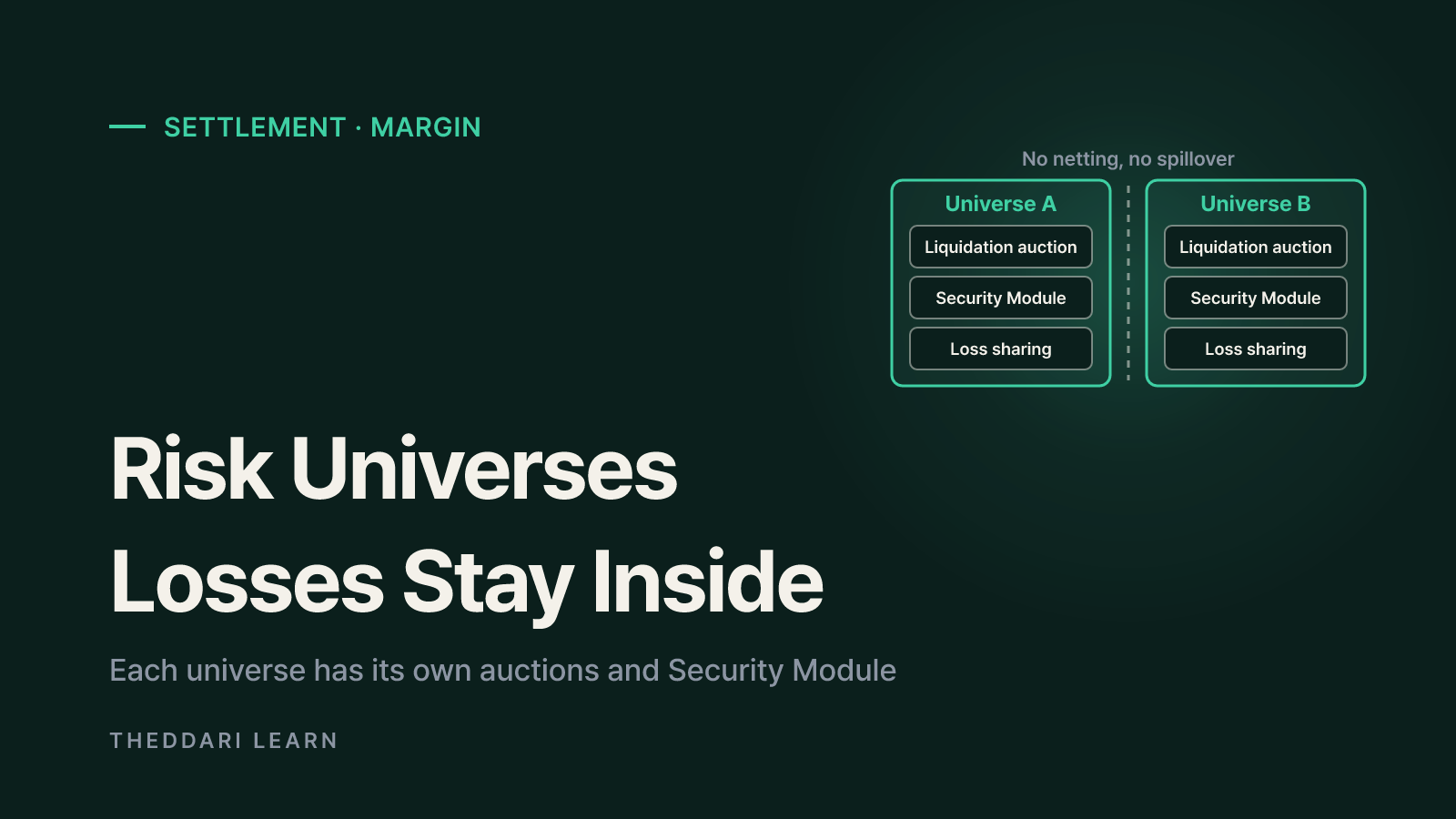
V3 splits markets into self-contained risk universes. The liquidation docs state that each universe has its own liquidation auctions and its own Security Module, so an insolvency in one universe cannot reach users of another. The flip side is that losses can be shared within the same universe. Margin does not net across universes, so trading in two of them requires separate subaccounts, each using either standard margin or portfolio margin.
Funding rates on perpetuals vary by venue. If you plan to use Derive perps, compare funding levels across major exchanges on theddari's funding rate dashboard and check them against the live rate shown in the Derive app.

The DRV token: utility, buybacks and supply
The official token page lists DRV as an Ethereum mainnet token with a total supply of 1,500,000,000. Staking DRV produces non-transferable stDRV, which carries governance voting and delegation. Unstaking takes seven days, or you can exit instantly with a 20% penalty. The same page lists weekly staking rewards of 100,000 stDRV and up to 50,000 DRV a week for trading and liquidity programs.
Total supply
- Official description
- 1.5 billion DRV
- What to check
- Raised from 1 billion by a 500 million mint in October 2025
Governance
- Official description
- Vote and delegate with stDRV
- What to check
- stDRV cannot be transferred
Unstaking
- Official description
- 7 days, or instant with a 20% penalty
- What to check
- Exiting quickly is costly
Buybacks
- Official description
- 35% of fees in docs; 50% proposed
- What to check
- Confirm the current rate in recent notices
Emissions
- Official description
- Weekly staking and trading rewards
- What to check
- Weigh against buybacks for net supply
A governance proposal posted on September 24, 2026 asked to raise the share of protocol fees used for weekly DRV buybacks from 35% to 50%, leaving the rest for the on-chain insurance fund. The proposal itself warns that a higher percentage does not guarantee larger buybacks, because amounts depend on trading activity, and that buybacks should be weighed against emissions, unlocks and the wider supply schedule.
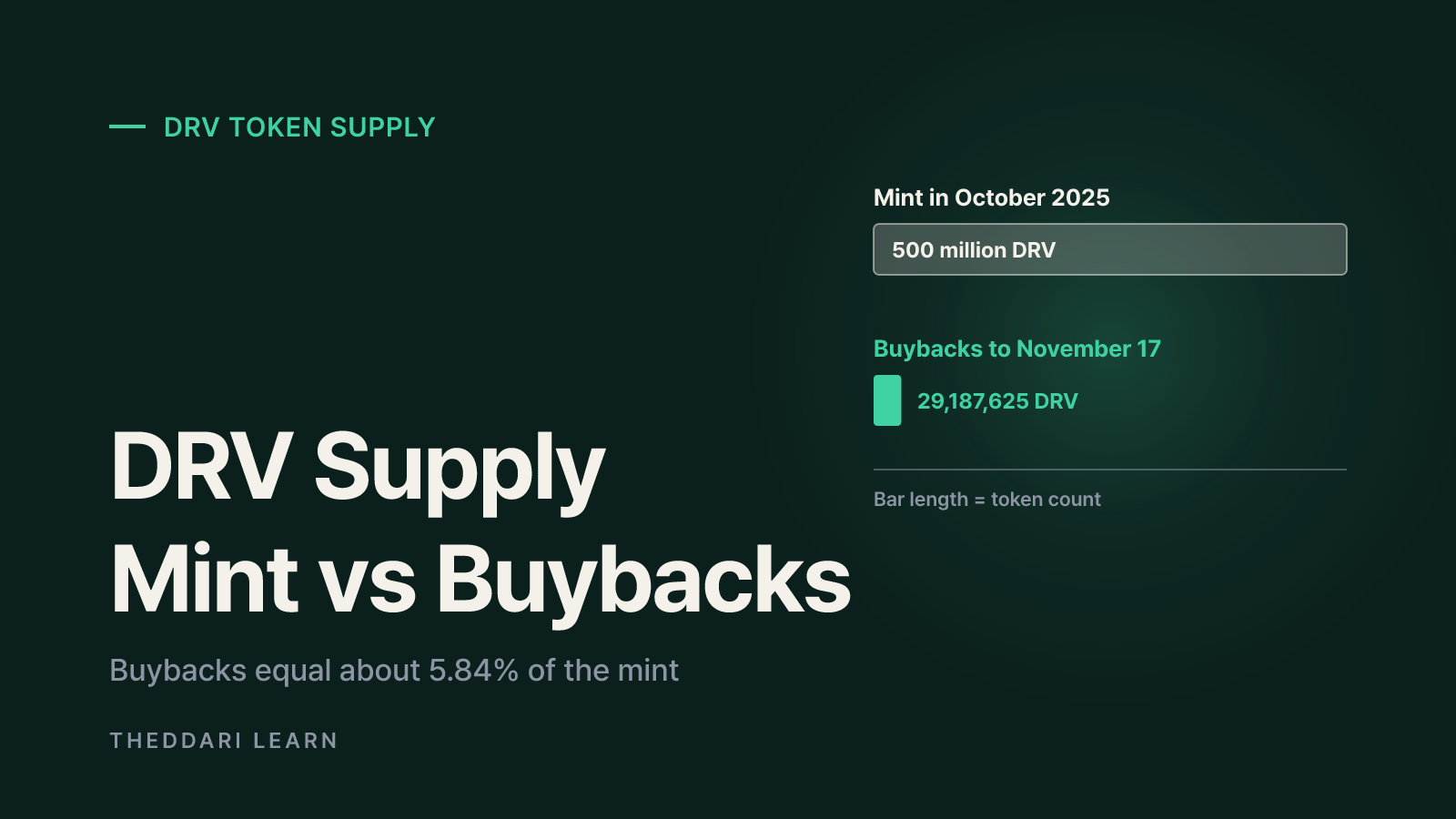
Supply is the bigger variable. A Ravel analysis from November 23, 2026 notes that a strategic mint in October 2025 created 500 million new DRV, lifting supply from 1 billion to 1.5 billion, while cumulative buybacks reported through November 17 totaled 29,187,625 DRV, about 5.84% of the mint. Ravel also found that the contributor allocation appears as 230 million DRV in the original proposal and 260 million in a later filing, and that it could not verify that repurchased tokens were burned.
Risks to check before using Derive
- Liquidation: once maintenance margin turns negative, anyone can flag the account, trading on it stops, a liquidation fee is charged and portions of the account are auctioned at a discount.
- Socialized losses: if the Security Module cannot cover an insolvent account, the shortfall is debited from solvent accounts in that universe in proportion to their value, and balance operations in the universe pause while this is processed.
- Option-specific risk: bought options can expire worthless, sold options can lose far more than the premium, and volatility and settlement-window mechanics move prices.
- RWA market risk: equity, index and oil options depend on traditional market hours and futures prices; confirm the product terms for each market.
- Smart contract and operational risk: the Ethereum contracts, proof system, off-chain matching engine and data layer can each fail or be paused.
The worked examples in the liquidation docs use illustrative fee and discount values; the live parameters sit on a separate page. Combining leveraged perps with short options can drain margin quickly after a modest price move.
DRV carries its own risks. Its price reflects sentiment, liquidity and unlocks, not only exchange activity. Right after a trending spike, look-alike tokens appear, so take the contract address only from Derive's official site. Watching which topics crypto Telegram channels mention alongside Derive can show how heated the conversation is, but mention counts are not a price signal.
A practical checklist before trading on Derive
- 1
Verify official addresses and eligibility
Confirm the app URL, DRV contract address and restricted jurisdictions on Derive's own site and docs. Ignore links from ads or direct messages.
- 2
Read the contract terms
Check expiry time, settlement price source and contract size in the settlement docs. For RWA options, also note the underlying market's hours and holidays.
- 3
Choose a margin mode and model your liquidation level
Decide between standard and portfolio margin, then use the app to see how much maintenance margin remains if prices move against you.
- 4
Test a small deposit and withdrawal
Run a small amount through the full deposit and withdrawal cycle to see rate limits and timing yourself.
- 5
Track DRV supply, not just buybacks
If you are researching DRV, record the latest buyback notice, staking emissions and contributor unlock schedule, with the date of each source.
In short, Derive is the continuation of Lyra Finance's on-chain options exchange, rebuilt in V3 to pair fast matching with Ethereum verification. Trading risk, loss sharing within a risk universe and the balance between DRV issuance and buybacks are separate questions, and each needs its own check. Figures here reflect sources published through November 24, 2026; buyback rates and listed markets can change through governance and new announcements.
Frequently asked questions
Is Derive the same as Lyra Finance?
Does holding DRV give me a share of Derive's revenue?
Can I exercise a Derive option early?
Who can use Derive?
Sources and references
- 1Derive Insights: RWAs are live on Derive (Nov 23, 2026)(opens in a new tab)insights.derive.xyz
- 2Derive Insights: Derive V3 is live (Oct 7, 2026)(opens in a new tab)insights.derive.xyz
- 3Derive Docs: Introduction(opens in a new tab)docs.derive.xyz
- 4Derive Docs: Settlement(opens in a new tab)docs.derive.xyz
- 5Derive Docs: Liquidations(opens in a new tab)docs.derive.xyz
- 6Derive Docs (legacy): Token(opens in a new tab)legacy.docs.derive.xyz
- 7Derive Forum: DIP to raise DRV buybacks from 35% to 50% of fees(opens in a new tab)forums.derive.xyz
- 8Ravel: Derive Bought Back 29 Million DRV. Its Token Supply Expanded by 500 Million(opens in a new tab)ravelalpha.com
Related articles
 Crypto
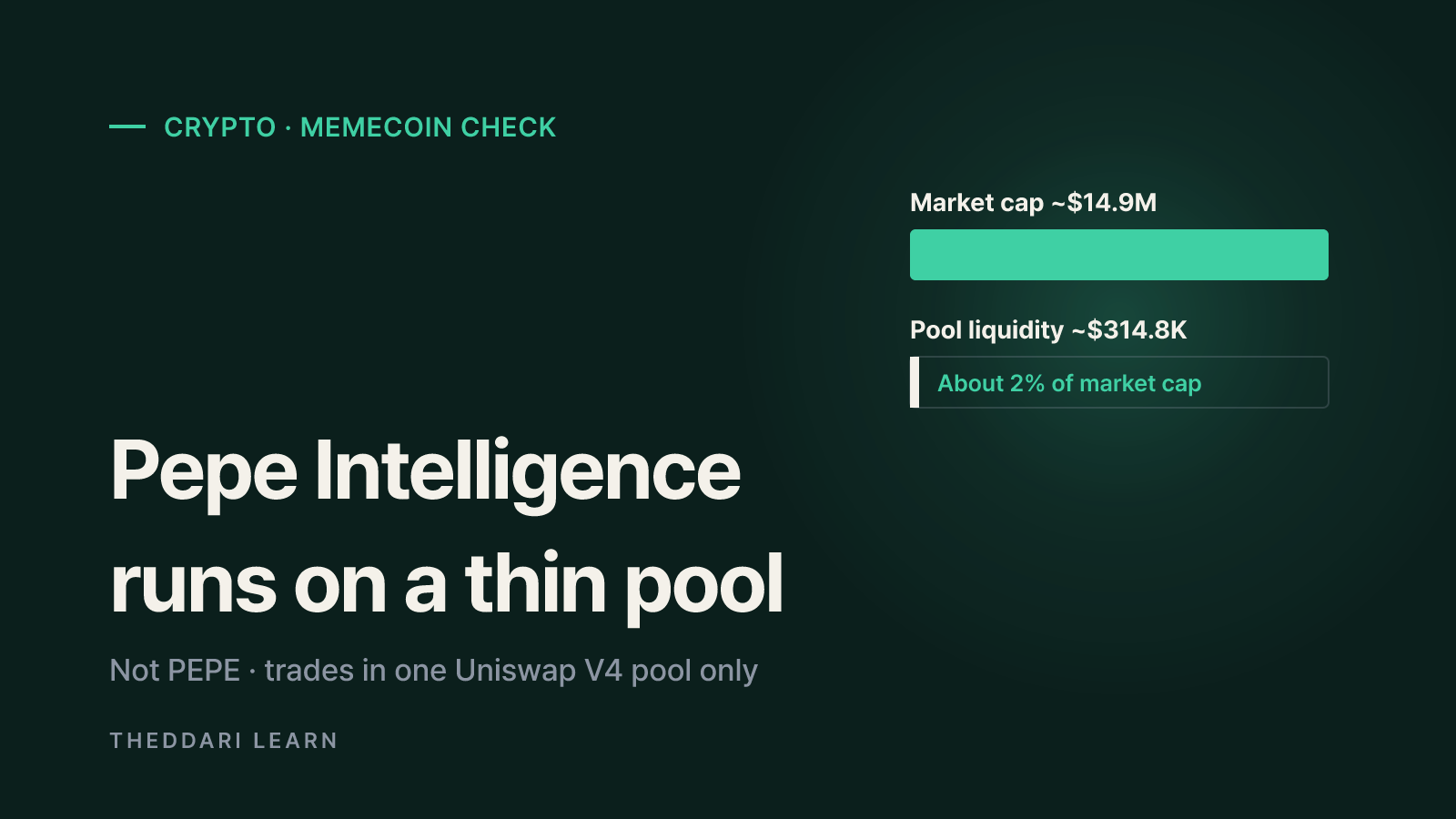
What Is Pepe Intelligence (PEI)? Checks Before You Buy
Pepe Intelligence hit the top of CoinGecko's trending list, but it is a separate day-old Ethereum token, not the original PEPE. Here is what on-chain data showed as of November 24, 2026.
 Crypto
Minelius (MINELIUS) Token: What to Check Before Buying
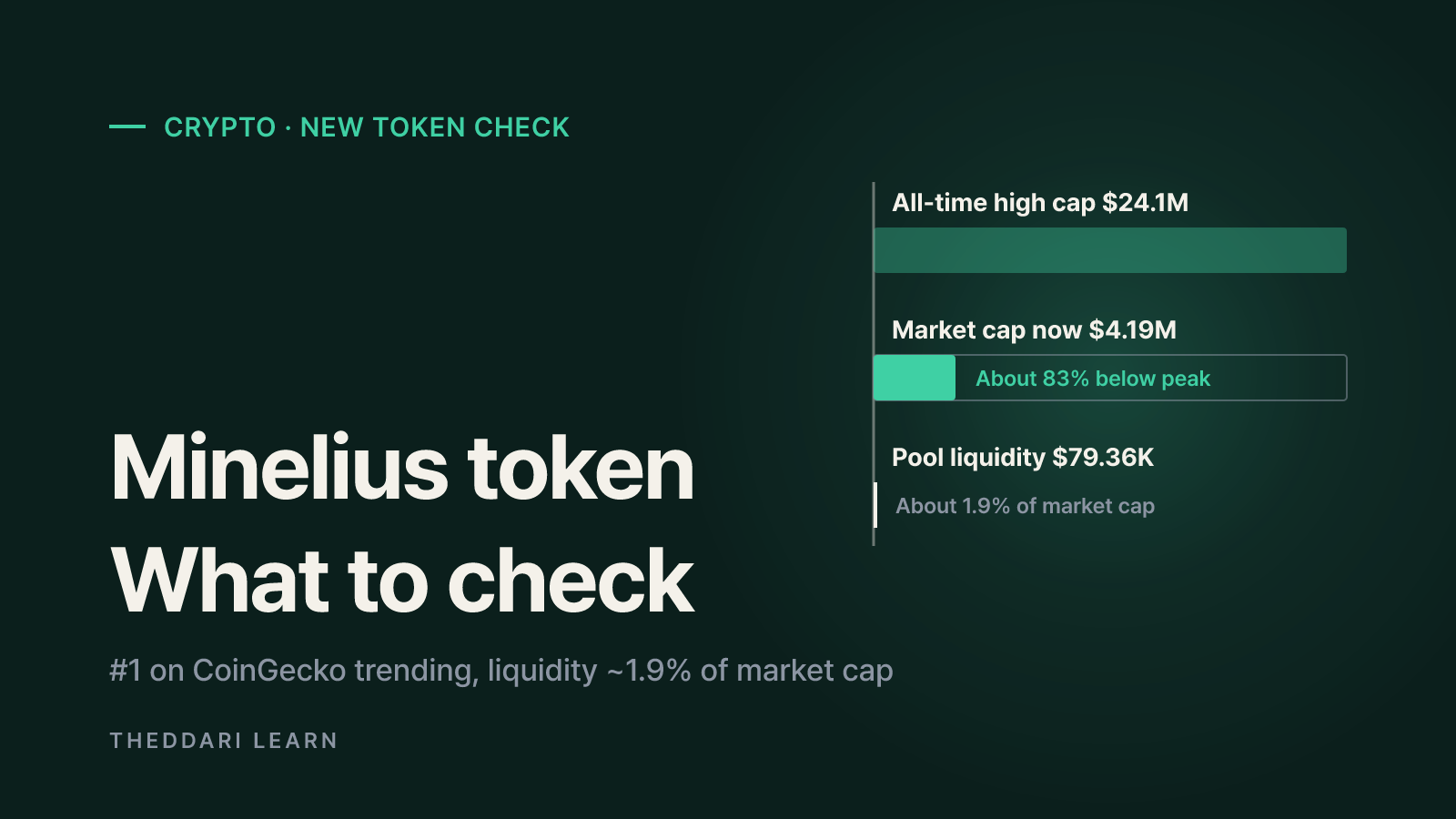
Minelius hit #1 on CoinGecko trending. Here is how its private-mine launchpad works, what the on-chain numbers showed on November 24, 2026, how to spot the same-name copycat, and the checks to run first.
 Crypto
Ethereum Treasury Companies Selling ETH: Why mNAV Matters
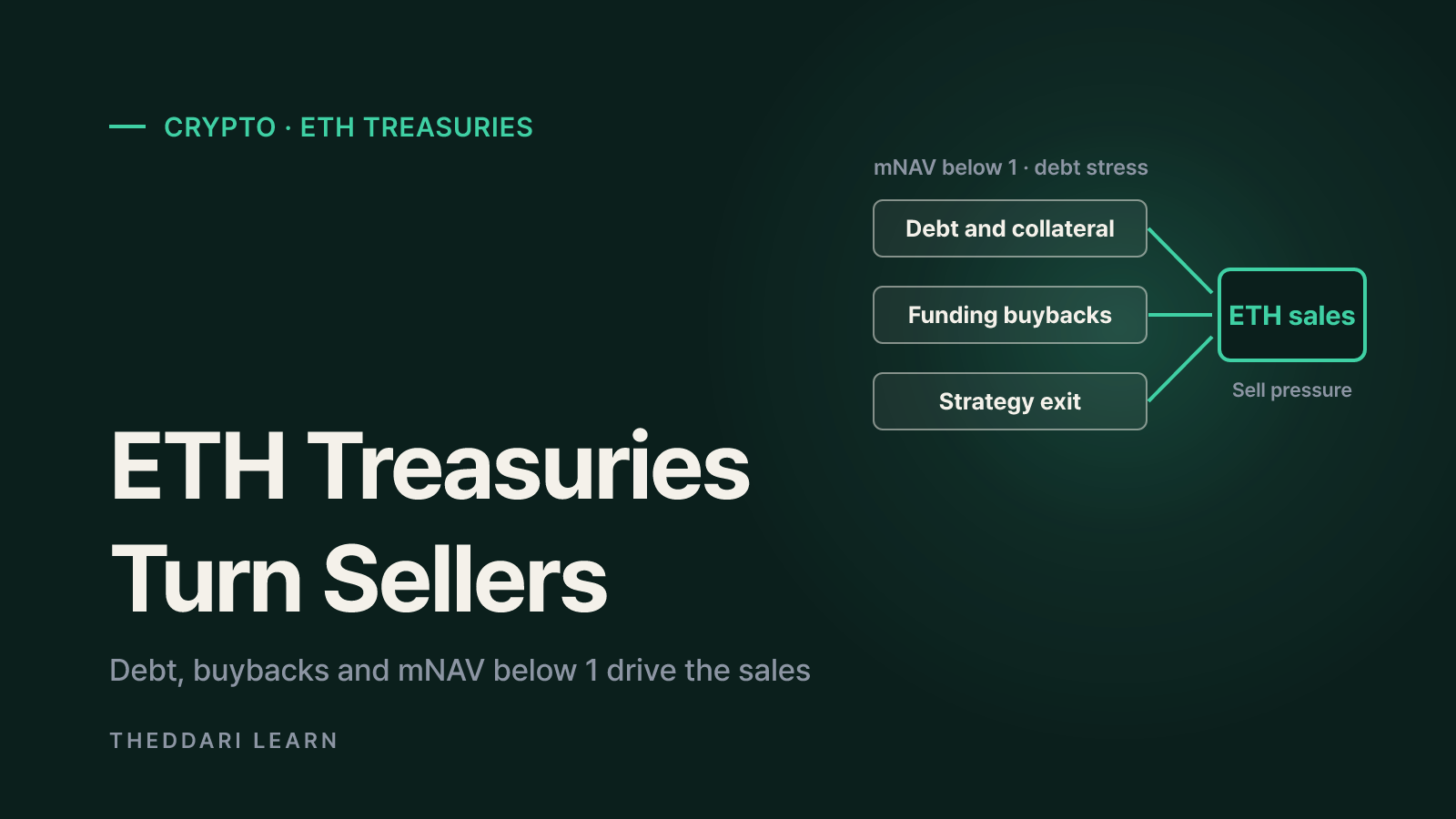
Some Ethereum treasury companies are now selling ETH below cost. Using BTCS's November 2026 filings, BitMine's data and DefiLlama figures, this guide explains why firms sell, how Aave liquidation lines work and how to check a sale claim.