Contents7 sections
An earnings call is less about hearing new numbers and more about hearing how management explains numbers that are already public and how it talks about what comes next. To listen well, focus on three things: how the guidance range and its assumptions changed from last quarter, which topics several analysts keep asking about in the Q&A, and which questions management answered without giving a number. This guide reflects the SEC's Regulation FD materials and related U.S. law as checked in October 2026, with a short note on how Korean-listed companies differ. It does not forecast results or price moves for any company.
What is an earnings call? Prepared remarks, then Q&A
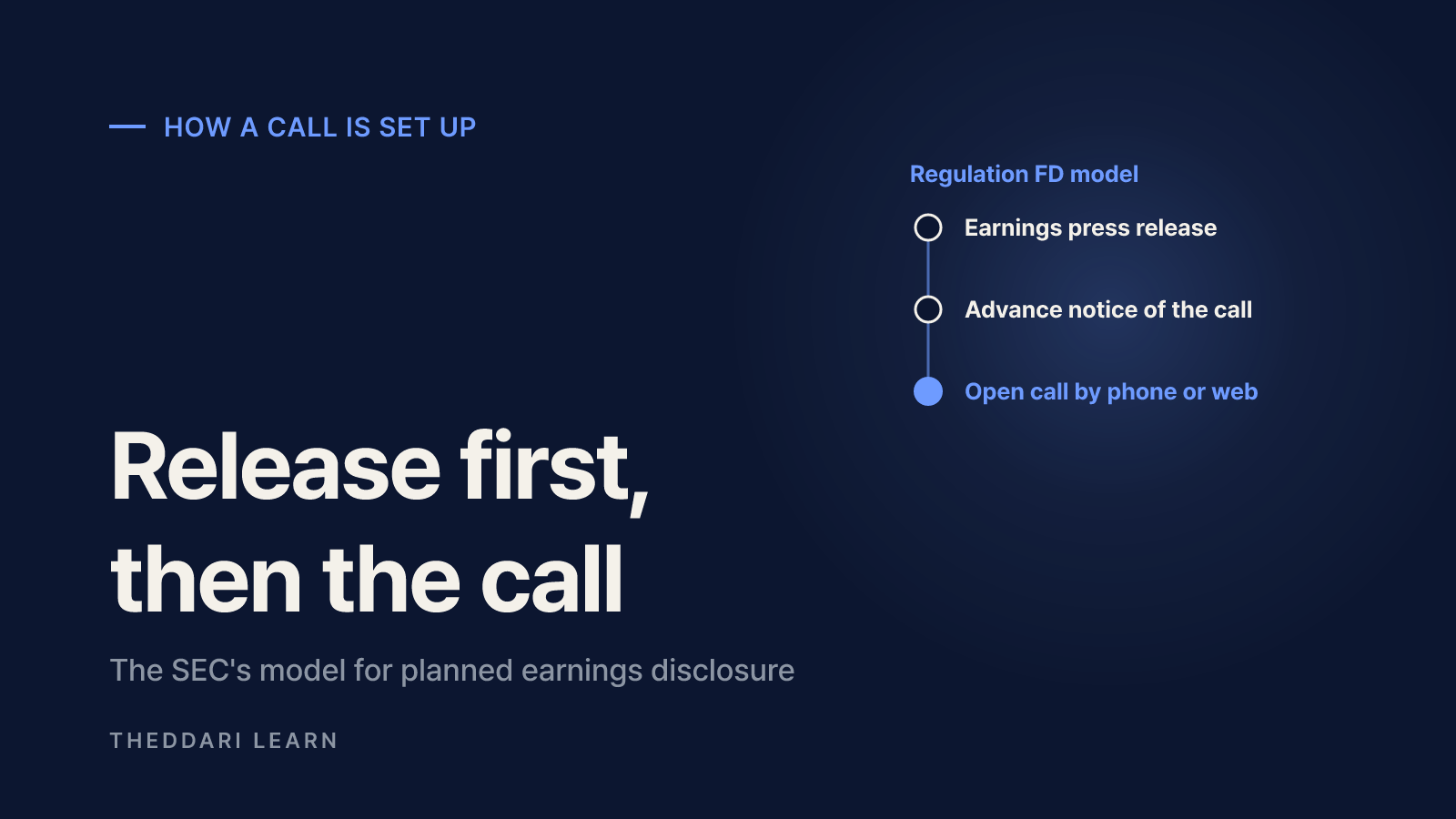
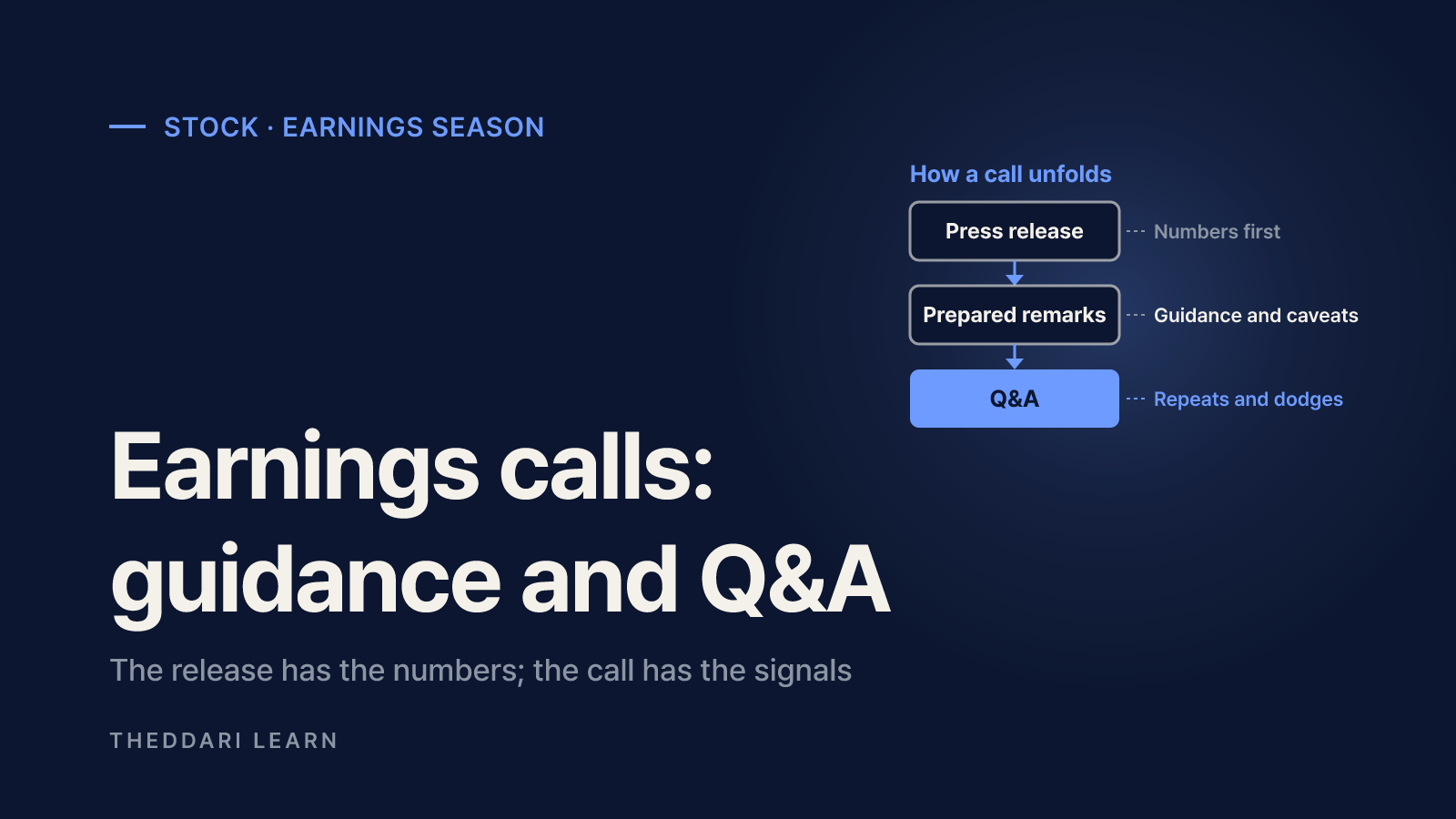
An earnings call is a conference call, usually also webcast, in which a public company's executives walk analysts and investors through quarterly or annual results and then take questions. The modern format is closely tied to regulation. In its Regulation FD final rule, effective October 23, 2000, the SEC addressed selective disclosure, the practice of giving material nonpublic information to analysts or favored investors before the public. The release described a model for planned disclosures such as earnings: first issue a press release, then give public notice of a scheduled call with its date, time and access instructions, and finally hold the call so anyone can listen by phone or internet webcast.
Because of that sequence, the headline revenue and earnings-per-share figures are usually in the press release before the call begins. What the call adds is context: why margins moved, what management expects for the next quarter or the full year, and how executives handle questions they did not script. That is why experienced listeners often read the release first and treat the call as the explanation, not the announcement.
Safe-harbor statement
- What you typically hear
- Cautionary language and a pointer to risk-factor filings
- What to listen for
- Which document management cites
CEO remarks
- What you typically hear
- Quarter summary, segment trends, strategic priorities
- What to listen for
- Topics that are new or missing versus last quarter
CFO remarks
- What you typically hear
- Income statement detail, cost and margin drivers, guidance
- What to listen for
- Guidance range, assumptions, changes in metric definitions
Analyst Q&A
- What you typically hear
- Unscripted questions and answers
- What to listen for
- Repeated topics, answers without numbers, deferred answers
The opening safe-harbor statement sounds like boilerplate, but it tells you how to treat everything that follows. The statutory safe harbor at 15 U.S.C. §77z-2 defines forward-looking statements to include projections of revenue, income, earnings per share, capital expenditures and dividends, management's plans and objectives, and the assumptions behind them. For oral statements, the company can identify them as forward-looking, warn that actual results could differ materially, and point to a readily available written document that lists the risk factors. The same section says it imposes no duty to update a forward-looking statement. In plain terms, guidance is a judgment at a point in time, not a promise.
Where to find earnings call replays and transcripts
Most U.S. companies post the live webcast, the replay and the slide deck in the investor relations section of their website. SEC staff guidance in the Telephone Interpretations, Fourth Supplement says adequate advance notice of a call must include the date, time and call-in information, and that several days' notice would be reasonable for a regularly scheduled quarterly earnings announcement. The staff also encourages companies to state in the notice how, and for how long, a transcript or replay will be available. Replay windows are therefore set by each company and can expire or move to an archive.
- Company IR site: the webcast replay, slides and press release are the primary record.
- SEC EDGAR: search the company's filings, such as Form 8-K reports, to check figures against the original documents.
- Financial portals: third-party transcripts are fast to skim but should be checked against the audio for key quotes.
- Your own notes: write down the call date and time zone, because replays and transcripts may not stay online.
If you follow companies listed in Korea, the path is different. The Korea Exchange's disclosure portal, KIND, publishes notices of investor relations events and preliminary earnings filings. A sample preliminary earnings filing on KIND lists who provides the information, the intended audience (analysts, institutional investors, individual investors and the press), the scheduled date and time, and a related IR event notice. It also states that the figures are preliminary and may differ from final results.
To keep earnings season manageable, put report dates and call times in one place. The theddari earnings calendar helps you track scheduled report dates, and the economic calendar shows whether inflation or jobs data land in the same week, which makes it easier to separate company news from macro moves when you read the price reaction. Many U.S. calls happen outside regular trading hours, so convert the time zone before you plan to listen live.

Prepared remarks: guidance and changes in wording
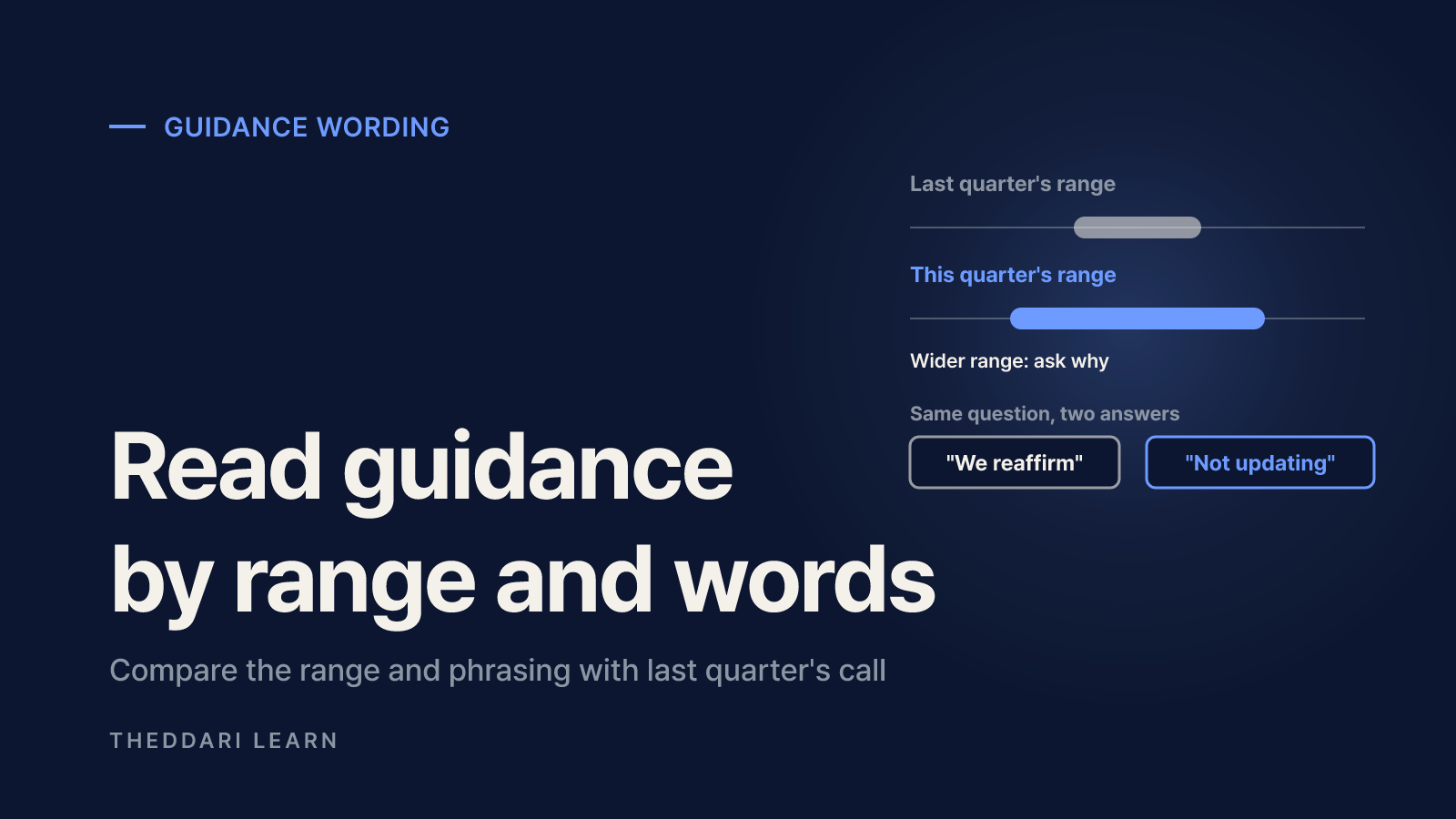
Prepared remarks are scripted and reviewed, so word choice itself can carry information. Start with guidance, the company's outlook for next quarter or the full year on revenue, earnings, margins or capital spending. Record more than the midpoint: note the width of the range, whether it moved up or down, and any conditions attached, such as "assuming current demand trends continue." A wider range can signal more uncertainty in management's view, and added conditions mean the outlook leans more heavily on assumptions.
Wording changes matter most when you compare them with last quarter's call. If a segment described as seeing "strong demand" is now described as "stable," that is a question worth checking rather than a conclusion. If a metric management highlighted every quarter disappears from the script, look for it in the Q&A or the next filing. When the company emphasizes an adjusted measure, such as earnings excluding one-time costs, compare it with the reported figure using the reconciliation in the press release.
Guidance raised or lowered
- Possible meaning
- The outlook itself changed
- What to check
- The prior range and the date of market expectations
Range widened
- Possible meaning
- More uncertainty
- What to check
- The factors management cites for the change
Guidance withdrawn or no longer given
- Possible meaning
- Lower visibility or a policy change
- What to check
- The stated reason and any substitute metrics
"Unchanged" or "still comfortable"
- Possible meaning
- Reaffirmation of the prior forecast
- What to check
- How late in the quarter the reaffirmation comes
A key metric goes unmentioned
- Possible meaning
- Shift in emphasis or possible weakness
- What to check
- The figure in Q&A or the next 10-Q
Phrases like "still comfortable" deserve attention for a specific reason. The SEC staff interpretation states that saying a prior forecast has "not changed," or that the company is "still comfortable with" it, is no different from confirming the forecast. It adds that a confirmation near the end of a quarter can convey information about how the company actually performed. If management does not want to confirm, the staff notes it can say "no comment" or make clear that the earlier estimate spoke only as of the date it was given. So "we are not updating guidance" and "we reaffirm guidance" should carry different weight in your notes.
Conference call Q&A: signals that can move the stock
The Q&A is unscripted, which is why many investors consider it the most informative part of the call. You probably will not get to ask a question, but the analysts' questions show what the market is worried about. The first signal is repetition: when several analysts ask about the same topic in different words, that topic is likely the main debate for the stock this quarter. The second is answers without numbers: if an analyst asks about margins or demand and management offers direction but no figure or range, mark that area as unconfirmed.
The third signal is deferral or narrowing, such as "we'll share more at our investor day" or "we don't comment on individual customers." That can be a legitimate disclosure policy or a way to avoid a sensitive subject. Compare it with how management handled the same topic in earlier quarters before drawing conclusions. The fourth is a mismatch between question and answer: if the question is about this quarter's demand and the answer drifts to long-term strategy, write down the original question and watch whether the number shows up in later filings.
Log Q&A by topic, not by analyst name. For each topic, note how many times it came up and whether management answered with a number. After the call, the market's main concerns become easy to see.
Regulation FD also explains why executives can sound guarded. The final rule warns that an official who privately gives an analyst guidance that earnings will be higher than, lower than, or even the same as forecasts likely violates the rule, whether the signal is explicit or implied. It also says material information cannot be made immaterial by breaking it into small pieces. That is why management is careful about mid-quarter commentary, and a cautious answer is not automatically a bad sign. When a new figure does come out on a public call, it carries weight precisely because everyone heard it at the same time.
Keep two limits in mind. First, the final rule excludes foreign private issuers from Regulation FD, so non-U.S. companies listed in the U.S. may handle calls and replays differently. Second, reading confidence from tone of voice is subjective. Use tone to generate questions, and rely on reported numbers and later results for conclusions. During earnings season, the theddari stock Telegram trends page can show which calls traders are discussing, but community summaries do not replace the original audio or filings.
An earnings call checklist and common mistakes
- 1
Prepare the numbers and last quarter's language
Read the press release first, then write last quarter's guidance and key phrases on one page. You need a baseline to hear what changed.
- 2
Capture guidance and its assumptions
Record the range, the direction of any change, the conditions attached and any adjusted metrics the company defines. Mark topics that are new or missing.
- 3
Log the Q&A by topic
Note how often each topic came up, whether management answered with numbers and which answers were deferred. Keep mismatched answers as open questions.
- 4
Verify against the source and set a review date
Check important quotes against the replay or slides, and compare guidance with the next quarterly filing. Put the next report date on your calendar so you can revisit the same questions.
The first common mistake is treating guidance as a commitment. The safe harbor protects properly identified forward-looking statements, and the law imposes no duty to update them, so a missed forecast may never be formally corrected. The second is treating the after-hours or next-day move as a verdict on the call. Price reactions blend expectations, peer results and macro data. The third is relying only on headline summaries, which often drop qualifiers like "if demand recovers." The goal of listening to an earnings call is not to time a trade but to record what management said about its outlook and risks, so you can test those statements against the numbers that follow.