Contents7 sections
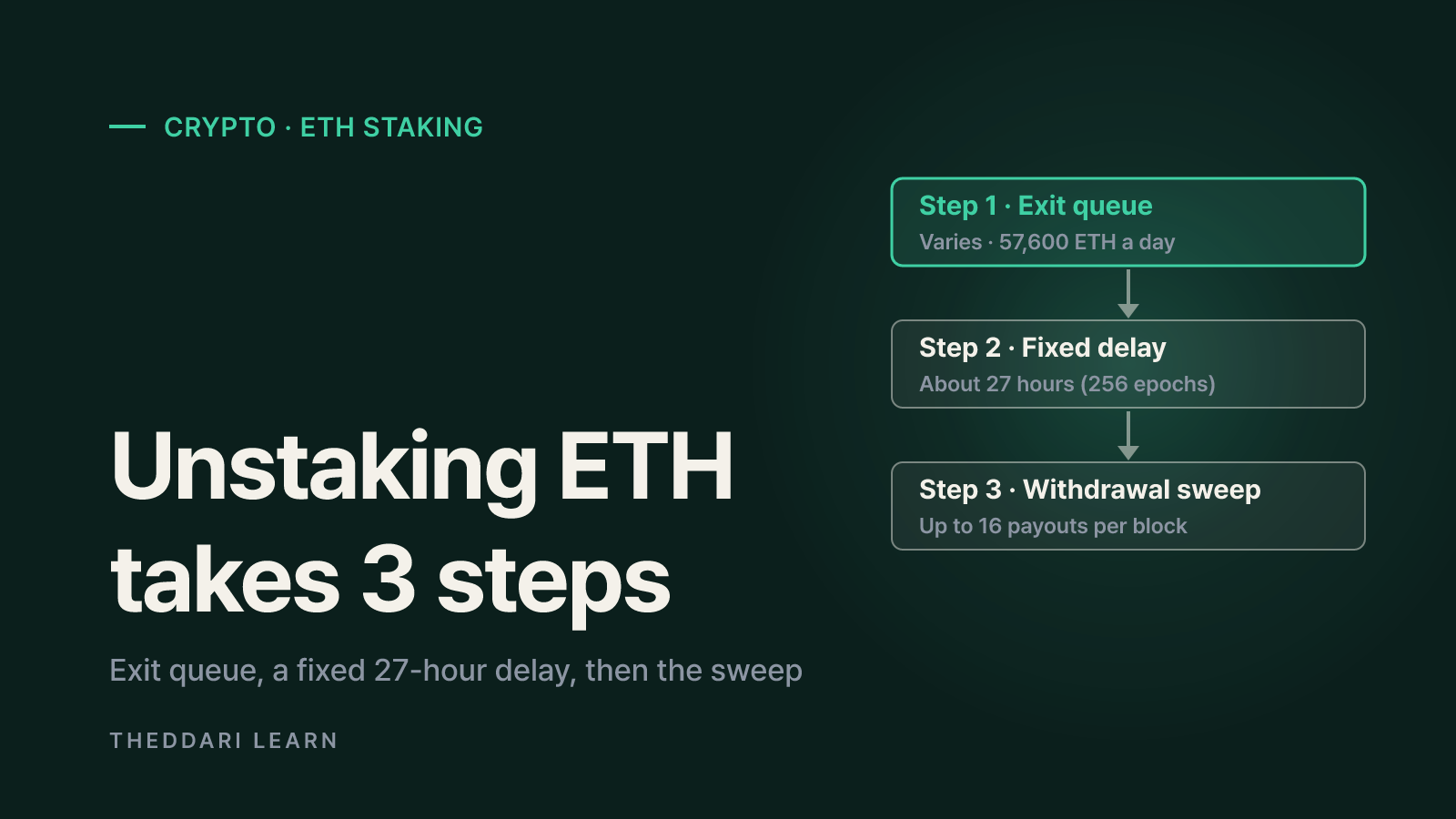
Ethereum unstaking time ranges from a couple of days to several weeks, and the answer depends on two things: how busy the network's exit queue is and which route you used to stake. As of November 2026, a validator you run yourself has to clear three protocol steps before ETH reaches its withdrawal address: the exit queue, a fixed delay of about 27 hours, and the withdrawal sweep. Exchanges and liquid staking protocols sit on top of those steps and add their own processing. Liquid staking tokens can also be sold immediately, but that trades waiting time for price risk. This guide breaks down where each delay comes from and how to estimate your own.
Why Ethereum unstaking time is never instant
Ethereum deliberately limits how fast stake can enter or leave so the validator set changes slowly. According to the beaconcha.in queue documentation, an epoch lasts 6.4 minutes and a day has 225 epochs. The exit queue lets 256 ETH through per epoch, which works out to about 57,600 ETH per day. That limit is shared by everyone on the network, not set per exchange or per user, so a large wave of exits from one provider slows everyone down.
- 1
Step 1: the exit queue
When the chain processes your exit, it books the first epoch with room under the limit, never earlier than 5 epochs (about 32 minutes) ahead. Your exit epoch does not change afterwards. Keep the validator online until then, because it still has duties and earns rewards or penalties.
- 2
Step 2: the withdrawability delay
After the exit epoch comes a fixed wait of 256 epochs, about 27 hours, regardless of queue length. A slashed validator waits much longer: at least 8,192 epochs, about 36 days.
- 3
Step 3: the withdrawal sweep
The sweep is a pointer that walks through all validators in index order and wraps around. Each block pays at most 16 withdrawals. When the pointer reaches your withdrawable validator, the full balance lands at the withdrawal address with no gas required.
ethereum.org compares the sweep to the hand of a clock that never skips an hour. At 16 withdrawals per block, the network can process 115,200 withdrawals per day, so a cycle of 800,000 withdrawals takes about 7.0 days. Validators without an eligible withdrawal are skipped, which can shorten the cycle, while missed slots slow it down. Validators that still have 0x00 credentials are skipped entirely, so solo stakers need a withdrawal address set before they exit.
Unstaking times compared: solo, exchanges and liquid staking
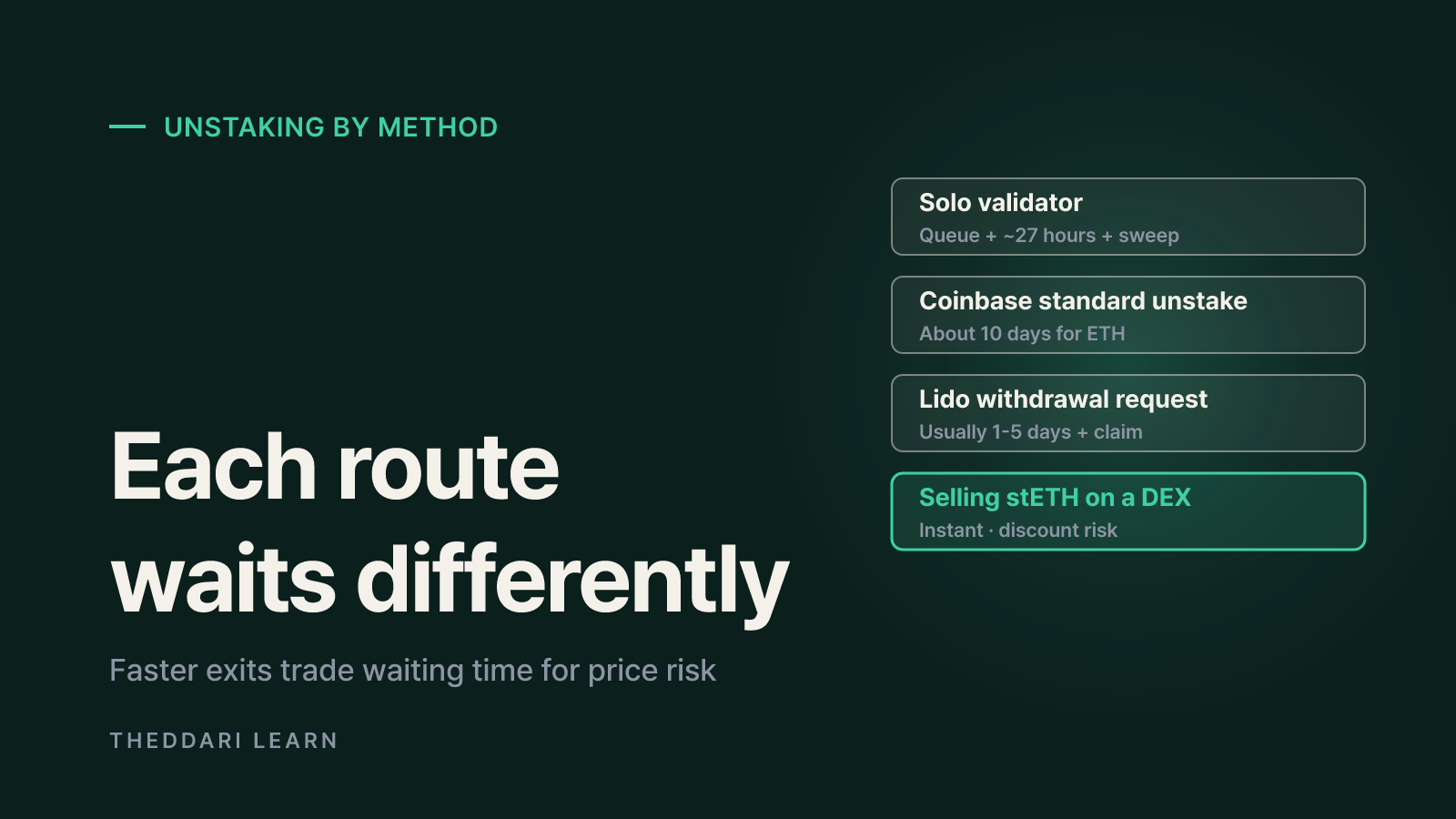
The table below summarizes the official guidance checked in November 2026. Treat every figure as the provider's estimate, not a promise; conditions at the moment you submit can change the result.
Solo validator
- How you get ETH back
- Signed voluntary exit or exit request from the withdrawal address
- Stated time
- Queue + ~27 hours + sweep
- Watch out for
- Withdrawal address required; stay online until exit
Coinbase (retail)
- How you get ETH back
- Standard unstake, or instant unstake for a fee
- Stated time
- ~10 days for ETH
- Watch out for
- No trading or transfers until done; instant option may be limited
Lido withdrawal
- How you get ETH back
- Request (NFT minted), wait for fulfilment, then claim
- Stated time
- Normally 1-5 days, can be longer
- Watch out for
- Two transactions, two gas payments
Selling stETH/wstETH
- How you get ETH back
- Swap on a DEX or aggregator
- Stated time
- Seconds to minutes
- Watch out for
- Discount to ETH and slippage
Upbit (Korea)
- How you get ETH back
- Request and authenticate, network queue, then credited
- Stated time
- Varies with the network
- Watch out for
- Cannot cancel after authentication
Exchanges do not get a private lane through the protocol. Coinbase explains that its unstaking periods are the network wait time plus its own processing time. It also notes that staked balances cannot be sold or sent until unstaking completes, that assets keep earning during the wait, and that instant unstaking carries a fee and may not always be available. For readers in South Korea, Upbit gives no fixed day count for ETH and instead describes the network unstaking queue followed by the withdrawal waiting period.
Liquid staking: redeem through the protocol or sell the token
If you hold stETH or wstETH, you have two exits. The first is a native withdrawal. Lido's help center describes three steps: submit a request, which mints an NFT representing it; wait for fulfilment, which normally takes 1 to 5 days; then claim your ETH. wstETH is unwrapped automatically during the request, so you do not need to unwrap it first.
Lido's timing depends on how much stETH is already waiting, the beacon chain exit queue, and validator performance. Because Lido can fill requests with incoming deposits and rewards, a request may finish faster than a fresh validator exit would. In an emergency mode Lido calls Bunker mode, triggered by events such as mass slashing, requests are still processed but more slowly.
The second exit is selling. Lido itself points to aggregators such as 1inch and CoW Swap for instant swaps. Speed is the advantage; the cost is that you accept whatever the market pays. When markets are stressed, liquid staking tokens can trade below ETH, and large orders move the price further. Check the quoted output and price impact before you confirm. If you plan to sell the resulting ETH on a centralized exchange, theddari's cross-exchange price gap and Korea premium pages show how ETH prices differ between venues; transfer time and fees still apply, so a displayed gap does not mean you will end up with more.

How to estimate your own unstaking wait
The basic formula is exit queue time + about 27 hours + sweep wait. As an illustration, if 115,200 ETH is queued ahead of you, the daily limit of 57,600 ETH implies about two days in the queue, then roughly 27 hours, then anything from zero to one sweep cycle. Be careful with that shortcut, though. The beaconcha.in documentation warns that dividing exiting ETH by 256 can mislead in both directions: partial withdrawal requests use the same limit but are not counted as exiting validators, while consolidations show as exiting yet use a separate limit.
- Identify your route. For Coinbase, Lido or another provider, start from the estimate shown in its interface. For a solo validator, the network queue is your reference.
- Check the live exit queue. Use a queue explorer that reads the latest booked exit epoch rather than one that only divides pending ETH by the churn limit.
- Add the fixed delay and the sweep. Add about 27 hours after the exit epoch, then compare your validator index with the current sweep position. If the pointer has already passed you, you wait for the next cycle.
- Leave a buffer. Provider processing, a sale and a bank withdrawal are separate steps. If you need the money by a specific date, plan for slippage in the timeline and check your request status regularly.
Sudden queue growth often follows large institutional exits or sharp market moves. theddari's Telegram crypto trends page shows how much Ethereum-related news is being discussed, which can give context for a queue spike. Discussion volume does not predict queue length, so confirm the actual numbers on a queue explorer.
Risks and costs while you wait
- Price exposure: ETH that is unstaking cannot be sold, so its value can rise or fall before it arrives. Coinbase states this risk explicitly.
- Reward gaps: a solo validator earns nothing during the roughly 27-hour withdrawability delay, and some exchanges pay no rewards on amounts waiting to unstake.
- Slashing: a slashed validator loses part of its balance and cannot withdraw for at least about 36 days.
- Discounted exits: selling a liquid staking token in a hurry can mean a below-ETH price plus slippage.
- Fees: instant unstaking fees, Lido's request and claim gas, and the small fee for exit requests sent from a withdrawal address all add up.
In short, the exit queue is the part of Ethereum unstaking time that swings the most, followed by a fixed 27-hour delay and a sweep that can add up to about a week. Exchanges add processing time, Lido adds its own fulfilment step, and selling a staking token swaps time for price risk. Before you submit, write down when you actually need the funds, how much price movement you can tolerate during the wait, and whether a discounted sale is acceptable, then check each provider's current estimate.