GPU depreciation debate: why server life matters for Nvidia
How the GPU depreciation debate works: what useful-life assumptions do to Big Tech earnings, what Meta and Amazon disclosed, and how Nvidia responded.
Contents9 sections
- What is the GPU depreciation debate?
- Four years vs six years: the same server, different annual cost
- Server useful lives at Big Tech, by the filings
- Nvidia's rebuttal vs the bear case
- GPU collateral loans and used GPU values
- What Nvidia stock investors can track
- Common misreadings to avoid
- Frequently asked questions
- Sources and references
Key takeaways
- The GPU depreciation debate is about how many years hyperscalers assume their AI servers stay useful. A longer life spreads the cost thinner and lifts reported earnings in the early years.
- As of October 2026, Alphabet, Microsoft and Oracle use up to six years for servers, Meta uses 5.5 years and Amazon five to six, after cutting a subset of servers from six years to five in 2025.
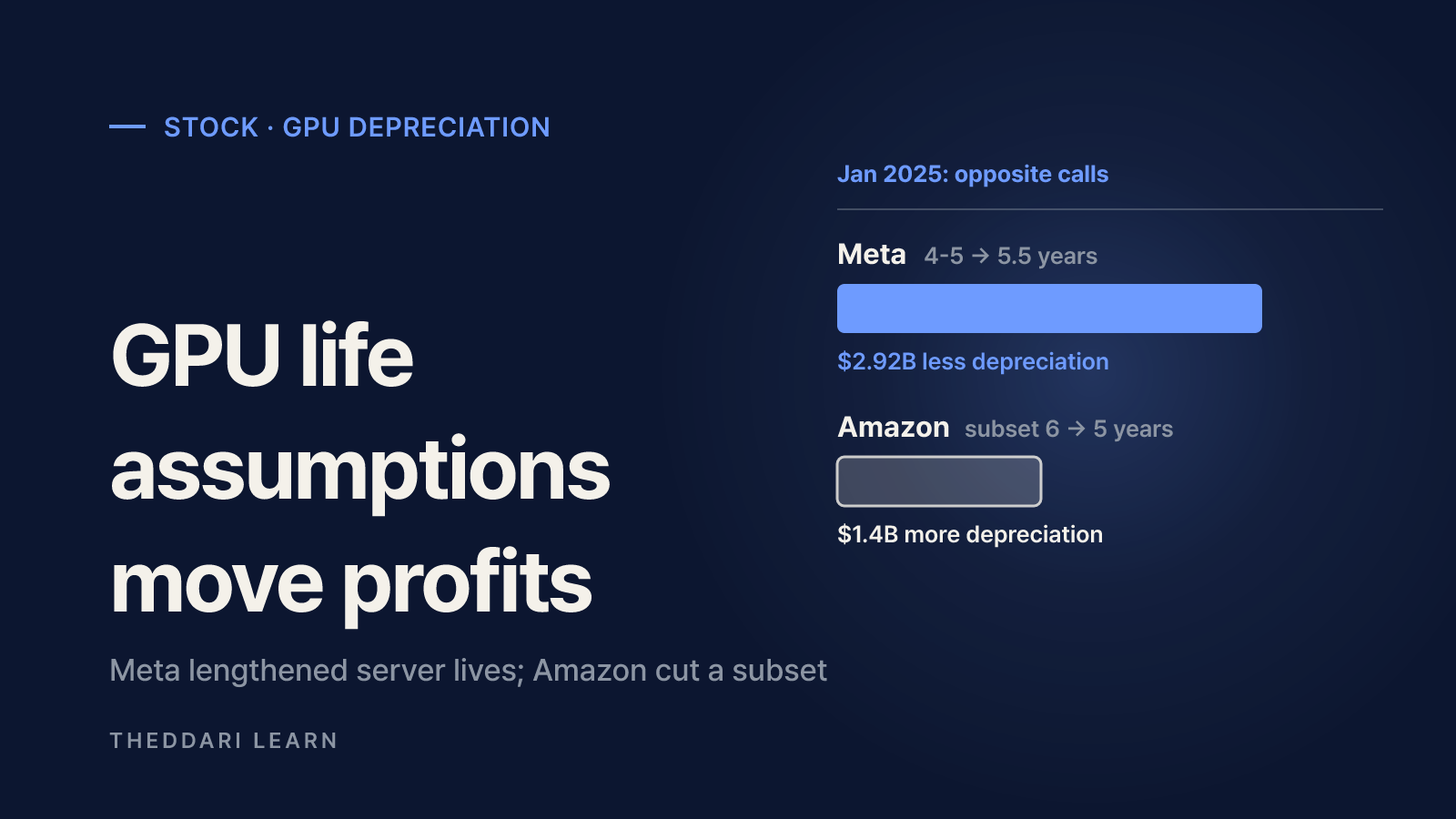
- Meta disclosed that its move to 5.5 years cut 2025 depreciation by about $2.92 billion; Amazon's shortening added about $1.4 billion of depreciation.
- Nvidia told analysts its customers depreciate GPUs over four to six years and that 2020-era A100 chips still run at high utilization; critics such as Michael Burry argue the economic life is shorter.
- Useful-life assumptions also underpin GPU-backed loans, so resale prices, rental rates and utilization are the outside tests of the accounting.
The GPU depreciation debate comes down to one estimate: how many years an AI server will stay useful. Write a GPU server off over four years and the annual expense is large; spread it over six and the expense shrinks, so reported profit rises. As of October 2026, most large US cloud providers depreciate servers over five to six years, while critics argue that Nvidia's near-annual product cadence makes the real economic life shorter. This guide explains the accounting, the dollar effects companies have disclosed, the arguments from Nvidia and its critics, and how the same assumption feeds into GPU-backed lending. It applies to companies reporting under US GAAP.
What is the GPU depreciation debate?
Depreciation allocates the cost of a long-lived asset across the years it is expected to serve. GPU servers and networking gear are expensive and last several years, so companies do not expense them in the year of purchase. They charge the cost to the income statement over an estimated useful life. That life is not set by law; management picks it based on operating experience, replacement plans and the pace of technology change, and auditors review it.
The estimate matters more now because the asset base is so large. According to a DECUS review of the filings, Microsoft's depreciation expense rose from $15.2 billion in fiscal 2024 to $22.0 billion in fiscal 2025 and $34.3 billion in fiscal 2026. At that scale, moving the useful life by six months can swing annual profit by billions of dollars. That is why investors now ask how much of AI-era earnings growth comes from operations and how much from accounting judgment.
Depreciation is not a cash outflow. The cash went out as capital expenditure when the servers were bought. Changing the useful life changes when the cost hits the income statement, not how much cash the business generates.
Four years vs six years: the same server, different annual cost
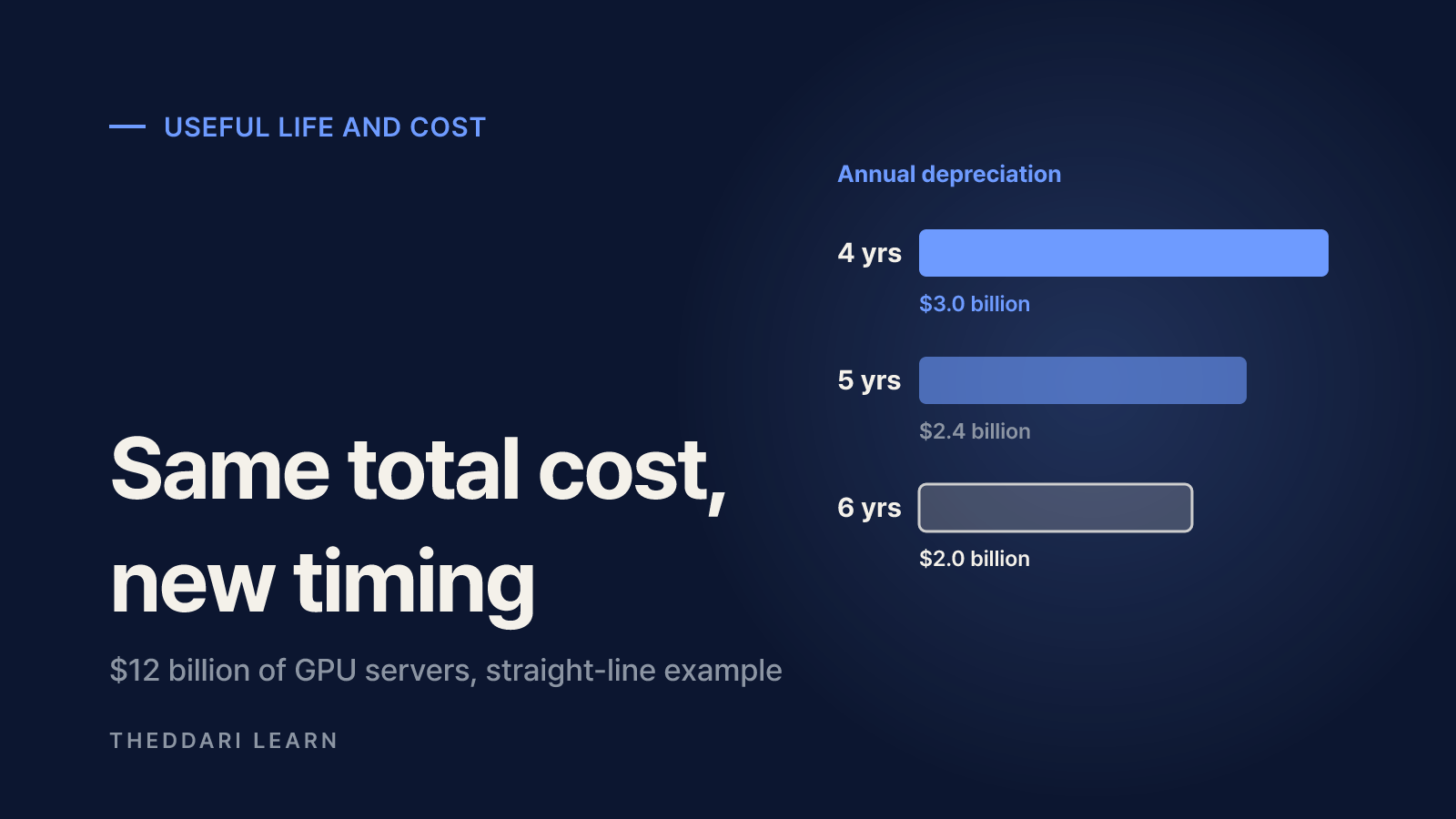
A simple hypothetical shows the mechanics. Assume a company buys $12 billion of GPU servers, expects no salvage value and uses straight-line depreciation. These are illustrative figures, not any company's actual numbers.
4 years
- Annual depreciation
- $3.0 billion
- Cumulative cost by year 4
- $12 billion
- Total cost over life
- $12 billion
5 years
- Annual depreciation
- $2.4 billion
- Cumulative cost by year 4
- $9.6 billion
- Total cost over life
- $12 billion
6 years
- Annual depreciation
- $2.0 billion
- Cumulative cost by year 4
- $8 billion
- Total cost over life
- $12 billion
The total cost is $12 billion in every case. What changes is timing. A six-year life books $1 billion less expense per year than a four-year life in the early years, so operating income looks higher. The cost does not disappear; it lingers into years five and six. If the servers actually become uncompetitive after four years and are retired, the remaining book value may have to be written off at once. That back-loaded risk is the heart of the bear case.
The effect compounds when capex grows every year, because each new cohort of servers carries the same timing gap. When spending slows, the opposite happens: book value accumulated during the boom keeps flowing through as expense and can weigh on margins.
Server useful lives at Big Tech, by the filings
Companies disclose the dollar impact when they change an estimate. Combining American Compute's schedule tracker, updated October 10, 2026, with the 10-K figures cited by DECUS gives the picture below. Note that Microsoft's latest annual report states a two-to-six-year range for servers and network equipment rather than a single number.
Alphabet
- Current disclosed life
- 6 years
- Change
- Jan 2023, 4 to 6 years
- Disclosed effect
- About $3.9B less 2023 depreciation
Microsoft
- Current disclosed life
- 2 to 6 years (servers, network)
- Change
- Fiscal 2023, 4 to 6 years
- Disclosed effect
- About $3.7B higher fiscal 2023 operating income
Oracle
- Current disclosed life
- 6 years
- Change
- Fiscal 2025, 5 to 6 years
- Disclosed effect
- About $733M lower fiscal 2025 operating expenses
Meta
- Current disclosed life
- 5.5 years (most servers)
- Change
- Jan 2025, 4-5 to 5.5 years
- Disclosed effect
- About $2.92B less 2025 depreciation; net income up about $2.59B
Amazon
- Current disclosed life
- 5 to 6 years
- Change
- Jan 2024 5 to 6; Jan 2025 subset 6 to 5
- Disclosed effect
- About $1.4B more 2025 depreciation; net income down about $1.0B
CoreWeave
- Current disclosed life
- 6 years (technology equipment)
- Change
- Jan 2023, 5 to 6 years
- Disclosed effect
- About $20M lower 2023 expenses
In its fourth-quarter 2024 results, Meta said it completed an assessment in January 2025 that raised the estimated life of certain servers and network assets to 5.5 years, which it expected to reduce 2025 depreciation by roughly $2.9 billion based on assets in service at year-end 2024. The same month, Amazon went the other way for a subset of servers and networking equipment, citing the increased pace of technology development in artificial intelligence and machine learning. Two buyers of similar chips reached opposite conclusions at the same time.
American Compute counts 17 changes since 2020, and 16 of them lengthened lives; Amazon's 2025 cut is the exception. The same five-to-six-year extension was worth about $20 million to CoreWeave and about $2.92 billion to Meta. The hardware did not change; the size of the asset base did.
Nvidia's rebuttal vs the bear case
The debate became a Nvidia stock story when Michael Burry, the investor known from The Big Short, argued that hyperscalers were stretching GPU lives and that the AI buildout resembled the late-1990s telecom boom. As CNBC reported, Nvidia circulated a seven-page memo to sell-side analysts in November 2025 rebutting his claims.
Nvidia said its customers depreciate GPUs over four to six years based on real-world longevity and utilization. It added that older GPUs such as the A100, released in 2020, still run at high utilization and retain meaningful economic value well beyond the two to three years critics claim. The logic is a value cascade: chips displaced from frontier training move to inference and other lighter workloads and keep earning. The idea that a GPU is money and a durable asset comes from this argument.
Burry said he stood by his analysis and compared Nvidia to Cisco in 1999-2000. The core objection is that being used is not the same as being profitable. Newer GPUs do the same work with far less power, so keeping old chips running can erode returns once electricity and cooling are counted. Critics also see tension in promoting each new generation as vastly better while insisting the old one keeps its value.
The filings cannot settle the question. DECUS points to three outside tests: whether resale prices for previous-generation accelerators hold into years four to six, whether rental rates for older chips still generate revenue in those years, and whether utilization stays high. If those indicators weaken, the six-year assumption comes under pressure; if they hold, Nvidia's case strengthens.
GPU collateral loans and used GPU values
The assumption reaches beyond the income statement. GPU cloud providers, often called neoclouds, borrow heavily against GPU servers and customer contracts. On August 10, 2026, CoreWeave closed a $2.6 billion delayed draw term loan (DDTL 5.5). The facility has an approximately five-year maturity, while the underlying customer contracts average about three years. CoreWeave framed that gap as lenders underwriting renewal risk on the long-term value of Nvidia GPUs. The loan priced at SOFR plus 5.50% and was rated Ba2 by Moody's and BB+ by Fitch.
Those extra two years are where the useful-life question becomes a credit question: the GPUs must be re-leased at adequate rates for the structure to work. American Compute stresses that book life is not resale value; in the conservative band of its own residual report it puts a used H100 at 11% to 19% of original list price in 2027. That is one firm's estimate, not a market quote, but it illustrates how far a six-year accounting life and secondary-market value can diverge.
Neoclouds also show the depreciation load most clearly. In CoreWeave's second quarter of 2026, as summarized by DECUS from the 10-Q, revenue was $2,575 million, depreciation on property and equipment was about $1.4 billion, net interest expense was $640 million and the net loss was $626 million. Accumulated depreciation was only 11.2% of gross cost, so the charge on equipment already owned has room to rise. Big Tech can absorb depreciation with other profits; a company whose main business is renting GPUs cannot.
Risk can travel in one direction. If a new GPU generation pushes used prices down quickly, collateral values fall, lending terms tighten and neoclouds have less capacity to buy new chips. That would weaken one of the customer groups supporting Nvidia demand.
What Nvidia stock investors can track
Useful-life assumptions do not sit on Nvidia's own income statement; Nvidia sells the chips and its customers carry the depreciation. The link is indirect, through customers' returns on AI spending, replacement cycles and access to financing. A practical routine each earnings season:
- 1
Read the useful-life footnote
In the property and equipment policy and any change-in-estimate paragraph, note the server and network life, the effective date and the disclosed impact on depreciation and earnings per share.
- 2
Compare depreciation growth with capex
When capex grows much faster than depreciation, more expense is queued up for future years. Record what management guides for next year's depreciation.
- 3
Strip out the estimate effect
Subtract the disclosed impact before comparing year-over-year earnings so you can separate operating growth from accounting-driven growth.
- 4
Watch the outside indicators
Track rental rates and resale prices for older GPUs, neocloud loan pricing and ratings, and, in Nvidia's results, data center revenue, customer concentration and product cadence.
The theddari earnings calendar lists report dates for Nvidia and its largest customers in one place; confirm dates against each company's investor relations page.

Depreciation arguments often spread through social media before anyone reads the footnotes. The theddari stock Telegram trends page and the AI Telegram trends page show which claims are circulating; check any viral number against the original filing.
Common misreadings to avoid
- A longer life is not automatically fraud. The change and its effect are disclosed in audited statements; the question is whether the estimate is reasonable.
- Lower depreciation does not mean more cash. Only the timing of expense recognition moves.
- Physically running is not the same as economically useful. Power efficiency and rental pricing matter.
- The disclosed effect is not the whole risk. It covers the year of change, not the size of a future write-down if the estimate proves wrong.
In short, the GPU depreciation debate is less about accounting fraud than about who is estimating the economic life of AI hardware more accurately. As of October 2026 most hyperscalers use five to six years, and only Amazon has shortened part of its fleet. Used GPU prices, rental rates, utilization and the terms of GPU-backed loans will test the six-year assumption. Reading the useful-life footnote alongside headline earnings, and computing growth with the estimate effect removed, lets you judge the competing claims for yourself.
Frequently asked questions
Does a longer depreciation schedule create more cash?
Are hyperscalers manipulating earnings by extending server lives?
Would shorter GPU lives be good or bad for Nvidia stock?
Does a useful-life change restate past results?
Sources and references
- 1Meta Reports Fourth Quarter and Full Year 2024 Results (Meta Investor Relations)(opens in a new tab)investor.atmeta.com
- 2GPU Depreciation Schedules (American Compute, October 2026)(opens in a new tab)www.amcompute.com
- 3Why Do Hyperscalers Depreciate GPUs Over Six Years? (DECUS, October 2026)(opens in a new tab)www.decus.co
- 4Nvidia pushes back on charges that AI investment is a bubble (CNBC)(opens in a new tab)www.cnbc.com
- 5CoreWeave Closes $2.6 Billion Loan Facility (CoreWeave Investor Relations)(opens in a new tab)investors.coreweave.com
Related articles
 Stocks
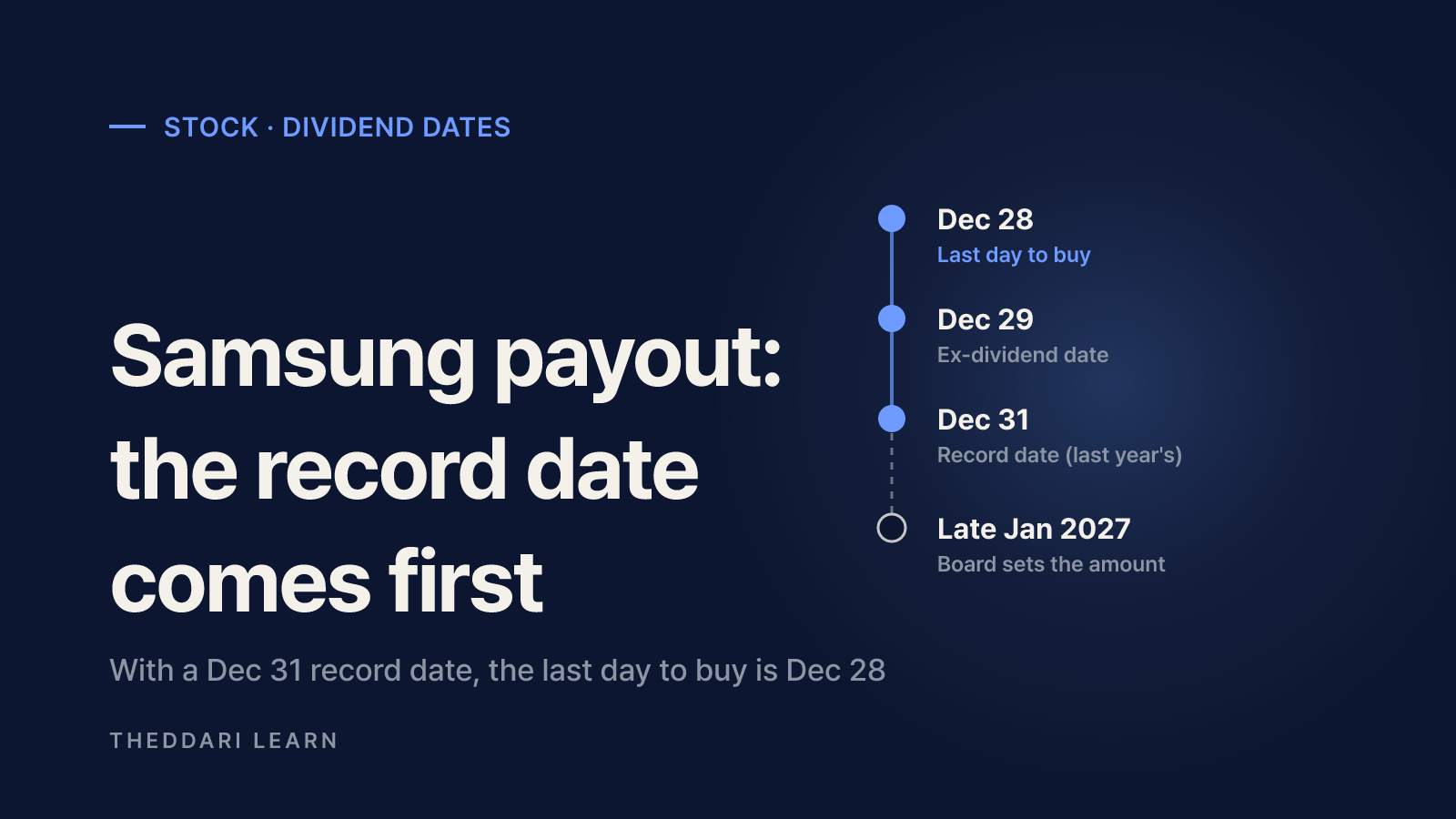
Samsung Special Dividend: Record Date, Ex-Date and Tax
Samsung confirmed a KRW 4,601 per-share Q3 2026 dividend, but the next payout will only be set by its board in late January 2027. Here is how record dates, ex-dates and Korean withholding tax work.
 Stocks
Baidu AI Hype Warning: Metrics for China AI Stock Investors
At the APEC CEO Summit in Shenzhen on Nov. 17, 2026, Baidu's Robin Li and Xiaomi's Lei Jun said few companies are making money from AI yet. Here is how to test that claim against Baidu's own Q3 numbers.
 Stocks
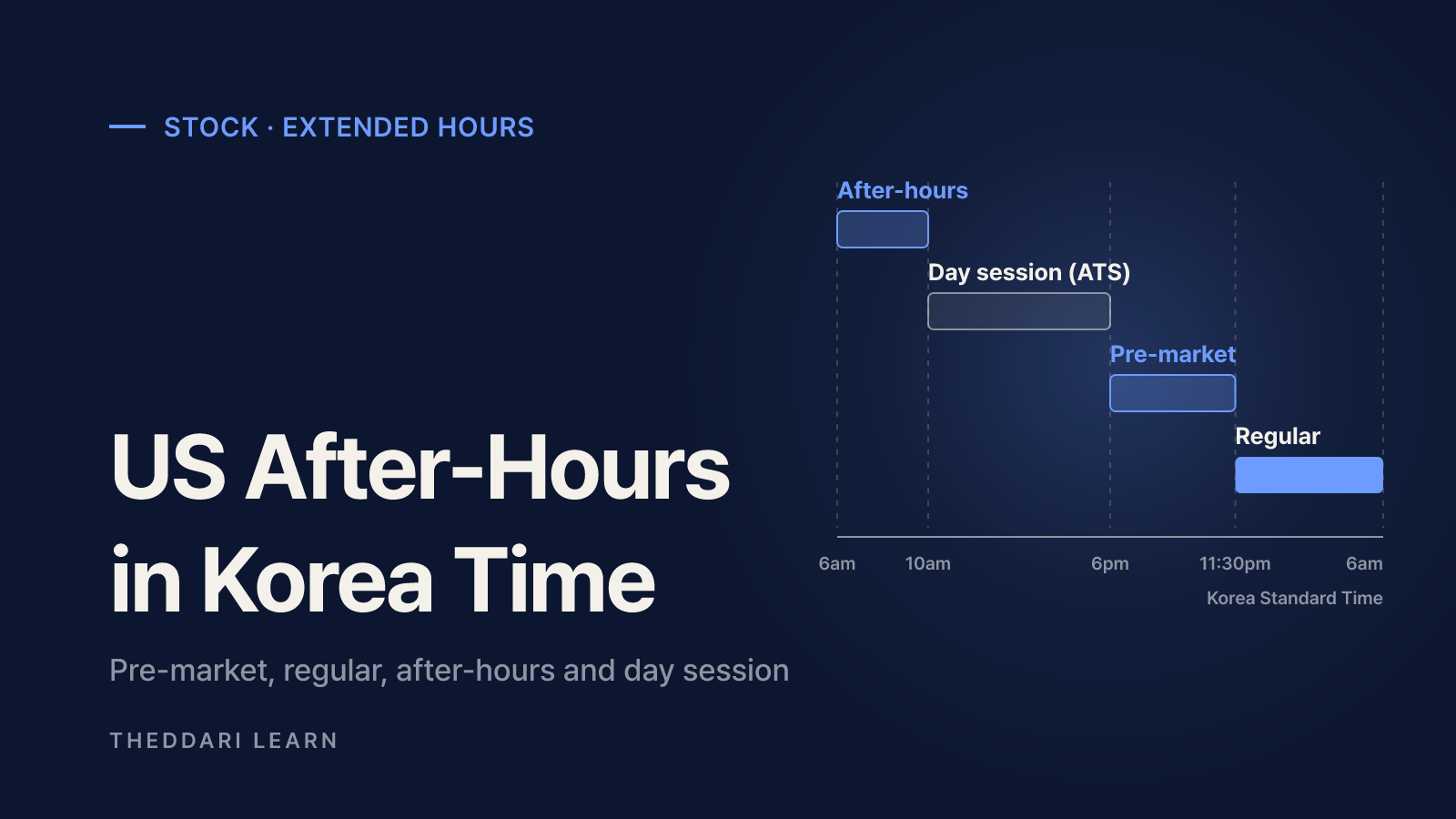
Pre-Market Trading and After-Hours Moves, Explained
An after-hours drop is usually measured against the last official close, set by a small number of trades. Learn the session times, how to read the move, and what changes for investors trading US stocks from Korea.