Contents8 sections
- What changed in the Goldman Sachs Claude Code policy
- How this differs from the Hong Kong restriction
- Why banks restrict AI coding agents
- What regulators actually say about AI tools
- A checklist before using AI coding tools at work
- What the move signals for the industry
- Frequently asked questions
- Sources and references
The Goldman Sachs Claude Code story is less about banning AI and more about who gets to run an AI that writes and executes code. According to Bloomberg's report, republished by Financial Advisor on November 2, 2026, Goldman updated its internal guidance in October so that Anthropic's Claude Code and Microsoft's GitHub coding tools are limited to engineers. Most traders and bankers who had been using them for months lost access. This guide, current as of November 2026, separates what was reported from what is interpretation, and explains why banks tend to restrict coding agents.
Details of the internal guidance come from a document seen by Bloomberg and from people familiar with the matter. Goldman has not published the policy; its spokesperson only described the general approach.
What changed in the Goldman Sachs Claude Code policy
For months, Goldman allowed bankers to use Claude Code and GitHub for work. Traders reportedly used the tools to monitor client trading flows, model market moves and positions, and produce written and graphic material. Bloomberg says the change frustrated some of them.
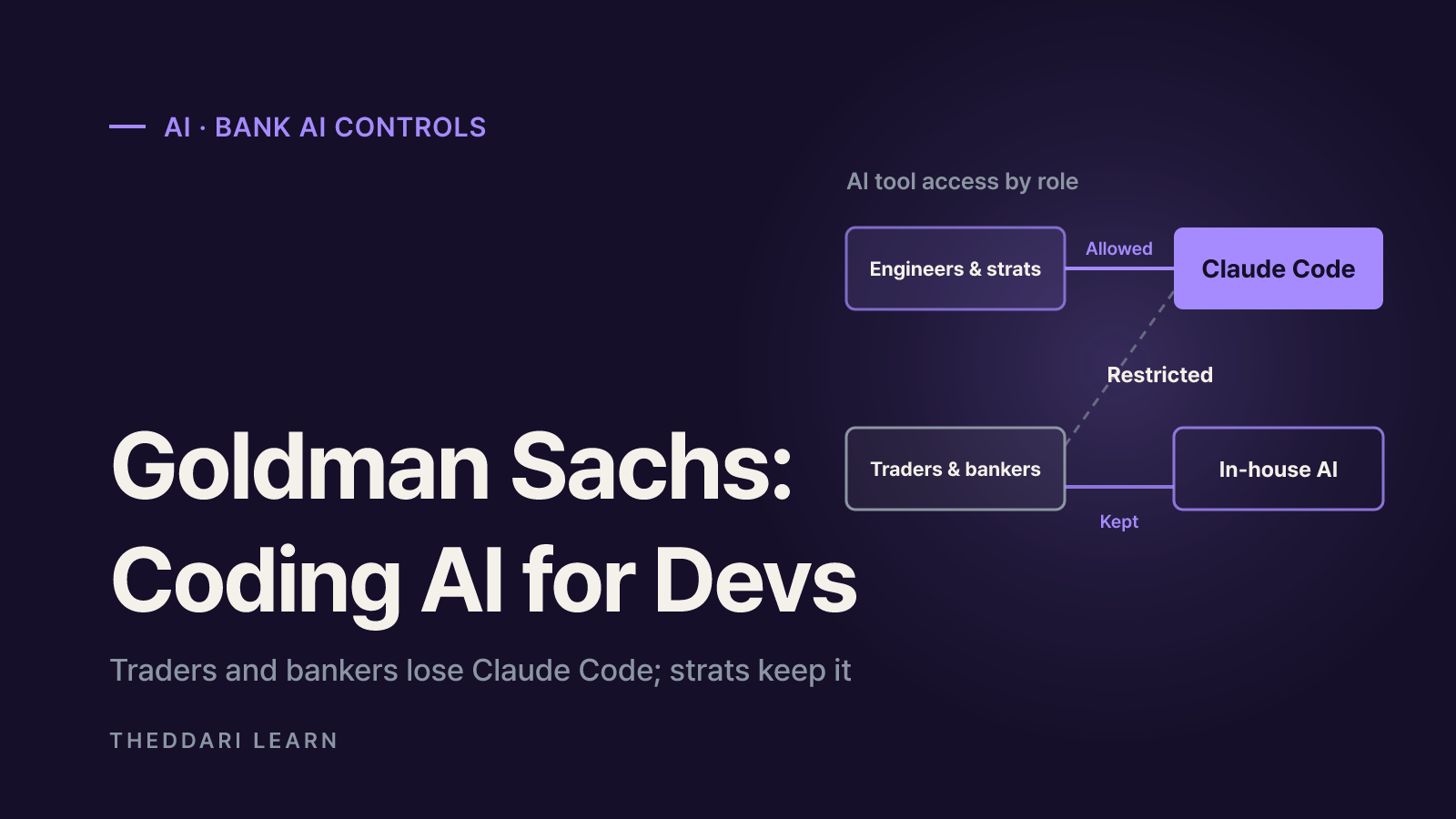
- Who lost access: most traders and bankers, meaning non-engineering staff.
- Who kept access: engineers, plus strats who work across trading, quantitative research and software engineering.
- What stays available: Goldman's in-house AI assistant, which combines models from OpenAI, Anthropic and Alphabet.
- Goldman's stated approach: after a period of experimentation that weighs productivity and risk management, tools go to the people best suited to use them over the long term.
The timing is notable. In July 2026, chief information officer Marco Argenti praised vibe coding by non-technical staff and described traders and bankers handing their AI-built tools to one of the firm's roughly 12,000 engineers to improve. The October update looks less like a retreat from AI and more like a move from broad experimentation to production-style controls.
How this differs from the Hong Kong restriction
This is not the first time Goldman narrowed Claude access. Reuters reported in April 2026 that Goldman removed Claude from its internal AI platform for bankers in Hong Kong. The Financial Times said the move followed a strict reading of Goldman's contract with Anthropic, and an Anthropic spokesperson said Claude had never been officially supported in Hong Kong. Gemini and ChatGPT stayed available there.
Basis
- April 2026 (Hong Kong)
- Location and contract terms
- October 2026 guidance
- Job function
Tools affected
- April 2026 (Hong Kong)
- Claude models on the internal platform
- October 2026 guidance
- Coding tools such as Claude Code and GitHub
Who is affected
- April 2026 (Hong Kong)
- Bankers based in Hong Kong
- October 2026 guidance
- Most traders and bankers
What remains
- April 2026 (Hong Kong)
- Gemini and ChatGPT
- October 2026 guidance
- Engineers, strats and the in-house AI assistant
Evidence
- April 2026 (Hong Kong)
- FT and Reuters reporting
- October 2026 guidance
- Internal guidance seen by Bloomberg
Reading the two together as Goldman dropping Anthropic would be wrong. Bloomberg notes Goldman is a lead underwriter on Anthropic's IPO, and State of AI points out that Anthropic engineers helped Goldman build Claude-based agents for trade accounting and client onboarding. Those agents are run by engineering teams, which fits the role-based logic of the new guidance.
Why banks restrict AI coding agents
Goldman has not listed its reasons. The four issues below come up repeatedly in vendor documentation and industry analysis. Treat them as sector-wide risk factors, not confirmed Goldman motives.
Agents act with the user's access
Unlike a chat assistant, Claude Code reads files, writes programs and runs commands. Anthropic's security documentation says that in Manual mode it asks before file tools reach outside the working folder, but a Bash command the user approves can still write anywhere that user's account can. The same page states that users are responsible for reviewing proposed code and commands before approval. Handing that judgment to non-engineers on machines that touch client data is a real exposure.
Information barriers
Investment banks must keep walls between dealmakers who hold confidential information and traders who could profit from it. An internal AI platform can be built around those entitlements. A script a trader assembles with an agent usually is not, and engineers can only check it if someone sends it their way.
Unreviewed code in daily use
Engineering code normally passes through review, testing and deployment approval. A position model a trader builds can become a daily tool without any of that. If the author cannot read the code, edge-case errors are hard to spot, and on a trading desk they can turn into losses.
Token costs and productivity
Agents are billed by usage. Bloomberg says banks are spending heavily on AI tools while weighing cybersecurity, cost and productivity, and that JPMorgan said in July 2026 it wanted employees to match models to tasks rather than use the most expensive model to summarize an analyst report. Goldman's spokesperson also named productivity as one of the factors assessed.
What regulators actually say about AI tools
Neither of the regulators reviewed here bans AI coding tools. Both say existing supervision and security duties still apply.
FINRA Regulatory Notice 24-09, published June 27, 2024, says FINRA rules are technology neutral and apply to generative AI just as they apply to any other tool. Under Rule 3110, firms need a reasonably designed supervisory system, and they should evaluate AI tools before deploying them. The notice explicitly covers third-party technology, including features embedded in existing products. It creates no new obligations; it restates existing ones.
Korea's Financial Services Commission announced a revised financial-sector AI guideline on June 18, 2026, effective June 22. It is self-regulation for any financial company using AI and sets seven principles: governance, legality, AI as an assistive tool, reliability, financial stability, good faith toward consumers, and security. The assistive-tool principle keeps final decisions and accountability with employees. Korean firms also face network-separation rules that the FSC says it is easing, and industry participants cited those rules and unclear liability as obstacles to adopting AI agents.
Put side by side, the logic behind Goldman's move is easy to follow. Regulators ask who supervises and who is accountable. Giving coding agents to people who can read and review the output makes that question easier to answer.
A checklist before using AI coding tools at work
Any organization that handles sensitive data faces the same trade-offs. Combining Anthropic's recommended controls with the principles above gives a practical order of checks.
- 1
Confirm the tool and account are approved
Use only tools on your firm's approved list, under an enterprise account. Personal accounts are a common policy breach.
- 2
Tighten permissions and managed settings
Claude Code supports managed settings to enforce organization-wide rules, plus allow and deny rules and sandboxing to limit what commands can do. Narrow broad auto-approval first.
- 3
Draw data boundaries
Keep client and trading data out of the agent's working directories, and treat anything behind an information barrier separately.
- 4
Assign a code owner
Before a tool built by a non-engineer touches production data, a named engineer should review, test and own it.
- 5
Log usage and cap spend
Anthropic documents OpenTelemetry metrics for monitoring Claude Code usage. Pair audit trails with token spending limits.
What the move signals for the industry
This is one bank's internal decision, but it shows a shift from giving agents to everyone toward giving them to people who can review what they produce. State of AI contrasts Goldman with Barclays, which is expanding Claude Code among its developers. Adoption and tighter control are happening at the same time.
When AI headlines move this fast, it helps to separate the original report from commentary. You can follow which AI stories are trending on the AI Telegram trends page, and track upcoming bank and tech earnings dates on the earnings calendar.

As of November 2026, Goldman's change is a role-based restriction that returns coding agents to engineers and strats. Its in-house assistant and back-office work with Anthropic continue, and regulators ask for supervision and accountability rather than prohibition. If your team uses AI coding tools, start by confirming the tool is approved, that execution permissions and data boundaries are set, and that someone owns the code it produces.