Contents7 sections
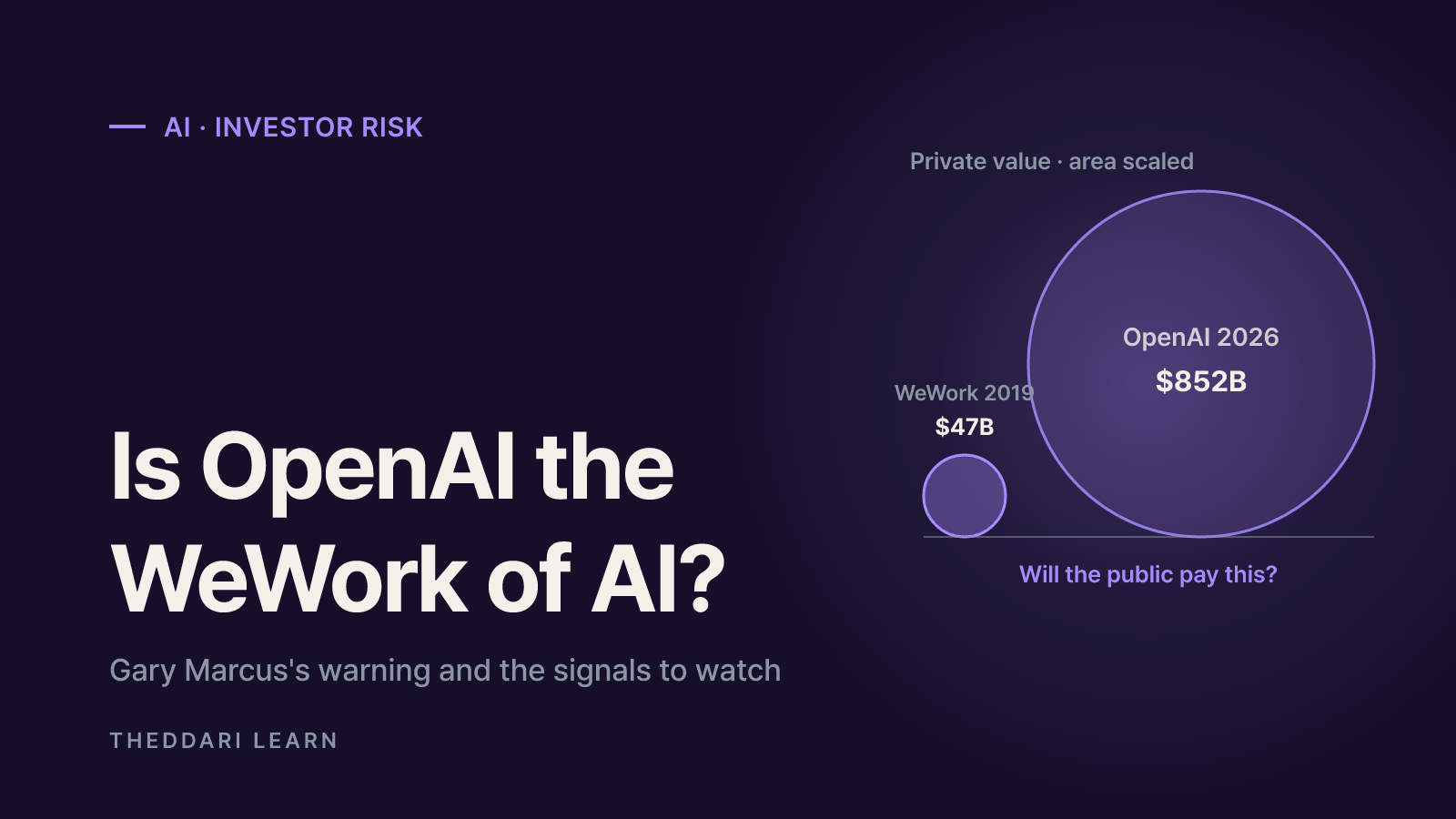
Calling OpenAI the WeWork of AI is not a prediction that ChatGPT disappears next quarter. It is a question about price: will public markets accept the valuation and the multi-year spending promises that private investors signed off on? NYU professor emeritus Gary Marcus revived the comparison on CNBC's Fast Money on November 6, 2026, saying he has long talked about OpenAI as possibly the WeWork of AI (Stocktwits summary).
This guide, current as of November 13, 2026, separates his argument from the public numbers and lays out what investors holding Nvidia, cloud or neocloud stocks can actually monitor. One caveat up front: OpenAI is private, so it has not published audited financial statements. Every figure below comes from company announcements or press reports, and that limits how far any comparison can go.
What Gary Marcus means by the WeWork of AI
According to coverage of the interview, Marcus made four points. WeWork never completed its planned IPO, and OpenAI keeps pushing its own listing back. The bigger worry is that OpenAI cannot hold its current valuation and is 'forced to sell at a discount to something like Microsoft.' If the industry's poster child takes a hit, Nvidia feels it. And neoclouds, the GPU-rental companies that depend on outside financing, are 'the most vulnerable' because that financing is getting more expensive.
He was careful to call Nvidia very well run with great chips. His doubt is about whether demand is infinite and whether the buyers of those chips can turn a profit. He also cited a Bank of England study of roughly 10,000 decision-makers that found limited productivity gains so far, and argued that sentiment could matter as much as fundamentals.
His three reasons OpenAI struggles to profit
In a February 27, 2026 newsletter post (Does OpenAI's new financing make sense?), Marcus summarized his case:
- The product is unreliable, which caps how much many customers will pay.
- It is expensive to operate because training and serving models burns large amounts of compute.
- There is no technical moat, so Google, Anthropic and Chinese labs caught up and triggered price wars.
In the same post he quoted investor George Noble describing the strategic-investor money as 'vendor financing dressed up as venture capital,' meaning suppliers invest in a customer whose spending then flows back to those same suppliers.
Keep opinion and fact apart. A discounted sale to Microsoft and operating losses near $2 billion a month are Marcus's scenarios and estimates. None of the sources reviewed for this guide show a sale agreement or insolvency proceeding as of November 13, 2026.
WeWork vs OpenAI: where the comparison holds and where it breaks
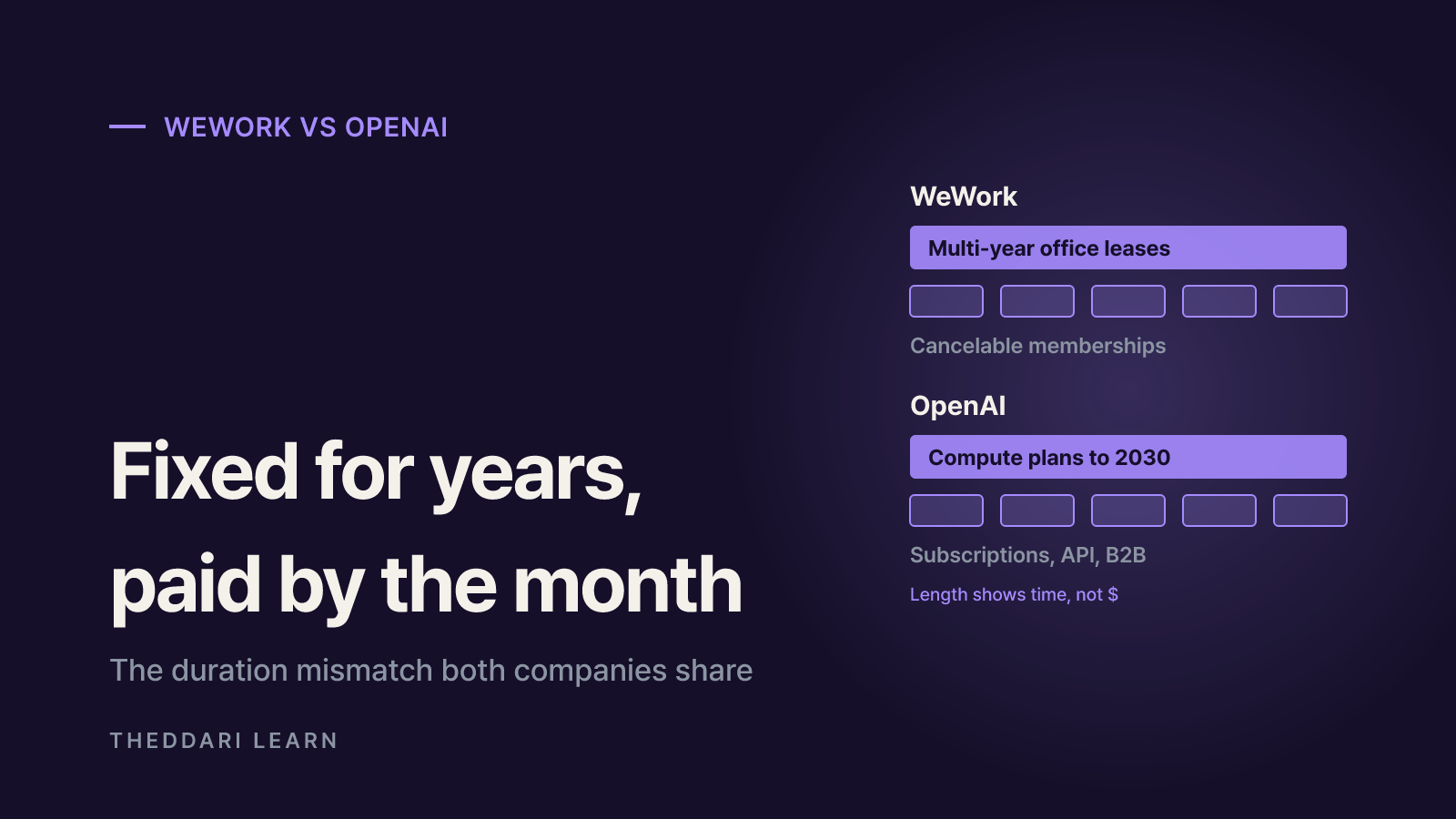
WeWork was valued at $47 billion in a 2019 round led by SoftBank, then failed to go public that year. It listed through a SPAC in 2021, lost about 98% of its value, and filed for Chapter 11 in New Jersey on November 6, 2023, reporting $18.65 billion of debt against $15.06 billion of assets. Securities filings showed close to $16 billion in long-term lease obligations (CNBC). The core flaw was a duration mismatch: rent locked in for years, revenue from memberships that customers could cancel quickly.
OpenAI announced on March 31, 2026 that it closed $122 billion in committed capital at an $852 billion post-money valuation. It reported $2 billion in monthly revenue, more than 900 million weekly active users and over 50 million subscribers. CNBC put 2025 revenue at $13.1 billion and noted the company is still burning cash. Earlier, CNBC reported that OpenAI told investors it now targets roughly $600 billion in total compute spending by 2030, down from the $1.4 trillion in infrastructure commitments Sam Altman had touted, alongside a 2030 revenue goal above $280 billion.
Peak private valuation
- WeWork (2019-2023)
- $47 billion (2019)
- OpenAI (as of Nov 2026)
- $852 billion post-money (March 2026)
Long-term fixed commitments
- WeWork (2019-2023)
- About $16 billion in lease obligations
- OpenAI (as of Nov 2026)
- About $600 billion compute target through 2030 (sourced report)
Revenue model
- WeWork (2019-2023)
- Short-term memberships
- OpenAI (as of Nov 2026)
- Consumer subscriptions, API and enterprise deals (enterprise over 40%)
Revenue scale
- WeWork (2019-2023)
- Growing with widening losses
- OpenAI (as of Nov 2026)
- $13.1 billion in 2025; $2 billion a month by March 2026
Key backers
- WeWork (2019-2023)
- SoftBank
- OpenAI (as of Nov 2026)
- SoftBank, Amazon, Nvidia, with Microsoft participating
Path to public markets
- WeWork (2019-2023)
- IPO pulled in 2019, SPAC in 2021
- OpenAI (as of Nov 2026)
- Confidential filing in June 2026; 2026 listing ruled out per reports
Outcome
- WeWork (2019-2023)
- Chapter 11 in November 2023
- OpenAI (as of Nov 2026)
- Ongoing
Where the analogy fits
- Spending is committed well ahead of revenue. Data center and chip contracts run for years, much like office leases.
- The price has only been set privately. A simple calculation puts $852 billion at about 65 times 2025 revenue of $13.1 billion, or about 35 times the $24 billion annualized from $2 billion a month.
- SoftBank is a common thread. It was WeWork's largest backer and co-led OpenAI's March 2026 round.
Where it breaks down
- Demand is visible. Over 900 million weekly users and enterprise revenue above 40% look nothing like empty coworking desks.
- Spending has already been revised. Moving from $1.4 trillion of talk to a roughly $600 billion target suggests some flexibility, though contract-level cancellation terms are not public.
- The investor base is broader, mixing Amazon, Nvidia, Microsoft and large asset managers, so a single backer pulling out matters less than it did for WeWork.
How OpenAI risk reaches listed stocks
You cannot buy OpenAI shares on an exchange, but many portfolios already carry the exposure. OpenAI's own announcement lists the partners:
- Chips: Nvidia GPUs run its training fleet and most inference. It also uses AMD, AWS Trainium, Cerebras and a custom chip built with Broadcom.
- Cloud: Microsoft, Oracle, AWS, CoreWeave and Google Cloud.
- Data centers: partnerships with Oracle, SBE and SoftBank.
- Shareholders: Amazon agreed to invest up to $50 billion, and Nvidia and SoftBank $30 billion each, per CNBC.
- Lenders: a bank syndicate including JPMorgan Chase, Citi and Goldman Sachs backs a roughly $4.7 billion revolving credit facility that was undrawn at close.
- Individuals: over $3 billion raised through bank channels, plus inclusion in several ARK Invest ETFs.
When a company is both investor and supplier, as Nvidia is, a funding squeeze at OpenAI can hit the equity stake and GPU orders at the same time. That is the chain Marcus pointed to. The same chain works in reverse: a successful IPO that raises fresh cash would support these suppliers.
Why neoclouds may crack first
Neoclouds such as CoreWeave borrow to buy GPUs and repay the debt from rental contracts. Their customer lists are concentrated in a few AI labs, and higher rates raise their interest bills quickly. Bond yields and new financing terms often flash stress before share prices do, which is why Marcus singled them out.

Six signals AI investors should track
- 1
Customer concentration in filings
Read 10-K and 10-Q disclosures from Nvidia, Oracle and CoreWeave for top-customer revenue shares and remaining performance obligations. Heavy reliance on one AI lab ties your stock to that lab's funding.
- 2
Committed vs deployed capital
The $122 billion figure is committed capital. Track when tranches arrive, under what conditions, and how fast spending actually happens.
- 3
The next private-round price
Whether the next round prices above or below $852 billion is the clearest signal before any IPO. Reported asking prices and closed deals often differ.
- 4
IPO filing disclosures
Once a registration statement is public, check operating losses, cash burn, minimum payments on compute contracts and termination clauses. WeWork's 2019 IPO was pulled within weeks of its filing going public.
- 5
Neocloud borrowing costs
New bond yields, loan terms and how often these companies issue stock show pressure in AI infrastructure financing early.
- 6
Big Tech capex guidance
Watch Microsoft, Amazon and Oracle earnings calls for changes in capital spending plans and AI revenue commentary. An earnings calendar helps you catch the dates.
Narratives move fast when a clip like Marcus's goes viral. Comparing how a theme spreads across channels on the Telegram AI trends page, then checking it against primary filings, is a better filter than reacting to one interview.
Counterarguments and limits of the comparison
- OpenAI beat its own targets in 2025, according to CNBC's sources: $13.1 billion of revenue against a $10 billion goal, and $8 billion of cash burn against a $9 billion budget.
- A benchmark is coming. Reports say Anthropic is preparing to list before OpenAI. A strong debut would weaken the WeWork thesis; a weak one would strengthen it.
- Marcus is a long-standing generative AI skeptic who has used this analogy since late 2023. Checking the numbers he cites is more useful than keeping score on the forecast.
- Data limits apply to everyone. Without audited statements, compute targets and loss estimates rely on sources or personal estimates.
The practical takeaway: treat 'WeWork of AI' as a checklist, not a verdict. Ask whether commitments run far ahead of revenue, whether the price has only been set privately, and whether a few backers carry the load. As of November 2026, OpenAI matches WeWork on the first two and differs sharply on revenue scale and investor breadth. The decisive evidence will arrive with an IPO filing. Until then, the filings and borrowing costs of the listed companies that do business with OpenAI are the most reliable signals available.