Contents9 sections
- What the United Airlines AI agent ban says
- What is blocked and what still works
- Why United says it is blocking AI agents
- The agentic commerce split: who blocks and who opens up
- How to use AI for travel booking without getting burned
- If you already used an agent, or book from outside the U.S.
- Bottom line: let AI research, keep the buy button
- Frequently asked questions
- Sources and references
Short answer: the United Airlines AI agent ban does not stop you from using AI to plan a trip. It stops unauthorized personal AI agents from logging in, booking, ticketing or managing reservations on your behalf. In a newsroom statement dated Nov. 11, 2026, United said it is restricting access directly within its digital platforms and indirectly via travel agencies and aggregators. This guide reflects what was public as of Nov. 12, 2026 and covers a U.S. carrier's policy and U.S. federal rules.
The timing matters. Consumer AI agents such as Meta's Muse and OpenAI's dots are being pitched as assistants that can research, compare and buy for you. Booking a flight is one of the most obvious use cases, and also one of the riskiest, because it needs your identity details, payment method and often your loyalty-program login.
What the United Airlines AI agent ban says
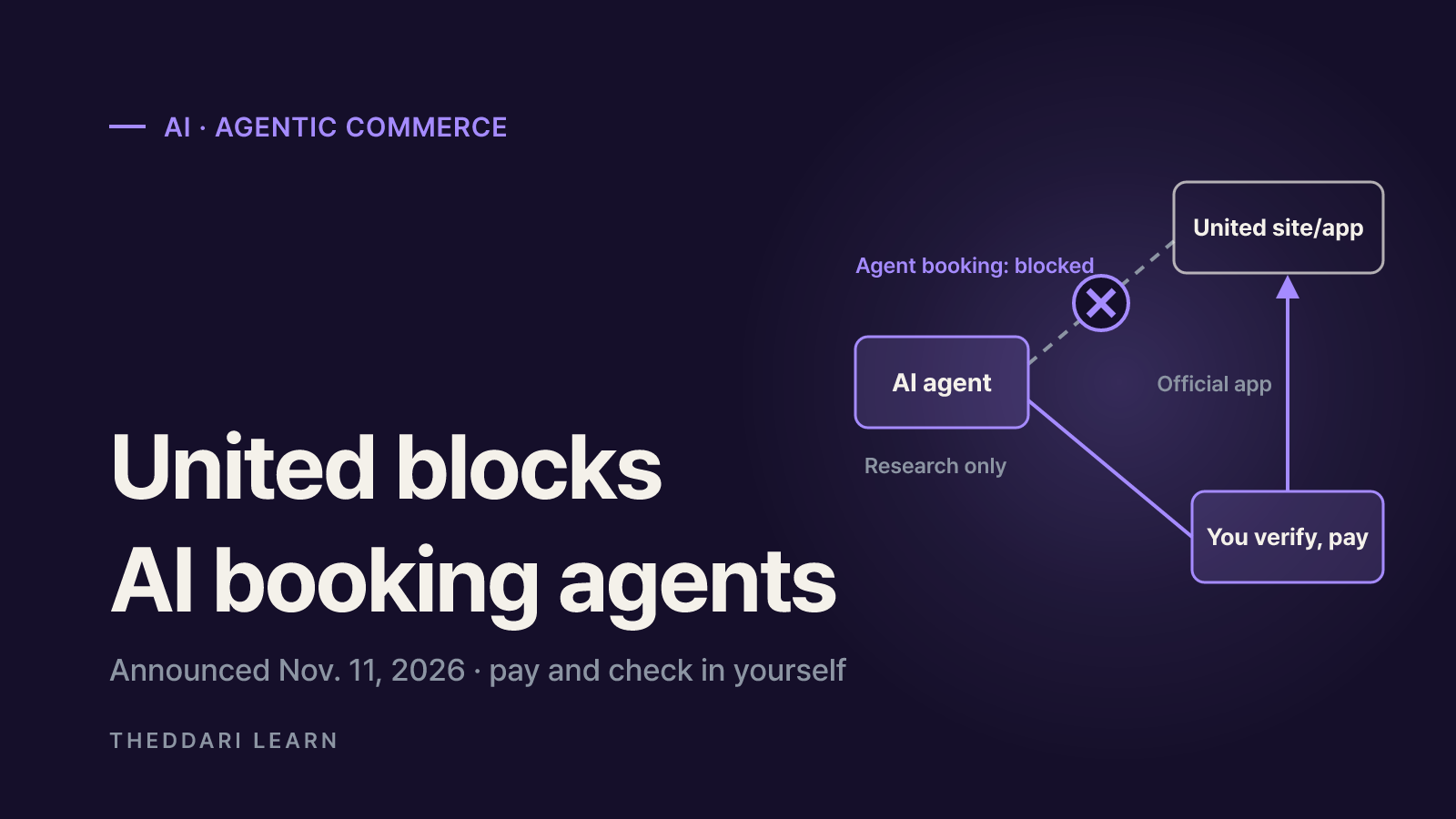
United's statement is titled "United Restricts Access for Third-Party AI Agents." The operative line: United is "taking steps to restrict access - directly within our digital platforms and indirectly via travel agencies and aggregators - to prohibit use by unauthorized, third-party personal AI agents or assistants." The airline said this includes updates to its booking, ticketing and distribution policies.
- Who is targeted: unauthorized third-party personal AI agents and assistants
- Where: united.com, the United app and other United digital platforms, plus indirect access through travel agencies and aggregators
- How: policy updates and access restrictions, not a change to fares
- Follow-up: an updated Digital Trust Center explaining what the restrictions mean, how to protect accounts, and where to get help if an agent takes an unintended action
- Door left open: United said it will keep evaluating how personal AI assistants interact with its services
According to The Verge, citing The Wall Street Journal, United says it has not yet seen many people try to book with AI agents. In other words, this is a pre-emptive rule rather than a reaction to a wave of agent bookings.
What is blocked and what still works
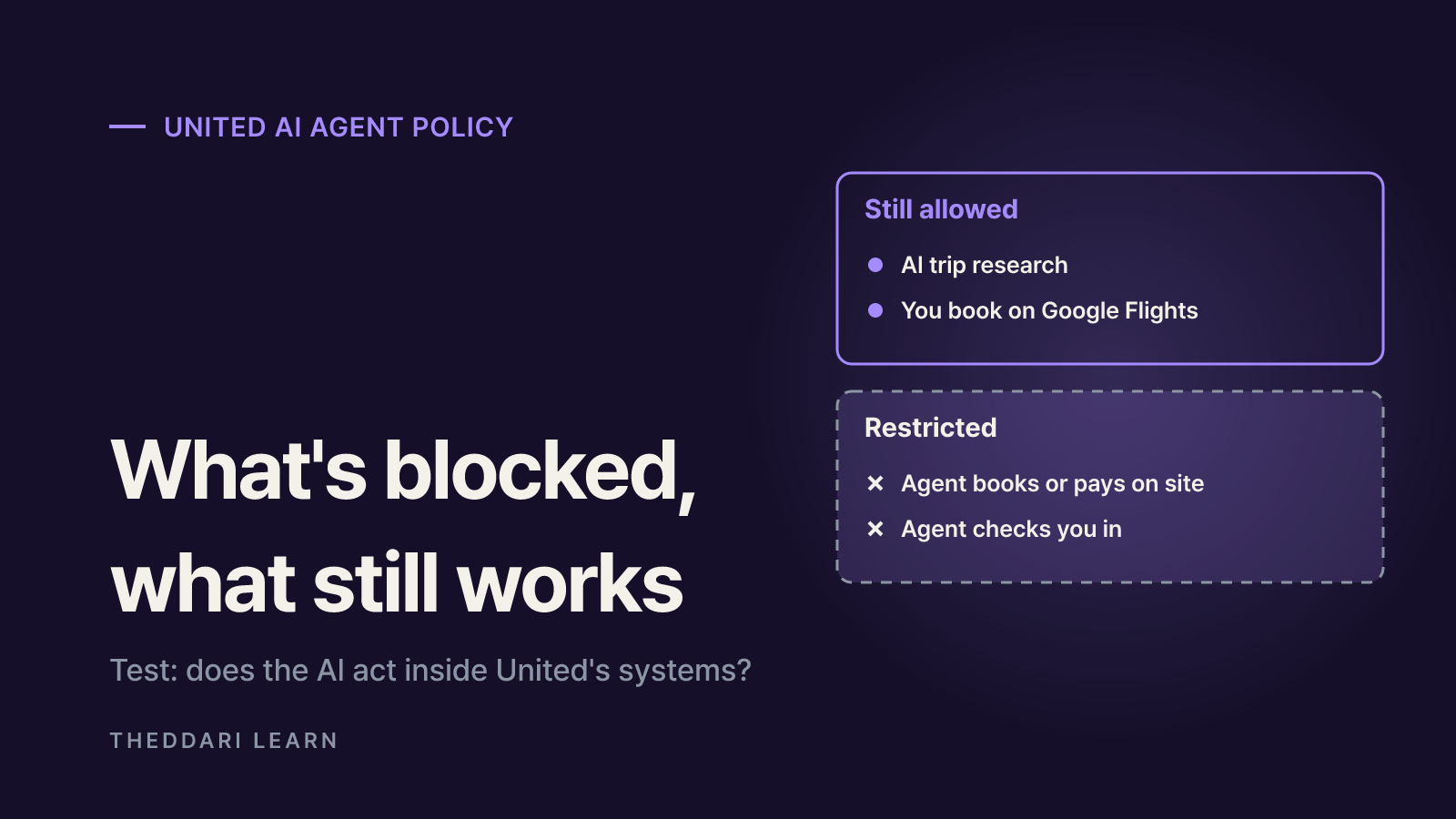
The dividing line is whether the AI is giving you information or acting inside United's systems. Here is how the public details sort out as of Nov. 12, 2026.
Asking an AI for destination ideas, routes or timing
- Status under United's policy
- Not affected (no access to United systems)
- Basis
- Policy targets platform access and transactions
An AI showing you United flight options
- Status under United's policy
- Reported as still possible
- Basis
- The Verge: only completing the transaction is blocked
Unauthorized agent booking or paying on united.com or the app
- Status under United's policy
- Restricted
- Basis
- United statement
Agent booking United via an agency or aggregator
- Status under United's policy
- Restricted (indirect channel)
- Basis
- United statement
You searching Kayak or Google Flights yourself
- Status under United's policy
- Expected to keep working
- Basis
- CBS News, analyst Henry Harteveldt
Agent checking you in and clicking the hazmat acknowledgment
- Status under United's policy
- Restricted over regulatory concerns
- Basis
- United statement and 49 CFR 175.25
Watch the word "unauthorized." United is not banning AI as such; it is blocking agents it has not approved. If United later signs official integrations, those channels could be allowed, so check current notices before you book.
Why United says it is blocking AI agents
Account security and unintended purchases
United says sharing account credentials with personal AI assistants "can expose sensitive information," and that actions taken by these tools "may result in unintended purchases, account changes, or use of MileagePlus miles." Airfare rules vary by fare class, and redeemed miles can be hard to reverse, so a small agent mistake can turn into real money.
A human must acknowledge hazmat warnings
The second reason is regulatory. United says automated AI actions could violate FAA and DOT rules, noting that check-in "requires human acknowledgment that bags do not contain banned substances like explosives." The relevant federal rule, 49 CFR 175.25, requires airlines to present forbidden hazardous-materials information at ticket purchase and at boarding-pass issuance. Where a passenger completes either step without another person involved, the passenger must acknowledge seeing it. An AI tapping that button blurs who actually acknowledged anything.
Not wanting another middleman
There is a business angle too. The Verge reports that CEO Scott Kirby said, "I don't want to create another middleman." Speaking to CBS News, analyst Henry Harteveldt said United already deals with Google search, metasearch sites and online travel agencies, and that flight searches cost airlines money, so United likely wants to avoid the expense of a surge in AI bot searches.
The agentic commerce split: who blocks and who opens up
Companies are taking opposite paths on agentic commerce. United's statement points to banking and retail leaders taking similar steps, and The Verge notes that eBay appeared to block agents while several major banks restricted them. By contrast, CBS News reports that Southwest made its flight inventory viewable to ChatGPT users inside the app. The practical takeaway: whether your agent can act on a site will increasingly depend on that site's explicit permission.
Policies around AI agents are shifting week to week. Following the AI channel on Theddari's Telegram trend tracker is one way to see these platform decisions in context as they break.

How to use AI for travel booking without getting burned
Whether or not you fly United, letting an agent book travel means delegating spending power. Run through this list first.
- 1
Confirm the seller allows it
Check whether the airline or agency has an official integration with your AI tool and whether its terms forbid bots or automated access. On a site that blocks unapproved agents, a booking can fail midway or trigger account restrictions.
- 2
Keep secrets out of the chat
Do not paste loyalty-program passwords, MileagePlus numbers, confirmation codes or passport details into a general-purpose AI. Review whether the AI service stores or trains on your conversations.
- 3
Narrow payment authority
If an agent must pay, require a human approval step before checkout and use a card with a low limit or a virtual card to cap the damage.
- 4
Do the final click yourself
Let the AI shortlist options, then read the fare rules, pay and check in on the official app or website. That keeps the hazmat acknowledgment with you.
- 5
Verify after booking
Open the airline's app to confirm the ticket was issued and that names, dates, seats and miles are correct. If anything looks off, change your password and contact the airline and your card issuer.
Who pays for an agent's mistake depends on the airline's terms, the AI provider's terms and your card's dispute rules. If you booked in a way the airline prohibits, its customer service may be less able to help.
If you already used an agent, or book from outside the U.S.
The announcement does not mention canceling existing bookings, so the safest move is to verify any recent agent-made reservation in the United app. The rule is framed by channel, not by country: it covers United's digital platforms and agencies or aggregators, and it cites U.S. FAA and DOT regulations. Travelers booking United from abroad should assume the same restrictions apply on those channels. Investors following airline stocks can track upcoming reports on Theddari's earnings calendar, though no figures yet show how this policy affects results.
Bottom line: let AI research, keep the buy button
United's move shows that in the agent era, the key question is who presses the button. For now, the practical approach is to use AI for inspiration and comparison, and to handle logins, payments and check-in yourself on official channels. Policies may change as United and others build approved integrations, so recheck the airline's notices right before you book.