Contents8 sections
To find a lost bitcoin wallet, start by working out where the coins were left. If you bought bitcoin on an exchange and never withdrew it, there is no wallet to restore: you need to recover the exchange account. If you moved it to an app, a hardware device or desktop software, you need the seed phrase or the wallet file. This guide was checked against the Bitcoin Core documentation, bitcoin.org and the FBI's Internet Crime Complaint Center (IC3) as of November 2026. It covers the search order, the default folders where Bitcoin Core keeps wallet.dat, and how to recognise crypto recovery scams that target people in exactly this situation.
Keep one principle in mind throughout. Bitcoin has no password-reset desk. With self-custody, only you hold the keys, and bitcoin.org warns that password recovery options are very limited. Not damaging the original files, and not handing your keys to anyone, matters as much as finding them.
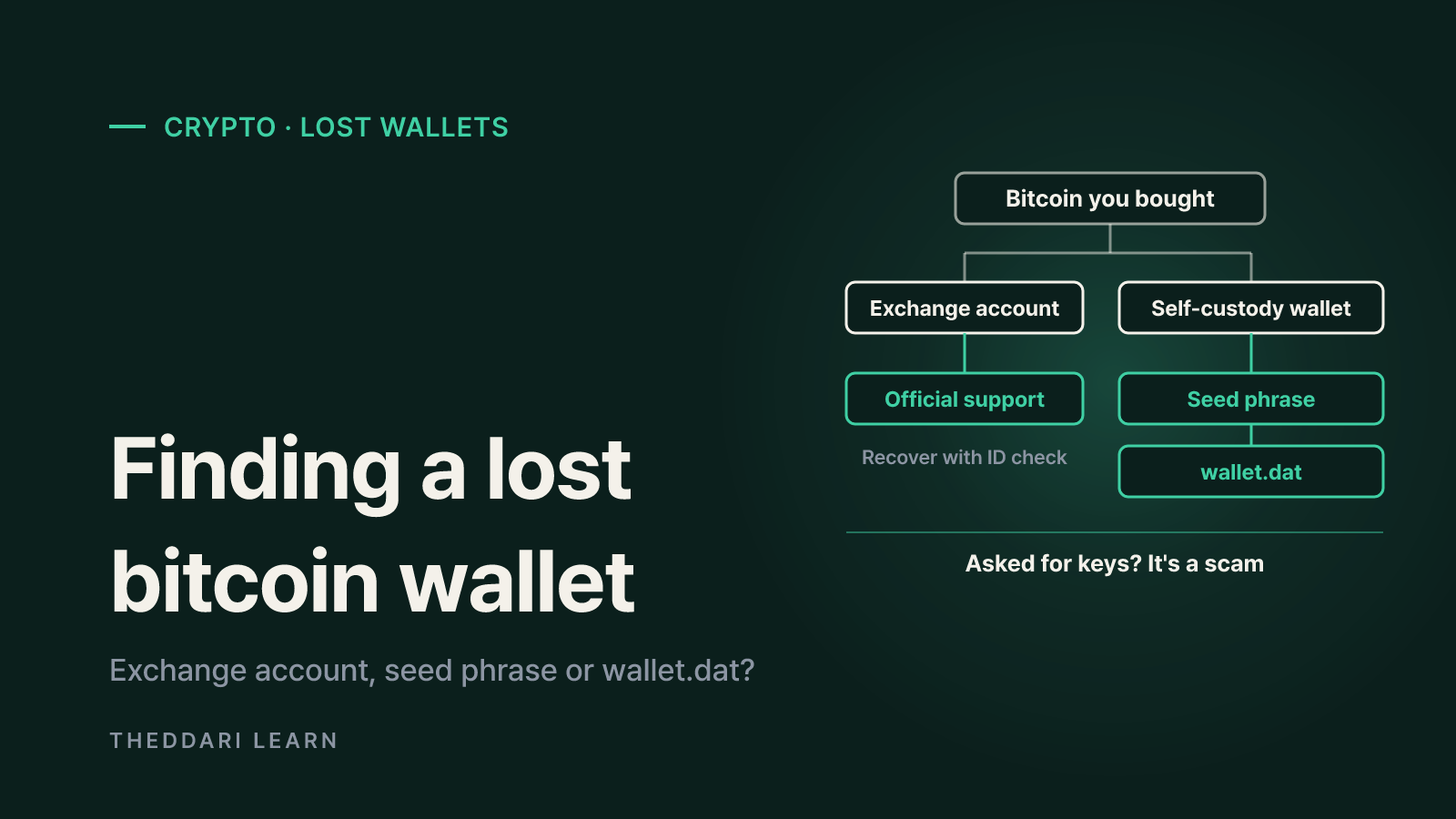
First: exchange account or self-custody wallet?
Think back to how you bought. If you used an exchange app with a bank card or transfer and never sent the coins anywhere, they most likely sit in your exchange balance. You never had a seed phrase; what you need is your login email and the exchange's identity verification. If you remember writing down 12 or 24 words, setting up a hardware device, or running a program such as Bitcoin Core on your computer, you were using a self-custody wallet.
Exchange account
- Who holds the keys
- The exchange
- What gets you back in
- Login email, phone, ID check
- First move
- Search email and bank records for the exchange name
Mobile or desktop wallet app
- Who holds the keys
- You
- What gets you back in
- Recovery (seed) phrase
- First move
- Check notebooks, safes, old phones
Old Bitcoin Core wallet
- Who holds the keys
- You
- What gets you back in
- wallet.dat file plus its password
- First move
- Search old computers and drives for the data folder
Hardware wallet
- Who holds the keys
- You
- What gets you back in
- Seed phrase written at setup
- First move
- Find the device and its recovery card together
Both can apply. If you bought on an exchange and later withdrew part of it, the exchange's withdrawal history shows the receiving address. That address is one of the best clues for locating the wallet you sent it to, so write it down.
How to find a lost bitcoin wallet, step by step
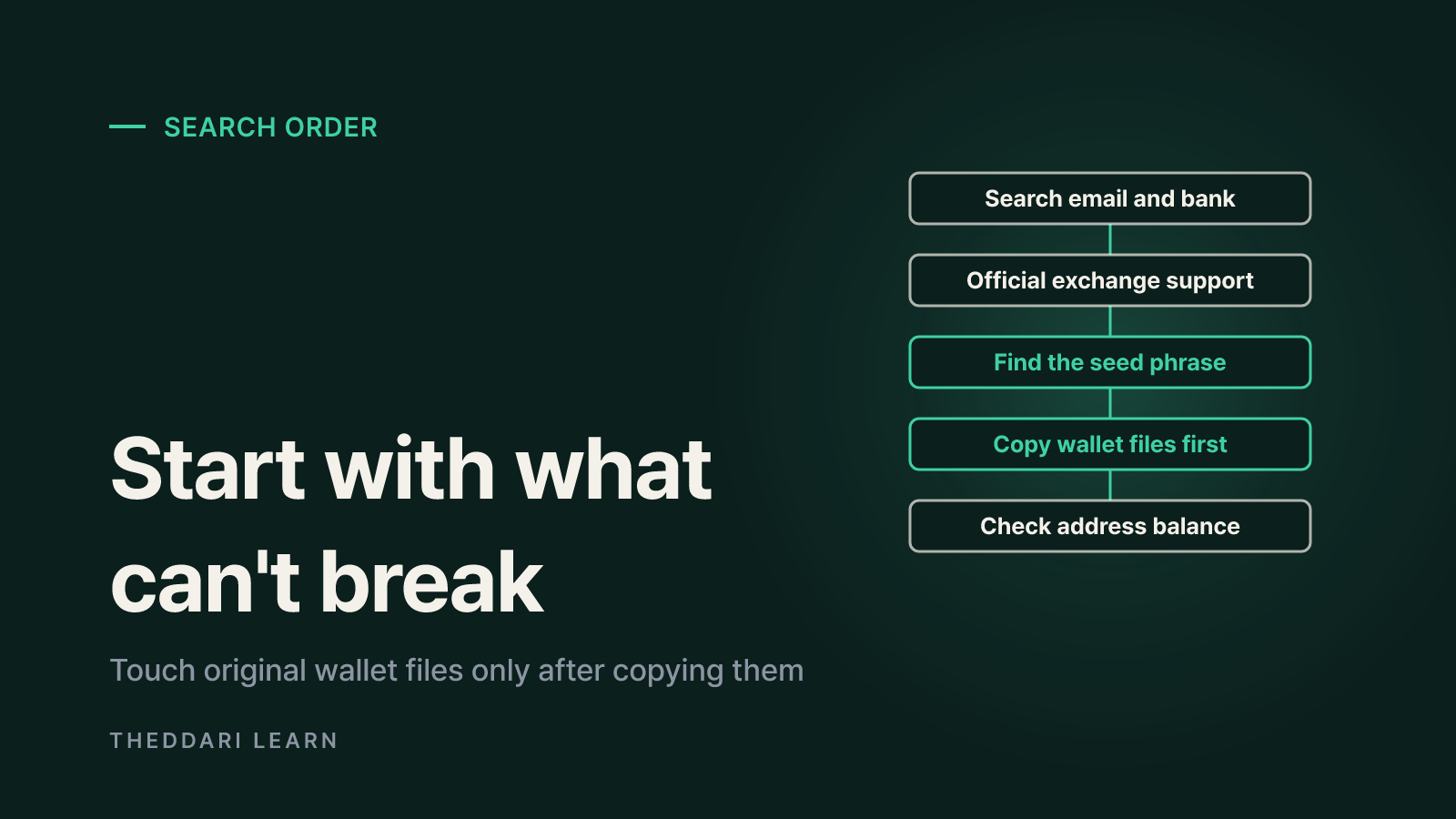
Begin with records that cannot be damaged, and only touch wallet files once you have copies.
- 1
Collect clues from email and bank records
Search your inbox for exchange names and phrases like 'welcome', 'deposit confirmed', 'withdrawal request' and 'verify your identity'. Old bank or card statements narrow down which service you paid. Note any bitcoin address that appears in a withdrawal notice.
- 2
Recover exchange accounts through official support
Type the exchange's address yourself instead of following ads or links in texts. Use the normal account recovery flow, and contact support if your phone number or email has changed. Be prepared to complete identity verification again.
- 3
Look for the seed phrase
Check notebooks, safes, drawers, photo galleries, password managers and notes apps on old phones. If an old phone with the wallet app still turns on, see whether the app's backup menu will show the recovery phrase again.
- 4
Search old computers and drives for wallet files
If you used desktop software, look on old laptops, external drives and USB sticks for wallet.dat or similar wallet files. Copy any file you find to offline media several times before doing anything else with it.
- 5
Check the balance before restoring
Enter any address you recovered into a public block explorer. If the coins are still there, you have a restore problem, not a loss. If they moved, compare the date with your own withdrawal records.
When you find a seed phrase, enter it only into a wallet app downloaded from the developer's official site or an official app store. The same words can show a zero balance if the new app uses a different address type or you originally added an extra passphrase, so try to restore with the same wallet and settings you used back then. Typing the words into a website or chat is the same as giving the coins away.
Where Bitcoin Core keeps wallet.dat
Bitcoin Core stores wallets inside its data directory. According to the Bitcoin Core file documentation, a named wallet lives in wallets/<wallet_name>/, the default wallet in wallets/, and if that subfolder does not exist, in the data directory itself. That last case is typical of very old installs, where wallet.dat sits loose at the top level.
Windows (current)
- Default data directory
- %LOCALAPPDATA%\Bitcoin\
- Note
- AppData is hidden by default
Windows (older installs)
- Default data directory
- %APPDATA%\Bitcoin\ (Roaming)
- Note
- Still used if it already exists
macOS
- Default data directory
- ~/Library/Application Support/Bitcoin/
- Note
- Library is hidden in Finder
Linux
- Default data directory
- ~/.bitcoin/
- Note
- Hidden dot-folder
Windows has two possible paths because of a change described in the Bitcoin Core 28.0 release notes, published in October 2024. The default moved from AppData\Roaming\Bitcoin to AppData\Local\Bitcoin, but Bitcoin Core keeps using the old folder if it exists. On an old PC, check Roaming first. The software may also have been pointed at another drive with the -datadir option, so a full-disk search for the file name is worthwhile.
The documentation says copies of a wallet should be made with the backupwallet call rather than by copying a file that is in use. On an old machine, copy the file while Bitcoin Core is not running and avoid writing anything new to the original disk. wallet.dat holds spendable keys, so do not upload it to cloud storage or send it through a messaging app.
Other desktop wallets were common in earlier years too. If you remember the program, use its official documentation for file locations. Bitcoin.org explains that most modern wallets are deterministic, so one recovery phrase restores past and future addresses, while some wallets needed fresh backups as new addresses were generated. An old backup may therefore lack keys for coins received after it was made.
Check the balance with just an address
Bitcoin addresses and transactions are public, so a block explorer can show a balance without any keys. This is read-only and cannot move funds. Addresses turn up in exchange withdrawal history, screenshots of a wallet's receive screen, old emails and paper notes.
- Enter only an address or a transaction ID. Close any balance checker that asks for a seed phrase, private key or wallet file.
- If the balance is intact, there is no rush. Make copies and work slowly.
- If the coins moved, check whether the date matches a withdrawal you made yourself.
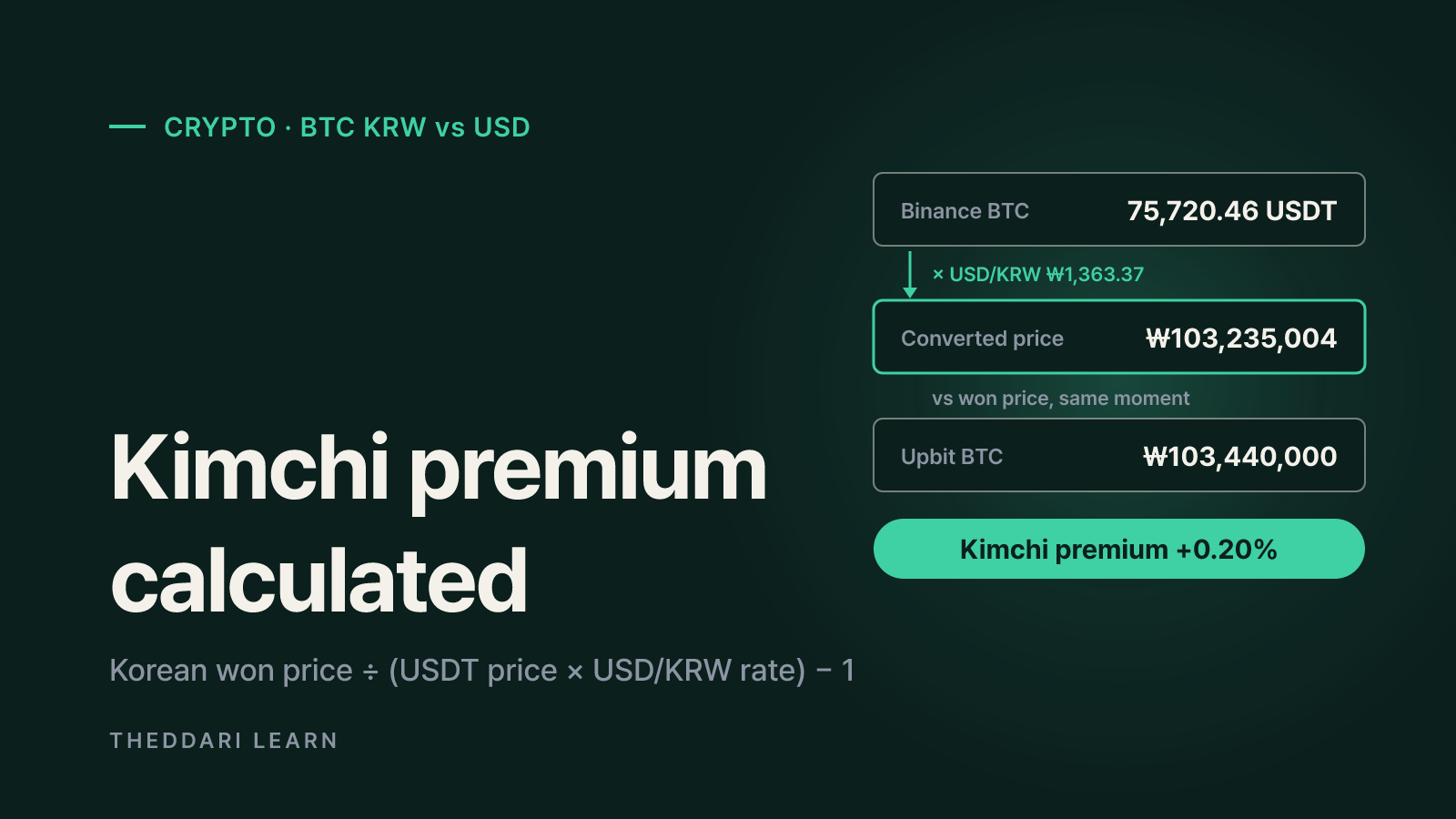
- If you plan to sell through a Korean exchange, compare domestic and overseas prices first, because they can differ.
For readers using Korean exchanges, the theddari kimchi premium page shows the gap between Korean and overseas bitcoin prices. It is a price comparison reference, not a signal for when to sell.

Crypto recovery scams: requests that mean stop
People searching for lost coins are prime targets. Bitcoin.org describes fake support staff who appear after someone posts a question publicly and ask for the seed phrase, private key or remote access, plus services that promise to recover lost funds for an upfront fee. No legitimate support representative asks for your seed phrase or private key.
The FBI IC3 alert from August 2023 says fraudulent recovery firms reach victims through social media and messaging apps, comment sections under crypto news and videos, and search results. They take an upfront fee, then go silent or send an incomplete tracing report and ask for more, sometimes claiming ties to law enforcement or law firms. Private recovery companies cannot issue seizure orders, and law enforcement does not charge victims to investigate. Regulators elsewhere report the same pattern: Korea's Financial Supervisory Service listed lines such as 'we will compensate your investment losses' and 'your compensation will be paid in coins' among the most common scam scripts in its August 2025 alert.
| Red flag | Why it matters |
|---|---|
| Asks for your seed phrase, private key or wallet.dat | Whoever has them can move your coins |
| Contacts you first and promises recovery | Legitimate firms do not cold-call with offers |
| Wants a deposit, fee, tax or bond upfront | Small first requests tend to grow |
| Asks you to install remote-access software | Exposes wallet files and logins on your device |
| Will only talk on Telegram or WhatsApp | Hard to verify and easy to vanish |
Verify any contact by looking up the organisation's official number yourself. If you have already sent money or information, keep chat logs, payment details and wallet addresses, and report the incident to ic3.gov in the United States or to the police and financial regulator where you live.
New scam scripts often spread through Telegram channels first. Theddari's crypto Telegram trends page shows what those channels are discussing, which gives context when an unfamiliar offer reaches you. Treat channel posts as unverified until you confirm them elsewhere.
After you find it
Once access is restored, make sure it does not happen again. Bitcoin.org recommends keeping backups in several secure places, encrypting any backup stored online, and planning how family could access funds if you could not. Keys that lived on an old computer for years may have been exposed to malware, so consider moving the coins to a newly created wallet, checking the full receiving address character by character.
- Did you decide whether it is an exchange account or a self-custody wallet?
- Did you collect exchange names and addresses from email, bank and withdrawal records?
- Are you working from offline copies of seed phrases and wallet files?
- Did you confirm the balance read-only on a block explorer?
- Have you cut contact with anyone asking for keys, files or upfront fees?
Finding old bitcoin is mostly patient detective work: records first, then the seed phrase, then wallet files, without ever giving your keys to someone else. If every trace is truly gone, accepting that is also how you avoid losing more money to people who promise otherwise.