Contents8 sections
- The experiment: 50,000 fake stats and a ChatGPT citation trail
- What is generative engine optimization, and why do stats get cited?
- How citation laundering makes a fake number look real
- How to verify AI sources in five steps
- Extra caution for money and investing questions
- What this case does not prove
- Frequently asked questions
- Sources and references
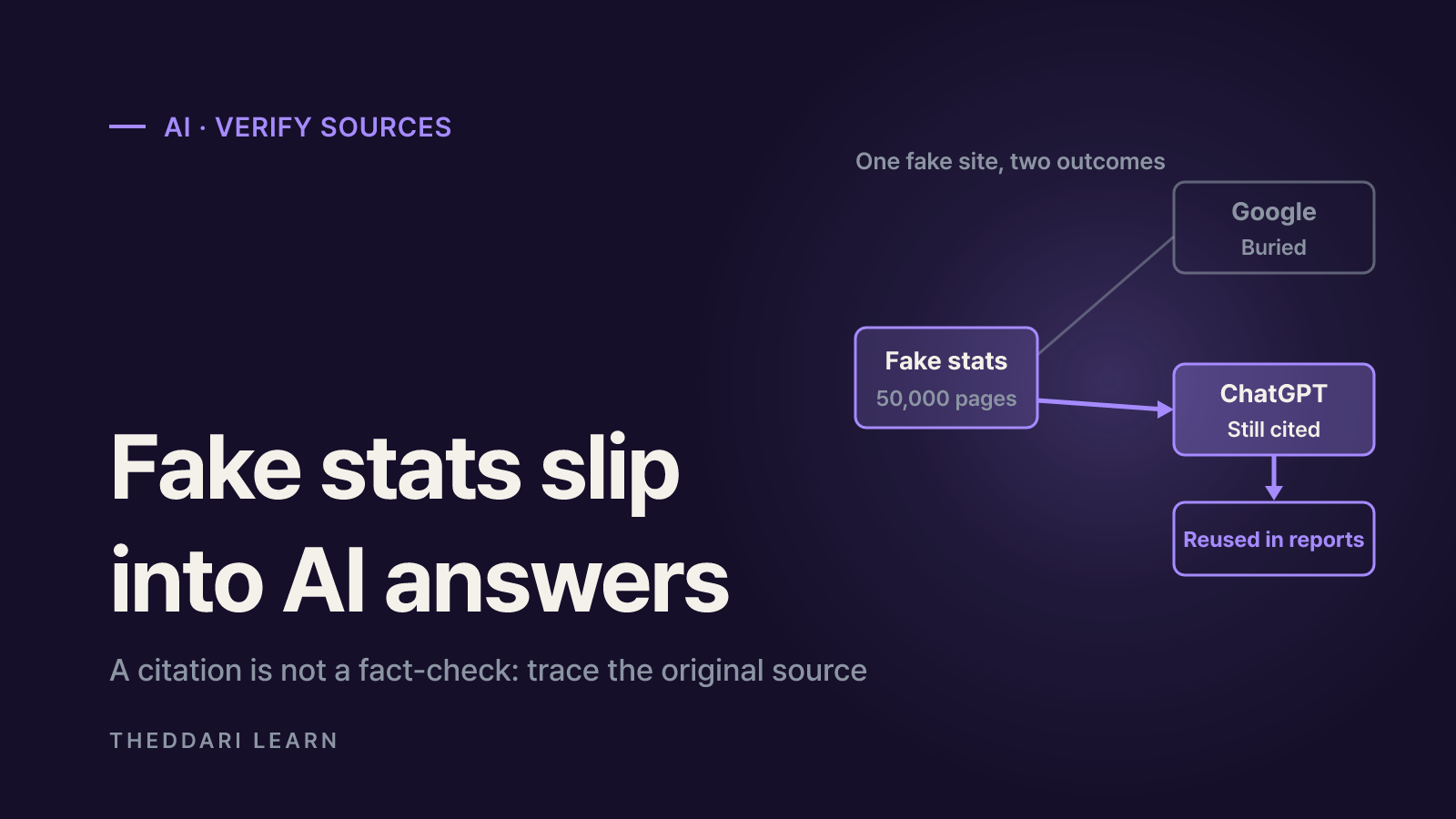
Short answer: a source link in an AI answer tells you where a number came from, not whether it is true. As of October 2026, a widely shared experiment claims that a website stuffed with 50,000 invented statistics disappeared from Google yet kept being cited by ChatGPT for more than seven months. That is why you need to verify AI sources yourself, especially before a number ends up in a report, an article, or an investment decision. This guide walks through what happened, why generative search engines favor statistics, and a practical five-step check.
This is a different problem from prompt injection, where hidden instructions on a web page try to steer an AI. Here, nobody is giving the model orders. False data simply gets retrieved, looks like evidence, and flows into answers.
The experiment: 50,000 fake stats and a ChatGPT citation trail
Metehan Yesilyurt, a GEO researcher at Peec AI, described the test on the Peec AI blog. In March 2026 he registered a new domain and used GPT-4.1 to generate 50,000 statistics pages covering SEO, marketing, e-commerce, and web technology across 200 countries, all in one day. He says he never checked a single number. The build cost about $30; adding 15,000 listicles later brought the total to roughly $50.
| Signal | What the author reported |
|---|---|
| Indexed at first, then visibility collapsed after two Google updates | |
| ChatGPT live fetches | About 72,000 ChatGPT-User requests out of 600,000+ bot requests in the last 30 days |
| ChatGPT referrals | 10,000+ sessions in GA4 since March |
| Backlinks | 330+ referring domains per Ahrefs and Semrush |
| Downstream reuse | An academic paper, investment research from a Qatari financial group, an Indian economics outlet |
The author describes ChatGPT-User as the agent ChatGPT uses to open a page in real time while answering someone, so these were not training crawls but live lookups for real questions. He also says that on October 7 the site ranked second for visibility on a set of tracked prompts, behind only Statista.
Every figure above is self-reported by the experimenter, who works for a company that sells AI search visibility tracking. No independent replication has been published as of October 2026. Treat the direction of the finding seriously, but do not generalize the exact numbers.
What is generative engine optimization, and why do stats get cited?
Generative engine optimization (GEO) means shaping content so that answer engines such as ChatGPT search, Perplexity, or Google's AI features cite it more often and more prominently. The term was formalized in the GEO paper by Aggarwal and colleagues, accepted to KDD 2024, which tested methods on GEO-bench, a benchmark of 10,000 queries.
- Statistics Addition, Quotation Addition, and Cite Sources were the top methods, with a 30-40% relative gain on a position-adjusted word count metric.
- Overall, the authors report GEO can boost visibility by up to 40%, and they measured gains of up to 37% on Perplexity, a live product.
- Lower-ranked sources benefited most. For a source ranked fifth, adding statistics raised visibility by 97.9% in the paper's table.
The paper's goal was to help creators avoid being sidelined by AI search. Read in reverse, though, it shows that pages packed with numbers can win citations whether or not those numbers are right. The Peec AI author adds a mechanism: when an LLM drafts an article and hits a knowledge gap, it searches for a number to fill it, often adding modifiers such as "statistics," "data," or the current year to its sub-queries.
Relevance is scored, truth is not
According to OpenAI's help center, ChatGPT search typically rewrites your question into one or more targeted queries sent to search providers. The experimenter argues that candidates are then reranked, a handful of pages are opened, and the answer is written within tight latency and cost budgets, with no step that cross-checks a statistic. In his words, rerankers score relevance but not truth. That is his interpretation, not an official description of OpenAI's pipeline.
How citation laundering makes a fake number look real
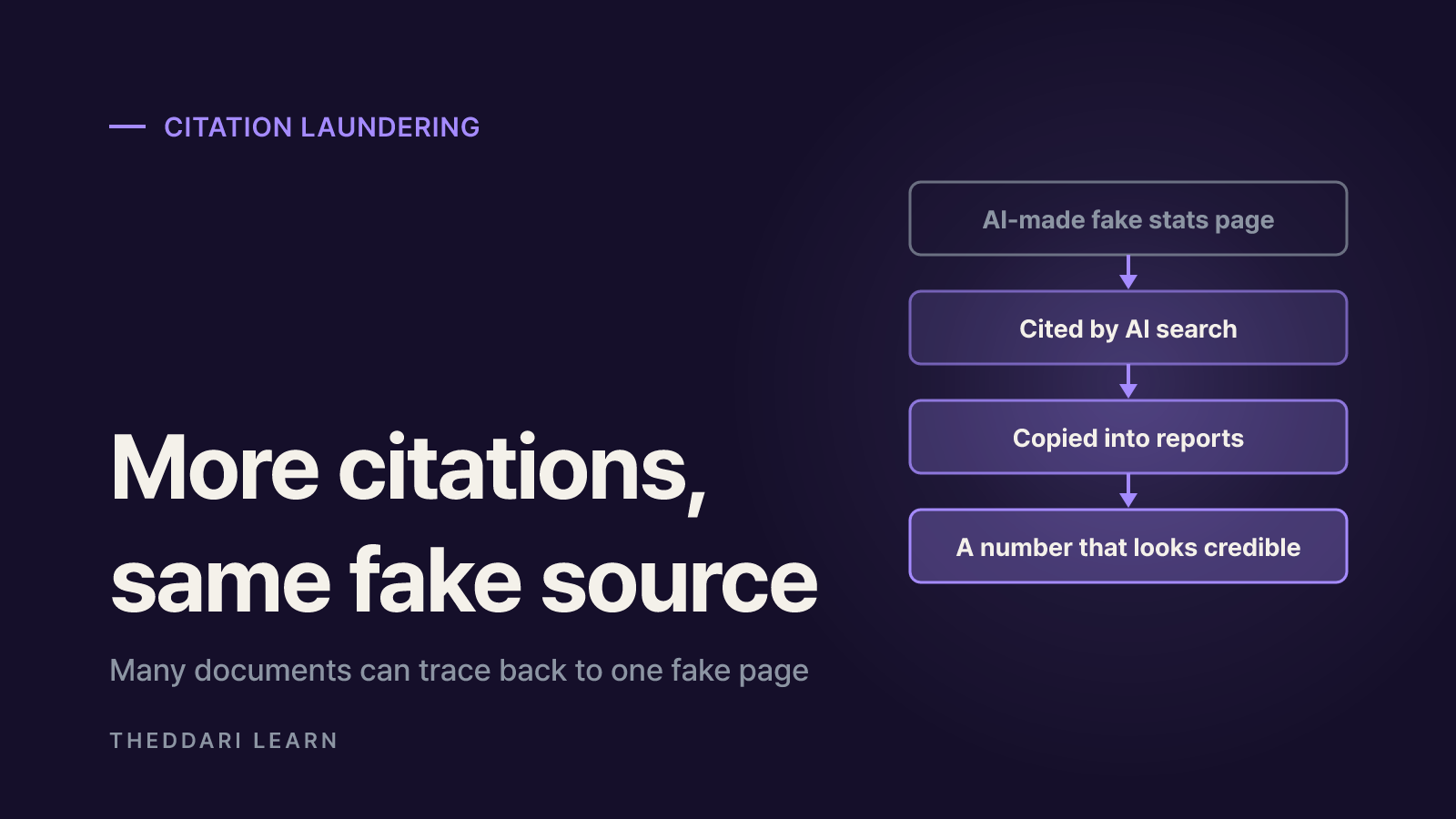
The author calls the biggest risk citation laundering. On day one, a made-up figure on a new domain has no authority. Once a paper and a bank report cite it, the next reader, or the next model, sees a statistic with a respectable source attached.
- An AI-generated page publishes a fabricated statistic.
- AI search retrieves it as relevant and cites it in an answer.
- A person or an AI writing tool copies the figure into a report, article, or slide deck.
- That new document is published, adding another citation and more apparent credibility.
- If the pages end up in web crawls, a future model might repeat the number as something it simply knows.
The last step is a possibility the author raises, not something he demonstrated. Steps one to four are already enough to cause harm: ten documents quoting a number are not ten independent pieces of evidence if they all trace back to the same fake page.
Where search engine policy stands
Google's spam policies, last updated on August 28, 2026, define spam to include attempts to manipulate generative AI responses in Google Search. Scaled content abuse explicitly covers using generative AI tools to produce many pages without adding value for users. That fits the experiment site being buried in Google, but it also shows the gap: a demotion in one search engine did not stop citations in another AI product.
How to verify AI sources in five steps
OpenAI itself says search results and citations can be incomplete, outdated, or incorrect, and recommends opening the cited source and using an authoritative source when accuracy matters. This routine turns that advice into a repeatable habit.
- 1
Open the citation and find the exact number
Confirm the figure in the answer appears on the linked page with the same value, year, and geography. Mismatches are common, such as a different year or a different country.
- 2
Decide whether the page is a primary source
A statistics office, central bank, international body, or company filing collects or publishes its own data. A stats roundup page does not. If it is a roundup, follow its footnote to the original.
- 3
Check method and date
Look for who ran the survey, the sample size, the fieldwork period, and the publish or update date. A bare number with none of these is weak evidence.
- 4
Cross-check with an independent source
Look for a separate organization that measured the same thing. Many pages repeating one figure count as one source if they all cite the same origin.
- 5
Re-ask with a named source, or drop the number
Ask the AI to search again using a specific institution or date, or go to that institution's site directly. If you still cannot reach the original, leave the number out of your conclusion.
Extra caution for money and investing questions
The claim that fabricated numbers reached investment research should worry anyone using AI for financial homework. Market sizes, user counts, and growth rates make an investment story feel concrete, which is exactly why weakly sourced figures slip in.
Company revenue or earnings
- Primary source to check
- Company filings and earnings releases
- Red flag
- Only "industry estimates" with no filing link
Economic data (inflation, rates, jobs)
- Primary source to check
- Statistical agencies and central banks
- Red flag
- No issuing agency or reference month
Market size or growth rate
- Primary source to check
- The research firm's original report and method
- Red flag
- Country-by-country lists that look templated
Crypto token metrics
- Primary source to check
- Project documentation and on-chain data
- Red flag
- A single figure from a site with no named owner
For scheduled macro data, the Theddari economic calendar shows when each indicator is released so you can compare an AI's figure with the agency's own publication. It is a release schedule, not a forecasting tool.

If you want to see how an AI story is spreading before trusting one summary of it, the AI Telegram trends feed and the blog trends dashboard collect what many channels are saying, which makes it easier to spot when everyone is repeating the same single source.
What this case does not prove
- Reproducibility: one practitioner's self-measured results, with no public third-party replication yet.
- Other products: the test centered on ChatGPT. Google demoted the site, and other AI search tools need their own checks.
- Durability: the author notes AI providers may close this gap now that it is public, so October 2026 results may not hold later.
- Incentives: the author's employer sells AI visibility tracking, and the experiment site reportedly now carries a disclaimer.
The practical takeaway is simple. AI search is very good at finding pages that contain numbers and much weaker at telling you whether those numbers are real. Before a figure shapes a decision, trace it from citation to primary source to method and date to an independent check. If a number fails that path, it does not matter how many places have repeated it.