Contents8 sections
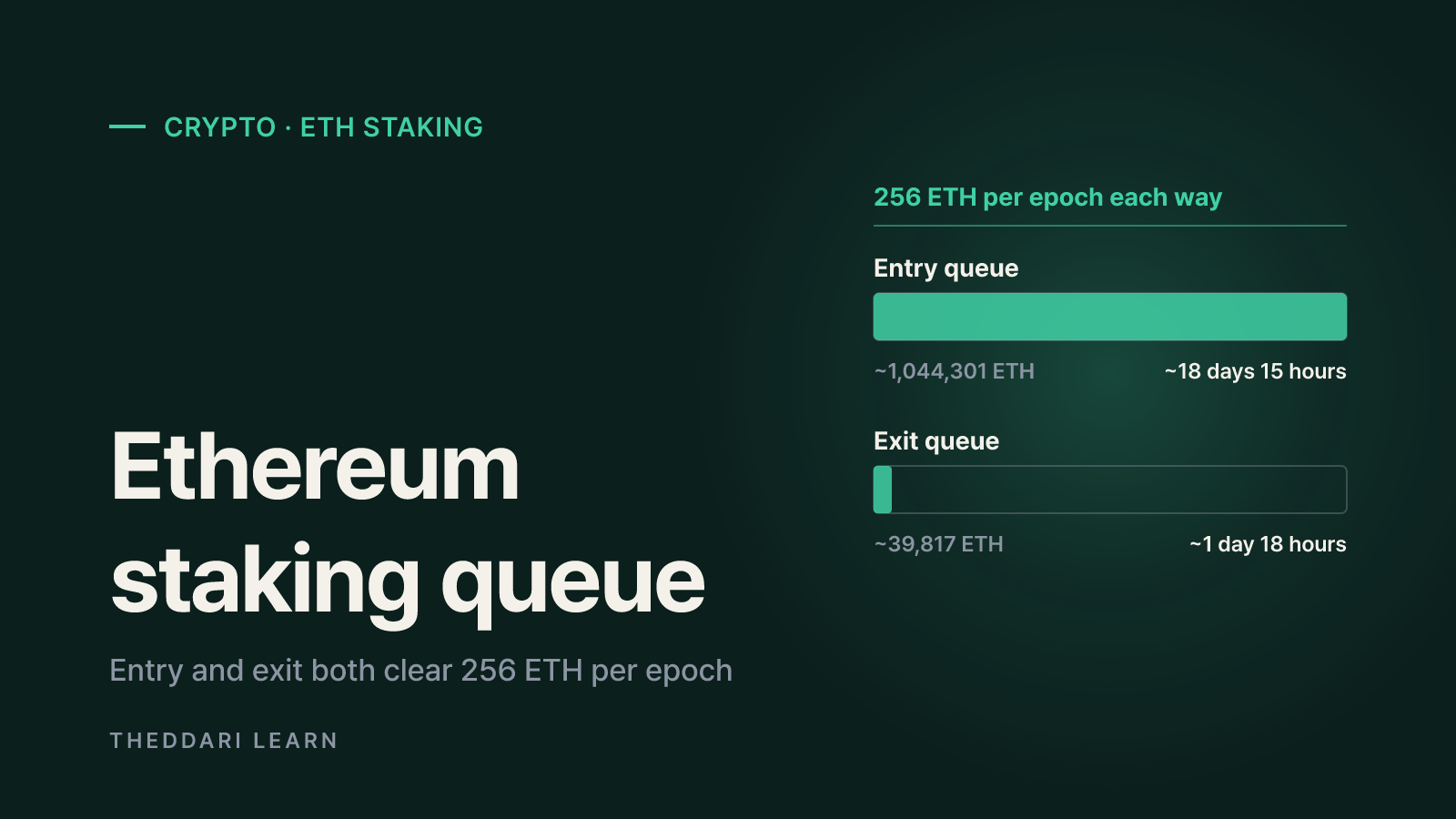
The Ethereum staking queue is the line that forms when more ETH wants to start or stop staking than the protocol allows through at once. Ethereum caps validator changes with a churn limit: today, 256 ETH can enter and 256 ETH can exit per epoch (about 6.4 minutes), or roughly 57,600 ETH per day in each direction (beaconcha.in docs). This guide uses data checked on November 4, 2026 and is written for solo stakers, node operators and anyone using a staking service who wants to know why unstaking takes days and how to check the real wait.
Queue sizes change every day, so treat the figures below as a snapshot and recheck a live dashboard before you act.
What is the Ethereum staking queue and why does it exist?
Proof of stake stays safe partly because the validator set changes slowly. If a large share of stake could leave or join in a few hours, nodes that sync from an old checkpoint could no longer trust it (the weak subjectivity period would shrink). So the protocol limits how much stake can change per epoch. That limit is the churn limit.
Churn is measured in ETH, not validators
Before the Pectra upgrade in May 2025, churn counted validators per epoch. Pectra let a single validator hold up to 2,048 ETH, so churn is now counted in ETH. As the EIP-8061 text explains, both activations and exits currently share a 256 ETH per epoch cap. A large validator uses several epochs of room: a 2,048 ETH validator takes about 8 epochs of exit capacity.
When does a line form?
Whenever more than about 57,600 ETH per day tries to enter or exit, the extra waits for later epochs. The queue grows while requests arrive faster than they clear and shrinks once demand slows. A long queue is not a network failure; it is the speed limit doing its job.
Entry queue vs exit queue
Both queues move at the same speed, but they differ in rewards and in what happens afterwards. The most common mistake is assuming ETH lands in your wallet the moment the exit queue clears.
Throughput
- Entry (deposit) queue
- 256 ETH per epoch, max 16 deposits
- Exit queue
- 256 ETH per epoch
Rewards while waiting
- Entry (deposit) queue
- None (not active yet)
- Exit queue
- Yes (still active, duties required)
Fixed step after queue
- Entry (deposit) queue
- Active about 50 minutes after processing
- Exit queue
- 256 epochs (~27 hours) withdrawability delay
Getting paid
- Entry (deposit) queue
- Rewards start after activation
- Exit queue
- Withdrawal sweep pays in index order
Size on Nov 4, 2026
- Entry (deposit) queue
- ~1,044,301 ETH
- Exit queue
- ~39,817 ETH
Wait on Nov 4, 2026
- Entry (deposit) queue
- ~18 days 15 hours
- Exit queue
- ~1 day 18 hours + ~7.1-day sweep
Queue sizes and waits are estimates shown by validatorqueue.com on November 4, 2026. The same page listed 812,409 active validators and about 44.4M ETH staked.
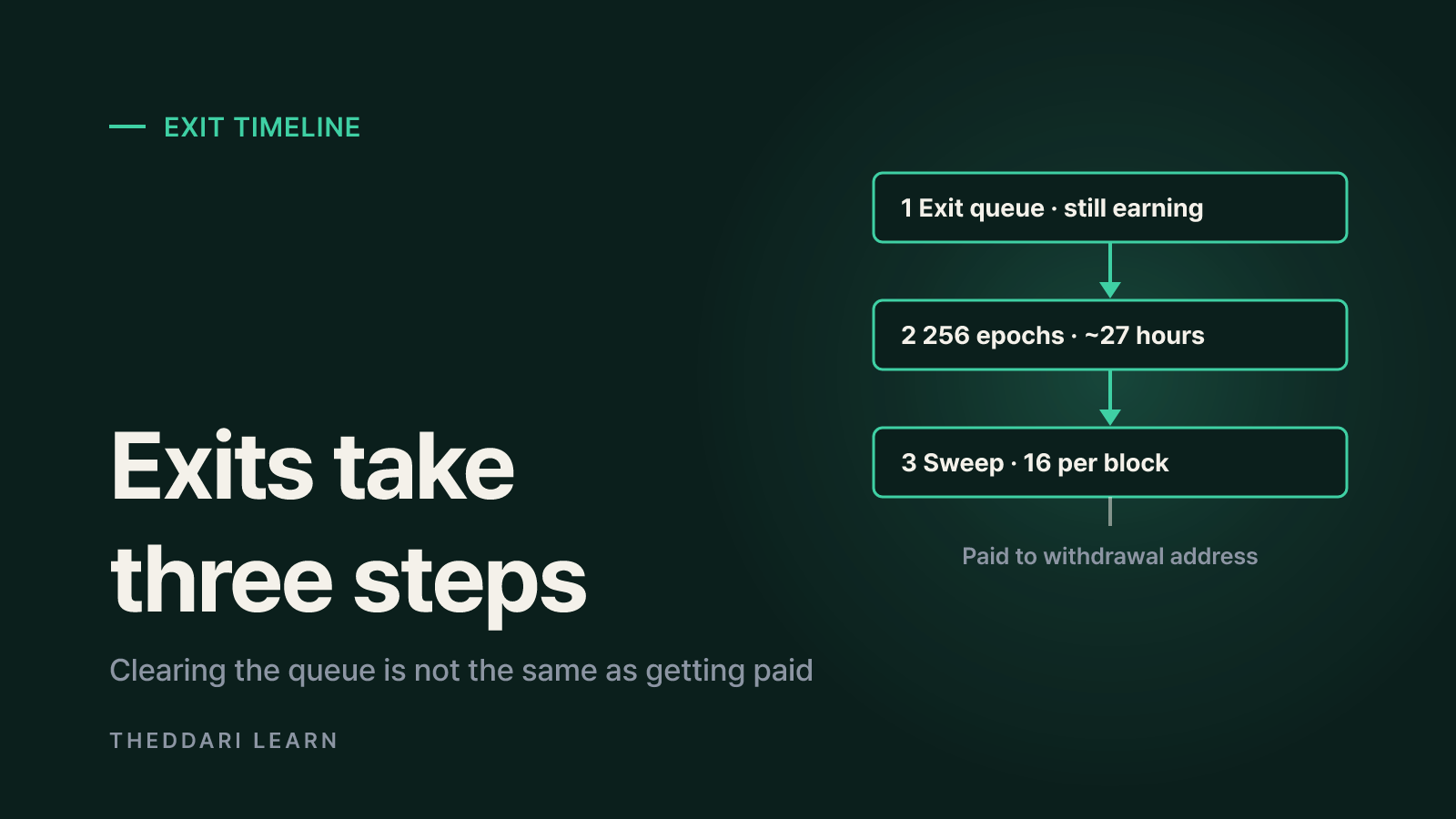
The three steps of a full exit
- Exit queue: your exit epoch is fixed when the chain processes your request. Later requests line up behind you.
- Withdrawability delay: another 256 epochs (~27 hours) regardless of queue length. Slashed validators wait at least 8,192 epochs (~36 days).
- Withdrawal sweep: each block pays up to 16 withdrawals while a pointer walks through validators in index order. Depending on where the pointer is, this takes anywhere from almost nothing to one full cycle.
ethereum.org describes the sweep as a clock hand that never skips accounts, with capacity for 115,200 withdrawals per day at 16 per block. Validators still on 0x00 credentials are skipped entirely, so update to 0x01 before you exit.
Why validator entry and exit queues grow
- Entry queue spikes
- Large holders, corporate treasuries and staking products depositing at once. EIP-8061 cites an inflow of more than 1M ETH that kept the deposit queue full for about 20 days.
- Many small deposits clear more slowly because of the 16-deposits-per-epoch cap.
- Exit queue spikes
- Large operators winding down validators or waves of liquid staking redemptions. EIP-8061 notes the exit queue stretched past 40 days during a mass exit of Kiln validators.
- Partial withdrawal requests from 0x02 validators share the same exit churn.
- Both at once
- Moving stake between operators uses the exit queue on one side and the entry queue on the other.
How traders read the queues
A long entry queue is usually read as strong staking demand and a long exit queue as stakers leaving. Neither tells you on its own whether ETH is being bought or sold. Exited ETH might be redeposited with another operator rather than sent to an exchange. If you want market context, theddari's crypto Telegram trends show what traders are discussing and the funding arbitrage tool shows ETH funding rates across venues.

How to check Ethereum unstaking wait times
- 1
Check a live queue dashboard
validatorqueue.com and beaconcha.in's queue page show entry, exit and consolidation queue sizes, estimated waits and the sweep delay. Methods differ slightly between sites.
- 2
Add up all three exit steps
Expected exit time = exit queue + ~27 hours + sweep wait. With the November 4, 2026 numbers that is about 1 day 18 hours + 27 hours + up to ~7.1 days, not the two days the queue alone suggests.
- 3
Look up your own validator
Search your validator index or public key on beaconcha.in to see its status (Pending, Active, Exiting, Withdrawing) and scheduled epochs. The exit_queue.estimated_processed_at API field also counts partial withdrawal requests.
- 4
Read your provider's redemption rules
Exchange staking and liquid staking tokens add their own redemption queues, fees or pool discounts on top of the protocol queue.
Dividing queued ETH by 256 is only a rough guide. According to beaconcha.in it misses partial withdrawal requests and wrongly includes consolidation sources, so it can run short or long.
What Glamsterdam and EIP-8061 could change
EIP-8061 removes the 256 ETH cap on exits and sets exit churn to total active stake divided by 32,768. Assuming 36M ETH staked, the EIP calculates exit churn of about 1,098 ETH per epoch (roughly 4x today) and consolidation churn of about 549 ETH. Activations keep the 256 ETH cap. The trade-off is a shorter weak subjectivity period, from about 15.7 days to about 7.0 days.
EIP-8061 is on the scheduled list in EIP-7773 for Glamsterdam, which went live on the Sepolia testnet on October 6, 2026. The Hoodi testnet fork was postponed by the Ethereum Foundation on October 22, 2026, and no mainnet date had been set as of early November 2026. Plan any exit today around the current 256 ETH rules.
Risks to keep in mind
- Liquidity gap: queue, delay and sweep together can approach ten days, so do not stake money you may need quickly.
- Price exposure: ETH keeps moving while you wait and the protocol offers no way to lock a price.
- LST discounts: selling a liquid staking token to skip the queue can mean accepting less than its underlying value.
- Operator mistakes: turning off a node before its exit epoch causes penalties, and 0x00 credentials stall withdrawals.
- Estimate drift: dashboard waits are snapshots and grow for later requesters if demand spikes.
In short, the staking queue is a deliberate speed limit. Think of entry as queue plus about 50 minutes, and exit as queue plus about 27 hours plus the sweep. Check a live dashboard and your own validator page right before you act, and watch official announcements for the Glamsterdam mainnet date, since it would change how exit churn is calculated.