Contents7 sections
The quickest way to check an earnings date is to use an earnings report calendar to find the expected day, read whether the release is scheduled before the open or after the bell, and then confirm the date on the company's investor relations (IR) page. After the release, the SEC filing is the authoritative record. This guide covers U.S.-listed companies as of October 2026, and all times are U.S. Eastern Time (ET) unless noted.
During earnings season dozens of companies can report on a single day, and different websites sometimes show different dates for the same stock. The steps below explain why that happens and which source to trust at each stage.
Where to find an earnings report calendar
There are three main places to look, and each answers a different question. Layering them is more reliable than relying on any single site.
Earnings calendar (e.g., Nasdaq, theddari earnings calendar)
- What it tells you
- Companies reporting on each date, pre-market vs. after-hours timing, EPS estimates
- Watch out for
- Dates may be projections based on past reporting patterns
Company investor relations page
- What it tells you
- Confirmed date, conference call time, webcast link
- Watch out for
- Timing of the announcement varies by company
SEC EDGAR filings (8-K, 10-Q)
- What it tells you
- The actual press release and quarterly financial statements
- Watch out for
- Useful after the release, not for advance scheduling
The Nasdaq earnings calendar tags each company with one of three keys: Pre-Market, After Hours, or Time Not Supplied. If you want a daily or weekly view of earnings reports this week, theddari's calendar organizes the same kind of information by date.

Projected dates vs. confirmed dates
A date on a calendar is not always a date the company has announced. Some data providers pre-fill the next report using the timing of previous quarters and update it once the company publishes a notice. That is why calendars can disagree by a day or two early in the season. When the IR page posts a conference call announcement, treat that as the confirmed date.
Pre-market vs. earnings after the bell
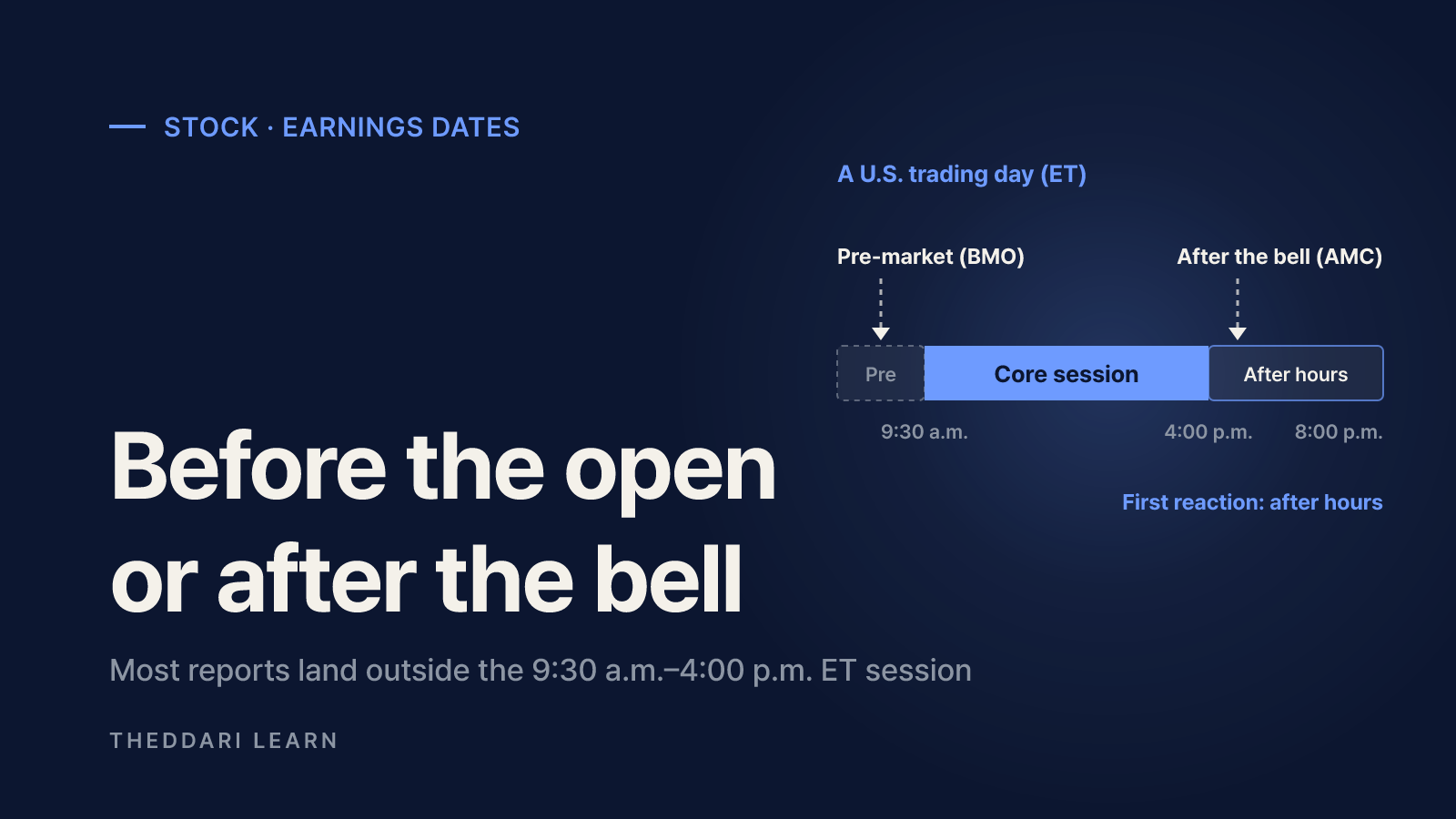
According to the NYSE trading hours page, the core trading session runs from 9:30 a.m. to 4:00 p.m. ET. Most companies release results outside that window so that the information is public before continuous trading resumes.
Pre-Market / BMO
- Meaning
- Released before the 9:30 a.m. ET open
- What to expect
- Early-session trading reacts first; the open reflects the news
After Hours / AMC
- Meaning
- Released after the 4:00 p.m. ET close
- What to expect
- Late-session trading reacts first; next morning's open reflects it
Time Not Supplied
- Meaning
- No confirmed time from the provider
- What to expect
- Check the company's IR announcement
BMO stands for before market open and AMC for after market close. If you follow U.S. stocks from another country, remember that U.S. daylight saving time normally runs from the second Sunday in March to the first Sunday in November, so the local time of a 4:00 p.m. ET release shifts by an hour during the year.
How after-hours trading reacts to results
When a company reports after the close, the first price reaction shows up in extended trading. Per the NYSE page, late trading sessions on venues such as NYSE Arca, NYSE American and NYSE National run from 4:00 p.m. to 8:00 p.m. ET, and some venues open early sessions before 9:30 a.m. Liquidity in these sessions is thinner, spreads are wider, and modest orders can move the price, so an after-hours move is not a reliable forecast of the next regular session.
The press release usually comes out first and management's conference call follows later. Guidance comments on the call can change the after-hours reaction, so note the call time from the company's announcement as well as the release time.
Verify the earnings schedule with SEC filings
U.S. public companies file annual reports on Form 10-K, quarterly reports on Form 10-Q and current reports on Form 8-K. As Investor.gov explains, Form 8-K is used to announce major events shareholders should know about, and companies generally have four business days to file one after a triggering event. Earnings press releases are typically attached under Item 2.02, Results of Operations and Financial Condition, and are usually 'furnished' rather than 'filed'.
Form 10-Q contains unaudited financial statements and is filed for each of the first three fiscal quarters; the fourth quarter is covered by the annual 10-K. In other words, the headline release and the formal quarterly report are separate documents and can arrive on different days.
- 1
Find the candidate date
Look up the stock on an earnings calendar and note the date plus the BMO or AMC label.
- 2
Confirm on the IR page
Search the company's investor relations news for a conference call announcement with the date and time.
- 3
Set an alert in your time zone
Convert the ET time, accounting for daylight saving time, and set a reminder.
- 4
Read the 8-K after the release
Search the company on SEC EDGAR and open the 8-K's Exhibit 99.1 press release to check the numbers.
- 5
Fill in details from the 10-Q
When the quarterly report is filed, review segment revenue, one-time items and risk factors in the notes.
Reading EPS consensus, revenue and guidance
Most calendars list an EPS consensus next to each company. Consensus is an aggregate of analyst estimates, and every provider uses its own set of analysts and update schedule. That is why the same stock can show slightly different estimates on different sites.
- GAAP vs. adjusted EPS: Press releases often show both. Make sure you compare the result with an estimate built on the same basis.
- Revenue: EPS can improve through cost cuts or buybacks, so check whether sales actually grew.
- Guidance: Forward outlook compared with prior expectations often drives the initial reaction more than the quarter itself.
- One-time items: Litigation costs, restructuring charges or tax benefits can distort a single quarter; the notes explain them.
Earnings weeks often overlap with macro releases such as inflation or jobs data, which can move stocks for reasons unrelated to company results. Checking the economic calendar for the same week gives useful context.
Risks and exceptions during earnings season
- Date changes: Companies sometimes move a report earlier or later. Recheck the IR page the day before.
- Holidays and early closes: NYSE markets close early at 1:00 p.m. ET on November 27, 2026 (the day after Thanksgiving) and December 24, 2026, which can affect release timing and extended-hours sessions around those days.
- Foreign issuers: Companies that list in the U.S. via ADRs may use different forms, such as 6-K instead of 8-K.
- Extended-hours liquidity: Orders may not fill, and prices can swing far more than in regular trading.
Watching which tickers are drawing discussion in stock-focused Telegram channels can show where attention is concentrated ahead of a report, but community chatter is not a substitute for the filing itself.
This guide explains how to check earnings dates and is for information only; it is not investment advice. Report dates, times and figures can change, so confirm them with the company's IR announcements and SEC filings, and make your own decisions.