Contents9 sections
- What DoorDash actually said about AI agent orders
- How agentic commerce works: the DoorDash MCP connector
- Why AI agent shopping is still rare
- How agent payments prove authorization: AP2 mandates
- Before you let an AI agent order for you
- What investors should take from the number
- Bottom line: where AI agent shopping shows up first
- Frequently asked questions
- Sources and references
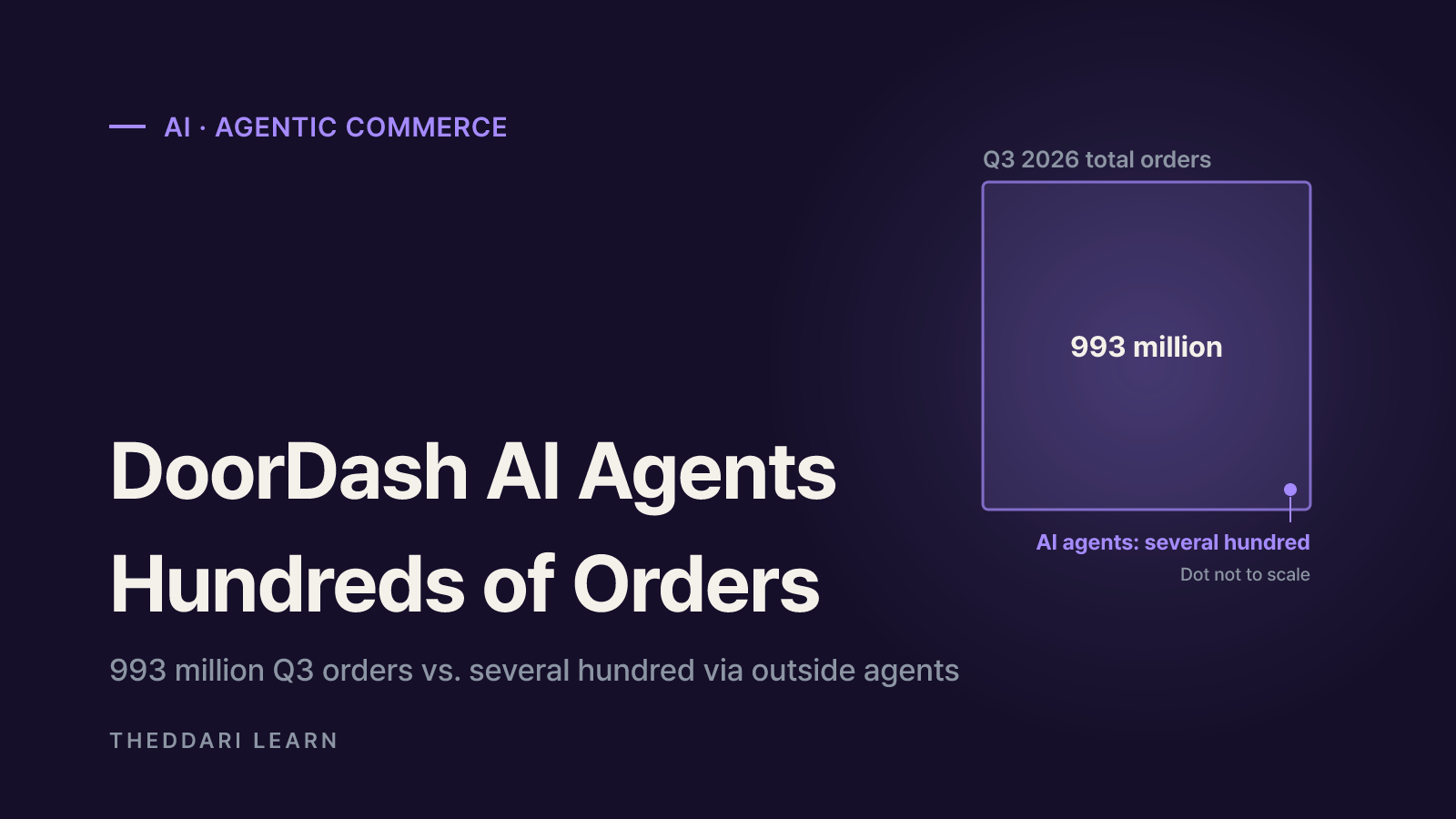
The short answer: agentic commerce is real, but it is not yet how people shop. On DoorDash's third-quarter 2026 earnings call on October 29, 2026, co-founder and CEO Tony Xu said third-party AI agents have generated "several hundred orders" across the entire time they have been running (earnings call transcript). In the same quarter, DoorDash processed 993 million orders. This guide, based on public sources checked in early November 2026, explains what that number does and does not mean, why AI agent shopping is slow to take off, and what to check before you let an agent spend your money.
What DoorDash actually said about AI agent orders
The comment came in response to an analyst asking how DoorDash's advertising business might change if consumers start shopping through AI agents. Xu answered that agents are "generating several hundred orders across the time that they've been up and running," calling it "a fairly low use case." Ars Technica summed it up bluntly: basically no one is using outside AI agents for their DoorDash orders.
Third-party AI agent orders
- What DoorDash disclosed
- Several hundred, cumulative since launch
- Caveat
- No exact count or time window given
Total Q3 2026 orders
- What DoorDash disclosed
- 993 million, up 28% year over year
- Caveat
- Includes the Deliveroo acquisition
MCP connector launch
- What DoorDash disclosed
- September 30, 2026, limited beta
- Caveat
- Less than a month before the call
Not counted
- What DoorDash disclosed
- DoorDash's own AI tools, such as Ask DoorDash
- Caveat
- No separate usage figures published
For a rough sense of scale: even if you generously assume 1,000 agent orders, that is about 0.0001% of one quarter's volume. One figure is cumulative and the other is quarterly, so treat this as an order-of-magnitude comparison, not a precise share.
Xu was not dismissive of agents. "My take on all things technology is you never want to fight gravity," he said, "but at the same time, you don't want to be delusional." He sees room for agents in long-consideration purchases and in work done "on your behalf proactively in the background," while simple food orders still tend to come directly to the DoorDash app.
How agentic commerce works: the DoorDash MCP connector
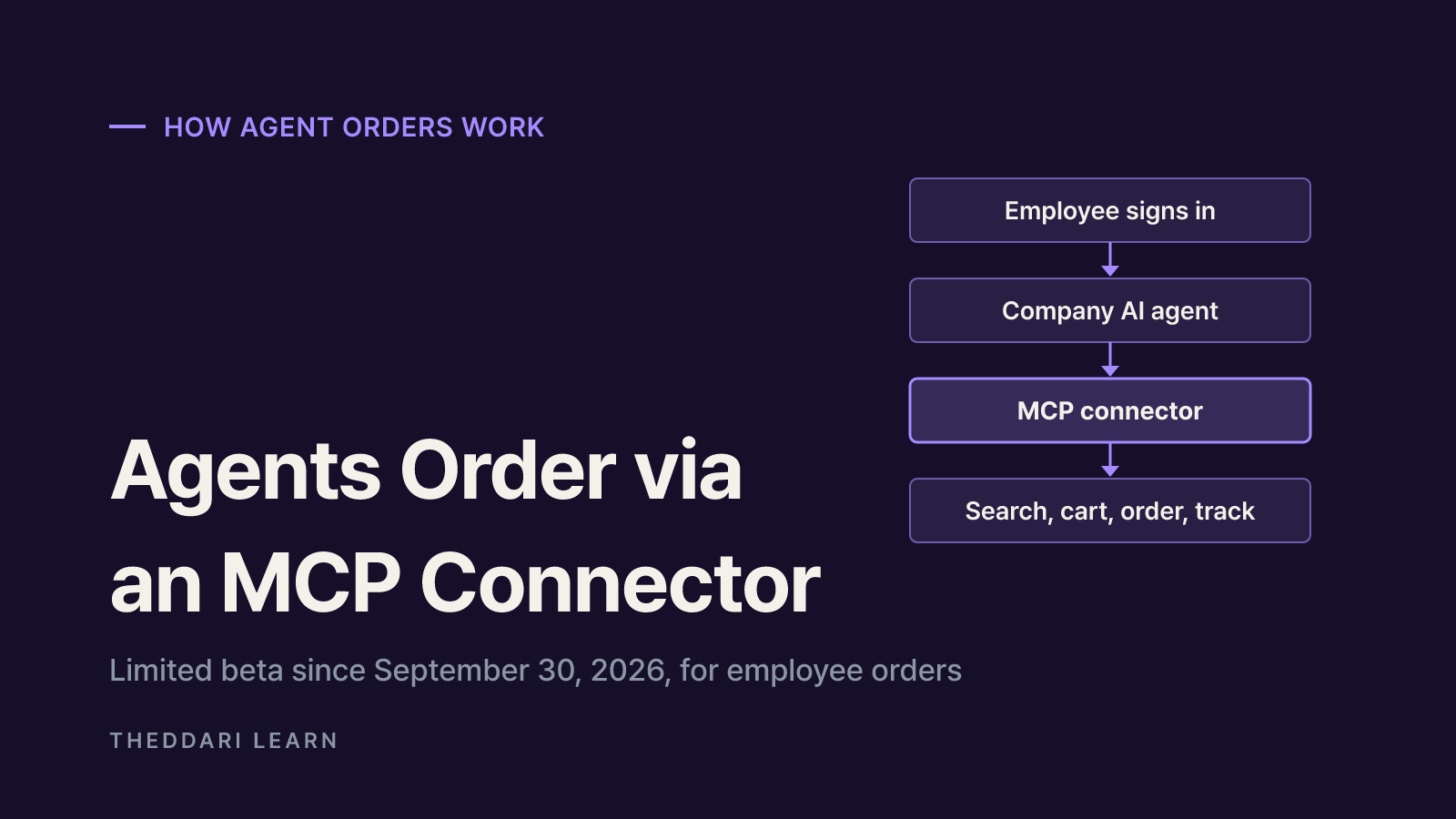
An AI shopping assistant suggests products and you tap buy. Agentic commerce goes further: the agent searches, builds the cart, places the order, pays, and tracks delivery. To do that reliably, the agent needs an official way into the merchant's systems rather than clicking through a web page.
That is what DoorDash's ordering connector, announced September 30, 2026, provides. It uses the Model Context Protocol (MCP), an open standard for connecting AI applications to outside services. Connected agents can find items, build a cart, place an order, and track its arrival.
- Who it is for: a limited beta focused on companies ordering for their own employees. Early beta partners named by DoorDash include SpaceXAI, Vercel, Cognition, Tempo, and Mercor.
- How permission works: access starts at the company level, and each employee signs in to their own DoorDash account and agrees to the terms before an agent can act on their behalf.
- Example uses: a Slack bot that collects lunch requests in a thread and places one group order, or an agent tied to office inventory that reorders snacks and supplies.
- Individual developers: DoorDash is also expanding beta access to a command-line tool for people building agents for personal use.
So the "several hundred" figure is not a verdict on a mass-market consumer feature. It reflects a corporate beta that was weeks old, plus agents that had to work around the regular web interface.
Why AI agent shopping is still rare
- Simple tasks are faster in the app. Reordering a usual meal takes a few taps. Explaining it to an agent and checking the result can take longer.
- Official access is narrow. Without a connector, agents must drive a website directly, which is slower and breaks more often.
- Payment authority is hard to prove. Payment systems generally assume a human is clicking buy on a trusted screen. An agent starting the payment breaks that assumption.
- Fulfillment is the hard part. Xu stressed that placing the order is not the difficult step. Making sure food arrives on time, in the expected condition, and fixing things when they go wrong is.
Meanwhile, DoorDash is pushing its own AI. According to Ars Technica, DoorDash says Ask DoorDash baskets are built "five times faster" and average nearly 50% higher basket value with about 60% more unique items than the same customers' traditional orders. Those are company-reported figures without independent verification.
How agent payments prove authorization: AP2 mandates
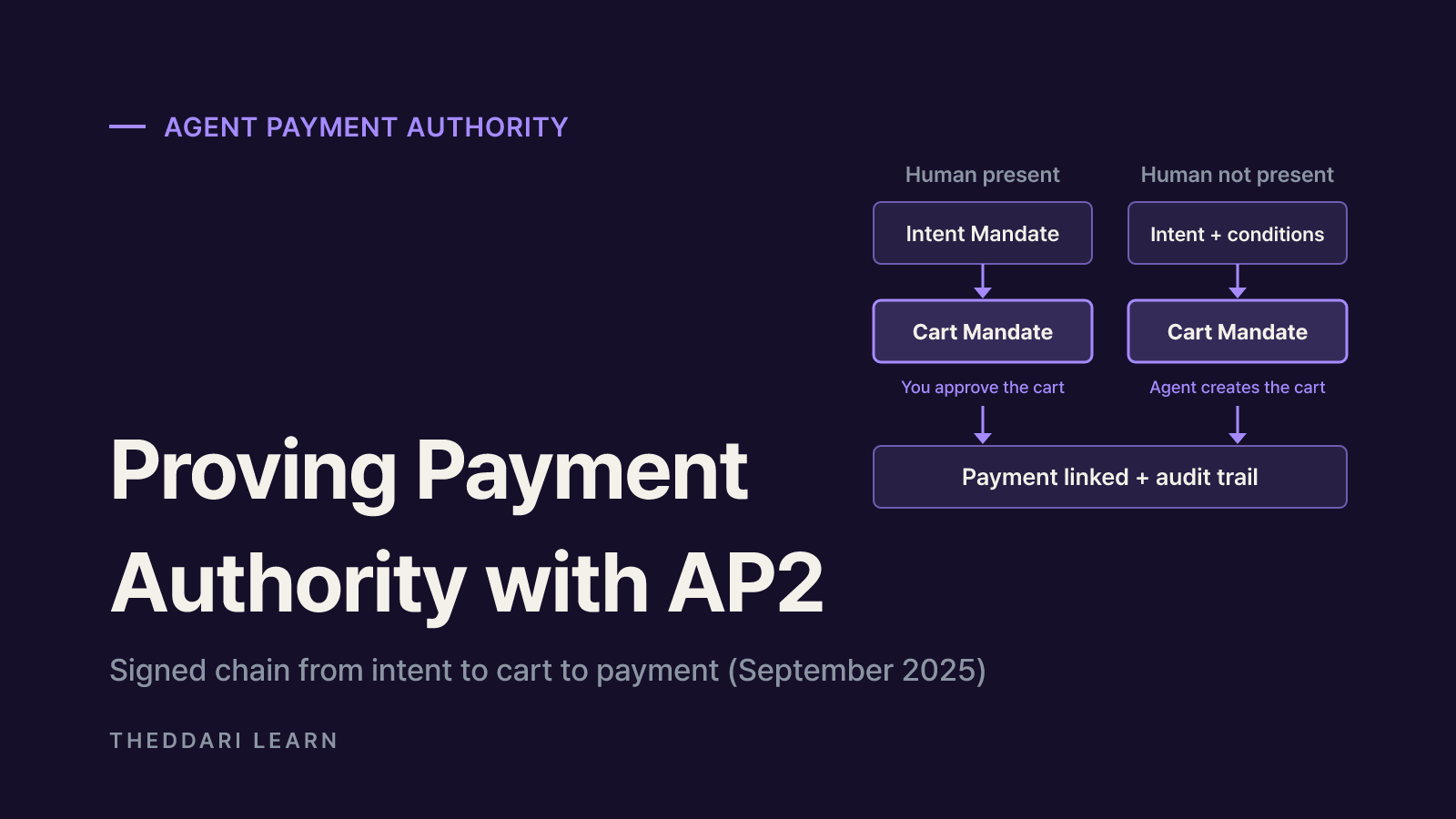
For agent orders to scale, merchants and banks need evidence that a specific user authorized a specific purchase. Google's Agent Payments Protocol (AP2), announced in September 2025 with more than 60 organizations including American Express, Mastercard, and PayPal, frames the problem as authorization, authenticity, and accountability.
You ask an agent to find white running shoes, and that request is captured in an Intent Mandate. When the agent shows you a cart and you approve it, you sign a Cart Mandate, a tamper-proof record of the exact items and price.
For a delegated task such as buying concert tickets the moment they go on sale, you sign a detailed Intent Mandate upfront with price limits, timing, and other conditions. Once those conditions are met, the agent can generate the Cart Mandate on your behalf.
This description follows the September 2025 announcement. The specification is still evolving, so names and steps may differ in the current version. The core idea stays the same: a signed chain from intent to cart to payment, so disputes can be traced back to what the user actually approved.
Before you let an AI agent order for you
- 1
Confirm the connection is official
Check whether the agent uses a connector or API the merchant provides, or simply automates a browser. Unofficial automation can violate terms of service and get accounts flagged.
- 2
Use a separate card and set caps
Link a low-limit card or virtual card instead of your main one, and set per-order and monthly spending limits so a repeated mistake stays small.
- 3
Keep a final approval step
Start in human-present mode and review the cart before checkout. Reserve fully automatic purchases for cases with precise item and price conditions.
- 4
Know your dispute path
Find out where order and approval records are stored and whether you should contact the platform or your card issuer first. Authorized-but-wrong orders may be handled differently from fraud.
- 5
Review data sharing
Your address, order history, and preferences may also be stored by the agent provider. Check how to disconnect and how data deletion works.
Never paste full card numbers or account passwords into a chat with an agent. Chat logs and hidden instructions on web pages can expose that information.
What investors should take from the number
The comment is one data point against the idea that general-purpose agents will quickly disintermediate delivery platforms. On the same call, DoorDash announced a definitive agreement to acquire Instacart for about $17 billion, a sign that management is betting on logistics, its own apps, and its own AI tools.
- Early data is thin. A beta less than a month old says little about long-run demand. Ars Technica compares it to Pizza Hut's tentative online ordering experiment in 1994.
- Separate first-party and third-party AI. Growth in DoorDash's own AI orders strengthens the platform, while growth in outside-agent orders could shift the customer relationship.
- Watch the next call. Whether management updates the agent order figure or widens the connector beta will be more telling than this first number.
You can track upcoming earnings dates for DoorDash and other commerce names on the earnings calendar.

To see how AI agent and commerce stories are spreading in online communities, check the AI Telegram trends page.
Bottom line: where AI agent shopping shows up first
As of early November 2026, outside AI agents ordering food for consumers is still extremely rare on DoorDash. Repetitive, rules-based workplace orders and conditional delegated purchases look like the first realistic uses. If you want to try it, use official connections, cap your spending, keep a final approval step, and start with small orders.