Ethereum Treasury Companies Selling ETH: Why mNAV Matters
Why Ethereum treasury companies sell ETH at a loss: BTCS's Aave loan, mNAV below 1, buybacks, how big the pressure is, and how to verify sales in filings.
Contents8 sections
- Why Ethereum treasury companies sell ETH
- The BTCS case: how an Aave liquidation line works
- Why mNAV below 1 changes the supply picture
- How big is the ether sell pressure, really?
- How to verify an ETH selling report
- Limits and risks when reading the pressure
- Frequently asked questions
- Sources and references
Key takeaways
- As of November 2026, Nasdaq-listed BTCS said in its 10-Q that it sold ETH below its original cost to keep an Aave loan healthy. It did not disclose how much it sold.
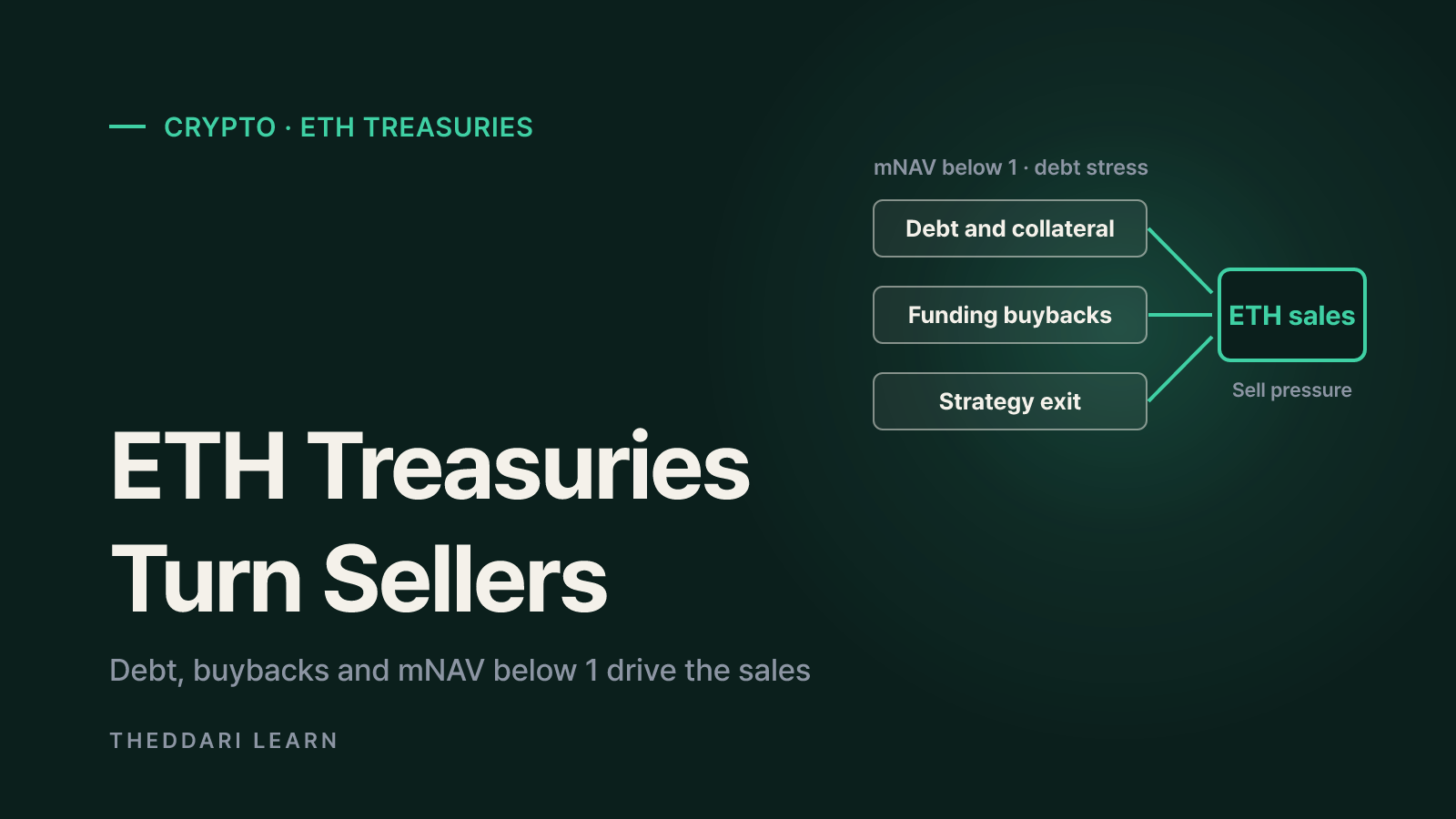
- Ethereum treasury companies sell for three main reasons: managing debt and collateral, funding share buybacks, or abandoning the strategy altogether.
- With mNAV (market cap divided by net asset value) below 1, selling shares to buy ETH dilutes holders, so the corporate bid fades. Lost demand can outweigh the sales.
- DefiLlama counted 24 public companies holding about 8.08 million ETH (about 6.6% of circulating supply) on Nov. 21, 2026. The largest holder, BitMine, says it carries no debt.
- Treat viral 'firms are dumping ETH' claims as unverified until you match them to SEC filings, company releases and on-chain movements.
Short answer: yes, at least one of the Ethereum treasury companies has sold ETH below what it paid. As of November 2026 the clearest case is Nasdaq-listed BTCS, which said in its quarterly filing that it sold ether below cost to manage collateral on a loan from the DeFi lender Aave. Claims that treasury firms are dumping ETH en masse are not supported by filings so far. The bigger price effect may come from something quieter: with mNAV below 1, the steady corporate buyer is disappearing.
This guide uses filings reported through Nov. 21, 2026, plus DefiLlama and CoinMarketCap data checked on Nov. 22, 2026. It covers why holders turn into sellers, how a DeFi liquidation line is calculated, how large the potential supply really is, and how to verify a sale claim yourself. All dollar figures are U.S. dollars.
Why Ethereum treasury companies sell ETH
An Ethereum treasury company is a listed business that holds ETH as its main reserve asset. During the 2025 boom these firms raised money through stock sales and convertible notes and used it to buy ETH. Once prices fell, three different reasons to sell appeared.
Debt and collateral management
- How it works
- If an ETH-backed loan gets too close to its liquidation line, the firm sells ETH to repay debt or rebalance
- Example (as of Nov. 2026)
- BTCS sold ETH below cost to protect its Aave borrowing
Funding buybacks
- How it works
- If shares trade below the ETH behind them, selling ETH to buy back stock raises ETH per share
- Example (as of Nov. 2026)
- ETHZilla sold ETH to fund buybacks and repay convertible notes, then rebranded as Forum Markets
Exiting the strategy
- How it works
- The company drops the treasury model and moves into another business
- Example (as of Nov. 2026)
- FG Nexus sold its entire ETH stack by June 30, 2026 and says it is moving into real estate
The ETHZilla and FG Nexus examples come from CoinMarketCap's comparison of ETH treasuries. The distinction matters. Debt-driven selling is price-sensitive: the lower ETH goes, the more likely it repeats. Buyback-driven selling is discretionary: management picks timing and size. A strategy exit tends to be a one-off.
A 'sale at a loss' only describes the accounting result. Whether it was done to protect a loan or to return value to shareholders tells you far more about the odds of further selling.
The BTCS case: how an Aave liquidation line works
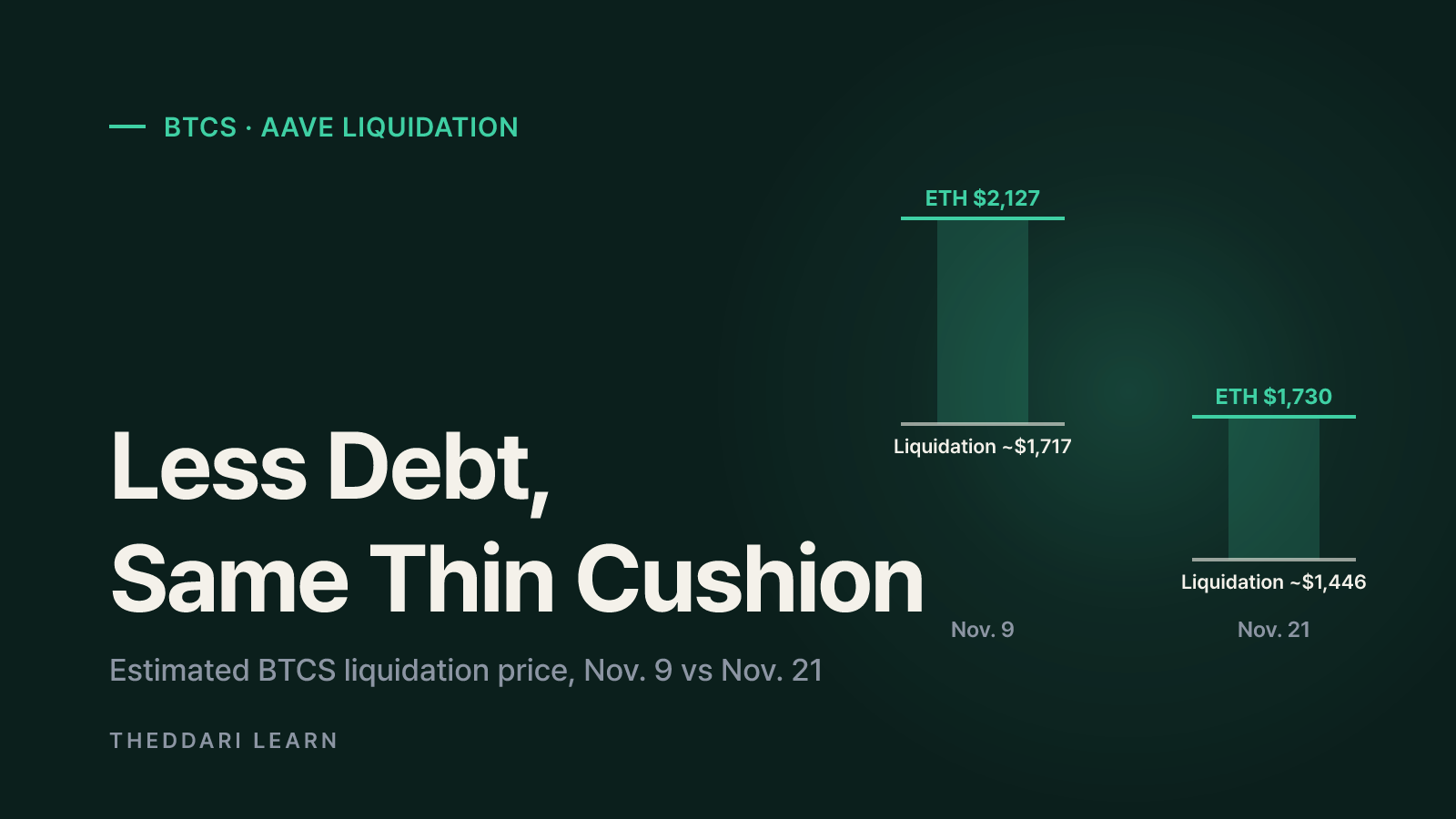
BTCS posts ETH on Aave and borrows stablecoins such as USDT and GHO, mainly to fund liquidity pools. According to CoinDesk's reading of the 10-Q filed Nov. 12, 2026, BTCS owed about $64.1 million on Aave as of Nov. 9, including interest. That was backed by 46,676 ETH worth $99.3 million at the company's stated ETH price of $2,127. The company wrote that ETH sales were executed below original cost basis as part of active management of collateral levels and health factors, but it did not say how much it sold.
What the health factor measures
Aave's documentation defines the health factor as collateral value times the liquidation threshold, divided by the borrowed amount. Below 1, anyone can liquidate the position: they repay part of the debt and take an equivalent amount of collateral plus a bonus. With a health factor above 0.95, up to 50% of the debt can be liquidated; at 0.95 or below, up to 100%. There is no margin call and nobody to negotiate with.
- 1
Nov. 9 snapshot
About $64 million of debt, 46,676 ETH at $2,127 and an assumed 80% threshold give a health factor near 1.24 and a liquidation price near $1,717, by CoinDesk's estimate.
- 2
Nov. 19 filing
An 8-K put Aave debt at about $54 million, plus about $18 million of senior secured convertible notes and about $111 million of crypto at an ETH price of $1,775. BTCS said it could give no assurance that a liquidation will not occur.
- 3
Nov. 21 price check
With ETH near $1,730 and the same assumed collateral, CoinDesk put the health factor around 1.2 and the modeled liquidation price near $1,446. Paying down roughly $10 million of debt was largely offset by the price drop.
Per CoinDesk's Nov. 21 report, BTCS stock fell 12.2% on Friday, Nov. 20, to close at 65.3 cents, down 28.1% for the week. The company held only about $463,000 in cash at the end of September, so if ETH keeps falling its main options are adding collateral or selling ETH to repay. Every figure above is an estimate tied to a specific date.
Why mNAV below 1 changes the supply picture
mNAV is market capitalization divided by the net value of the crypto a company holds. Above 1, a firm can sell new shares and buy ETH while increasing ETH per share. That loop drove the 2025 treasury wave. Below 1, each dollar raised buys less than a dollar of ETH backing, which hurts existing shareholders, so the loop stalls.
BitMine (BMNR), the largest holder, shows the shift. CoinMarketCap reports it held 6,060,506 ETH, or 4.9% of supply, on Nov. 1, 2026. Its monthly additions fell 96%, from about 1.17 million ETH in August 2025 to about 51,000 in October 2026. With mNAV at 0.89 in early November, it bought back 22.9 million shares for $399.6 million this year. BitMine has not sold ETH, but the market's most reliable buyer has slowed to a crawl.
BitMine (BMNR)
- ETH held
- about 6.04M
- Realized mNAV (DefiLlama)
- 0.76
- Holdings date
- 2026-11-09
SharpLink (SBET)
- ETH held
- 888,938
- Realized mNAV (DefiLlama)
- 0.62
- Holdings date
- 2026-08-03
Bit Digital (BTBT)
- ETH held
- 164,842
- Realized mNAV (DefiLlama)
- 0.63
- Holdings date
- 2026-09-09
BTCS
- ETH held
- 54,841
- Realized mNAV (DefiLlama)
- 0.36
- Holdings date
- 2026-06-30
These figures come from the DefiLlama Ethereum treasury tracker, checked on Nov. 21, 2026. Holdings dates differ by company, and BitMine's mNAV reads 0.76 there versus 0.89 elsewhere because trackers use different dates and methods. Note too that BTCS's 54,841 ETH is a June figure, not the 46,676 ETH pledged in November.
A discount to NAV is not a sell order. BitMine says it has no debt, and CoinMarketCap estimates its staking rewards cover annual running costs as long as ETH stays above roughly $1,140. Forced-selling risk sits mostly with small firms that combine debt, convertible notes and thin cash.
How big is the ether sell pressure, really?
To size the pressure, start with who could sell and how much. DefiLlama shows 24 public companies holding about 8.08 million ETH, roughly 6.6% of circulating supply, on Nov. 21, 2026. BitMine alone accounts for about 4.94% of supply.
- At risk of forced sale: BTCS's 46,676 pledged ETH is about 0.6% of the 8.08 million ETH held by public companies. Small in aggregate, but a liquidation would hit the market at the worst moment, at market prices.
- Discretionary supply: discounted mid-sized holders could sell ETH to fund buybacks. Bit Digital's chief executive has described its discount to NAV as persistent.
- Possible new supply: Tom Lee has said BitMine may sell staking rewards after reaching its 5% cap, which CoinMarketCap puts at roughly 3,000 ETH a week.
- Missing demand: BitMine's monthly buying fell from about 1.17 million ETH to about 51,000 ETH. That gap is less visible than a sale headline but weighs on the market for longer.
So the pressure has three layers: direct sales, the chance of liquidation cascades, and the end of steady buying. Liquidations hurt most when they coincide with leverage unwinding in derivatives. Checking funding rates across venues and auto-deleveraging signals helps you tell whether a spot sale headline is landing in an overleveraged market.

How to verify an ETH selling report
- Name the company. If a video or post doesn't say who sold, park the claim.
- Read the SEC filings. On EDGAR, check 8-K current reports, 10-Q quarterly reports and 10-K annual reports for sale volumes, average prices, realized losses, debt and pledged collateral.
- Compare weekly holdings updates. Firms such as BitMine publish holdings weekly; a drop between updates is the cleanest sign of a sale.
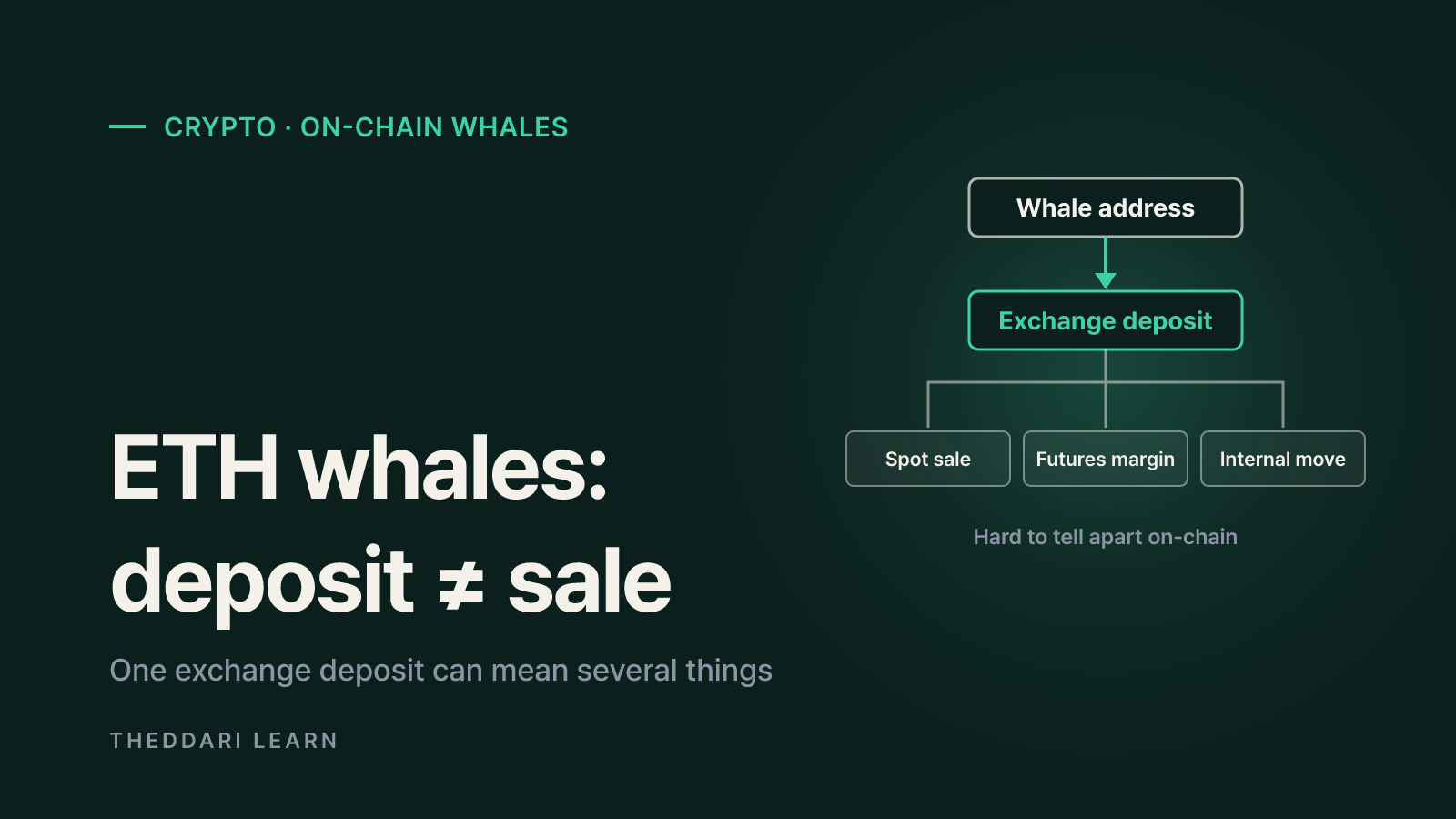
- Use on-chain data carefully. ETH moving from a company wallet to an exchange is not always a sale. It may be collateral, staking or a custodian change.
- Scale the number. Put any sale next to total corporate holdings, daily spot volume and spot ETF flows for the same period.
- Classify the motive. Debt-driven (can repeat), discretionary (management's choice) or exit (usually one-off).
To see how a story spreads before filings catch up, the Telegram crypto trends page shows how channels are framing it. Treat those summaries as leads to check, not as evidence.
Limits and risks when reading the pressure
- Estimates, not facts: the $1,717 and $1,446 liquidation levels are press calculations built on disclosed numbers plus assumptions. A collateral change voids them.
- Filing lag: quarterly reports arrive weeks or months after the trades. By the time you read one, the selling may be over.
- Tracker differences: mNAV and holdings vary by source, date and formula. Never rely on a single number.
- Cause and effect: it is hard to tell whether firms sell because ETH fell or ETH fell because firms sold. In November 2026 the whole market was weak, with bitcoin also at two-year lows.
- Regional pricing: if you trade on non-U.S. venues, local ETH prices also reflect exchange rates and regional premiums, so the move may not match U.S. headlines one-for-one.
The bottom line: an ETH selling headline only becomes useful once you know who sold, why and how much. Debt-driven sales by small, cash-thin firms can repeat as prices fall and deserve close watching. The slowdown in buying by large debt-free holders is quieter but lasts longer. Separating the two helps you judge the real risk instead of reacting to the headline.
Frequently asked questions
Do ETH sales by treasury companies push the price down right away?
Does an mNAV below 1 force a company to sell ETH?
Could BitMine start selling ETH?
What is BTCS's exact liquidation price?
Where can I find a company's ETH sales disclosures?
Sources and references
- 1CoinDesk: Ethereum treasury firm BTCS sold ether at a loss to keep $64 million Aave loan healthy (Nov. 13, 2026)(opens in a new tab)www.coindesk.com
- 2CoinDesk: Ether treasury firm BTCS warns SEC its $54 million Aave loan could be liquidated (Nov. 21, 2026)(opens in a new tab)www.coindesk.com
- 3CoinMarketCap Academy: Tom Lee's BitMine Nears Its Ethereum Cap(opens in a new tab)coinmarketcap.com
- 4DefiLlama: Ethereum Treasury Companies(opens in a new tab)defillama.com
- 5Aave Help: Health Factor & Liquidations(opens in a new tab)aave.com
Related articles
 Crypto
ETH Whales Selling at a Loss? Reading On-Chain Whale Data
Headlines about Ethereum whales dumping at a loss are often read as a bottom signal or a warning. Here is how to check the wallet cohorts, exchange inflows and labels behind them, using November 2026 data.
 Crypto
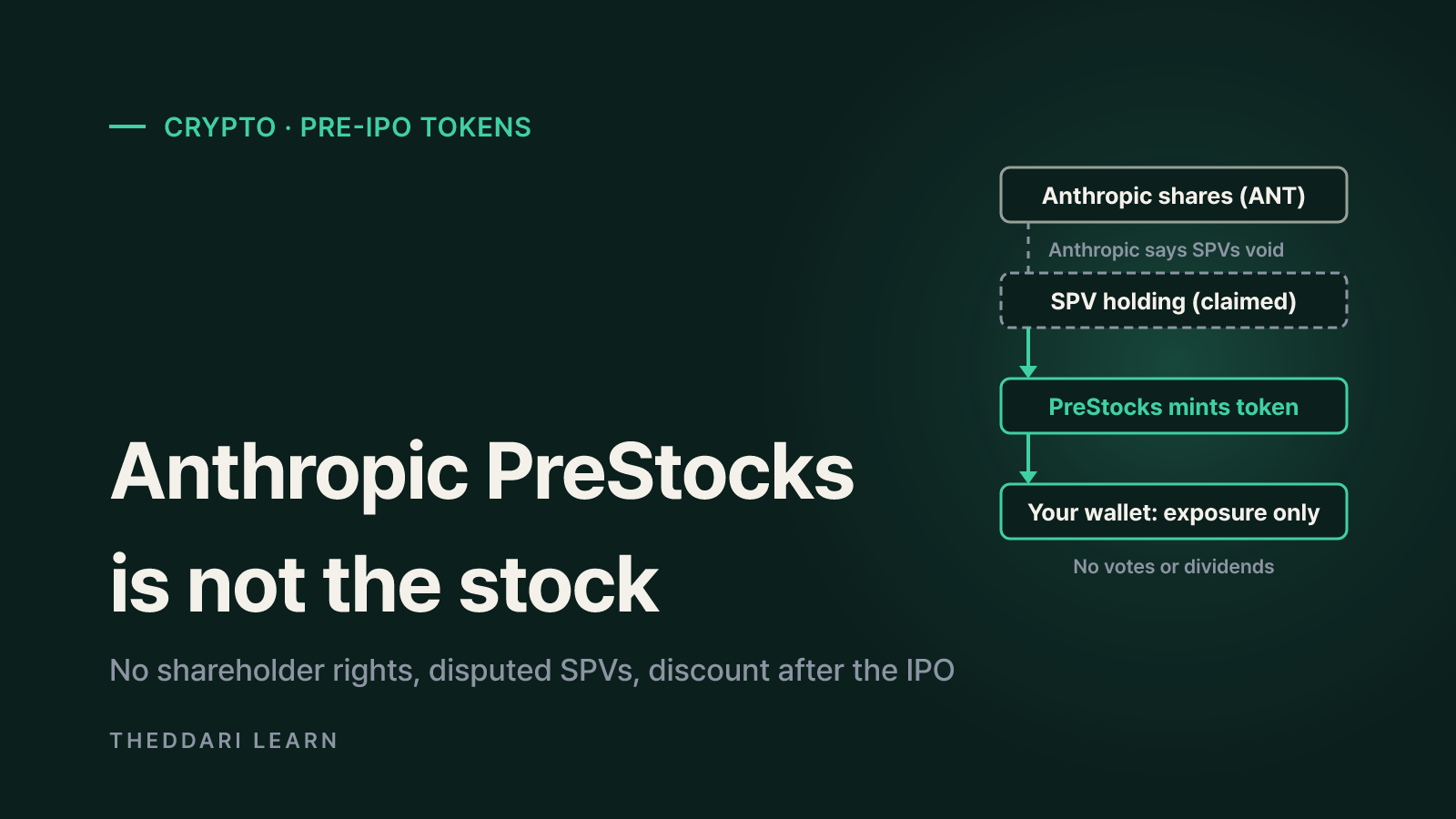
Anthropic PreStocks Token: How It Works, Risks After IPO
The ANTHROPIC token from PreStocks offers economic exposure only, with no shareholder rights. Here is how it is structured, why Anthropic disputes SPV transfers, and what the Nasdaq listing changes for holders.
 Crypto
GTA 6 Memecoins on CoinGecko Trending: What to Check First
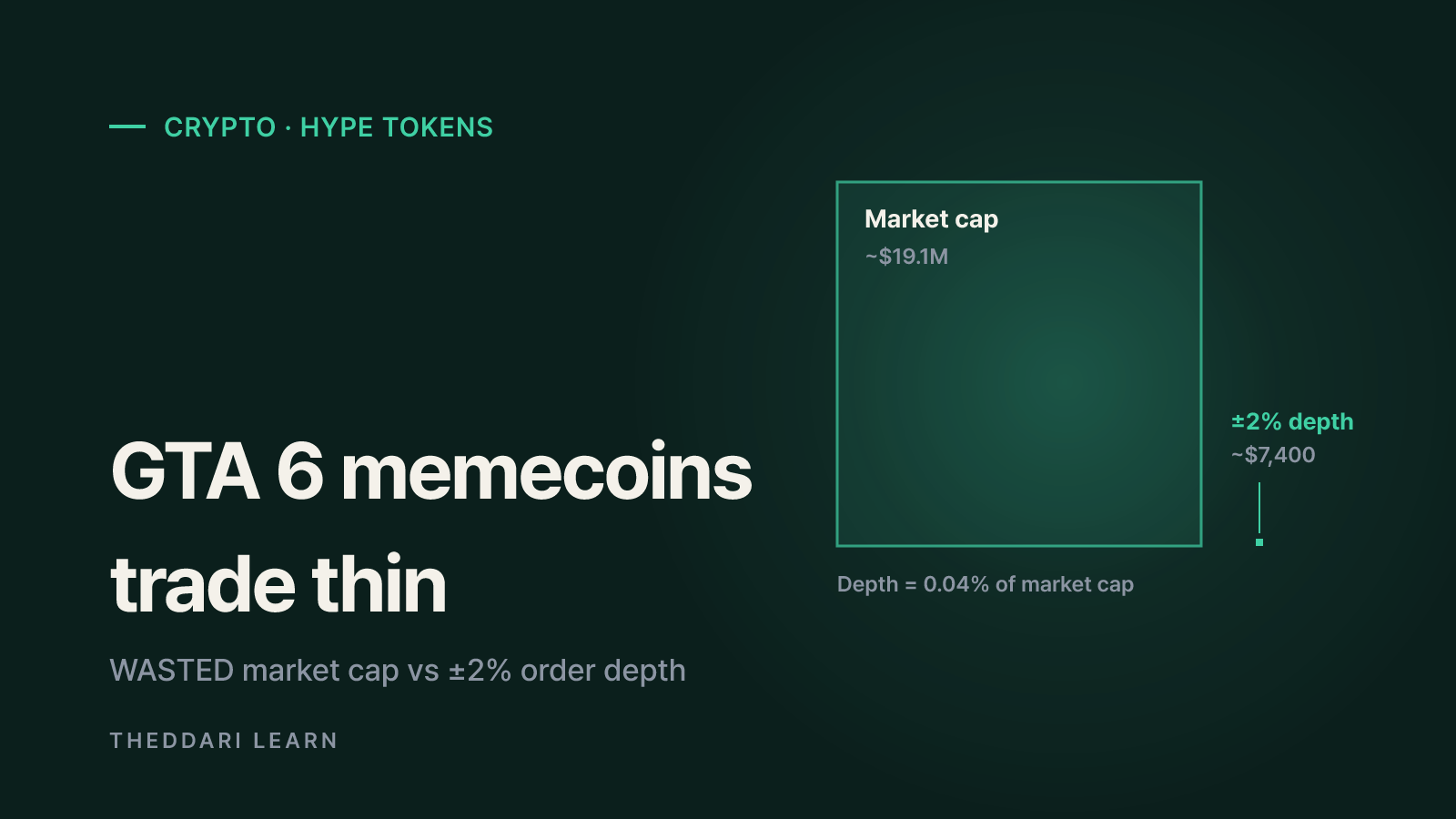
On November 19, 2026, GTA 6 launch day, three GTA-themed tokens hit CoinGecko's trending list. Here is what the data showed, why market cap misleads, and a step-by-step checklist before buying a hype token.