Contents8 sections
- Step one everywhere: find the gain and your cost basis
- Stock capital gains tax rates side by side
- US capital gains tax brackets: holding period and taxable income
- Capital gains tax UK: the £3,000 allowance, then 18% or 24%
- Capital gains tax Canada: the 50% inclusion rate
- Before you use a capital gains calculator
- Frequently asked questions
- Sources and references
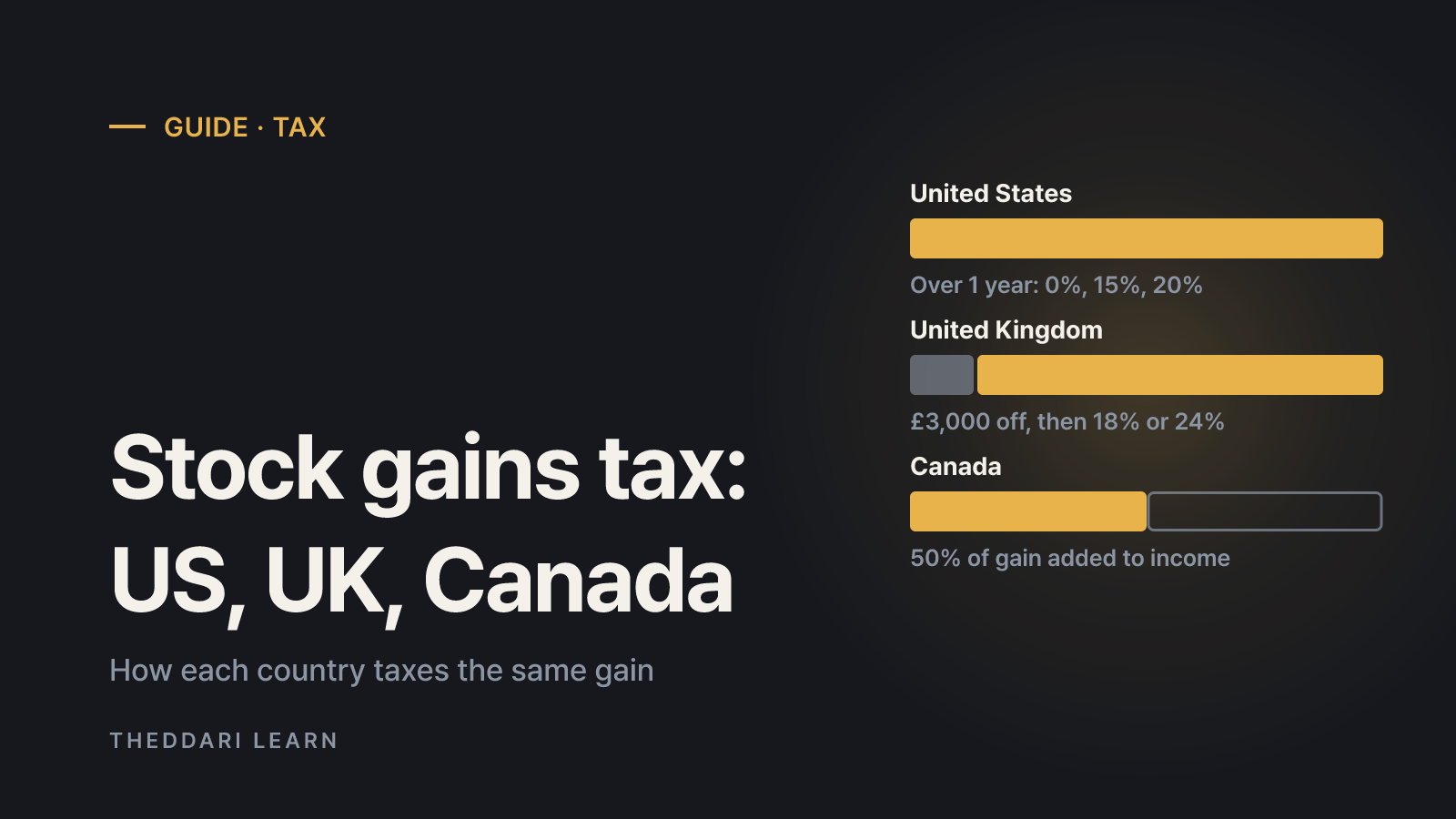
Stock capital gains tax starts with the same calculation in the US, the UK and Canada: what you sold the shares for, minus what they cost you. What happens next is very different. The US looks at how long you held the stock and where your total taxable income falls, then applies 0%, 15% or 20% to long-term gains. The UK subtracts a £3,000 annual allowance and charges 18% or 24%. Canada has no separate rate at all; it adds half of the gain to your income. This guide reflects official guidance checked as of October 2026 and assumes you are a tax resident of the country being discussed.
Step one everywhere: find the gain and your cost basis
The IRS defines a capital gain or loss as the difference between the amount realized from a sale and the asset's adjusted basis, which is usually what you paid for it. Shares received as a gift or an inheritance follow different basis rules (IRS Topic 409). Canada uses the term adjusted cost base (ACB), and HMRC in the UK similarly works from disposal proceeds minus allowable costs.
Three details trip people up before any rate is applied. If you bought the same stock in several lots, each country has its own rule for which shares you are treated as selling. If you traded in a foreign currency, the exchange rate used to convert proceeds and cost into your reporting currency changes the result. And losses can offset gains, but the order and the limits vary. Pulling the purchase date, purchase amount, sale date and sale amount for every lot from your brokerage statement is the most reliable way to feed any capital gains calculator.
Stock capital gains tax rates side by side
How gains are taxed
- United States
- Long-term gains have their own rates; short-term gains are ordinary income
- United Kingdom
- Gains above the allowance taxed at CGT rates
- Canada
- Half of the net gain added to income
Holding period matters?
- United States
- Yes: more than one year = long-term
- United Kingdom
- No
- Canada
- No
Rates
- United States
- Long-term 0%, 15%, 20%; short-term 10% to 37%
- United Kingdom
- 18% within basic rate band, 24% above
- Canada
- Federal + provincial marginal rate on 50% of the gain
Annual tax-free amount
- United States
- None as such (0% bracket instead)
- United Kingdom
- £3,000 for 2026 to 2027
- Canada
- None
Losses
- United States
- Up to $3,000 a year against other income, rest carried forward
- United Kingdom
- Offset gains; reported losses carried forward
- Canada
- Offset taxable gains; net losses carried to other years
Where reported
- United States
- Form 8949 and Schedule D
- United Kingdom
- Self Assessment or HMRC's CGT service
- Canada
- Schedule 3 and line 12700
US figures refer to tax year 2025 (returns filed in 2026), UK figures to disposals on or after 6 April 2026, and Canadian information to the CRA's 2025 tax year guidance. Thresholds and allowances can change every year, so confirm the numbers for the year in which you sell.
US capital gains tax brackets: holding period and taxable income
Gains on stock held one year or less are short-term and taxed at your ordinary graduated income tax rates. Hold for more than one year and the gain becomes long-term. For tax year 2025, a single filer pays 0% on long-term gains when taxable income is $48,350 or less, 15% up to $533,400, and 20% above that. For married couples filing jointly the 0% bracket runs to $96,700 and the 15% bracket to $600,050 (IRS Topic 409). The holding period is counted from the day after you acquired the shares through the day you sold them.
The bracket is set by your total taxable income including the gain, not by the size of the gain alone. Suppose a single filer buys shares for $5,000 and sells them 18 months later for $8,000, a $3,000 long-term gain. If taxable income including that gain is $40,000, the whole gain sits inside the 0% bracket and the federal capital gains tax is $0. With taxable income of $100,000 the same gain is taxed at 15%, or $450. Sell after 11 months instead and the $3,000 is a short-term gain taxed at your ordinary marginal rate.
US exceptions worth checking
- Net capital losses can reduce other income by up to $3,000 a year ($1,500 if married filing separately); the rest carries forward.
- The taxable part of gains on qualified small business stock (section 1202) and on collectibles can be taxed at up to 28%.
- Higher-income investors may also owe the net investment income tax (NIIT).
- State income tax is separate from federal tax and varies by state.
- Tax year 2026 thresholds are inflation-adjusted under Rev. Proc. 2025-32 and apply to returns filed in 2027 (IRS IR-2025-103).
Capital gains tax UK: the £3,000 allowance, then 18% or 24%
The UK ignores how long you held the shares. Gains are pooled across the tax year, which runs from 6 April to 5 April. According to GOV.UK, for the 2026 to 2027 tax year the annual exempt amount is £3,000. After deducting it, you add the remaining gain to your taxable income: the part that fits inside the basic rate band (£37,700) is taxed at 18%, and anything above it at 24%. Higher and additional rate taxpayers pay 24% on their gains.
- 1
Work out taxable income
Take your income and subtract your Personal Allowance and any other Income Tax reliefs. The GOV.UK example uses taxable income of £20,000.
- 2
Deduct the £3,000 allowance
With taxable gains of £12,600, deducting £3,000 leaves £9,600 to tax.
- 3
Split across the basic rate band
£20,000 + £9,600 = £29,600, which is below £37,700, so the whole £9,600 is taxed at 18%: £1,728. With gains of £52,600, £49,600 remains after the allowance; £17,700 is taxed at 18% and £31,900 at 24%, for a total of £10,842.
When some gains fall at 18% and some at 24%, you can set the allowance against the gains taxed at the higher rate. Shares held inside tax-advantaged wrappers such as ISAs or pensions follow their own rules, so check which account the shares sit in before running a UK capital gains tax calculator.
Capital gains tax Canada: the 50% inclusion rate
Canada does not publish a capital gains tax rate. Instead, you calculate your gains and allowable losses on Schedule 3 and report the taxable capital gains on line 12700 of your return, where they are added to employment and other income (CRA, Line 12700). The inclusion rate remains one-half: the increase to two-thirds announced in the 2024 budget was cancelled by the federal government on March 21, 2025 (Prime Minister of Canada).
If you realize a C$10,000 gain on shares, C$5,000 is included in income and taxed at your combined federal and provincial marginal rate. The effective rate on the full gain is therefore about half of your marginal rate. Because provincial rates differ, a Canadian capital gains tax calculator must ask for your province; the same gain produces a different bill in Ontario than in Alberta. The lifetime capital gains exemption (limit of C$1,250,000) applies to qualifying property such as qualified small business corporation shares, not to an ordinary sale of listed shares.
Before you use a capital gains calculator
- Confirm your tax residence. A non-resident or someone with cross-border ties may face different rules and treaty provisions.
- Gather the purchase and sale dates, amounts, fees and currency for every lot.
- Check the holding period (US) and the tax-year boundary (6 April in the UK, 1 January in the US and Canada).
- Combine the year's other income and losses to find your bracket or marginal rate.
- Reconcile the result with the official form: Schedule D, your Self Assessment return or Schedule 3.
Investors weighing when to sell often look at scheduled events too, such as company earnings releases and inflation or interest-rate data. The theddari earnings calendar and economic calendar help you check dates and time zones, but they do not predict price direction and they do not replace a tax calculation.

This AI-written guide is general information based on official sources checked as of October 2026 and is not investment advice or tax advice. Your actual tax depends on residence, account type, other income and the rules in force when you sell. Confirm current figures with the IRS, HMRC or the CRA and consult a qualified tax professional.