Contents7 sections
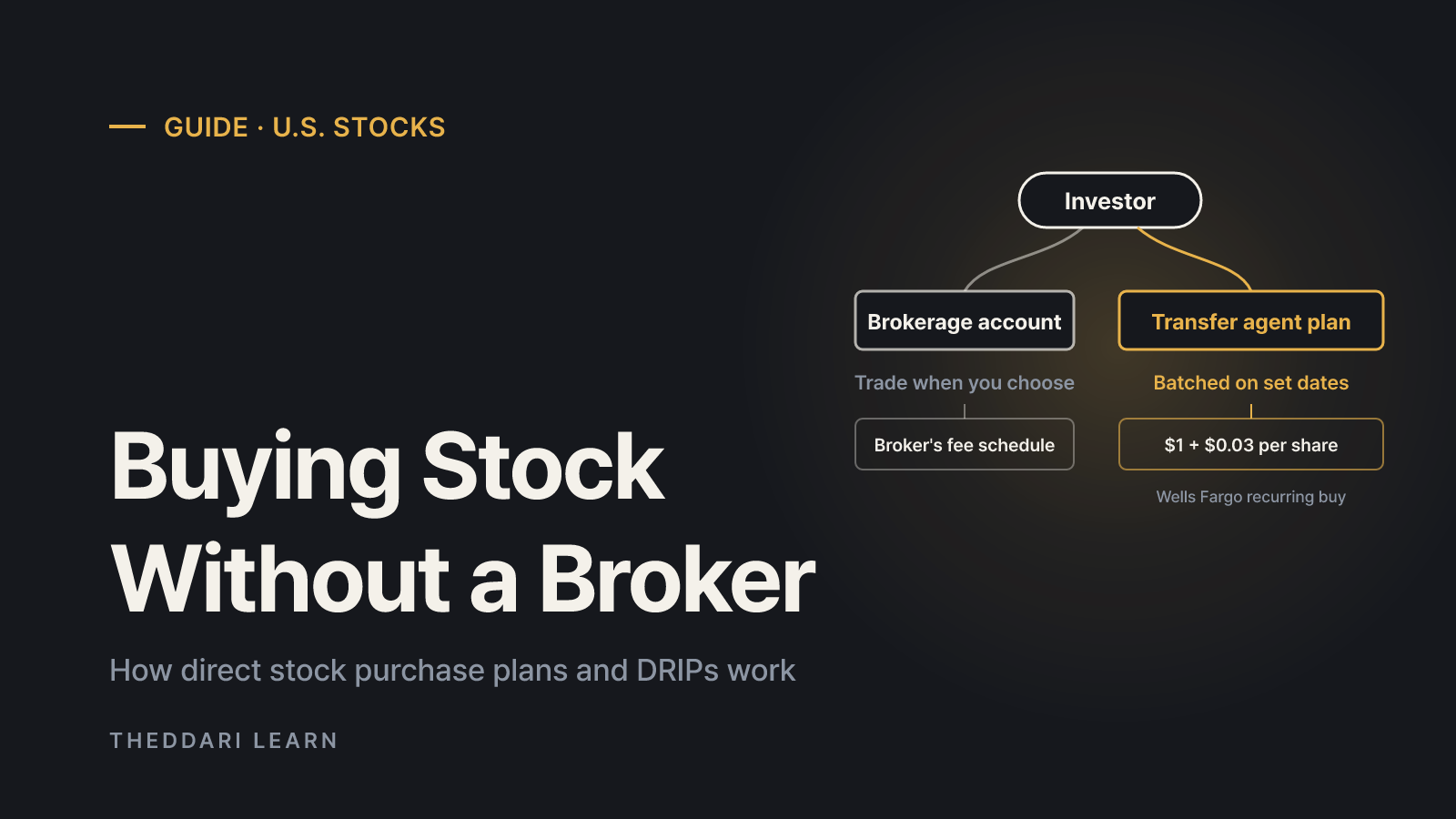
Yes, you can buy stocks without a broker, but only for companies that run a direct stock purchase plan. These plans, usually administered by the company's transfer agent, let you send money straight to the plan and receive whole or fractional shares, often with an option to reinvest dividends automatically (a DRIP). The trade-off is control: purchases are pooled and executed on set dates, and most plans charge per-transaction fees. This guide covers U.S. rules as of October 2026, based on Investor.gov guidance from the SEC and a real plan prospectus filed with the SEC.
How to buy stocks without a broker: DSPPs and DRIPs
Investor.gov describes two direct investing routes. A direct stock plan (often called a DSPP) lets you buy or sell a company's stock through the company instead of a brokerage. You skip broker commissions but may pay plan fees, including fees if you later transfer shares to a broker to sell them. Some companies limit their plans to employees or existing shareholders, and some set minimum purchase amounts or account balances. A dividend reinvestment plan (DRIP) uses the cash dividends from shares you already own to buy more shares, and you must sign an agreement with the company to enroll.
In practice the two are often bundled. The Wells Fargo Direct prospectus, dated March 22, 2024, describes one plan that handles a new investor's first purchase, optional cash purchases, and full or partial dividend reinvestment.
What the transfer agent actually does
A transfer agent keeps the company's official shareholder records. In a direct purchase plan it usually acts as plan administrator: it collects your money, batches purchase and sale requests, forwards them to an independent broker, and sends your statements. In the Wells Fargo plan, the administrator is Equiniti Trust Company (EQ Shareowner Services), and plan shares are held in the administrator's or its nominee's name for all participants together. So "no broker" means you never open a brokerage account; a broker still executes the trades.
Street name vs. direct registration
According to the joint SEC and FINRA bulletin on holding your securities, most investors hold shares in street name: the company's books list an intermediary such as Cede & Co., while your broker records you as the beneficial owner. With the Direct Registration System (DRS), the shares are registered in your own name on the company's books and held electronically by the transfer agent. You get dividends, proxy materials and annual reports directly, but you lose some of the order flexibility a brokerage account offers.
Direct stock purchase plan vs. brokerage account
Name on company records
- Brokerage account (street name)
- Broker or depository nominee
- Direct stock purchase plan
- Plan administrator (plan shares) or you (after moving to DRS)
Trade timing
- Brokerage account (street name)
- When you place the order during market hours
- Direct stock purchase plan
- Pooled and executed on set dates
Price
- Brokerage account (street name)
- Market or limit price you choose
- Direct stock purchase plan
- Usually the weighted average price for that batch
Order types
- Brokerage account (street name)
- Limit, stop and more
- Direct stock purchase plan
- Batch buys; sale order types depend on the plan
Cash while waiting
- Brokerage account (street name)
- Held in your brokerage account
- Direct stock purchase plan
- No interest on pending funds (Wells Fargo plan)
Investor protection
- Brokerage account (street name)
- SIPC covers up to $500,000 per customer, including $250,000 cash, if a member broker fails
- Direct stock purchase plan
- Shares registered to you; no protection from market losses either way
The SIPC limits above come from the SEC bulletin. SIPC covers missing customer property when a member broker-dealer fails; it does not cover a drop in the market value of your shares.
What a DSPP costs: a real fee schedule
Every plan sets its own terms, so always read the prospectus for the company you want. The Wells Fargo plan below is one public example, and the company says it can change fees after giving notice.
| Item | Wells Fargo Direct (prospectus dated March 22, 2024) |
|---|---|
| Minimum to start | $250, or $25 with recurring automatic bank withdrawals |
| Setup fee | $10 for new investors |
| Annual cap | $120,000 per calendar year, excluding reinvested dividends |
| Check purchase | $3 plus $0.03 per share |
| One-time automatic purchase | $2.50 plus $0.03 per share |
| Recurring automatic purchase | $1 plus $0.03 per share |
| Dividend reinvestment | Service fee paid by the company; $0.03 per share commission |
| Selling | Batch $15, market $25, limit or stop $30, plus $0.06 per share online or $0.12 by mail or phone |
| Direct deposit of sale proceeds | $5 |
Flat fees matter most on small amounts. A $1 fee on a $25 recurring purchase is 4% of the deposit (1 ÷ 25), while a $3 fee on a $250 check is 1.2% (3 ÷ 250). Selling 10 shares through an online batch order costs $15 plus 10 × $0.06, or $15.60.
You give up control over price and timing
- Investor.gov notes that direct stock plans usually do not let you buy or sell at a specific price or time; trades happen daily, weekly or monthly at an average market price.
- Wells Fargo invests optional cash generally within five trading days of receiving it and reinvests dividends on the dividend payment date.
- The SEC bulletin warns that paper orders may take until the next business day to process, so a fast-moving market can give you a different price than you expected.
- In the Wells Fargo plan, a batch sale can take up to five business days, and a batch sale request cannot be canceled once entered.
Because execution can lag by days, earnings releases and major economic reports can widen the gap between when you send money and the price you get. Check the dates ahead of time:

DRIP taxes and record-keeping (U.S.)
Reinvesting dividends does not defer the tax. The Wells Fargo prospectus states that reinvested dividends are taxed as if paid to you in cash on the payment date, and fees the company pays on your behalf may count as income. The administrator reports dividends on Form 1099-DIV and sale proceeds on Form 1099-B.
- Per IRS Topic 404, payers send Form 1099-DIV for distributions of at least $10, and you must file Schedule B if taxable ordinary dividends exceed $1,500. Taxable dividends must be reported even without a form.
- Each reinvestment creates a new tax lot with its own cost basis. The Wells Fargo plan assumes first-in, first-out (FIFO) unless you choose another method in writing, so keep every statement.
- Nonresident aliens generally face 30% withholding on U.S. dividends unless they claim a treaty rate with the proper Form W-8; that income is reported on Form 1042-S.
How to enroll in a direct stock purchase plan
- 1
Confirm a plan exists
Check the company's investor relations page under shareholder services or transfer agent, and look for the plan prospectus on SEC EDGAR.
- 2
Read eligibility and funding rules
Confirm that new investors can join, whether you need a U.S. bank account and taxpayer ID, and the minimum initial and recurring amounts.
- 3
Run the fees on your numbers
Apply the per-transaction and per-share fees to the amount you plan to invest each month, then compare with your broker's fee schedule.
- 4
Plan your exit
Read the sale order types and processing times, and ask what it costs to move shares to DRS or a broker and whether a medallion signature guarantee is needed.
- 5
Keep records
Save statements for every purchase and reinvestment and pick a cost-basis method before you sell.
Bottom line: a direct stock purchase plan suits a U.S. investor who wants to add small, regular amounts to one company and reinvest dividends over years. If you want to control trade timing, hold many stocks in one place, or live outside the U.S. without a U.S. bank account, a brokerage account is often the more practical route. For a sense of which stocks investors are discussing, see the stock Telegram trends page.