Contents8 sections
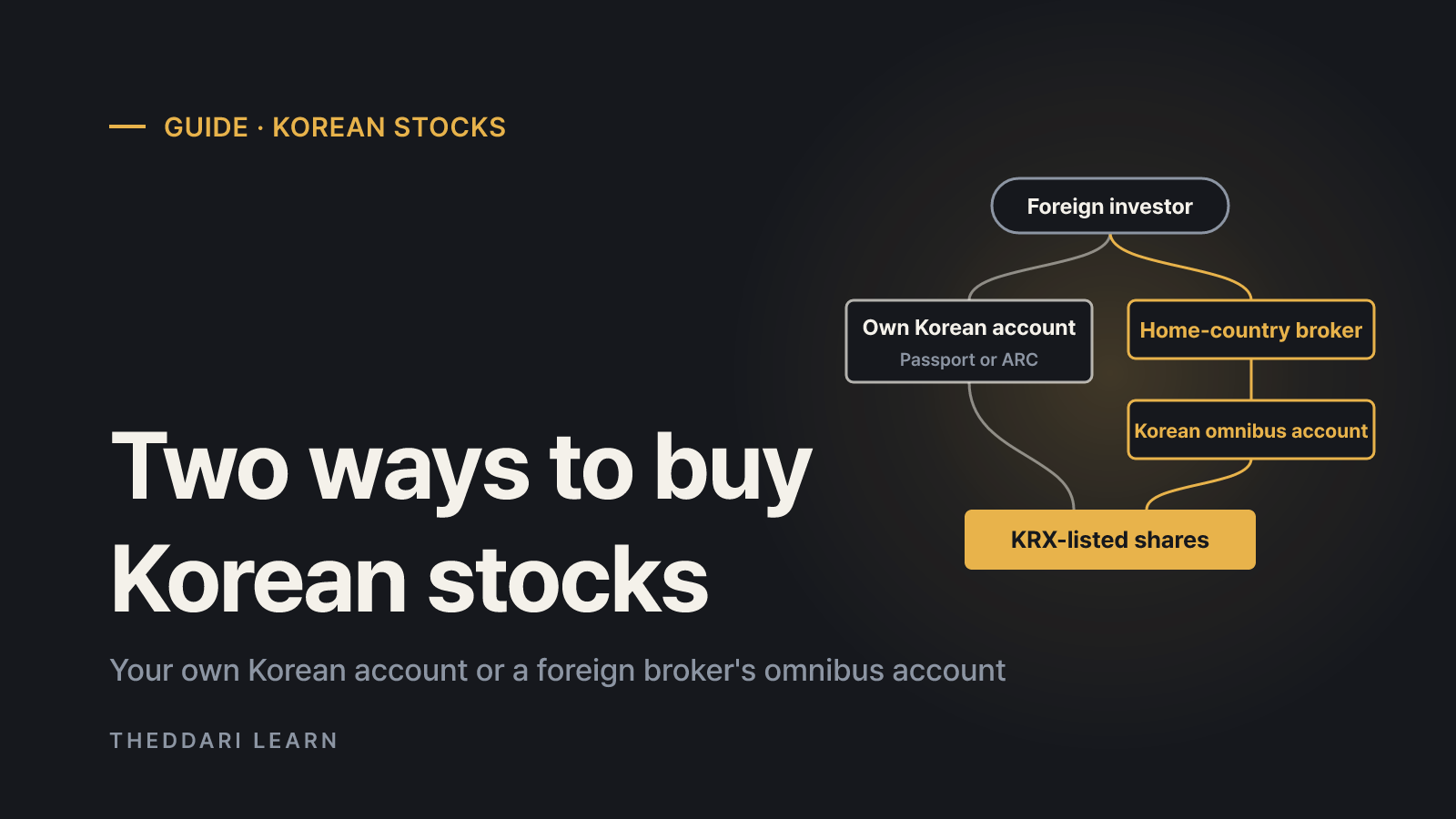
If you want to buy Korean stocks as a foreigner, there are two practical routes as of October 2026. You can open your own account at a Korean securities firm, which is the usual path for people living in Korea, or you can trade through a broker in your home country that has opened an omnibus account in Korea. Korea dropped its old investor pre-registration rule in December 2023, so the main hurdles today are broker-level identity checks and whether your own broker supports the Korea Exchange (KRX).
This guide covers rules published by Korea's Financial Services Commission (FSC) and National Tax Service (NTS). It applies to Korean-listed shares, not to Korea-focused ETFs listed in the US or elsewhere. Broker documents and app support change often, so treat the dates below as reference points and confirm with the firm before you apply.
How to buy Korean stocks as a foreigner: what changed
For about three decades, foreign investors had to register with the Financial Supervisory Service (FSS) and obtain an Investment Registration Certificate, or IRC, before buying Korean-listed securities. The FSC abolished that requirement effective December 14, 2023. Individuals can now open an account with a passport number, and companies with a Legal Entity Identifier (LEI). Existing IRC holders can keep their number.
The same package eased omnibus accounts. Korea allowed them in 2017, but foreign brokers had to report each end investor's trades at settlement (T+2), so nobody used them. From December 2023, the reporting cycle became monthly: foreign brokers report by the 10th of the following month.
Momentum picked up in 2025. According to an FSC explanatory note from February 26, 2026, the first foreign omnibus account opened in August 2025 between Hana Securities and Hong Kong's Emperor Securities, with the first trades in October 2025. In September 2025, Yuanta Securities (with Hong Kong's TFI and US-based Banctrust) and Samsung Securities (with UK-based Interactive Brokers) received regulatory sandbox approval. In January 2026, a rule amendment removed limits on which foreign firms may open omnibus accounts.
Two routes compared
Best fit
- Your own Korean brokerage account
- Foreigners living in Korea; non-residents willing to handle Korean paperwork
- Foreign broker's omnibus account
- Retail investors living outside Korea
Account holder
- Your own Korean brokerage account
- You
- Foreign broker's omnibus account
- Your foreign broker; you hold a local account
ID used
- Your own Korean brokerage account
- Passport number (residents also show an Alien Registration Card)
- Foreign broker's omnibus account
- Your broker's own KYC process
Where you place orders
- Your own Korean brokerage account
- Korean broker's app, desktop platform or branch
- Foreign broker's omnibus account
- Your home broker's app or phone desk
How dividends arrive
- Your own Korean brokerage account
- Directly to your account
- Foreign broker's omnibus account
- Depository → foreign broker → you, pro rata
Main question to ask
- Your own Korean brokerage account
- Can foreigners open the account remotely?
- Foreign broker's omnibus account
- Does my broker offer KRX shares yet, and at what cost?
Both routes give you exposure to the same KRX-listed shares. The difference is whose name the shares sit in and which app you use. A direct account keeps ownership simple but takes more paperwork; an omnibus route is convenient but depends on your broker having signed up.
Living in Korea: how to open a foreigner brokerage account in Korea
BNK Securities' English guide lists an Alien Registration Card and a copy of your passport for foreign nationals who have lived in Korea for more than six months. Other firms follow a similar pattern, though details vary.
- 1
Pick a broker that serves foreigners
Check for English support and whether foreigners can open accounts remotely. Korea Investment & Securities, for example, says on its smartphone account-opening page that foreigners cannot open accounts by smartphone, which means a branch visit.
- 2
Prepare documents
Bring your ARC, passport, a Korean mobile number in your name and a Korean bank account. Make sure the English spelling of your name matches across all of them.
- 3
Open the account
Open a standard brokerage (domestic equity) account at a branch or online where allowed. New customers may start with a limited-withdrawal account as an anti-fraud measure.
- 4
Fund and trade
Transfer Korean won from your own bank account, then place orders in the app by ticker, quantity and price. Trades settle two business days later (T+2).
- 5
Plan for leaving Korea
Your status can change from resident to non-resident when you move abroad, which affects taxes and account terms. Ask the broker what happens to the account before you leave.
Living abroad: omnibus accounts and direct accounts
Trading through your home broker
The FSC describes the omnibus model as the mirror image of how Koreans buy US shares: a foreign broker opens an account in its own name at a Korean securities firm, collects orders from its clients, and sends them to Korea in bulk. Under the FSC's November 2025 guideline, the foreign broker must keep end-investor trade records for 10 years and submit them monthly, while dividends pass from the Korea Securities Depository to the broker and then to each client.
As of February 2026, seven Korean firms besides Hana (Samsung, Yuanta, Meritz, Mirae Asset, Shinhan, NH and KB) were preparing launches, with timing dependent on foreign partners.
We could not find an official, current list of foreign brokers that offer Korean shares as of October 2026. Ask your broker directly whether KRX orders are available on your account type and in your country.
Opening a Korean account from abroad
Non-residents can open a Korean account with a passport number, but the process may involve appointing a standing proxy, notarizing documents and posting originals. BNK's guide, for instance, asks Korean nationals living abroad for a standing proxy agreement and proof of overseas residence. For small personal portfolios, compare this effort with omnibus access or with Korea-focused ETFs listed on your home exchange.
Taxes, currency and other risks
- Dividends: Under the NTS non-resident withholding table, a non-resident without a permanent establishment in Korea is withheld at 20% on dividends. If your country's tax treaty sets a lower rate, the treaty rate applies, usually after you file residency paperwork with the payer.
- Capital gains: When a non-resident's securities gain is taxable, withholding is the lower of 10% of proceeds or 20% of the gain. Whether a gain on listed shares is taxable depends on your stake and treaty, so check case by case.
- Currency risk: Korean shares trade in won. A weaker won against your home currency can turn a flat share price into a loss in your currency.
- Costs: Omnibus routes can add home-broker commissions and FX spreads. Compare total cost, not only the headline fee.
- Information: Korea began phasing in mandatory English disclosures from January 2024, but not every filing is available in English.
Korean equities react strongly to rates, the won and earnings. Before you place a first order, it helps to know when major economic data and company results are scheduled.

To see which Korean stocks and themes local investors are talking about, the stock Telegram trends page tracks frequently mentioned topics. Mentions show attention, not value.
Quick checklist
- Living in Korea: matching name spelling on ARC and passport → broker that accepts foreigners (online or branch) → Korean bank account linked
- Living abroad: confirm KRX access with your broker → compare fees and FX → read how dividends are paid
- Everyone: check your treaty withholding rate → review tax residency if you move → account for won exchange-rate risk
In short, foreigners no longer need government pre-registration to invest in Korea. What remains is choosing between a direct Korean account and your home broker's omnibus access, then confirming taxes for your country. Rules were still changing through 2026, so recheck the sources above before you open an account.