Contents6 sections
Bumble Inc. (Nasdaq: BMBL) is an Austin, Texas–based company that runs the Bumble and Badoo dating apps and the BFF friendship app. It earns most of its revenue when members buy subscriptions or make in-app purchases, so the two numbers that explain the Bumble business are paying users and average revenue per paying user (ARPPU). This guide uses the company's Q2 2026 results released on August 5, 2026 and the take-private reports of October 12, 2026. Figures are as of October 13, 2026.
How Bumble makes money
Whitney Wolfe Herd, a Tinder co-founder, launched Bumble in 2014. The app became known for letting women send the first message after a match. According to the BBC, Bumble dropped that rule in August 2026, so anyone in a match can now start the conversation. Wolfe Herd stepped down as CEO in January 2024 and returned in March 2025. The company went public on Nasdaq in February 2021, and affiliates of Blackstone and the founder hold outsized voting power.
Bumble reports two revenue lines. Bumble App revenue comes from subscriptions and in-app purchases on Bumble and Bumble For Friends. Badoo App and Other covers Badoo, launched in 2006, plus other apps the company has operated, third-party apps using its technology, and advertising and partnership revenue. The BFF app, relaunched in the United States in September 2025, is not yet being monetized, so it is excluded from the key operating metrics.
Bumble App
- Q2 2026 revenue
- $171.7M
- YoY change
- -14.7%
- Paying users (monthly avg.)
- 2,077,100
- ARPPU
- $27.55
Badoo App and Other
- Q2 2026 revenue
- $38.8M
- YoY change
- -17.1%
- Paying users (monthly avg.)
- 1,080,100
- ARPPU
- $11.21
Total
- Q2 2026 revenue
- $210.5M
- YoY change
- -15.2%
- Paying users (monthly avg.)
- 3,157,200
- ARPPU
- $21.96
The Bumble App generates about 82% of revenue ($171.7M ÷ $210.5M) while accounting for about 66% of paying users. The gap exists because a Bumble App payer spends more than twice as much per month as a Badoo payer. In practice, the direction of the Bumble App's paying users and ARPPU drives the consolidated result far more than Badoo does.
How paying users and ARPPU are defined
Bumble counts a paying user as a member who bought or renewed a subscription or made an in-app purchase in a given month, then averages the monthly counts over the period. ARPPU is revenue for the period divided by paying users, divided again by the number of months. It answers a simple question: how much does the average payer spend per month? For the Bumble App, $171.7 million ÷ 2.0771 million ÷ 3 months gives roughly $27.55. The company excludes advertising and partnership revenue from these metrics, so dividing total revenue by total paying users will not exactly reproduce Total ARPPU.
Key metrics that move BMBL stock
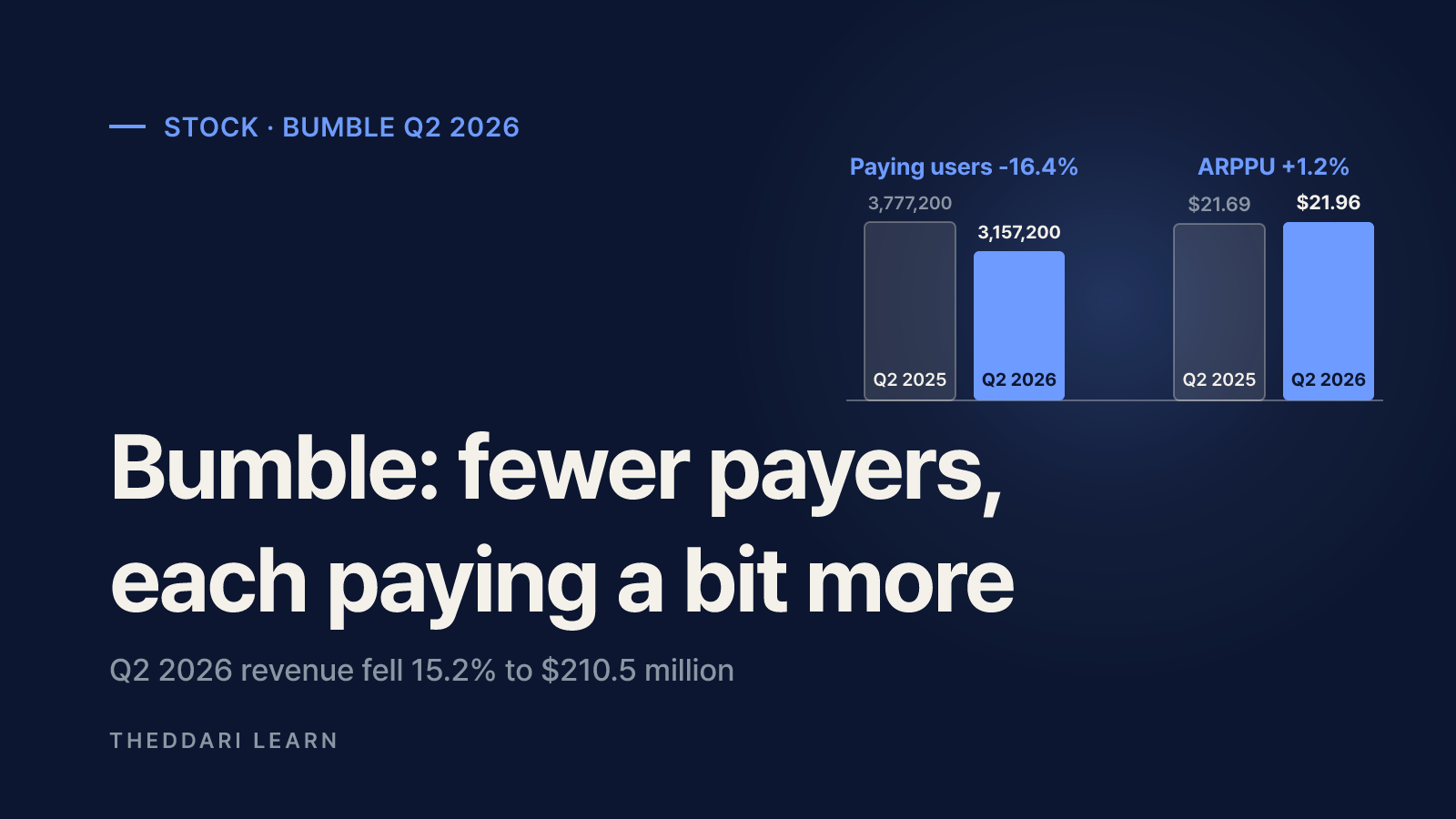
The short version of Q2 2026 is fewer payers, each paying slightly more. Total Paying Users fell from 3,777,200 a year earlier to 3,157,200, a 16.4% drop. Total ARPPU rose from $21.69 to $21.96, up 1.2%. Because the decline in payers was far larger than the gain in spend per payer, revenue fell 15.2%. The two apps also diverged: Bumble App ARPPU rose from $26.85 to $27.55, while Badoo App and Other ARPPU slipped from $11.57 to $11.21.
- Paying-user trend: the most direct recovery signal is a smaller year-over-year decline, and eventually a quarter-over-quarter increase.
- ARPPU: price increases or a richer plan mix can lift it, but rising ARPPU alongside churn may simply mean only the most committed users remain.
- Adjusted EBITDA and margin: $72.9 million, or 34.6% of revenue, down from 38.1% a year earlier. Management said it is now reinvesting in product, technology and brand.
- Free cash flow: $51.1 million in Q2, defined as operating cash flow minus capital expenditures, which shows capacity to service debt.
- Guidance: for Q3 2026 Bumble guided to total revenue of $205–213 million, Bumble App revenue of $167–173 million, and Adjusted EBITDA of $56–60 million.
Separate the impairment from the operating picture
GAAP net loss was $127.9 million in Q2, or -60.7% of revenue. That figure includes a $169.3 million impairment of indefinite-lived intangible assets and goodwill; the year-earlier quarter carried a $404.9 million impairment. Impairment does not drain cash in the quarter, but it is an accounting admission that acquired assets or brands are worth less than once expected. Goodwill stood at $603.5 million on June 30, 2026, down from $732.7 million at the end of 2025. Treat positive Adjusted EBITDA as one input and check whether impairments keep recurring.
Watch the balance sheet
At June 30, 2026, Bumble had $154.0 million in cash and cash equivalents and $451.0 million of total debt. It refinanced its term loans in April 2026, and the current portion of long-term debt rose to $52.2 million. For a company with shrinking revenue, interest costs and repayment schedules deserve as much attention as user metrics.

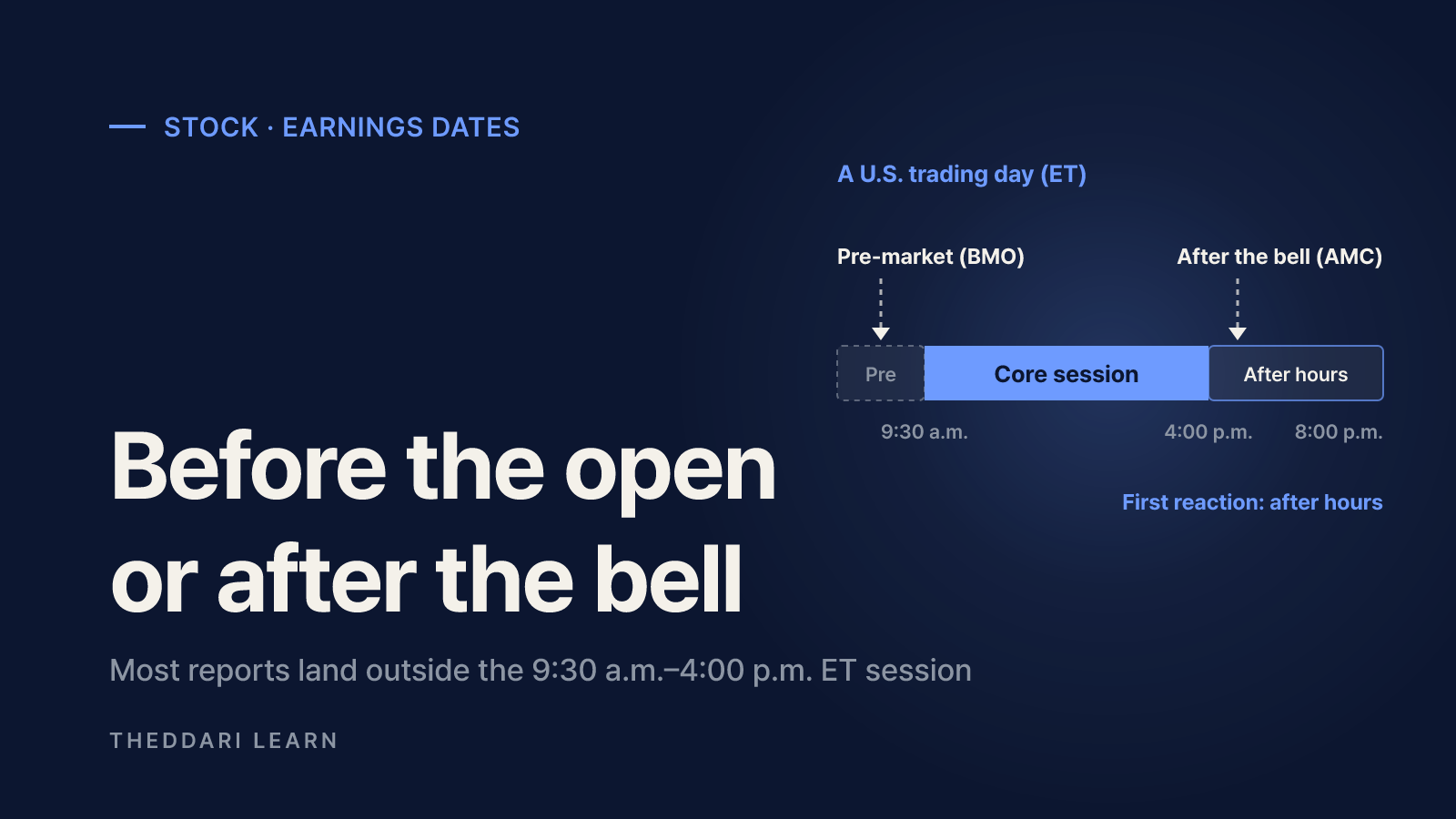
Bumble confirms its next report date through investor-relations notices. You can track it on the theddari earnings calendar, then compare the five metrics above against the prior quarter and the same quarter a year earlier. The Q2 release came with a conference call at 4:30 p.m. Eastern Time, after the regular U.S. trading session, so check the release time before reading any price move.
The October 2026 take-private reports
On October 12, 2026, the Wall Street Journal, Reuters and Bloomberg reported that Ithaca Holdings was in advanced talks to take Bumble private in a deal valuing the company at roughly $1 billion. The BBC reported that the shares rose almost 50% that day, lifting the market value above $580 million. That remains far below the peak of more than $14 billion reached after the 2021 listing.
Bloomberg cited people familiar with the matter who said no final decision had been made and that talks could fall through or the timing could change. As of October 13, 2026, neither Bumble nor Ithaca had commented. Whether the $1 billion is equity value or enterprise value, and what shareholders would receive per share, will only be clear from an official announcement.
The distinction matters. Enterprise value is roughly equity value plus net debt (debt minus cash). With $451.0 million of debt and $154.0 million of cash at the end of June, a $1 billion enterprise value would leave meaningfully less for shareholders. Bumble's structure, with Class A shares plus holding-company Common Units, also makes a simple market-cap comparison unreliable. The merger agreement, if one is signed, will state the per-share consideration.
What to check while a deal is only rumored
- 1
Wait for the press release and 8-K
An announced deal will specify the per-share cash price, structure and expected closing timeline. Reported terms can change before signing.
- 2
Compare the share price with the offer
Once terms are public, the gap between the market price and the offer price, known as the merger spread, reflects the perceived risk that the deal fails and the time until closing.
- 3
Check approvals and major holders
Shareholder approval, regulatory review and the positions of Blackstone affiliates and the founder can all shape whether a transaction closes.
- 4
Consider the no-deal scenario
If talks collapse, the takeover premium can fade and the stock is again priced on operating metrics, where shrinking paying users and debt return to the center.
Competition and risks for dating app stocks
Bumble's main rival is Match Group, owner of Tinder, Hinge and OkCupid. Both stocks have fallen sharply from their 2021 peaks. The BBC notes that some younger users have grown tired of swiping and are turning to group activities such as board-game nights and book clubs, and that Bumble said in 2025 it would cut almost a third of its workforce. Management now describes a product overhaul that includes a platform migration, new matching algorithms, new ways to start conversations, more in-person events and group features.
- App store distribution: the company lists its reliance on third-party platforms such as Apple's App Store and Google Play, and its ability to offset their fees, as a risk factor.
- Privacy and security: dating apps hold sensitive personal data, so privacy regulation and data breaches are material risks.
- Governance: the outsized voting rights of Blackstone affiliates and the founder limit the influence of public shareholders.
- Currency: the company flags foreign exchange movements as a factor that can change reported results.
Sentiment around dating app stocks can shift quickly. The theddari Telegram stock trends page shows how often names like Bumble and Match Group are being discussed, but discussion volume says nothing about valuation or whether a deal will close. Keep community chatter separate from company filings.
In short, Bumble is a subscription app business whose revenue depends on how many people pay and how much each payer spends. In Q2 2026 the first number fell sharply, and in October takeover reports drove the stock. From here, the useful sequence is the terms of any official announcement, the next quarter's paying-user trend, whether impairments recur, and the debt repayment schedule.