Contents7 sections
A bitcoin live price differs from exchange to exchange because every exchange runs its own order book, and money cannot move freely between some markets. The biggest and best-known gap is between South Korea's won-based exchanges, such as Upbit and Bithumb, and dollar-based global exchanges such as Binance. Expressed as a percentage, that gap is called the Kimchi premium. This guide explains, as of November 2026, why the numbers differ, how to calculate the premium from KRW and USD quotes, and why the gap is much harder to capture than it looks. It does not forecast prices.
Why the bitcoin live price is different on every exchange
A stock usually has one primary listing. Bitcoin trades on hundreds of venues at once, and each one is a separate marketplace that matches only its own users' buy and sell orders. The "current price" on any screen is simply the most recent trade on that venue, not an official global price.
Separate order books, separate traders
Korean exchanges are dominated by Korean residents trading in won. Global exchanges attract users worldwide who trade against USDT or other dollar-linked assets. Whichever side sees more buyers at a given moment prints a higher last price. When trading is thin, the last price can also be seconds or minutes old.
Different currencies bring in an exchange rate
To compare a won price with a USDT price you must multiply the dollar price by the USD/KRW rate. That means the comparison changes when the exchange rate moves, even if bitcoin itself does not. If USDT trades slightly away from one dollar, that adds a small error too.
Capital controls slow down arbitrage
Within one country, a price gap invites traders to buy low and sell high until it closes. Across borders, that is harder. Igor Makarov and Antoinette Schoar's study of 34 exchanges in 19 countries found that price deviations were much larger across countries than within them, and pointed to capital controls as a key reason (Journal of Financial Economics). They calculated that the daily average price ratio between the US and Korea from December 2017 to early February 2018 was more than 15% and reached 40% for several days, while gaps between exchanges in the same country typically did not exceed 1% on average (MIT Sloan summary).
How to calculate the Kimchi premium from KRW and USD prices
The Kimchi premium measures how far the Korean won price sits above the overseas price after converting it into won. The overseas converted price is the base. A negative result, where Korea is cheaper, is often called a reverse premium.
Kimchi premium (%) = (Korean KRW price ÷ (overseas USDT price × USD/KRW rate) − 1) × 100
- 1
Pick the overseas quote
Take the BTC/USDT price on one global exchange. Most trackers treat 1 USDT as 1 US dollar.
- 2
Convert it into won
Multiply the USDT price by the USD/KRW rate. Write down which rate you used.
- 3
Divide the Korean price
Divide the Korean exchange's won price at the same moment by the converted price, then subtract 1.
- 4
Turn it into a percentage
Multiply by 100. Positive means Korea is more expensive; negative means Korea is cheaper.
A worked example with real numbers
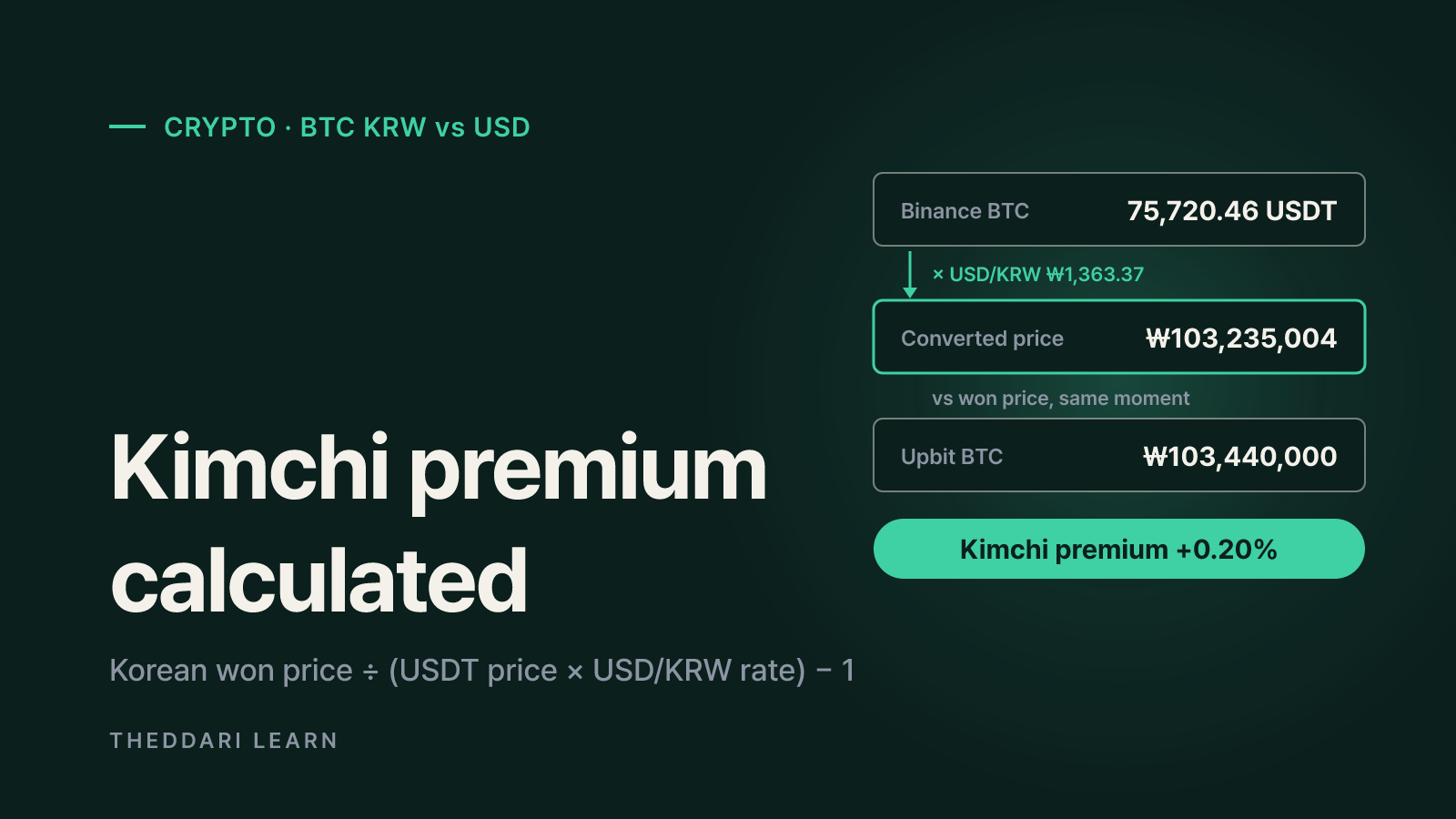
The Korean premium tracker CoinGaja published this calculation on its method page for 9 November 2026 at 06:17 Korea Standard Time (CoinGaja method):
Binance BTC
- Value
- 75,720.46 USDT
- How
- Overseas last price
USD/KRW rate
- Value
- ₩1,363.37
- How
- Market rate
Converted price
- Value
- ₩103,235,004
- How
- 75,720.46 × 1,363.37
Upbit BTC
- Value
- ₩103,440,000
- How
- Korean last price
Kimchi premium
- Value
- +0.20%
- How
- 103,440,000 ÷ 103,235,004 − 1
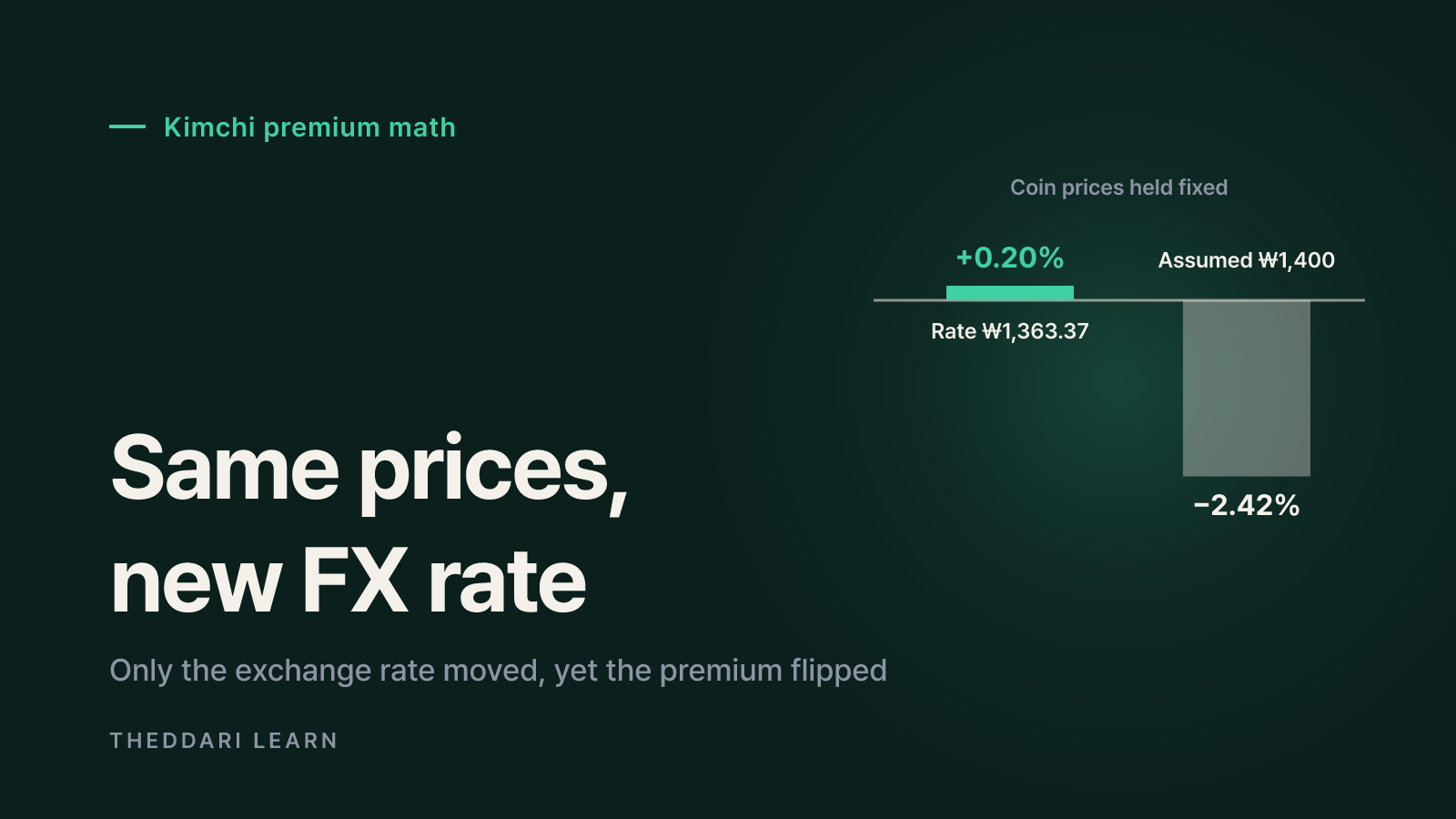
That is one snapshot and it changes within seconds. To see how sensitive the result is to the exchange rate, keep both bitcoin prices and assume a rate of ₩1,400 instead. The converted price rises to about ₩106 million and the premium becomes roughly −2.42%. The coin prices did not move; only the rate did.
The tether premium as a cross-check
Some trackers convert with the won price of USDT on a Korean exchange instead of the bank rate. The tether premium itself is (Upbit USDT price in won ÷ USD/KRW rate − 1). If bitcoin's premium is high but the tether premium is equally high, bitcoin is not uniquely expensive; dollars are simply expensive inside Korea's crypto market.

BTC KRW vs USD: why price sites disagree
Search for a bitcoin price and an exchange app, CoinGecko, Yahoo Finance and a premium tracker may all show different numbers. Usually none of them is wrong; they define "price" differently.
Exchange app
- What the number means
- Last trade on that exchange's market
- Watch out for
- Your order fills at the bid or ask, not the last trade
Global exchange
- What the number means
- Last trade on a USDT or USD pair
- Watch out for
- USDT can drift slightly from $1
Aggregator (e.g. CoinGecko)
- What the number means
- Volume-weighted average across venues
- Watch out for
- A KRW figure is converted, not a Korean exchange price
Premium tracker
- What the number means
- Ratio of Korean price to converted price
- Watch out for
- Rate source, refresh speed and filters vary by site
CoinGecko says it builds its bitcoin price index from BTC/USD, BTC/USDT, BTC/USDC and BTC/EUR pairs, converts to other fiat currencies with external exchange-rate data, removes outliers and then takes a volume-weighted average (CoinGecko methodology). Its won figure therefore reflects mostly global trading, which is why it can sit apart from Upbit by roughly the size of the Kimchi premium. Premium trackers also differ: CoinGaja, for example, reports the median across four Korean exchanges and hides prices that have not updated for more than 20 seconds.
Why the premium is hard to arbitrage
A 3% premium looks like 3% profit from buying abroad and selling in Korea. In practice several costs and limits sit in between.
- Trading fees on both exchanges, plus withdrawal and network fees, stack up.
- Prices and the premium move while coins are in transit.
- Large orders walk the order book and fill at worse prices than displayed.
- Banks charge a currency spread, so your real rate is worse than the tracker's rate.
- Coins with suspended deposits or withdrawals can show big gaps that nobody can close.
Repeating the trade means sending won back out of Korea. South Korea's finance ministry said in December 2025 that it would unify the annual undocumented overseas remittance limit for residents at USD 100,000 across banks and non-bank providers from January 2026, and that repeated small transfers after the limit is used up would be reported to tax and customs authorities (Korea.kr briefing). Larger transfers need documentation, and structuring payments to dodge the rules can breach Korean foreign-exchange law.
Be cautious with anyone selling Kimchi premium arbitrage as a side hustle or asking to borrow your exchange account or wallet. These schemes can expose you to fraud and money-laundering investigations.
A quick checklist before you trust a price
- Look at the order book on the exchange you will actually use, not just the headline price.
- Fix one overseas exchange and one pair, such as Binance BTC/USDT, for comparisons.
- Check which exchange rate the premium site uses and whether it also shows a tether-based figure.
- On days with a big currency move, do not read a premium change as a shift in crypto demand alone.
- Treat prices from exchanges under maintenance or with suspended transfers separately.
Price gaps between exchanges are not glitches. They come from separate markets, different currencies and limits on moving money. The Kimchi premium is a useful gauge of how strong Korean demand is relative to the rest of the world, but its value depends on the inputs and it ignores costs. Whenever you see a number, ask which exchange, which rate and what time it refers to.