Contents7 sections
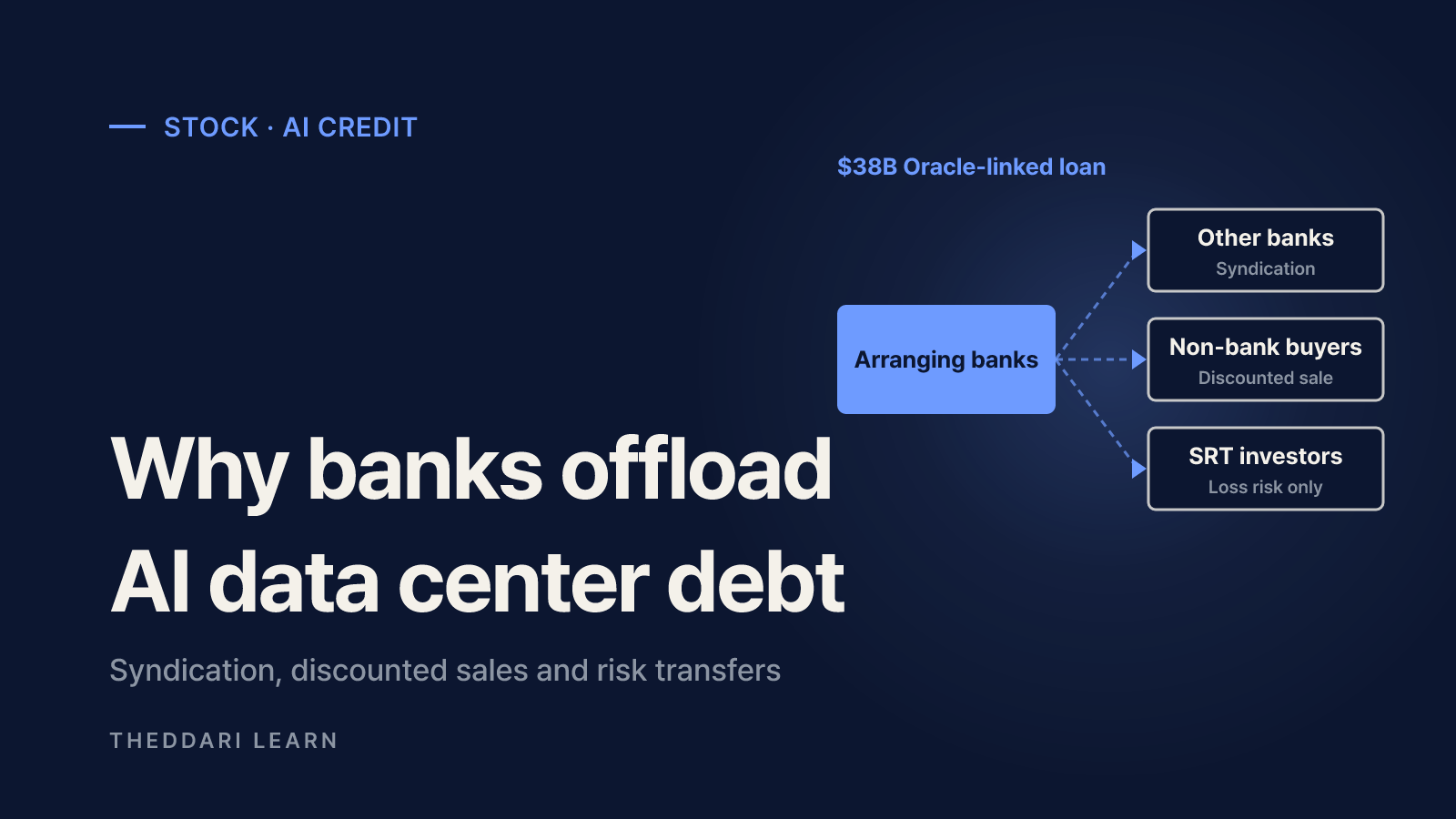
Banks are offloading AI data center debt mainly because their exposure to a handful of AI borrowers is pressing against internal risk limits, not because the loans have defaulted. As of October 2026, a group led by JPMorgan Chase and Mitsubishi UFJ Financial Group (MUFG) was still distributing a record $38 billion construction loan for Oracle-leased data centers in Texas and Wisconsin, more than six months after it was underwritten. Some lenders were reportedly willing to sell the last pieces to non-bank buyers at a discount. This guide covers the US-led market for AI infrastructure lending: what these loan sales are, why markets treat them as a signal, how the pressure can reach stocks and bonds, and what to monitor. It relies on reporting and official material available through October 15, 2026.
The deals behind the headlines
According to AI Weekly's summary of Bloomberg's reporting, the $38 billion package splits into a $23.25 billion facility for the Texas site and a $14.75 billion facility for Wisconsin. Both campuses are being developed by Vantage Data Centers and leased by Oracle for its Stargate commitment with OpenAI. The debt is priced around 2.5 percentage points over the benchmark rate and matures in four years, with two one-year extension options. More than two dozen banks and investors have joined, and lenders were still looking to place less than $1 billion. Wells Fargo, BNP Paribas, Goldman Sachs, Sumitomo Mitsui and Societe Generale took allocations after the first round.
A second deal shows how pricing changes with borrower quality. Vector reports that JPMorgan and Goldman Sachs were marketing about $5.01 billion of loans for Volta, a young company that rents out AI computing power, tied to a converted data center campus at Tydal, Norway. Roughly $3.71 billion funds graphics processors and $1.3 billion supports the collateral Volta must post for its lease. The lease runs 16 years, but the tenant can leave after ten without a fee, and indicative yields were reported above 11%. That is a very different risk profile from a loan backed by an investment-grade hyperscaler.
Timeline note: the Financial Times first reported in May 2026 that JPMorgan, Morgan Stanley and SMBC were exploring private loan sales and risk transfers for data center debt. October coverage revisited how far the sell-down had progressed. Individual banks' remaining holdings and sale prices have not been disclosed.
How banks offload AI data center debt
"Offloading" covers several structures. They move different amounts of risk to different buyers, so it helps to separate them before drawing conclusions.
Loan syndication
- What moves
- Shares of the loan go to other banks and institutions
- What the bank keeps
- Arranger fees and a retained slice
- What to watch
- Routine for jumbo loans; speed and pricing matter
Outright loan sale
- What moves
- The loan itself
- What the bank keeps
- Any gain or loss on sale
- What to watch
- Discounts reveal the price buyers demand
Significant risk transfer (SRT)
- What moves
- Part of the loss risk, usually a junior slice
- What the bank keeps
- The loan and the senior risk
- What to watch
- Limited disclosure makes the risk harder to track
Loan syndication is the normal first step
No single bank wants to hold a multibillion-dollar construction loan to maturity. Arrangers typically underwrite the full amount, then sell participations to other banks, insurers and funds. The question is not whether syndication happens but how quickly and on what terms. A fast sell-down at par signals strong demand. A process that drags on for six months and ends with discounted sales suggests the original pricing was too generous for the risk.
Significant risk transfers keep the loan but shed the losses
The Basel Committee's February 2026 report describes synthetic risk transfers as deals in which a bank passes all or part of the credit risk on a pool of assets to a counterparty while keeping ownership of the assets. Private investment funds dominate the buyer base, and banks use the trades chiefly for capital and credit risk management. The committee estimates that about EUR 750 billion of assets in Canada, the euro area, the US and the UK are protected this way, roughly 1.1% of total bank assets. It also notes that some jurisdictions see remaining blind spots around disclosure and how SRT investors finance their positions. Slicing a single concentrated data center loan into risk layers, as banks were reported to be exploring, pushes this tool into new territory.
Why the sell-off is read as a warning sign
The signal lies in who is selling, why and at what price. Startup Fortune's roundup, citing the FT and Bloomberg, says lenders are approaching internal limits on AI-linked exposure. A credit risk-sharing executive at Man Group told the FT the deal sizes were "out of scale to anything we've thought about, ever." When the lenders closest to the borrowers start trimming, other investors pay attention.
- Concentration: once one borrower or sector fills a bank's limit, the bank cannot lend more without selling down.
- Tenant credit: S&P reportedly cut Oracle to BBB- in July 2026, and its five-year CDS spread was reported near 151 basis points in early October.
- Softer bond demand: Bloomberg reported that order books for big tech bond deals shrank from about five times the amount offered in February to under two times by July.
- Higher base rates: the 10-year Treasury yield was reported above 5.3% in October, raising the cost of long construction financing.
There is a less alarming reading. Most of the Oracle-linked loan did find buyers, which looks more like repricing than a closed market. Reports that capital is rotating toward data centers leased to highly rated tenants such as Microsoft and Google suggest lenders are discriminating between borrowers rather than abandoning AI infrastructure. Both readings can be true at once.
How AI bubble risk travels into stocks and credit
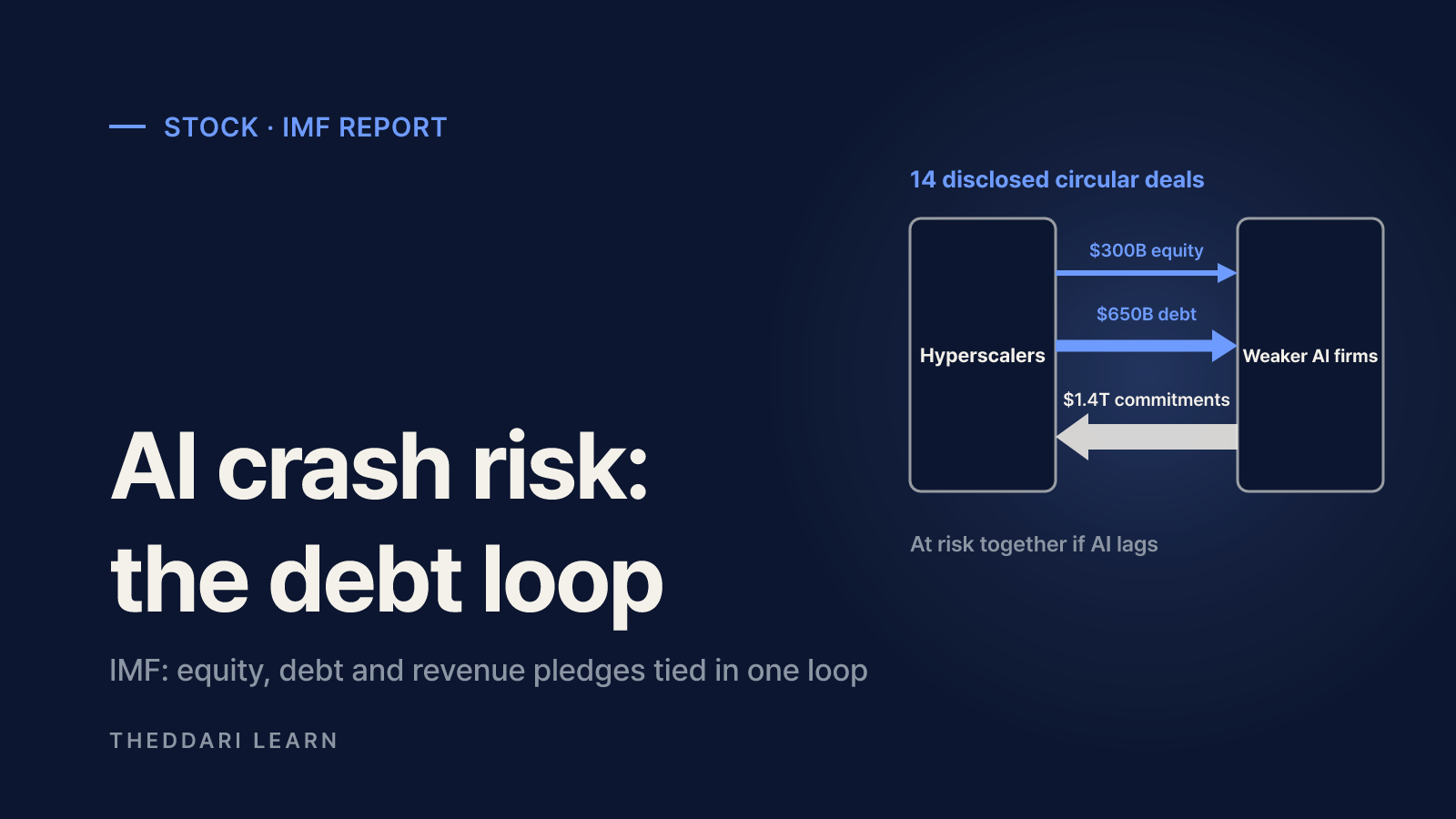
The IMF's October 2026 Global Financial Stability Report, as reported by The Guardian, warned that a correction in AI-related assets could be amplified by rising leverage, concentrated exposures and circular financing. It counted about $300 billion of transactions between hyperscalers and weaker AI firms over three years, supplemented by $650 billion of debt, in exchange for $1.4 trillion of future commitments. Bank loan sales sit at the credit end of that chain.
- 1
Financing gets more expensive
If banks struggle to sell existing loans, they charge more or tighten terms on new ones. Developers and lower-rated AI compute providers feel this first.
- 2
Build-out plans adjust
Higher funding costs can delay or shrink projects, which can affect order expectations for chip, power equipment and memory suppliers.
- 3
Bonds and stocks reprice
Wider bond spreads and CDS for tenants and developers can translate into lower equity valuations. Smooth loan placements would ease this pressure.
None of these steps is inevitable. If AI revenue grows fast enough to prove that tenants can cover their rent, lender appetite can return. Treat loan market news as a prompt to check fundamentals, not as a forecast.
A checklist for investors
- Identify the tenant. A loan backed by an investment-grade hyperscaler carries very different risk from one backed by a young compute provider.
- Read the lease terms. Early exit rights, like the ten-year option in the Volta deal, can shorten the effective repayment period.
- Track spreads and discounts. Rising margins over the benchmark and more reports of discounted sales mean the price of risk is climbing.
- Check balance-sheet reliance. Look in annual reports for how much data center spending is funded through bonds, leases or special purpose vehicles.
- Listen to bank earnings calls. Sector exposure, credit loss provisions and mentions of risk transfers are useful clues.
The theddari earnings calendar helps you track reporting dates for Oracle, the big banks and AI infrastructure companies, and the economic calendar lists the inflation, jobs and Federal Reserve dates that move Treasury yields. These are scheduling aids, not price predictors, so confirm dates with the official publisher. You can also follow how market chatter about AI debt evolves on the stock Telegram trends page.

Bottom line: banks selling down AI data center debt is not proof of a crisis, but it shows the loan market is charging more for AI infrastructure risk. Watch whether syndications keep dragging, whether discounted sales and risk transfers multiply, and whether weaker borrowers face sharply higher rates. Several reported figures have not been confirmed by the banks or borrowers, so recheck them against new filings and earnings disclosures.