Contents7 sections
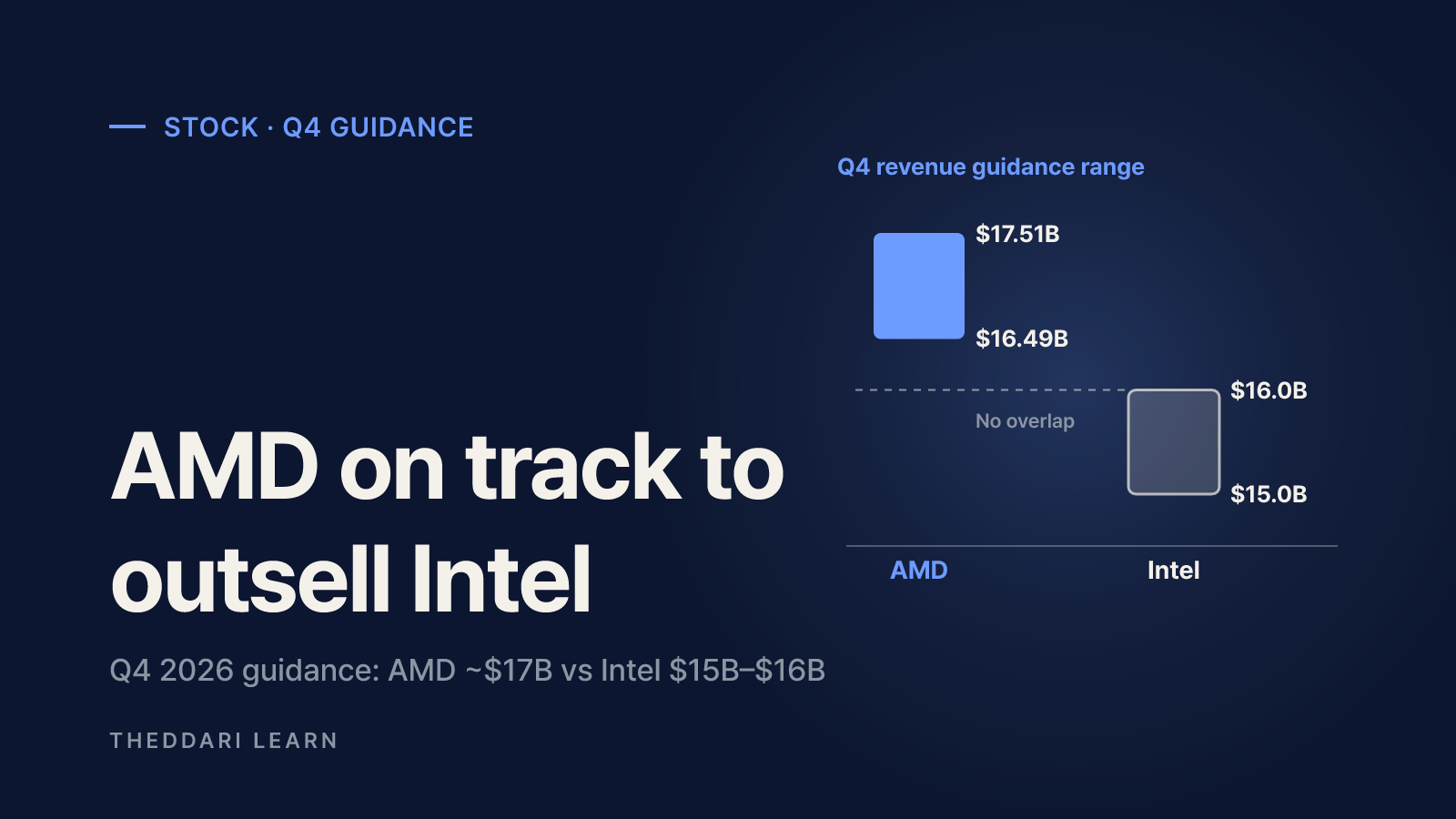
Short answer: will AMD outsell Intel in Q4 2026? Very likely, for the first time ever, but it is a forecast, not a result yet. As of November 5, 2026, AMD has guided fourth-quarter revenue to about $17 billion, plus or minus 3%, while Intel has guided $15.0 billion to $16.0 billion. The bottom of AMD's range (about $16.49 billion) sits above the top of Intel's, so if both companies land inside their own ranges, the smaller rival will report the bigger quarter. The numbers below come from AMD's Q3 2026 earnings release and Intel's Q3 2026 earnings release.
For investors, the headline matters less than the mix behind it. Both companies are facing the same PC slowdown driven by expensive memory. One responded with record guidance; the other suffered its worst trading day in roughly half a century. The difference is where each company's revenue comes from.
AMD outsell Intel: the Q4 guidance side by side
Guidance is management's forward estimate for the next quarter, usually a revenue range plus a margin target. It is not a promise; both press releases carry forward-looking statement warnings. Still, it is the best public signal of what each company expects.
Report date (US)
- AMD
- Nov 3, 2026
- Intel
- Oct 29, 2026
Q3 2026 revenue
- AMD
- $13.4B (+45% YoY)
- Intel
- $16.5B (+21% YoY)
Q4 2026 revenue guidance
- AMD
- ~$17B ±3%
- Intel
- $15.0B–$16.0B
Implied range
- AMD
- $16.49B–$17.51B
- Intel
- $15.0B–$16.0B
Midpoint
- AMD
- $17.0B
- Intel
- $15.5B
Q4 non-GAAP gross margin outlook
- AMD
- ~55%
- Intel
- 38.0%
Through Q3, Intel was still larger: $16.5 billion versus AMD's $13.4 billion. For Q4, AMD's midpoint implies about 27% sequential growth and about 66% year-over-year growth, while Intel expects revenue to fall from Q3. The midpoint gap is roughly $1.5 billion. Even comparing AMD's low end with Intel's high end, AMD leads by about $490 million.
Watch margins, not just revenue. AMD expects a non-GAAP gross margin near 55% in Q4, Intel 38%. Equal revenue does not mean equal profit, and the margin gap is arguably the more durable story for both stocks.
How the revenue mix differs: data center, PC and foundry
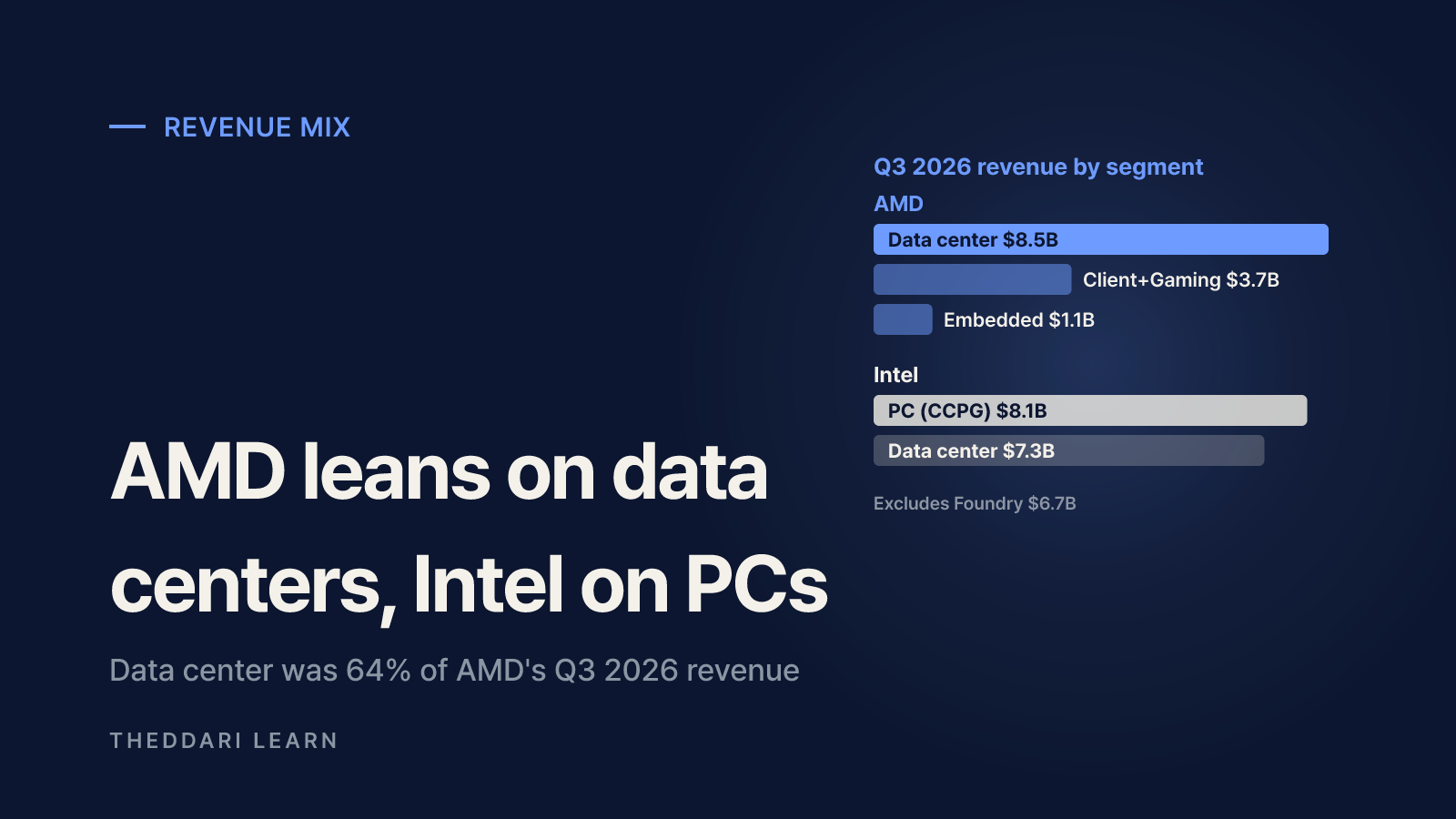
In Q3 2026, data center made up 64% of AMD's revenue. Intel's largest segment is still its PC business, the Client Computing and Physical AI Group (CCPG).
Data center
- AMD
- $8.5B (+97%) — EPYC CPUs, Instinct GPUs
- Intel
- DCAI $7.3B (+78%) — Xeon and more
PC / client
- AMD
- Client and Gaming $3.7B (-8%); client alone $2.9B
- Intel
- CCPG $8.1B (-5%)
Gaming
- AMD
- $773M (-40%)
- Intel
- No separate segment
Embedded / other
- AMD
- Embedded $1.1B (+29%)
- Intel
- All other $0.7B
Foundry
- AMD
- None (outsourced manufacturing)
- Intel
- Intel Foundry $6.7B, mostly internal sales
AMD: data center carries the growth
AMD's Data Center segment nearly doubled year over year to $8.5 billion. Per Tom's Hardware, AMD expects Q4 data center revenue to rise about 50% sequentially, Client and Gaming to fall more than 20%, and Embedded to grow double digits. CEO Lisa Su said server revenue should double in 2027 and data center should exceed 80% of total revenue. In other words, the $17 billion outlook is data center growth outrunning a PC decline.
Intel: PC-heavy, with a costly foundry build-out
Intel's DCAI segment grew 78% to $7.3 billion, its strongest growth in 15 years. But CCPG, at $8.1 billion, is still the biggest piece. On the Q3 earnings call, Intel guided DCAI up mid-teens percent sequentially and CCPG down more than 20%. Intel Foundry's $6.7 billion is mostly sales to Intel's own product groups; external foundry revenue was $411 million, and the segment posted a $1.9 billion operating loss.
Why Intel stock dropped: the outlook, not the quarter
Intel actually beat its own Q3 guidance. The selloff came from the outlook. According to CNBC, Q4 revenue guidance came in $1 billion to $2 billion below analyst estimates. Shares fell 29% on Friday, October 30, the worst day since the 1970s, capping a 45% drop for October, and were down another 8% in Monday trading on November 2.
- PC demand: Intel now plans for PC units to fall about 12% in 2026 and roughly 10% in 2027 as memory prices and tight IT budgets bite.
- Inventory correction: PC makers are cutting weeks of inventory, with most of the correction expected in Q4 and Q1 2027.
- Fab 28 incident: a shutdown at Intel's Israel fab is expected to cost about $300 million of Q4 revenue and about 200 basis points of gross margin.
- Supply limits: server CPU demand exceeds what Intel can ship, constrained by Intel 3 output and a shortage of EMIB packaging substrates.
- Cash burn: the CFO described 2027 as an investment year and said positive free cash flow is unlikely.
AMD is not immune. It also expects a double-digit decline in PC units in 2027. The difference is exposure: a 20% PC drop is a smaller share of AMD's revenue base, and AMD has the data center growth to absorb it.
Common traps when comparing AMD and Intel revenue
- Guidance is not results. Both figures can miss, especially in a supply-constrained market where wafers, substrates and memory are short.
- Revenue lead is not CPU market share. AMD's total includes GPUs and rack systems. Unit share is measured separately by third-party trackers, and their numbers differ.
- Match the accounting basis. Revenue is GAAP, but margins and EPS differ between GAAP and non-GAAP. Intel's Q4 gross margin outlook is 37.1% GAAP versus 38.0% non-GAAP.
- Do not add up Intel's segments. Foundry sales to Intel Products are eliminated in consolidation, so the segment sum overstates total revenue.
- One quarter is not a trend. Intel is betting on Nova Lake and more server supply in 2027; AMD on a larger data center share. Track several quarters before drawing conclusions.
What to check at the next earnings reports
Both companies will report Q4 2026 results in early 2027 once dates are announced. You can track the dates on the theddari earnings calendar.

- 1
Actual revenue versus the range
Compare AMD against $16.49B–$17.51B and Intel against $15.0B–$16.0B. Landing near the top or bottom sets the tone for the next outlook.
- 2
Data center growth and supply
Did AMD deliver roughly 50% sequential data center growth? Did Intel hit mid-teens DCAI growth and ease Intel 3 and substrate constraints?
- 3
Depth of the PC decline
Both expected PC revenue to fall more than 20% sequentially. Look for signs the inventory correction ends in Q1 2027.
- 4
Gross margin
Check AMD near 55% and Intel near 38%. Intel said most Fab 28 scrap hits Q4, so a Q1 margin rebound is a key tell.
- 5
Q1 2027 guidance
This episode showed that next-quarter guidance can move a stock more than the quarter just reported. Compare it with consensus.
Memory prices and PC demand also track the broader economy. Upcoming US data releases are on the economic calendar, and you can follow how retail investors are discussing chip stocks on the Telegram stock trends page.
Bottom line: AMD outselling Intel would not mean AMD has won the CPU war. It means a company that rebuilt itself around data center chips and a company still tied to PCs are absorbing the same memory-driven PC slump very differently. Segment growth, margins, supply and the next guidance tell you more than the milestone itself.