Contents8 sections
- What Lumentum does: the light sources behind optical networking
- Lumentum revenue mix: Components vs Systems
- How AI data center optics demand reaches Lumentum
- LITE stock: six metrics to watch each quarter
- Risks to weigh before buying Lumentum stock
- A checklist for Lumentum earnings day
- Frequently asked questions
- Sources and references
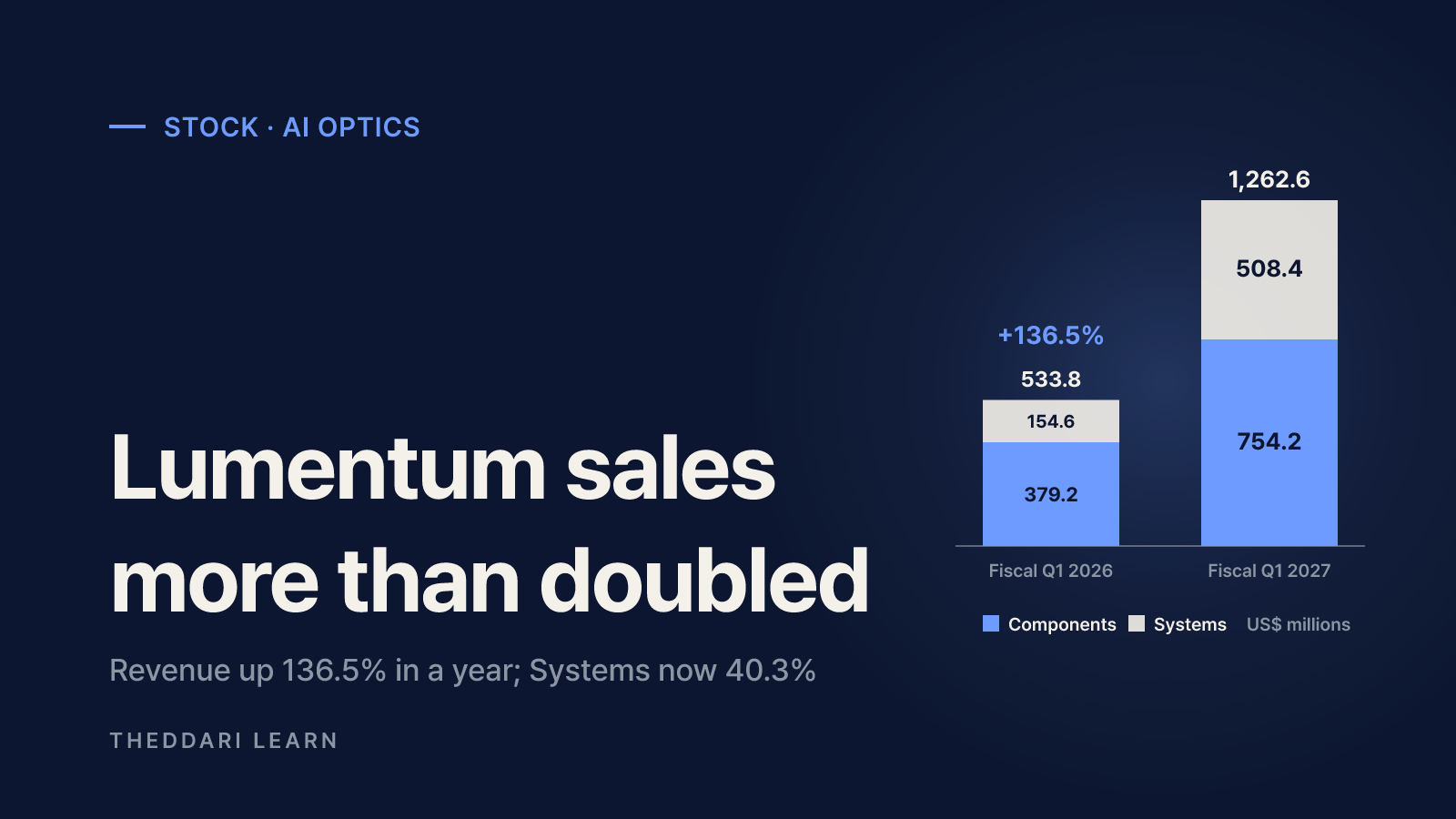
Lumentum (Nasdaq: LITE) is a San Jose-based photonics company that makes the lasers, optical transceivers and optical circuit switches used to move data as light between servers and switches in AI data centers. In its fiscal Q1 2027 results, released November 2, 2026, revenue reached $1.26 billion, up 136.5% from a year earlier. This guide, current as of November 2026, explains what Lumentum sells, how it connects to AI infrastructure spending and which numbers matter most when you look at LITE stock.
When LITE suddenly tops trending-ticker lists on sites like Yahoo Finance, the trigger is usually an earnings report, a guidance change or news about a large customer. A trending rank alone does not explain a price move, so start with what the company actually reported.
What Lumentum does: the light sources behind optical networking
Optical networking converts electrical signals into light, sends them through fiber and converts them back at the other end. Compared with copper, fiber carries more data over longer distances with less power, which is why it is used inside data centers, between data centers, in long-haul telecom networks and in undersea cables. Lumentum supplies many of the parts that generate and manage that light.
- Laser chips and laser assemblies: the light sources inside high-speed transceivers. Data center links are the biggest driver.
- Cloud transceiver modules: pluggable units that sit in server and switch ports and convert between electrical and optical signals. Lumentum expanded here after acquiring Cloud Light.
- Optical circuit switches (OCS): switches that redirect light paths without converting them to electrical signals, used to reconfigure large AI clusters.
- Pump lasers and transport components: used to amplify signals in long-haul and submarine networks.
- Industrial lasers and 3D sensing: lasers for precision manufacturing and VCSEL light sources for sensing applications.
According to a summary of its fiscal 2026 10-K, Lumentum grew through acquisitions including Oclaro, NeoPhotonics and Cloud Light, and had 13,757 employees as of June 27, 2026. It reports as a single segment but splits revenue into two product types: Components and Systems.
Lumentum revenue mix: Components vs Systems
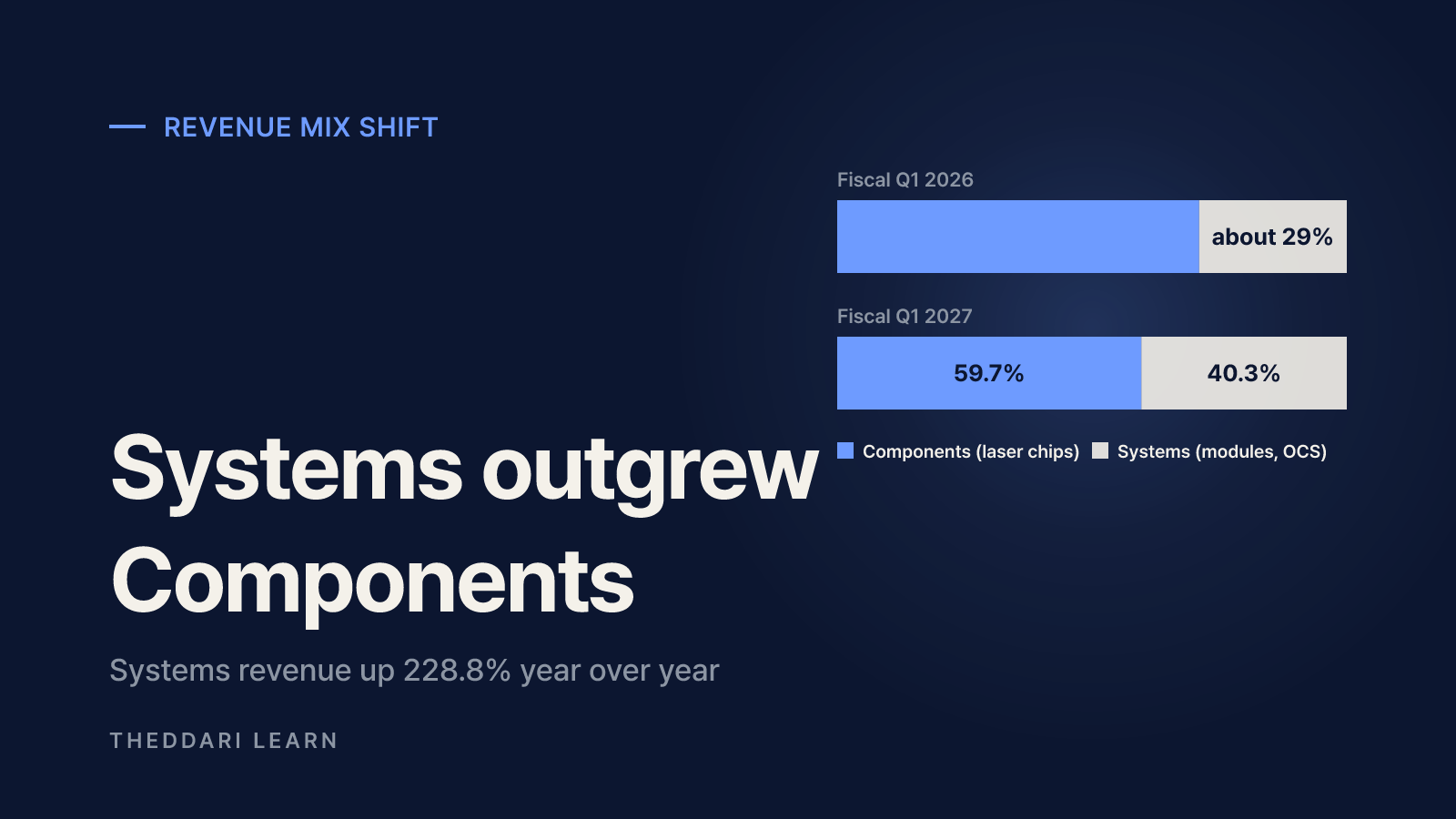
Components are building blocks, such as laser chips and subassemblies, that customers integrate into their own products. Systems are finished products such as transceiver modules and OCS units. The two grow at different speeds and carry different margins, so mix shifts can move overall profitability. The table below copies the company's reported figures in millions of US dollars.
Components
- Fiscal Q1 2027
- 754.2 (59.7%)
- Fiscal Q4 2026
- 649.4
- Fiscal Q1 2026
- 379.2
- Year over year
- +98.9%
Systems
- Fiscal Q1 2027
- 508.4 (40.3%)
- Fiscal Q4 2026
- 356.9
- Fiscal Q1 2026
- 154.6
- Year over year
- +228.8%
Total
- Fiscal Q1 2027
- 1,262.6
- Fiscal Q4 2026
- 1,006.3
- Fiscal Q1 2026
- 533.8
- Year over year
- +136.5%
Systems grew much faster than Components. A year earlier Systems were about 29% of revenue (154.6 divided by 533.8); this quarter they reached 40.3%. CEO Michael Hurlston said pump lasers and OCS were the leading contributors to growth and that the cloud modules business is improving on the gross margin line. Module businesses usually earn lower margins than chips, so watch whether overall gross margin holds up as the Systems share rises.
How AI data center optics demand reaches Lumentum
AI training and inference clusters tie together thousands of accelerators. As clusters grow and per-link speeds climb, they need more transceivers and higher-spec lasers. Lumentum's 10-K says AI and machine learning have caused a dramatic surge in data center networking demand and accelerated the use of optical components and modules. Demand reaches the company through four main paths.
- 1
Links inside the data center
Short-reach connections between servers and switches use transceivers, and each transceiver needs laser chips. Faster links push demand toward higher-spec lasers.
- 2
Reconfiguring the cluster
OCS units physically switch light paths to reshape large clusters. Management said OCS demand visibility has expanded significantly and could become a multi-billion-dollar annual revenue stream.
- 3
Optics moving closer to the chip
Near-packaged and co-packaged optics (NPO/CPO) place optical engines next to switch or accelerator silicon to cut power. Lumentum said it secured its second major NPO/CPO win this quarter, backed by purchase commitments exceeding $5 billion.
- 4
Links between data centers
Data center interconnect and long-haul routes use coherent optics and pump lasers for amplification.
The $5 billion-plus NPO/CPO commitment is the company's own description. The release does not say over how many years it converts to revenue, so do not map it directly onto quarterly forecasts.
LITE stock: six metrics to watch each quarter
For a fast-growing stock, the change in expectations often matters more than the quarter itself. Read Lumentum's report in this order.
Revenue and growth
- Fiscal Q1 2027
- $1.26B, +25.5% quarter over quarter
- What to look for
- Is sequential growth slowing?
Components/Systems mix
- Fiscal Q1 2027
- 59.7% / 40.3%
- What to look for
- Margin impact as modules and OCS grow
Non-GAAP gross margin
- Fiscal Q1 2027
- 53.2% (39.4% a year ago)
- What to look for
- Factory utilization, mix and pricing pressure
Non-GAAP operating margin
- Fiscal Q1 2027
- 42.3% (Q2 guide 45–46%)
- What to look for
- Does the company hit its own guide?
Next-quarter revenue guide
- Fiscal Q1 2027
- $1.575B–$1.625B
- What to look for
- Gap versus Wall Street consensus
Diluted shares (GAAP)
- Fiscal Q1 2027
- 101.7M (78.3M a year ago)
- What to look for
- How much per-share dilution
Read GAAP and non-GAAP side by side
GAAP net income was $360.3 million ($3.54 per diluted share) and non-GAAP net income was $461.1 million ($4.57). Most of the gap is $146.7 million of stock-based compensation and related payroll taxes, including an $89.4 million equity award modification tied to an executive retirement. In the prior quarter, a $7,756.6 million loss on debt extinguishment produced a GAAP net loss of $7.2 billion. Headline figures can mislead, so check the reconciliation tables.
Inventory, cash and capacity
Cash, cash equivalents and short-term investments ended the quarter at $2.0 billion, down $758.8 million from the prior quarter. Inventory rose from $691.6 million to $807.7 million and net property, plant and equipment from $1,159.1 million to $1,410.4 million. Lumentum is spending to add capacity; if demand slows, that inventory and equipment become a burden. The balance sheet also shows $1,360.3 million in the current portion of long-term debt, so watch repayment and conversion timing.

Use the theddari earnings calendar to track the next report date and the economic calendar for macro releases such as jobs and inflation data that can move growth stocks the same week. Both are scheduling tools, not forecasts.
Risks to weigh before buying Lumentum stock
- Customer concentration: Customer A was 26.6% of fiscal 2026 revenue, up from 15.4% a year earlier, and Customer B was 15.0%. One inventory adjustment or a supplier switch by either could swing revenue sharply.
- Inventory cycles: optical component demand has historically moved in build-and-digest cycles. Lumentum lists changes in customer inventory practices and order cancellations or delays among its risk factors.
- Pricing and competition: the company says declining average selling prices and product mix shifts can compress margins.
- Capacity execution: missing factory ramps or supply shortages, including rare earth materials, could leave demand unmet.
- Export controls and tariffs: 79.2% of fiscal 2026 revenue shipped to customers outside the US, and the 10-K summary notes that US export controls have halted all business with Huawei.
- Dilution and debt: diluted shares rose sharply over the year and the capital structure includes convertible notes and preferred stock, so EPS growth can trail net income growth.
When revenue more than doubles in a year, expectations get priced in quickly. A guide that lands only slightly below consensus can still trigger a large one-day move, so size any position with that volatility in mind.
A checklist for Lumentum earnings day
- Open the press release on Lumentum's investor relations site and confirm the fiscal period end date.
- Compare year-over-year and sequential revenue growth and the Components/Systems split.
- Check gross and operating margins on both GAAP and non-GAAP bases, and note which items were adjusted.
- Compare the midpoint of next-quarter guidance with the quarter just reported. This time management said it expects roughly $350 million of sequential growth.
- Compare inventory, cash, current debt and diluted shares with the prior quarter.
- Revisit claims about new businesses such as OCS and NPO/CPO in the following quarter to see whether the numbers back them up.
Commentary spikes right after results. The theddari stock Telegram trends page shows which themes traders are discussing, and you can check those claims against the filed numbers above. In short, Lumentum is a direct beneficiary of AI data center optical connectivity, but that comes with heavy reliance on a few customers, an industry known for inventory cycles and a fast build-out of capacity and inventory. Guidance and gross margin are usually where a change in direction shows up first, so record both every quarter.