Auto-Research Arena: How Good Are AI Research Agents?
Auto-Research Arena benchmarks AI research agents on nine LLM efficiency targets. See the results, why simple search ranked second, and the limits to check.
Contents9 sections
- What is an AI research agent, and why benchmark it?
- How Auto-Research Arena scores research agents
- Results: simple search beat most sophisticated harnesses
- Did the agents discover anything useful?
- Limits: how autonomous is this research, really?
- A checklist for reading 'AI did the research' claims
- Bottom line
- Frequently asked questions
- Sources and references
Key takeaways
- Auto-Research Arena shows AI research agents can run a closed loop of propose, test, and refine inside a tightly defined experiment, but humans still set the goals, constraints, and evaluator.
- The benchmark compares seven research harnesses on nine efficiency targets for small LLM pretraining, using Claude Opus 5 and GPT-6 Astra as the underlying models.
- A deliberately simple Sequential Search baseline ranked second overall with both models, which the authors read as large headroom in current agent design.
- Combining the agents' discoveries cut training loss from 2.675 to 2.544 in a one-hour run, but the evidence comes from a small model, one seed, and a not-yet-peer-reviewed v1 paper.
- When you see an 'AI did the research' claim, check task scope, human involvement, experiment budget, and whether code and logs are public.
Short answer: Auto-Research Arena shows that today's AI research agents can run hundreds of rounds of 'change the code, train, measure, decide what to try next' and find real efficiency gains, but only inside a problem that humans have carefully defined. The Auto-Research Arena paper, posted to arXiv on October 26, 2026 by researchers from UC San Diego and Adobe Research, is one of the clearest attempts so far to measure that ability across many objectives at once. This guide is based on the v1 paper and the public code as read in October 2026.
What is an AI research agent, and why benchmark it?
An AI research agent (often called an auto-research system or, more loosely, an AI scientist) uses a large language model to propose ideas, implement them as code, run experiments, and use the results to choose the next step. The model is the brain; the harness is the procedure that organizes the work. Some harnesses run a team of agents, some keep a tree of hypotheses, and some evolve a population of candidate programs.
Comparing harnesses fairly has been hard. Andrej Karpathy's autoresearch setup, for example, asks an agent to minimize validation loss within a fixed training time. That is a useful task, but a single objective can reward methods tuned to it. Auto-Research Arena keeps Karpathy's small pretraining testbed and adds nine different targets in the same environment, so you can see whether a harness is broadly capable or just good at one thing.
How Auto-Research Arena scores research agents
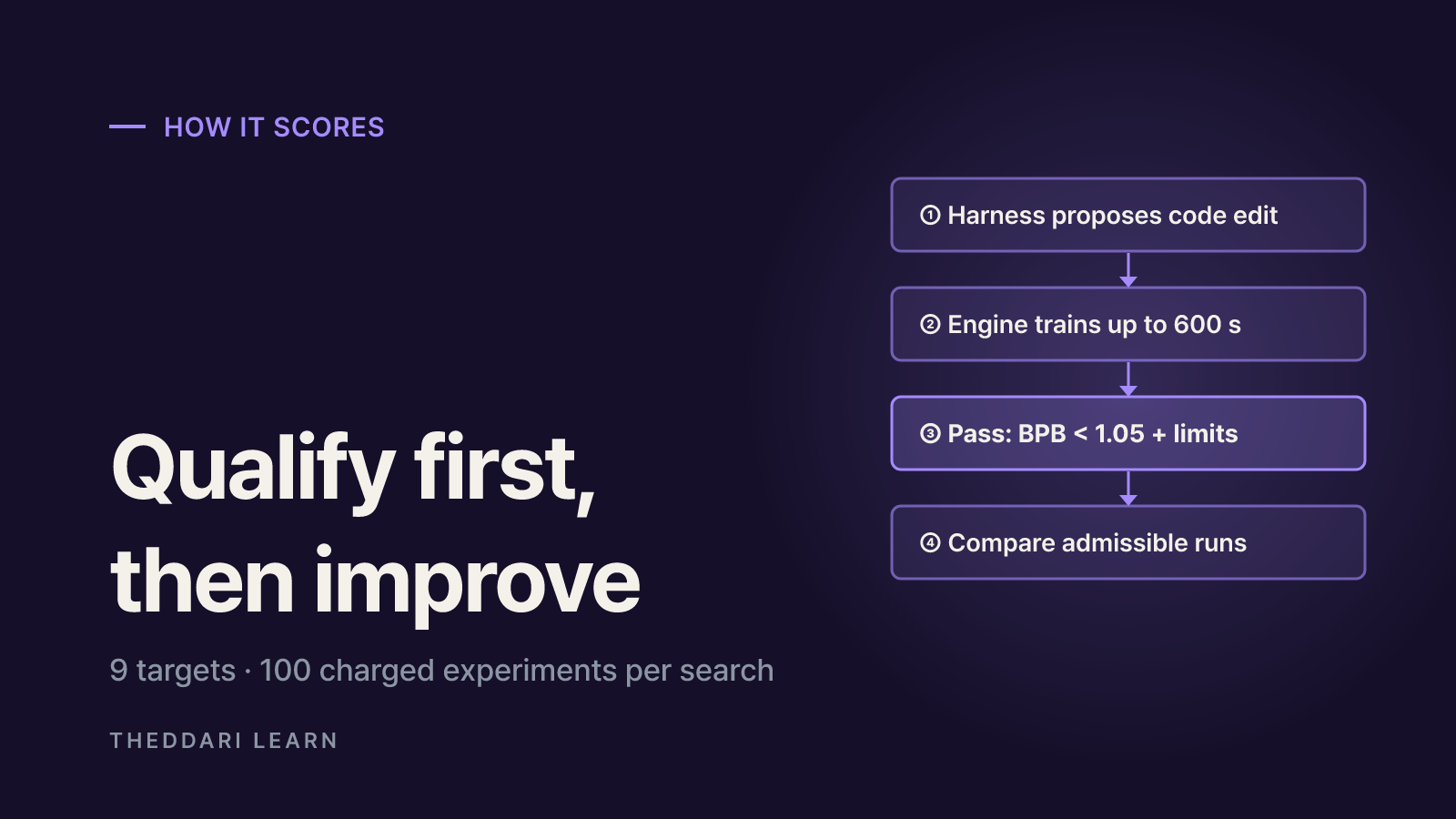
The key design choice is separating admissibility from improvement. A candidate program first has to pass a quality bar and stay within resource limits. Only then does the benchmark compare how far it pushed the chosen target down. This blocks the obvious shortcut of shrinking a number by quietly wrecking model quality.
| Setting | Value in the v1 paper |
|---|---|
| Task | Small LLM pretraining code from Karpathy's autoresearch testbed |
| Quality bar | Validation bits per byte (BPB) below 1.05 |
| Targets | 9: parameters, training tokens, optimizer updates, training FLOPs, peak memory, training time, live-state memory, decode latency, long-prompt latency |
| Budget | 100 charged experiments per search; a run counts once GPU execution starts, even if it fails |
| Hardware | One NVIDIA A100 80GB per candidate, seed 42, up to 600 seconds of training |
| Data | About 631M tokens from the ClimbMix pool |
| Models | Claude Opus 5 and GPT-6 Astra, both at medium reasoning effort |
| Contestants | Six LLM-based harnesses plus a non-agentic TPE baseline |
Each harness starts from the same reference program, edits code, submits candidates, reads the measurements, and decides what to explore next. The benchmark's own engine runs and records every experiment. The score is the best recorded candidate that met all constraints, regardless of what the harness kept at the end. Because the nine targets use different units, the authors compare harnesses head to head within each target and roll the results into an Elo rating.
Bits per byte (BPB) is the average number of bits a model needs to predict each byte of text. Lower means better prediction. The 1.05 bar sits slightly above the reference program's score, which leaves room for structural changes that cost a little quality.
Results: simple search beat most sophisticated harnesses
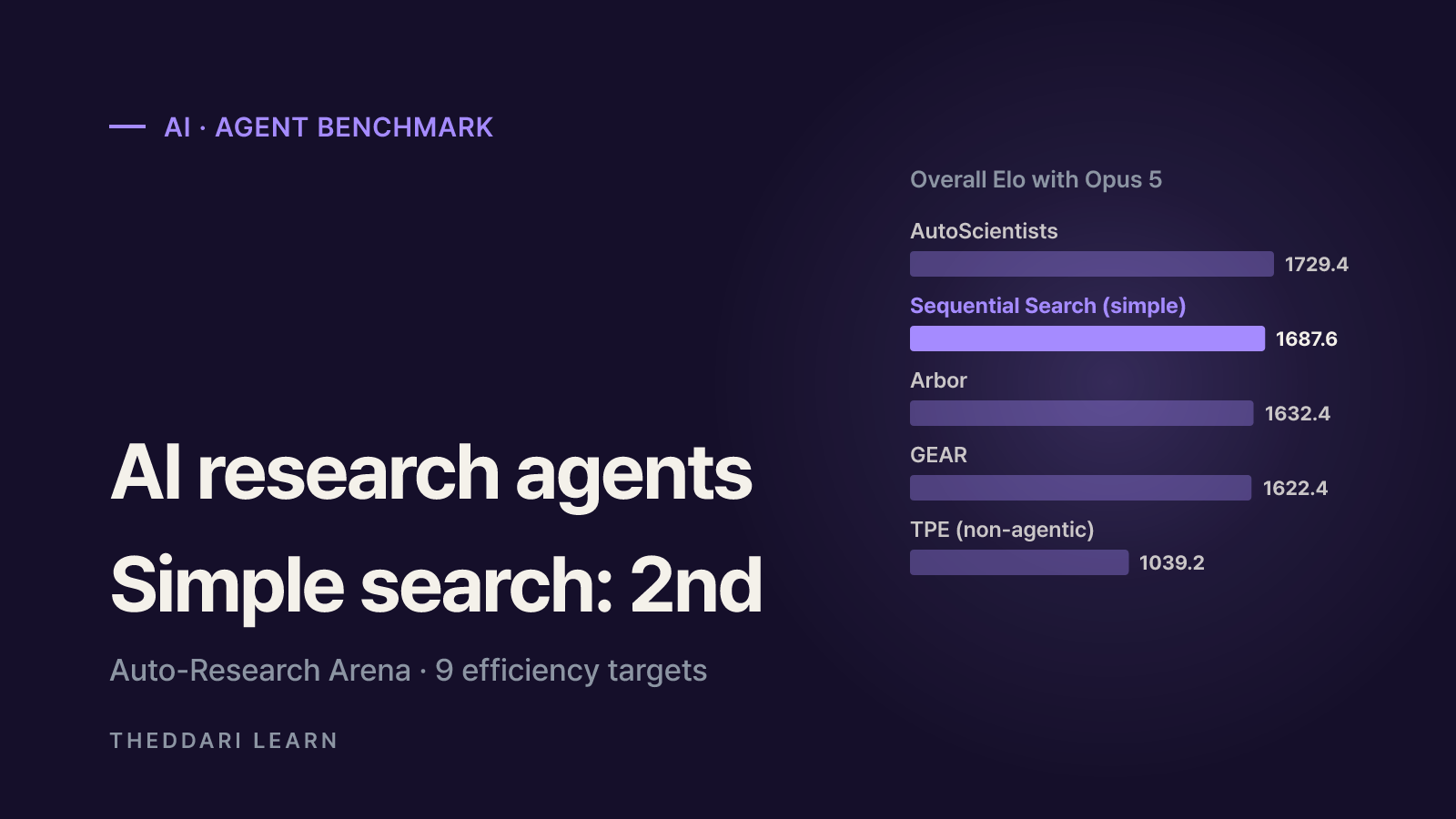
Here are the overall Elo ratings from Table 2 of the paper. A higher rating means the harness beat its rivals more often across the nine targets.
1
- With Claude Opus 5
- AutoScientists
- Elo
- 1729.4
- With GPT-6 Astra
- GEAR
- Elo
- 1835.3
2
- With Claude Opus 5
- Sequential Search
- Elo
- 1687.6
- With GPT-6 Astra
- Sequential Search
- Elo
- 1702.4
3
- With Claude Opus 5
- Arbor
- Elo
- 1632.4
- With GPT-6 Astra
- Arbor
- Elo
- 1459.6
4
- With Claude Opus 5
- GEAR
- Elo
- 1622.4
- With GPT-6 Astra
- Beam Search
- Elo
- 1423.3
5
- With Claude Opus 5
- Beam Search
- Elo
- 1438.6
- With GPT-6 Astra
- AutoScientists
- Elo
- 1298.7
6
- With Claude Opus 5
- Heuresis
- Elo
- 1350.4
- With GPT-6 Astra
- Heuresis
- Elo
- 1280.6
7
- With Claude Opus 5
- TPE (non-agentic)
- Elo
- 1039.2
- With GPT-6 Astra
- n/a
- Elo
- n/a
The simplest baseline came second, twice
Sequential Search is the authors' own minimal baseline: keep one program, try one change, accept it if it is admissible and better, repeat. It ranked second with both foundation models and outranked several far more elaborate systems. The authors' reading is that more orchestration does not yet reliably translate into better research, so there is a lot of room to improve harness design.
Specialists did not generalize
TPE, a classic hyperparameter optimizer built for the original loss-minimization setting, finished well behind every LLM-based harness once the benchmark widened to nine targets. Topping one leaderboard is not the same as broad research ability.
Same final score, very different cost
On the Opus 5 training-time target, GEAR, Arbor, Beam Search, and Heuresis all reached 270 seconds, but first hit that value after 12, 39, 50, and 99 charged experiments respectively. Average experiments actually used also ranged from 14.7 (Arbor with GPT-6) up to 100, so some harnesses stopped well short of their budget. If you compare agents, look at the path, not only the endpoint.
If you want to keep up with new agent benchmarks and how AI communities react to them, the AI channel tracker collects the daily discussion.

Did the agents discover anything useful?
Within the benchmark, the gains are large. In the Opus 5 group, the best programs cut model size from 50.33M to 13.20M parameters, training compute from 239.08M to 52.15M FLOPs per token, and peak training memory from 43.96 GiB to 0.373 GiB, all while staying under the 1.05 BPB bar. Keep in mind these are results for a small model trained for ten minutes.
The authors catalogued 32 distinct findings, 20 of which were accepted as improvements during search, and grouped them into nine idea families across architecture, optimization, memory, and inference. The headline example came from the parameter target: agents turned the network into a looped Transformer by reusing one block's weights across depths, then learned separate residual gains for each depth. That mirrors a direction human researchers have been exploring, though the mechanism differs.
To test whether these ideas travel, the authors handed the catalogue to a new quality-focused search, then trained the resulting model from scratch for one hour. Training loss fell from 2.675 to 2.544 at matched training data and from 2.617 to 2.544 at matched cumulative FLOPs, and held-out BPB dropped from 0.9295 to 0.9112 at essentially the same model size.
These figures are self-reported from a single run on a model trained on hundreds of millions of tokens. The paper does not show whether the same ideas hold for frontier-scale models trained on trillions of tokens.
Limits: how autonomous is this research, really?
- Humans define the problem. Targets, the quality bar, resource limits, which files can change, and the evaluator are all fixed by the benchmark designers.
- The scope is narrow. Roughly 50M-parameter models, up to 600 seconds of training each. No new data collection, no large-scale runs, no lab work.
- Single seed. Candidates are evaluated with seed 42, so run-to-run noise is not fully characterized.
- Home-team baseline. Sequential Search, which ranked second, was built by the authors. Other harnesses were adapted to the benchmark, for example GEAR received an added constraint-check patch, which can shift their behavior.
- Preprint. As of October 2026 this is an arXiv v1 that has not been through peer review.
- Expensive to reproduce. The README requires Linux and an NVIDIA A100-SXM4-80GB GPU.
A checklist for reading 'AI did the research' claims
- 1
Who chose the question?
Separate an AI picking a research direction from an AI optimizing a metric someone handed it. Auto-Research Arena is the second kind.
- 2
Was there a quality floor?
A shrinking number means little if quality was allowed to collapse. Look for an explicit admissibility rule like the BPB bar here.
- 3
What did it cost?
Ask how many attempts it took and whether failed runs were counted. Finding a result in 12 tries and in 99 tries are different achievements.
- 4
How much did humans touch it?
Check prompts, integration patches, and any manual filtering of results. Public configuration files and integration examples are the best evidence.
- 5
Can anyone reproduce it, and does it generalize?
Look for released code, logs, and submission reports, and for tests outside the search setting such as longer training or different model sizes.
For a broader view of how researchers and builders are discussing autonomous research tools, the blog trend dashboard surfaces recurring topics across tech blogs.
Bottom line
As of October 2026, Auto-Research Arena puts AI research agents at a clear but bounded level: given a well-specified problem and about 100 experiments, they can deliver large efficiency gains and land on ideas that resemble active human research. The fact that the simplest search strategy matched or beat elaborate multi-agent systems says harness design is still early. Choosing what is worth studying and judging what a result means for a field remain outside what this benchmark measures, so read new auto-research claims with scope, constraints, budget, human involvement, and reproducibility in mind.
Frequently asked questions
Can AI do scientific research on its own yet?
Which AI research agent performed best on Auto-Research Arena?
Why does the paper use Elo instead of a single score?
How is this different from Sakana's AI Scientist or MLE-bench?
Can I run the benchmark myself?
Sources and references
Related articles
 AI
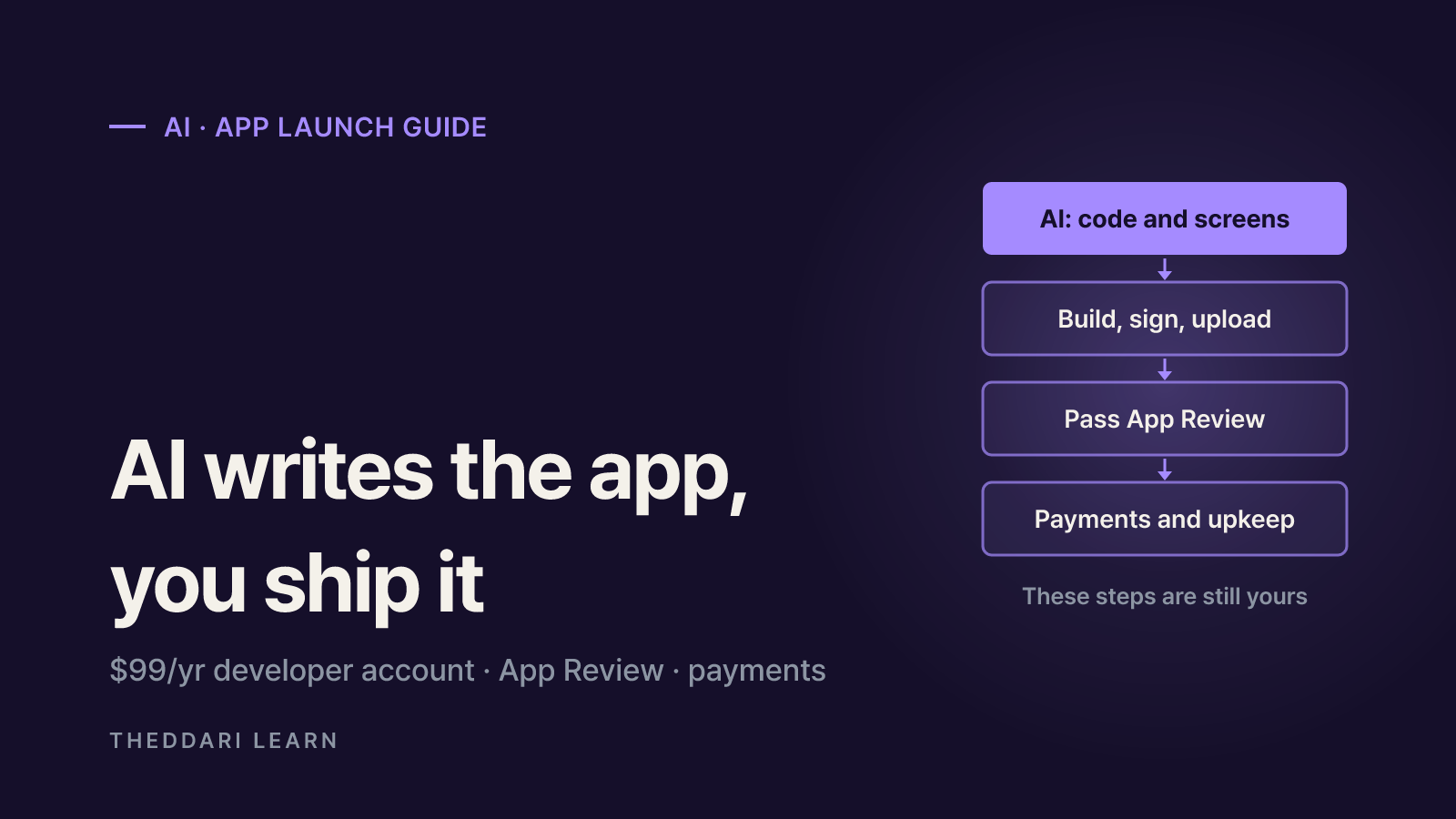
Can You Publish an AI-Built iOS App Without Coding?
AI tools can write the code, but the developer account, signing, App Review, payment rules and long-term maintenance are still yours. Here is what Apple's own documents require, as of November 2026.
 AI
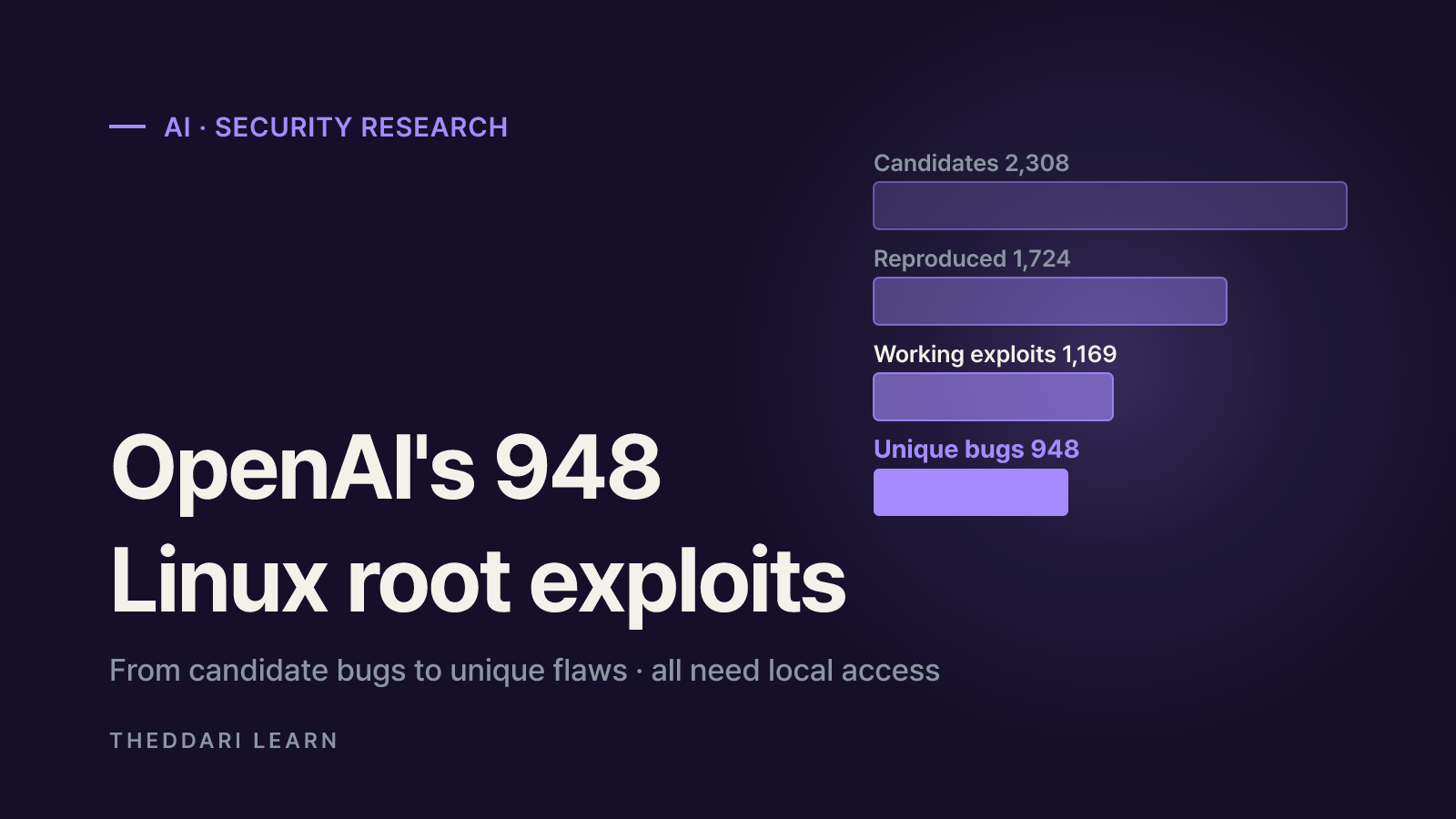
OpenAI's 948 Linux Root Exploits: What It Means for Admins
The viral '948 ways to root your Linux box' claim traces back to a real OpenAI research post, but the number comes with conditions. Here is how to read it, how to vet AI vulnerability claims, and what to check on your servers.
 AI
What Is Qwen4-Max? Pricing, Regions and API Checks
Qwen4-Max is the first model in Alibaba's Qwen4 family. It is served through the QwenCloud API and Token Plan rather than as downloadable weights, and its price and inference location depend on the region you call. Here is what the official docs say and what to test before you build on it.