What Is Ares Capital (ARCC)? BDC Dividends and Non-Accruals
How Ares Capital (ARCC) turns middle-market loan interest into a high dividend, and how to check dividend coverage, non-accruals and NAV using Q3 2026 results.
Contents7 sections
Key takeaways
- Ares Capital (ARCC) is a BDC that lends to private U.S. middle-market companies and pays most of the interest out to shareholders. Its Q4 2026 dividend is $0.48 per share.
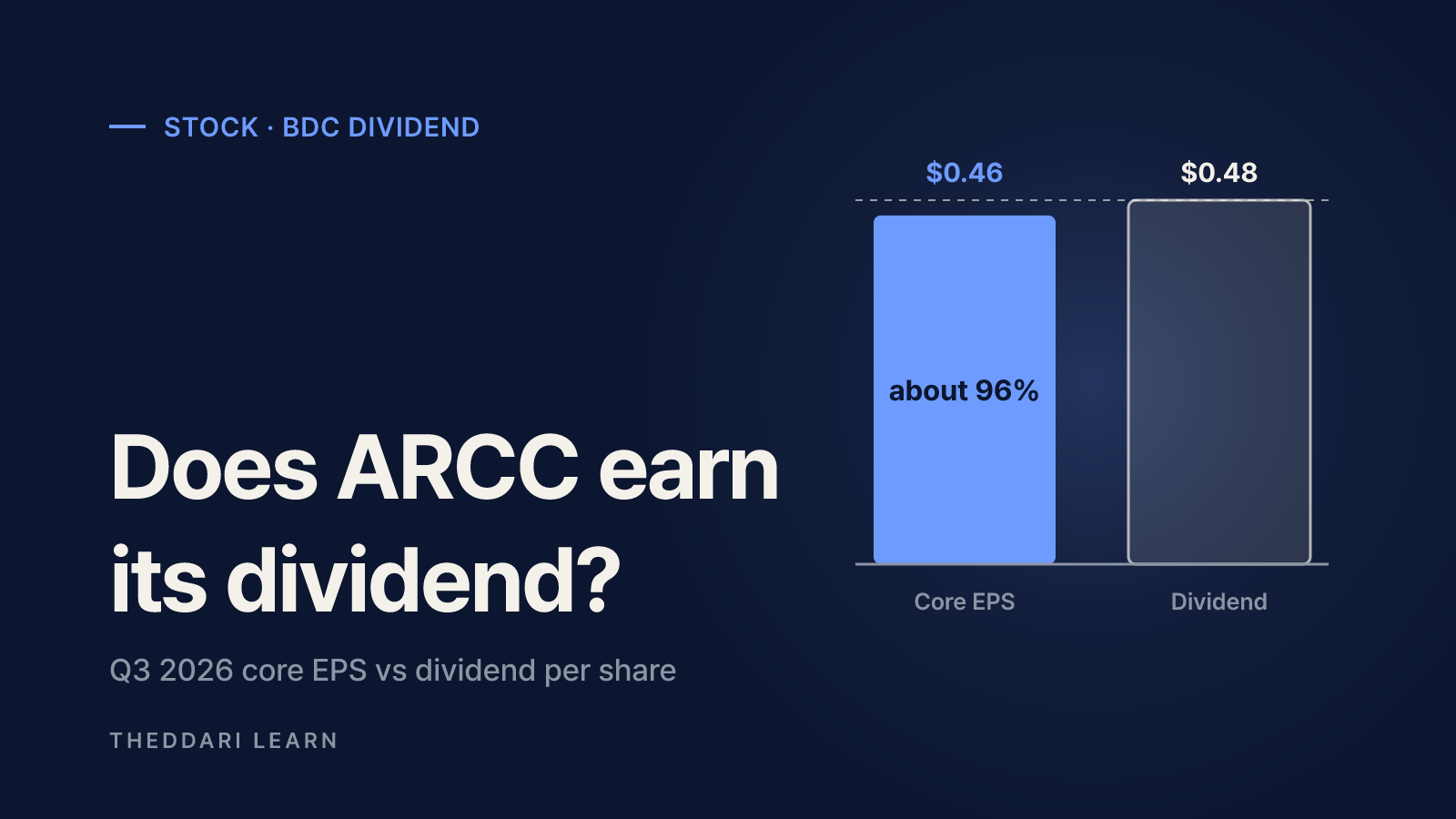
- Dividend safety is about coverage, not yield. In Q3 2026, core EPS was $0.46 against a $0.48 dividend, so earnings fell slightly short.
- Non-accrual loans rose to 2.4% of the portfolio at amortized cost (1.4% at fair value) on September 30, 2026, up from 1.8% (1.2%) at the end of 2025.
- NAV per share slipped from $19.94 to $19.31 over the first nine months of 2026, so total return matters more than headline yield.
- About 70% of the portfolio is floating rate, which means lower base rates would reduce interest income.
ARCC (Ares Capital Corporation) is a business development company, or BDC, that lends to private U.S. middle-market companies and pays most of the resulting interest income out as dividends. The yield looks high, roughly 10% at recent prices, but whether the ARCC dividend holds up depends on three things: whether recurring earnings cover the payout, whether troubled loans are rising, and whether net asset value (NAV) per share is shrinking. This guide walks through each check using ARCC's Q3 2026 earnings release, published October 27, 2026, and the SEC's investor bulletin on publicly traded BDCs. Figures are as of October 2026.
How BDC stocks like ARCC work
The SEC describes BDCs as a type of closed-end fund that gives ordinary investors access to the debt and equity of small and medium-sized private companies. Many of those borrowers are owned by private equity firms and cannot easily get bank loans, so they borrow directly from lenders like Ares. You buy BDC shares on an exchange, and the BDC passes the interest through to you.
- Asset rules: at least 70% of a BDC's total assets must sit in qualifying investments, mostly privately issued securities.
- High payouts: BDCs that elect a particular tax status must distribute 90% of taxable income each year, which is why yields run high.
- More leverage than most funds: under certain conditions a BDC may borrow up to $2 for every $1 of equity, which magnifies both gains and losses.
- External management: ARCC is run by a subsidiary of Ares Management, which collects a base management fee and income-based incentive fees.
Founded in 2004, ARCC was the largest publicly traded BDC by market capitalization as of September 30, 2026. On that date it held $29.2 billion of investments at fair value across 636 portfolio companies backed by 271 private equity sponsors. First lien senior secured loans made up 58% of the portfolio, second lien 4%, senior subordinated loans 7%, preferred equity 8%, its Ivy Hill Asset Management (IHAM) affiliate 10% and other equity 9%. About 70% of the portfolio was floating rate.
Where the ARCC dividend comes from
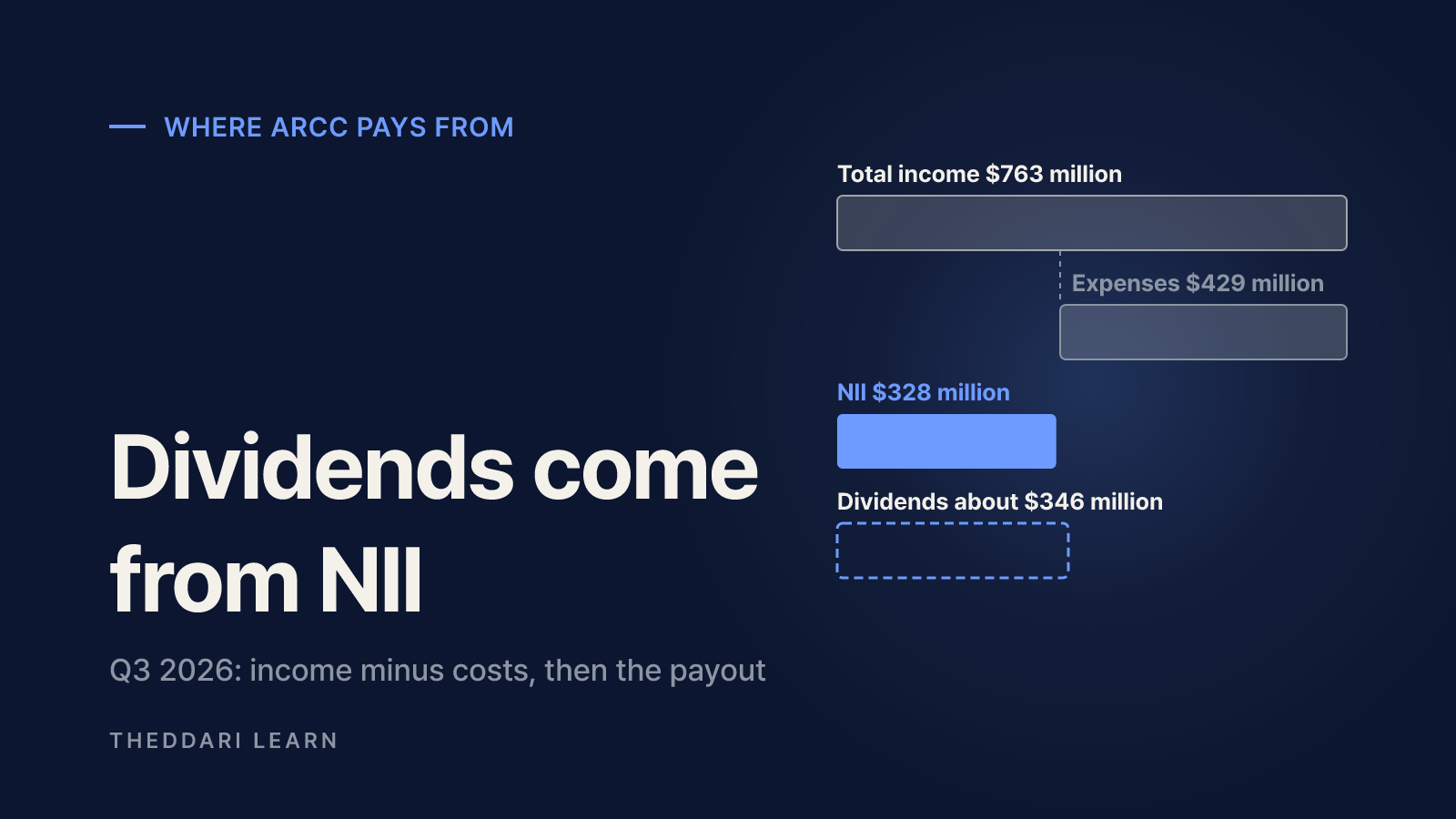
Follow the income statement from top to bottom and the source of the payout becomes clear. In Q3 2026, total investment income was $763 million: $558 million of interest, $160 million of dividend income (largely from affiliated and equity holdings), $23 million of capital structuring fees and $22 million of other income.
- 1
Total investment income: $763 million
Interest, dividends and fees combined. Because most loans float, this line moves with short-term interest rates.
- 2
Minus expenses of $429 million
The biggest item is $221 million of interest and credit facility fees, followed by a $109 million base management fee and an $82 million income-based fee. BDCs invest borrowed money, so funding costs come first.
- 3
Minus $6 million of taxes: net investment income of $328 million
Net investment income (NII) is the real dividend engine. Per share it came to $0.46.
- 4
Dividends paid: about $346 million
The Q3 dividend of $0.48 per share, roughly $346 million in total, was paid on September 30, 2026, slightly more than NII for the quarter.
Two lessons stand out. First, base and incentive fees together took $191 million in a single quarter. The SEC notes that BDC advisory fees are typically 1.5% to 2% of gross assets a year plus incentive fees of up to 20% of profits, and because fees are charged on gross assets, more leverage means higher fees for shareholders. Second, the dividend depends on what is left after costs, so lower base rates, higher borrowing costs or more non-paying loans can each squeeze it.
How to check ARCC dividend coverage
The first number to read in any ARCC report is core EPS versus the dividend. Core EPS is a non-GAAP measure that strips out realized and unrealized gains and losses, plus the related incentive fees and taxes, leaving the recurring income that actually funds payouts.
Q3 2025
- Core EPS
- $0.50
- GAAP EPS
- $0.57
- Dividend declared
- $0.48
Q2 2026
- Core EPS
- $0.47
- GAAP EPS
- $0.24
- Dividend declared
- $0.48
Q3 2026
- Core EPS
- $0.46
- GAAP EPS
- $0.44
- Dividend declared
- $0.48
Jan-Sep 2026
- Core EPS
- $1.39
- GAAP EPS
- $0.81
- Dividend declared
- $1.44
Q3 2026 core EPS of $0.46 covered about 96% of the $0.48 dividend, and the nine-month figures ($1.39 against $1.44) tell the same story. In other words, the current payout is running slightly ahead of current earnings, with the gap filled from earnings retained in earlier years. The balance sheet showed $504 million of accumulated undistributed earnings on September 30, roughly $0.70 per share across 722 million shares, but that accounting figure is not the same as taxable spillover income, which management discusses separately.
On the Q3 2026 earnings call, management said ARCC has paid stable or increasing regular dividends for 69 consecutive quarters and pointed to a growing investment backlog and the planned acquisition of MidCap Financial Investment Corporation (MFIC), agreed on October 26, 2026 in a cash and stock deal, as reasons for confidence. Until the deal closes, its terms and impact can change, so treat guidance as context and confirm coverage in the next report. Ares Capital's next report date is on the earnings calendar.

Non-accruals, NAV and leverage
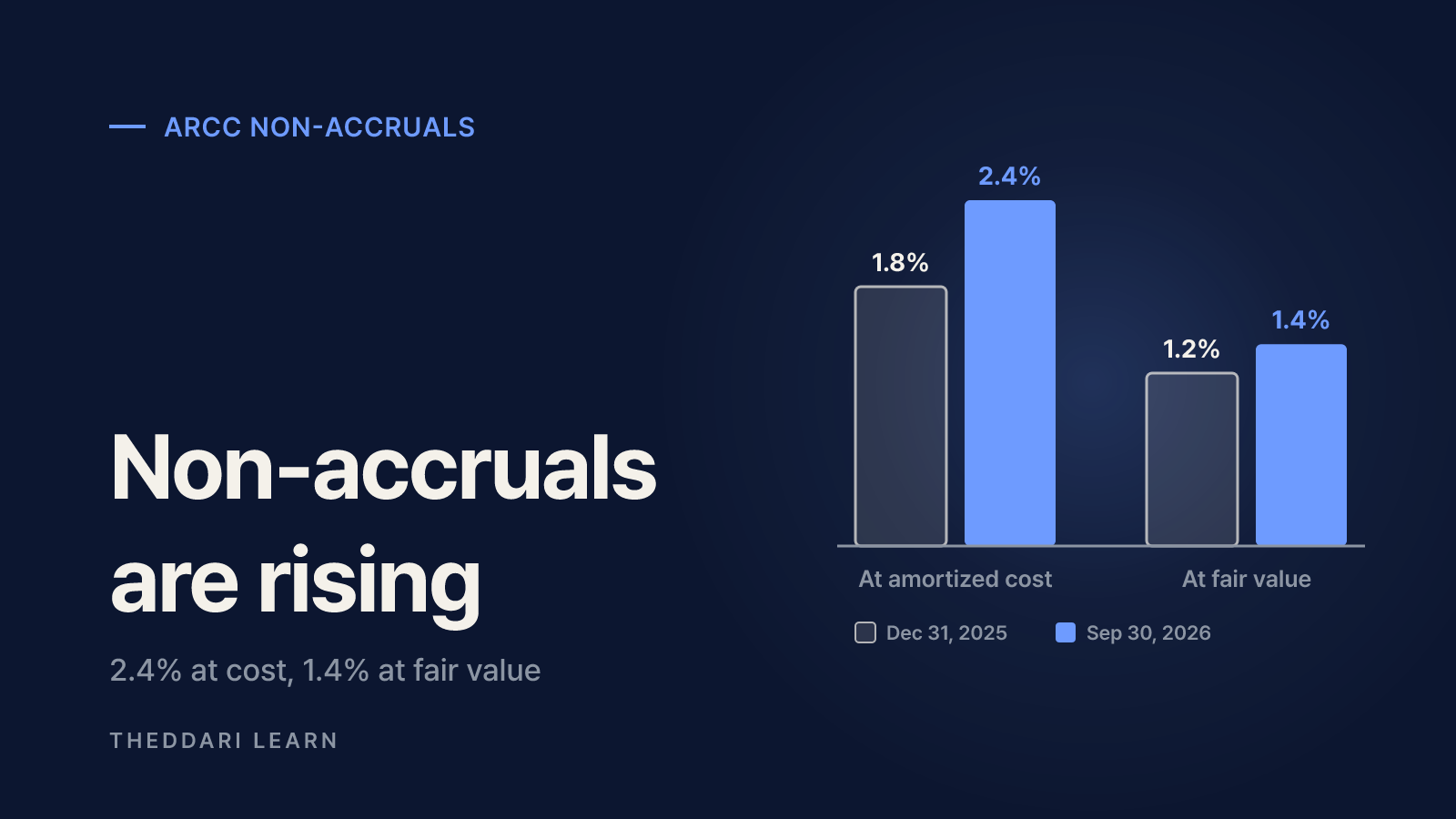
A non-accrual loan is one where the borrower has fallen behind and the BDC has stopped booking interest. It cuts income immediately and, if the loan is written off, also cuts NAV. ARCC discloses the rate at both amortized cost and fair value.
Non-accruals at amortized cost
- Dec 31, 2025
- 1.8%
- Sep 30, 2026
- 2.4%
- What it tells you
- Size of troubled loans as originally lent
Non-accruals at fair value
- Dec 31, 2025
- 1.2%
- Sep 30, 2026
- 1.4%
- What it tells you
- What those loans are marked at now
Weighted average portfolio grade
- Dec 31, 2025
- 3.1
- Sep 30, 2026
- 3.1
- What it tells you
- Lower grades mean more risk
NAV per share
- Dec 31, 2025
- $19.94
- Sep 30, 2026
- $19.31
- What it tells you
- Capital lost or gained beyond dividends
Debt-to-equity
- Dec 31, 2025
- 1.12x
- Sep 30, 2026
- 1.11x
- What it tells you
- Compare with the 2-to-1 legal cap
Non-accruals at cost climbed 0.6 percentage points this year. Management said the rate remains below ARCC's roughly 3% average since the global financial crisis and the BDC industry's roughly 4%. The direction is still worth tracking. The wide gap between the cost and fair value figures shows those loans have already been marked down heavily.
Why NAV matters
NAV per share fell about 3.2% in the first nine months of 2026, driven by $552 million of net unrealized losses. That is also why GAAP EPS ($0.81) trailed core EPS ($1.39) over the same period. If NAV keeps eroding, the share price tends to follow, so judge ARCC on total return: dividends plus the change in NAV.
Price versus NAV
At the October 27, 2026 close of $18.51, ARCC traded about 4% below NAV. Annualizing the $0.48 quarterly dividend gives $1.92, a simple yield of about 10.4% at that price.
Leverage and liquidity
Debt-to-equity was 1.11x (1.06x net of available cash), well inside the legal limit. ARCC had $15.5 billion of principal debt outstanding and about $7 billion of available liquidity. In September it issued $750 million of 6.250% unsecured notes due 2033 and swapped them to floating rate. Rising funding costs shrink the spread between what ARCC earns on loans and what it pays to borrow.
Key risks before buying ARCC
- Falling rates: with about 70% of the portfolio floating, rate cuts reduce interest income. Management said earnings remain sensitive to base rates. Track Federal Reserve meetings and inflation releases on the economic calendar.
- Credit risk: borrowers are private middle-market firms with limited public disclosure. The SEC warns such companies may be more likely to default than large public companies.
- Valuation uncertainty: private loans have no market price, so fair values are estimates and may differ from what is eventually recovered.
- Deal risk: the MFIC acquisition still has closing conditions, and issuing new shares could dilute existing holders. Check whether post-deal core EPS covers the dividend.
- Fees: base and incentive fees come out of NII before you see a dividend.
A practical routine for ARCC or any BDC stock: each quarter, check whether core EPS covers the dividend, whether non-accruals are rising, whether NAV is holding, and where interest rates are heading. You can also follow how investors are reacting to high-yield stocks on the stock Telegram trends page, but the filed numbers should drive the decision.
Frequently asked questions
Is ARCC a good dividend stock for income investors?
What does non-accrual mean for a BDC?
Can a BDC dividend include a return of capital?
Why does ARCC trade below its NAV?
Sources and references
- 1Ares Capital Corporation, September 30, 2026 Financial Results (PR Newswire, Oct 27, 2026)(opens in a new tab)www.prnewswire.com
- 2SEC Investor.gov: Publicly Traded Business Development Companies (BDCs) Investor Bulletin(opens in a new tab)www.investor.gov
- 3Ares Capital Q3 2026 Earnings Call Transcript (Stock Analysis)(opens in a new tab)stockanalysis.com
Related articles
 Stocks
Pre-Market Trading and After-Hours Moves, Explained
An after-hours drop is usually measured against the last official close, set by a small number of trades. Learn the session times, how to read the move, and what changes for investors trading US stocks from Korea.
 Stocks
Jensen Huang Return Petition: Can Staff Reinstate a CEO?
After Jensen Huang resigned as Nvidia CEO, employees pushed for his return. This guide explains what an employee petition can and cannot do, how board and shareholder power works under Delaware law, and why the 2023 OpenAI reversal is a weak template.
 Stocks
Nvidia Circular Financing Claims: What Holders Should Check
A Wall Street Journal report, relayed by tech outlets, says Nvidia leaned on investments and guarantees to keep customers buying GPUs. Here is how to separate the allegation from the filings and what to watch on the Q3 call.