Contents8 sections
- What the Amazon AI union monitoring documents show
- How Atlas scores union risk: data in, tiers out
- Amazon's response and what remains unverified
- UK law: workplace AI surveillance and union rights
- The CNIL precedent: where monitoring crosses the line
- What employers, workers and investors should check
- Frequently asked questions
- Sources and references
The Amazon AI union monitoring story comes down to one set of documents. Material disclosed in a Canadian labour dispute describes Atlas, an in-house AI forecasting model that gives each warehouse a union-risk score between 100 and 900 and sorts sites into five tiers. As openDemocracy reported on 16 October 2026, two UK warehouses sit in the highest-risk tier. Amazon rejects the surveillance label and says the analysis is site-level only.
This guide, written as of October 2026, separates what the documents say from what Amazon disputes, then explains how UK data protection and trade union law could apply. It focuses on the UK (England, Wales and Scotland for the labour law points). The documents have not been tested in a UK court, so treat the details as reported claims rather than established findings.
What the Amazon AI union monitoring documents show
The documents surfaced in Canada. During proceedings between Amazon and the private-sector union Unifor before the British Columbia Labour Relations Board, Amazon had to hand over internal material. Unifor shared it with Truthout, which published on 30 September 2026. Truthout says the files date from 2024 and include more than 100 pages of manager training on responding to union drives, with the Atlas model described in an appendix.
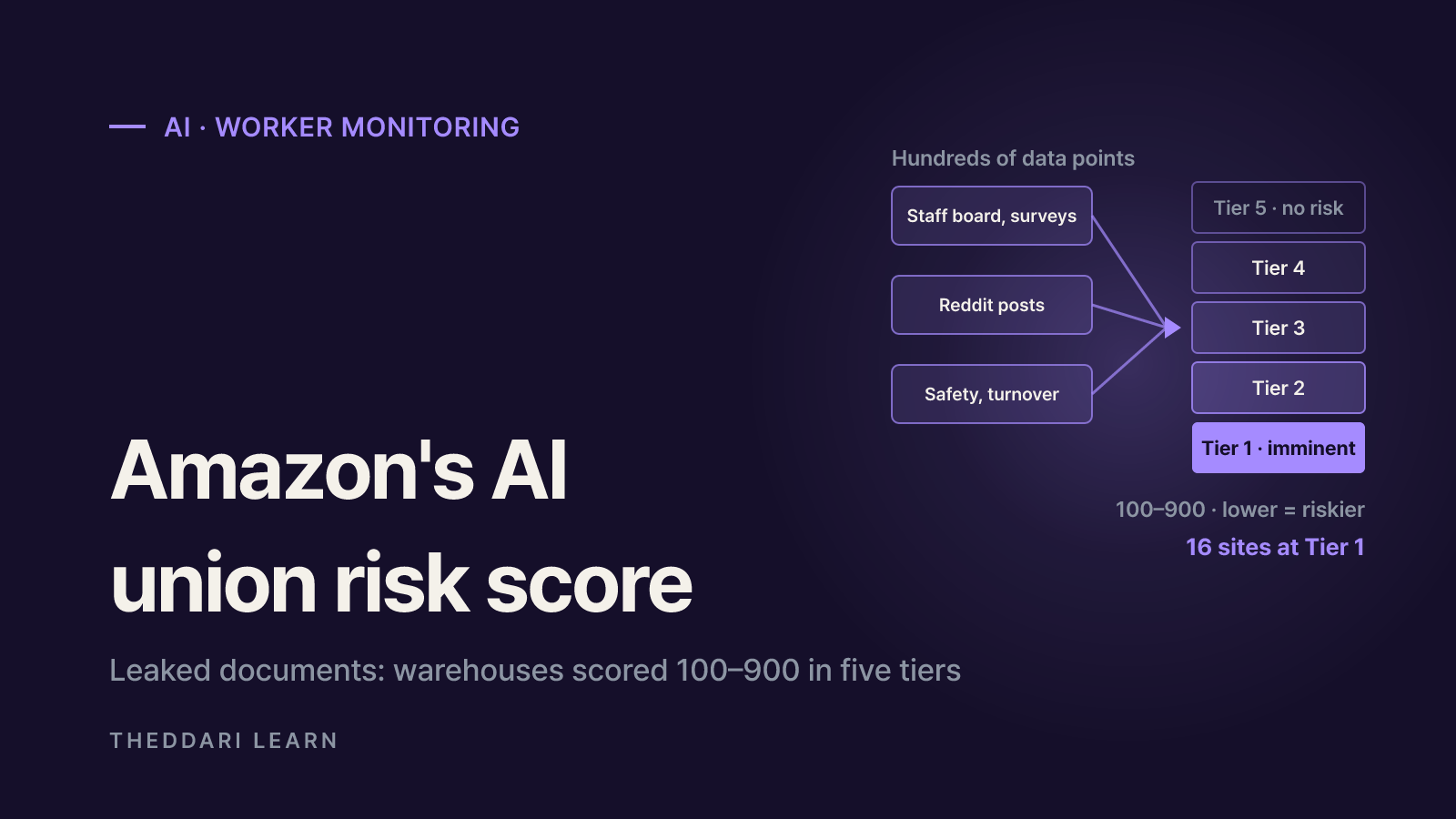
openDemocracy then examined the UK angle. According to the documents, 16 warehouses across the US, Canada and the UK were rated 'Tier 1', meaning 'future activity is imminent'. Two were British:
- EMA4 — a robotic fulfilment centre in Sutton Coldfield, north-east Birmingham, described in the report as a £500m site.
- BHX4 — a warehouse near Coventry where workers held the first formal UK strike against Amazon in January 2023.
Coventry matters because it is where the GMB union came closest to formal recognition. In the 2024 recognition ballot, around 2,600 workers took part and GMB lost by 28 votes. GMB and the tech justice group Foxglove, with law firm Leigh Day, are already pursuing a legal challenge over 'click-to-quit' QR codes that allegedly encouraged staff to cancel union membership before the vote. Foxglove says it is reviewing whether the Atlas material adds to that claim.
How Atlas scores union risk: data in, tiers out
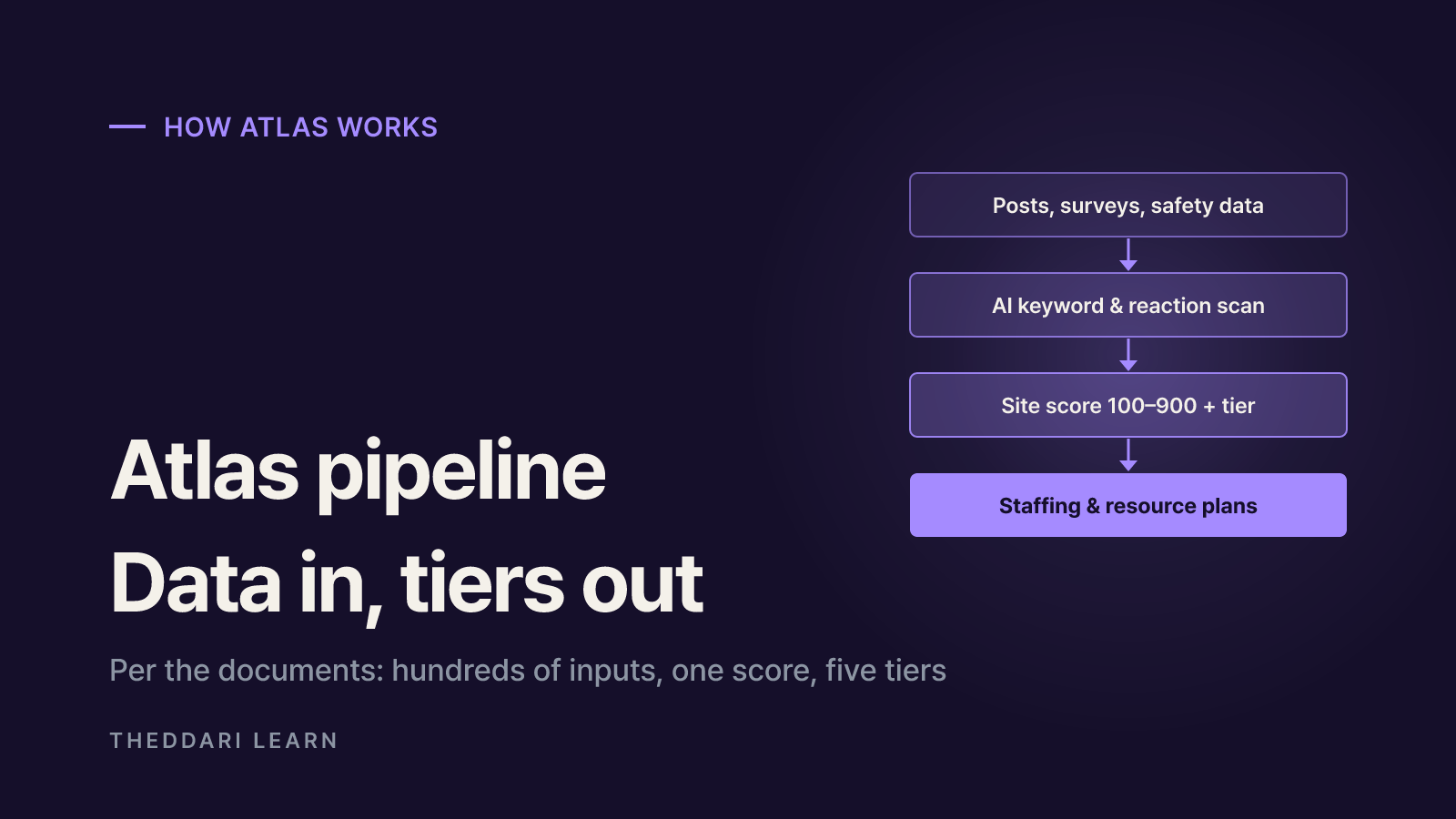
The documents call Atlas 'a labor risk framework to clarify how Amazon evaluates emerging workforce issues, labor union targets, and internal or external labor threats'. In practice it is a pipeline: many signals go in, and a single score, tier and monthly trend come out for each site.
| Input or output | What the documents describe |
|---|---|
| Internal channels | Posts on the 'Voice of the Associate' (VOA) board and answers to daily digital questions |
| External forums | Reddit and similar forums, used to read 'the tenor of the discussion at the site level' |
| Workplace metrics | Training completed, health and safety incidents, feedback on managers, tenure, turnover, indoor and outdoor temperature |
| Local context | Distance to other workplaces with union activity, local minimum wage and economic conditions |
| Past events | 'Employee relations events' such as card signing, delegations, protests, sickouts, each with a severity rating |
| Output | A 100–900 score (lower means higher risk), Tier 1 to Tier 5, and month-over-month trends |
Per openDemocracy, the document states that for leadership a higher score is 'better'. Tier 5 means 'no immediate perceived risk'; Tier 1 means activity is imminent. Truthout reports that AI is used to pick out common keywords in posts and to weigh the positive, negative or neutral reactions they draw.
What the scores were used for
The documents say tiers can 'inform staffing decisions, resource planning, standard actions, and ownership to mitigate risks to Amazon labour structure'. Truthout adds that four Tier 1 sites were flagged for Amazon's travelling 'rapid response' team, and that Tier 2 sheets asked which sites 'are showing the most future risk that are not Tier 1 sites yet'. That predictive purpose is what separates Atlas from the productivity tracking most people associate with workplace AI surveillance.
Amazon's response and what remains unverified
An Amazon spokesperson told openDemocracy that Atlas is not 'individual employee monitoring or surveillance' and covers 'site/building level activity only'. The company said it does not track individual opinions, affiliations, union membership or personal data, and that the tool helps it 'understand where associates need more support'. It added that employees 'always have the choice of whether or not to join a union'.
Who is monitored
- Documents and critics
- Sentiment from staff posts and surveys
- Amazon
- Sites only, no individuals
Purpose
- Documents and critics
- Predict and pre-empt organising
- Amazon
- Find where staff need support
UK use
- Documents and critics
- Two UK sites rated Tier 1
- Amazon
- Atlas not currently used in the UK
Similar tools
- Documents and critics
- Leigh Day plans further questions
- Amazon
- No answer at publication
Three gaps are worth keeping in mind. First, the material is reported to date from 2024, so current practice is unknown. Second, 'not currently used' leaves open past use and any equivalent system under another name. Third, Truthout says the documents describe a 'deep dive into the worker population driving the discussion', which sits uneasily with a purely site-level description and is likely to be argued over in any legal process.
UK law: workplace AI surveillance and union rights
Two bodies of UK law are relevant. A government spokesperson told openDemocracy that monitoring technology should be used 'transparently and in ways that are fair, accountable and reliable' and that employers are expected to respect lawful trade union activity.
Data protection: UK GDPR and ICO guidance
The ICO's guidance on monitoring workers sets out several points that map directly onto Atlas. Note that as of October 2026 the ICO flags the guidance as under review following the Data (Use and Access) Act.
- Trade union membership is special category data; if monitoring is likely to capture it, even incidentally, the employer needs a special category condition as well as a lawful basis.
- Monitoring communications between a worker and a union representative 'gives rise to significant concerns'.
- High-risk monitoring requires a data protection impact assessment (DPIA) before it starts.
- Consent is rarely valid at work because of the power imbalance.
- Purposes must be documented, monitoring 'just in case' should not happen, and the least intrusive means must be chosen.
- Relying on legitimate interests requires a purpose, necessity and balancing test.
The pivotal question is whether a site-level score involves personal data. Even if the output is a warehouse number, collecting and analysing identifiable posts or survey answers on the way in could itself be processing personal data. If the inputs were genuinely anonymised and aggregated, the analysis changes. That cannot be judged without seeing the actual data flows.
Trade union law: TULRCA section 146
Section 146 of the Trade Union and Labour Relations (Consolidation) Act 1992 gives workers the right not to be subjected to detriment by their employer where the sole or main purpose is to prevent, deter or penalise union membership or activity at an appropriate time, and lets them complain to an employment tribunal. A risk score alone is not a detriment; a claim would turn on whether it led to concrete changes in how particular workers were treated.
The CNIL precedent: where monitoring crosses the line
Regulators have already ruled on Amazon warehouse monitoring once. As BBC News reported on 23 January 2024, France's data watchdog CNIL fined Amazon France Logistique €32m (£27m) for 'excessive' surveillance using handheld scanner data. The findings included alerts when an item was scanned less than 1.25 seconds after the previous one, alerts tracking breaks of one to ten minutes and of ten minutes or more, questions over keeping the data for 31 days, and failures to inform staff and visitors properly. Amazon called the conclusions 'factually incorrect' and reserved the right to appeal. The lesson is that the test is proportionality, not technical capability.
What employers, workers and investors should check
- 1
Read primary material
Look at the disclosed documents, the BC Labour Relations Board rulings and the UK litigation rather than headlines, and keep the 2024 date in mind.
- 2
Ask about data flows
Which inputs are collected, whether posts are stored in identifiable form, who can access them and for how long. UK workers can use a subject access request to find out.
- 3
If you deploy sentiment tools
Document the purpose, run a DPIA, consult staff, and design out special category data before launch.
- 4
Track reputational and regulatory risk
Investigations, tribunal claims and bargaining disputes can follow stories like this. Follow the news flow on theddari AI Telegram trends and check Amazon's next results date on the earnings calendar.

The bottom line: the Atlas documents suggest workplace AI surveillance can extend from measuring work rate to forecasting what staff think and whether they might organise. How the model was used day to day, whether it touched identifiable individuals, and whether anything like it runs in the UK today are still unanswered. Those answers will come from tribunals, regulators and further disclosure, not from either side's press statements.