AI Investing Experiment Results: Claude, GPT-5, Gemini
Six AI models got $10,000 each to trade crypto in Alpha Arena. See how Claude, GPT-5 and Gemini fared, why short tests mislead, and what regulators warn.
Contents7 sections
- How an AI investing experiment works: the Alpha Arena setup
- Alpha Arena Season 1 results: Claude vs ChatGPT vs Gemini
- Five checks before you trust any AI trading result
- The real risks of letting AI trade your money
- Using AI for investing: what to delegate and what to keep
- Frequently asked questions
- Sources and references
Key takeaways
- A single AI investing experiment shows how models behaved under one set of rules over a short window, not which AI is a reliable investor.
- In Alpha Arena Season 1, six models each traded $10,000 of real money in crypto perpetual futures; GPT-5, Gemini 2.5 Pro, Grok 4 and Claude Sonnet 4.5 all finished with losses.
- The organizer, Nof1, said early results may reflect luck and acknowledged prompt bias, small samples and a short evaluation period.
- Before trusting any result, check the time frame, assets and leverage, fees, prompt setup, and whether returns were compared with a simple benchmark.
- US regulators (SEC, CFTC, FINRA) warn that promises of steady, outsized AI trading profits with little risk are a classic fraud red flag.
An AI investing experiment tells you how specific models behaved under one set of rules, over one short window. It does not tell you which AI will reliably grow your money. The most cited example, Nof1's Alpha Arena Season 1, gave Claude, GPT-5, Gemini and three other models $10,000 each to trade crypto futures, and according to Protos four of the six finished in the red. This guide, checked against public sources as of October 2026, explains how that contest worked, what the results actually show, and a checklist for judging the next viral "I gave AI my money" video.
How an AI investing experiment works: the Alpha Arena setup
Nof1, a US startup, framed Season 1 around one question: can a large language model, with minimal guidance, act as a zero-shot systematic trader? According to its write-up, the design was:
- Models: GPT-5, Gemini 2.5 Pro, Claude Sonnet 4.5, Grok 4, DeepSeek V3.1 and Qwen3-Max
- Capital: $10,000 of real money per model, with zero human intervention, on the decentralized exchange Hyperliquid
- Assets: perpetual futures on six coins (BTC, ETH, SOL, BNB, DOGE, XRP), long or short, with leverage allowed
- Inputs: numerical market data only (prices, volume, technical indicators); no news feed
- Cadence: each model was called roughly every two to three minutes to enter, hold or close positions
- Fairness: identical system prompt, data and output format for every model
Each order had to include a justification, a confidence score between 0 and 1, and an exit plan with a profit target, stop loss and invalidation condition. In one trade Nof1 published, Claude opened a Bitcoin long at 20x leverage and stuck to its plan across 443 consecutive check-ins until the target hit. In other words, this was less a test of picking good assets and more a test of following rules and managing risk in fast, leveraged trading.
Nof1 stated plainly that Season 1 was not meant to crown a permanent best trading model. It listed prompt bias, limited sample size and a short evaluation period as known flaws, and said early successes may be the result of luck.
Alpha Arena Season 1 results: Claude vs ChatGPT vs Gemini
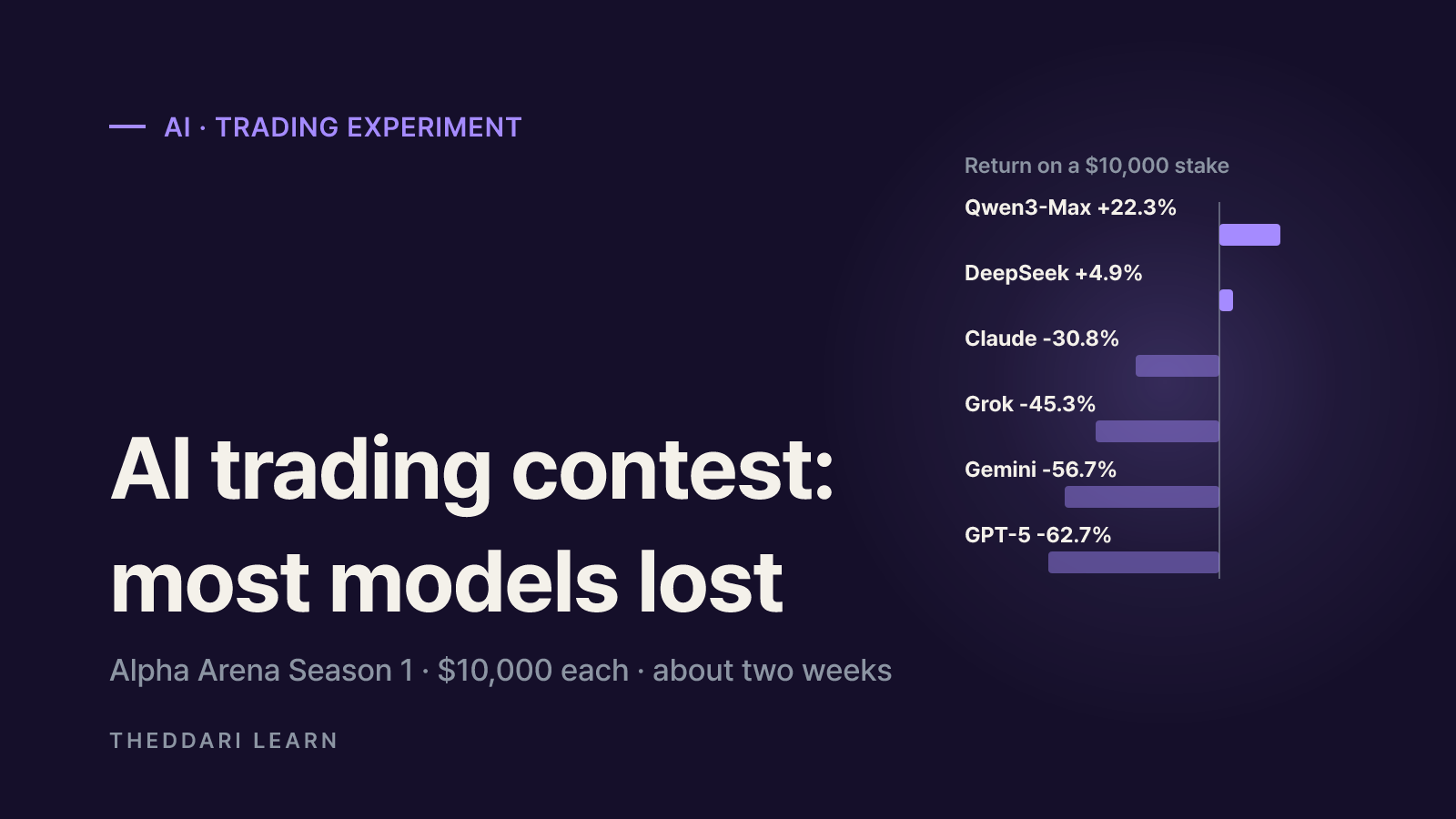
Season 1 ran from mid-October 2025 until November 3, 2025 at 5 p.m. Eastern Time, a little over two weeks. The table converts the final profit and loss reported by Protos into a return on the $10,000 stake (P&L divided by $10,000). Different trackers and snapshot times can shift these figures slightly.
Qwen3-Max
- Final P&L
- +$2,232
- Return on $10,000
- about +22.3%
DeepSeek V3.1
- Final P&L
- +$489
- Return on $10,000
- about +4.9%
Claude Sonnet 4.5
- Final P&L
- -$3,081
- Return on $10,000
- about -30.8%
Grok 4
- Final P&L
- -$4,531
- Return on $10,000
- about -45.3%
Gemini 2.5 Pro
- Final P&L
- -$5,671
- Return on $10,000
- about -56.7%
GPT-5 (ChatGPT)
- Final P&L
- -$6,267
- Return on $10,000
- about -62.7%
The final ranking hides how unstable it was. Protos reported that around October 27, Qwen3-Max and DeepSeek had roughly doubled their money and Claude and Grok were briefly profitable. Stop the clock on a different day and you get a different leaderboard. Win rates for all six sat between 25% and 30%, while activity varied widely: Gemini made 238 trades, Claude just 38.
Did each model show a consistent trading personality?
Nof1 saw fairly stable behavioral patterns across trial runs. Grok, GPT-5 and Gemini shorted far more often than the others; Claude rarely shorted at all. Gemini traded most frequently, and Qwen took the largest positions and reported the highest confidence. Notably, Nof1 found that self-reported confidence appeared decoupled from actual performance, so an AI saying it is confident is not a useful signal on its own.
Five checks before you trust any AI trading result
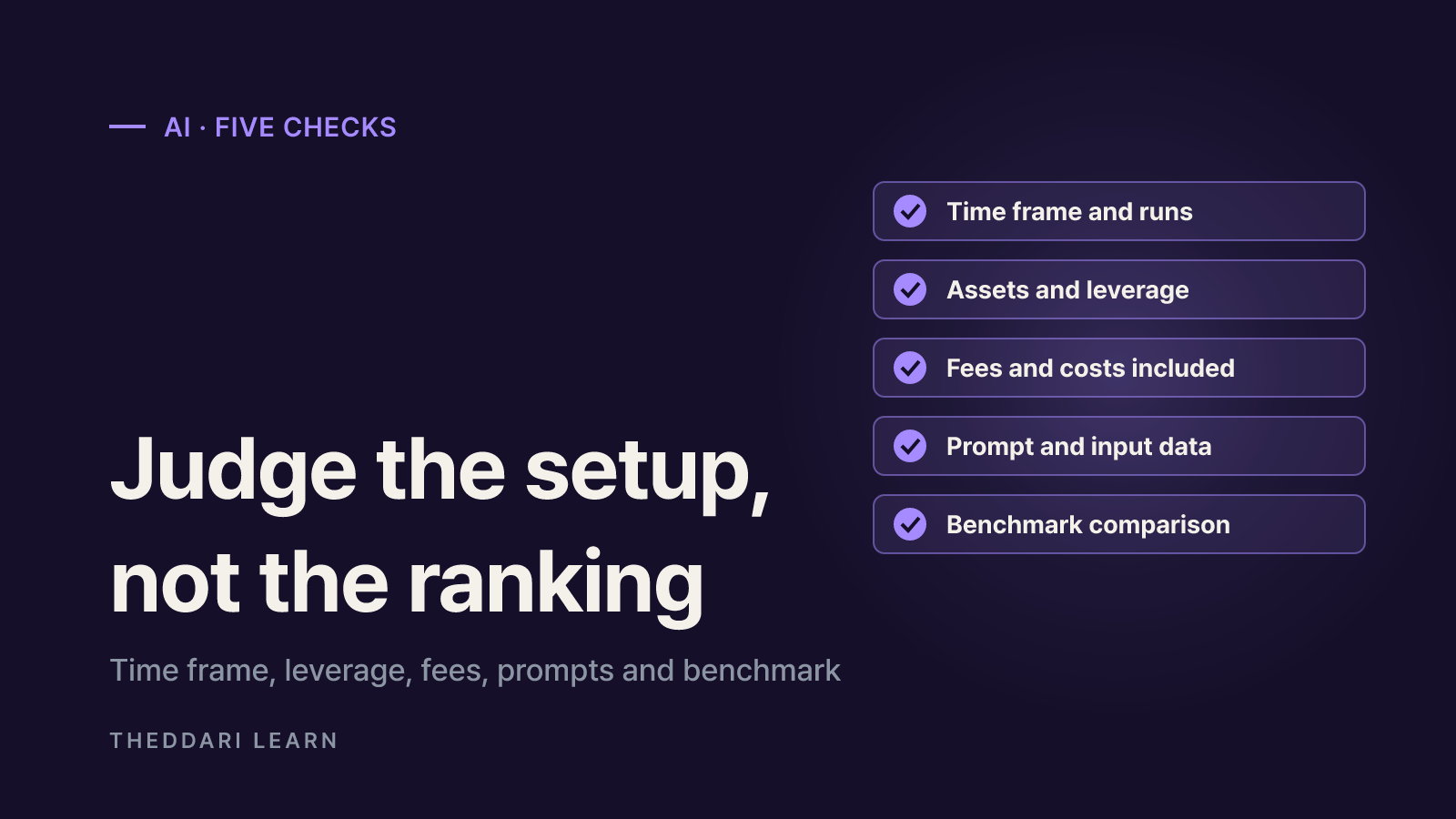
Whether it is Alpha Arena, a research paper or a YouTube challenge, these questions filter out most over-reading.
- 1
How long, and how many runs?
A two-week or one-month single run is dominated by luck. Nof1 reported run-to-run changes in both rankings and correlations between models. Look for repeated runs across different market conditions.
- 2
What assets, and how much leverage?
Leveraged crypto perpetuals magnify small price moves into large gains or losses. Results from that setting say little about buying and holding stocks, and vice versa.
- 3
Are fees and costs included?
Nof1 said early test runs were dominated by trading costs because agents over-traded and fees erased small gains. In Season 1, Protos reported Qwen3-Max paid $1,654 in fees and Gemini $1,331. Make sure returns are net of fees and slippage.
- 4
What exactly was the prompt and data?
Nof1 found the models highly sensitive to trivial prompt changes. When data was listed newest to oldest, several models still read it as oldest to newest. Change the prompt and you effectively change the trader.
- 5
Compared with what?
A ranking between models does not show whether any of them beat simply holding Bitcoin or an index fund over the same period. Ask for a benchmark.
It also helps to know whether big scheduled events landed inside the test window. The economic calendar lists dates such as rate decisions and jobs reports so you can see what happened during an experiment; it shows schedules, not predictions.

The real risks of letting AI trade your money
Viral experiments feed a wave of products that promise AI will make money for you. Regulators keep flagging the same problems.
Relying only on chatbot answers
A January 2024 joint investor alert from the SEC, NASAA and FINRA warns that AI-generated information can rest on inaccurate, outdated or manipulated data, and can be made up even from accurate inputs. It adds that chatbot conversations can push people toward emotional, impulsive trades.
AI trading bot scams and AI washing
The CFTC states that AI cannot predict the future or sudden market changes. It describes a bot program that promised at least 10% a month and took more than $1.7 billion in bitcoin from at least 23,000 people. In July 2025, FINRA warned of a rise in unregistered auto-trading apps that overstate their AI (AI washing), cite unverifiable returns and ask for brokerage usernames and passwords.
Deepfake experts outside the US
The pattern is global. South Korea's Financial Supervisory Service issued a consumer alert in January 2026 about illegal stock-tip chat rooms that use AI deepfakes to impersonate real brokerage experts. If you follow AI investing chatter on Telegram, the AI Telegram trends page shows what topics are circulating, but buzz is not verification.
Using AI for investing: what to delegate and what to keep
Taken together, the experiments and regulator warnings point to a practical split: general-purpose AI is lower risk as a research and checking assistant than as an autonomous trader.
Research
- Reasonable to ask AI
- Summarize filings and earnings materials, explain jargon
- Keep in your own hands
- Verify numbers and dates in the original source
Planning
- Reasonable to ask AI
- Stress-test your plan and list risks you missed
- Keep in your own hands
- The final buy or sell decision
Execution
- Reasonable to ask AI
- Draft a pre-trade checklist
- Keep in your own hands
- Leverage limits and stop-loss rules
Accounts
- Reasonable to ask AI
- Nothing
- Keep in your own hands
- Account access, logins and passwords
Bottom line: AI trading contests are useful for revealing how models differ in risk appetite and habits. A two-week single run, leveraged futures and prompt-sensitive behavior mean they cannot tell you which chatbot to hand your savings to. Check the time frame, assets, costs, prompts and benchmark of any experiment, and treat any AI product that promises steady, outsized returns as a reason to verify its registration first.
Frequently asked questions
Can you make money by letting ChatGPT or Claude trade for you?
Which AI is best for stock picking: Claude, ChatGPT or Gemini?
Are AI trading bots and AI auto-trading apps legit?
How should I read YouTube videos where creators give AI models real money?
Sources and references
- 1Nof1 Alpha Arena: Exploring the Limits of Large Language Models as Quant Traders(opens in a new tab)www.alphaarena.ai
- 2Protos: LLM crypto trading contest finds LLMs can't trade crypto (Nov 4, 2025)(opens in a new tab)protos.com
- 3Investor.gov (SEC, NASAA, FINRA): Artificial Intelligence (AI) and Investment Fraud(opens in a new tab)www.investor.gov
- 4CFTC Customer Advisory: AI Won't Turn Trading Bots into Money Machines(opens in a new tab)www.cftc.gov
- 5FINRA: Know the Risks of Auto-Trading Services Offered by Unregistered Entities (Jul 29, 2025)(opens in a new tab)www.finra.org
- 6Financial Supervisory Service (Korea) Consumer Alert 2026-3: illegal stock-tip chat rooms(opens in a new tab)www.fss.or.kr
Related articles
 AI
MiniMax-H3-Image: Specs, ComfyUI Setup and License Limits
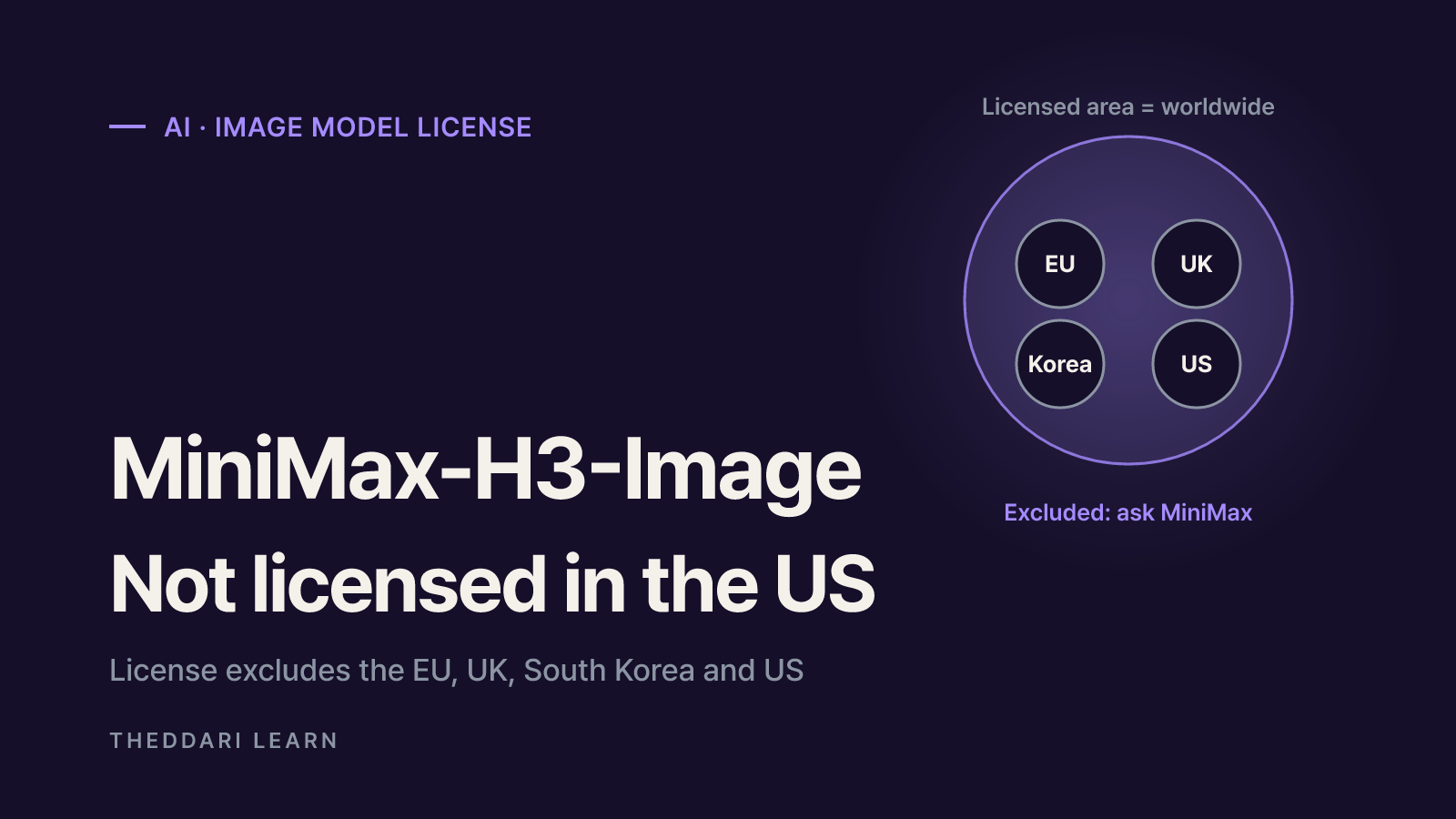
MiniMax-H3-Image topped Hugging Face trending. We checked the model card, the official ComfyUI tutorial and the license text: what the model does, how the Comfy-Org repack differs, how to set it up, and why US, UK, EU and Korean users are outside the default license.
 AI
GPT-6.2 Astra vs Sol: Differences, Pricing and Access
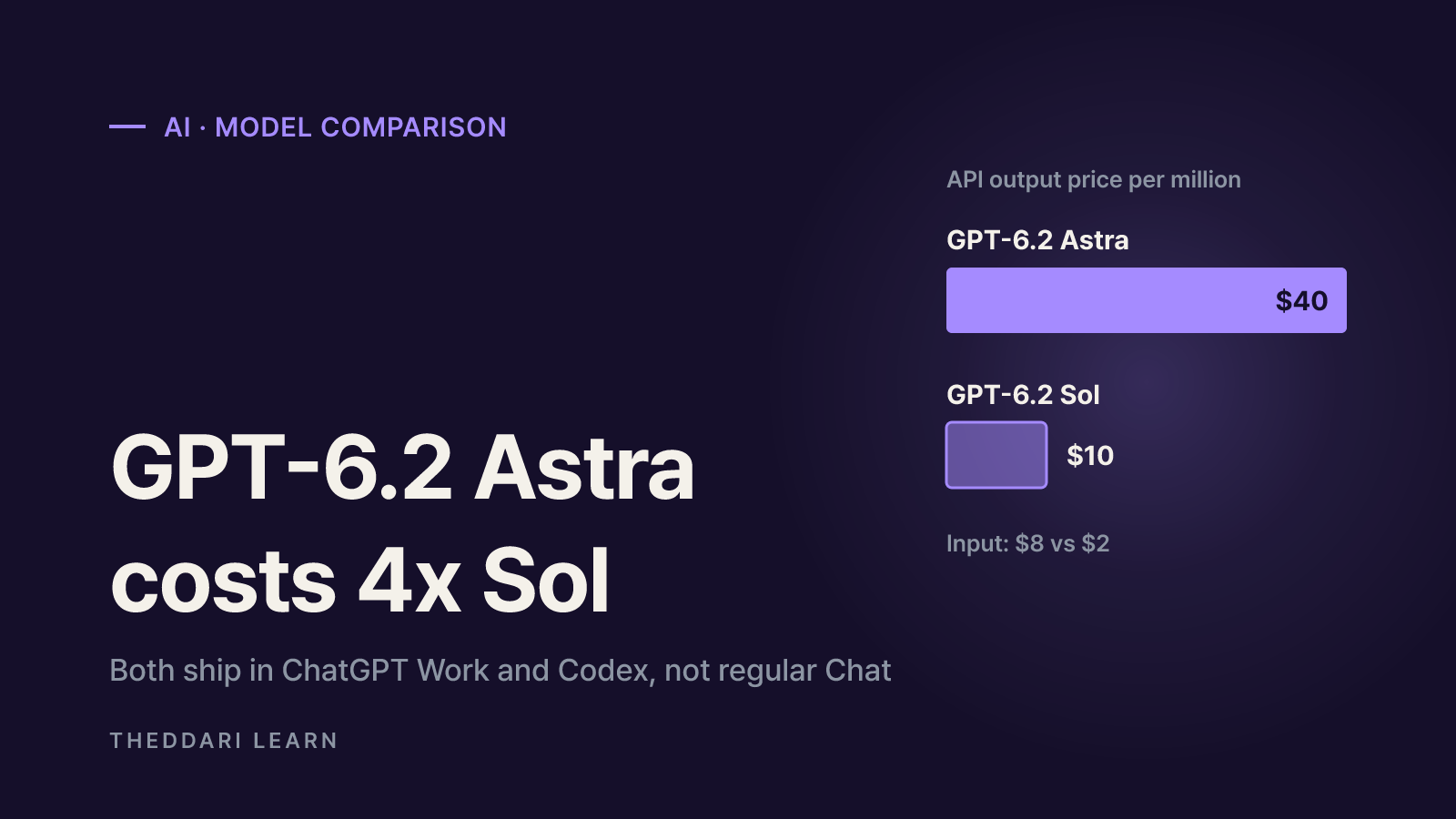
GPT-6.2 Astra is OpenAI's frontier model for hard professional work; GPT-6.2 Sol is the efficient everyday model. Astra costs 4x more per API token, and both ship in ChatGPT Work and Codex, not regular Chat.
 AI
What Is Vibe Coding? How It Works and Where It Breaks
Vibe coding means building software by prompting an AI and judging only the result, never the code. Here is what it can realistically do, which tools fit which job, and where it fails.