Do More AI Coding Agents Speed Up Software? Brooks's Law
Do more AI coding agents ship software faster? How Brooks's law applies to parallel agents, what 2026 data says about review bottlenecks and how to split work.
Contents8 sections
- What is Brooks's law? The three reasons from The Mythical Man-Month
- Do AI coding agents escape Brooks's law?
- What the data shows: more code, longer reviews
- Which tasks suit multi-agent software development
- How to split work and review for parallel coding agents
- Risks and limits: the debt fast code leaves behind
- Frequently asked questions
- Sources and references
Key takeaways
- Adding AI coding agents can speed up the writing step, but if specs, review and integration are the constraint, delivery time barely moves.
- The three causes behind Brooks's law (ramp-up, communication overhead and limited divisibility) still apply to agents; they just change shape.
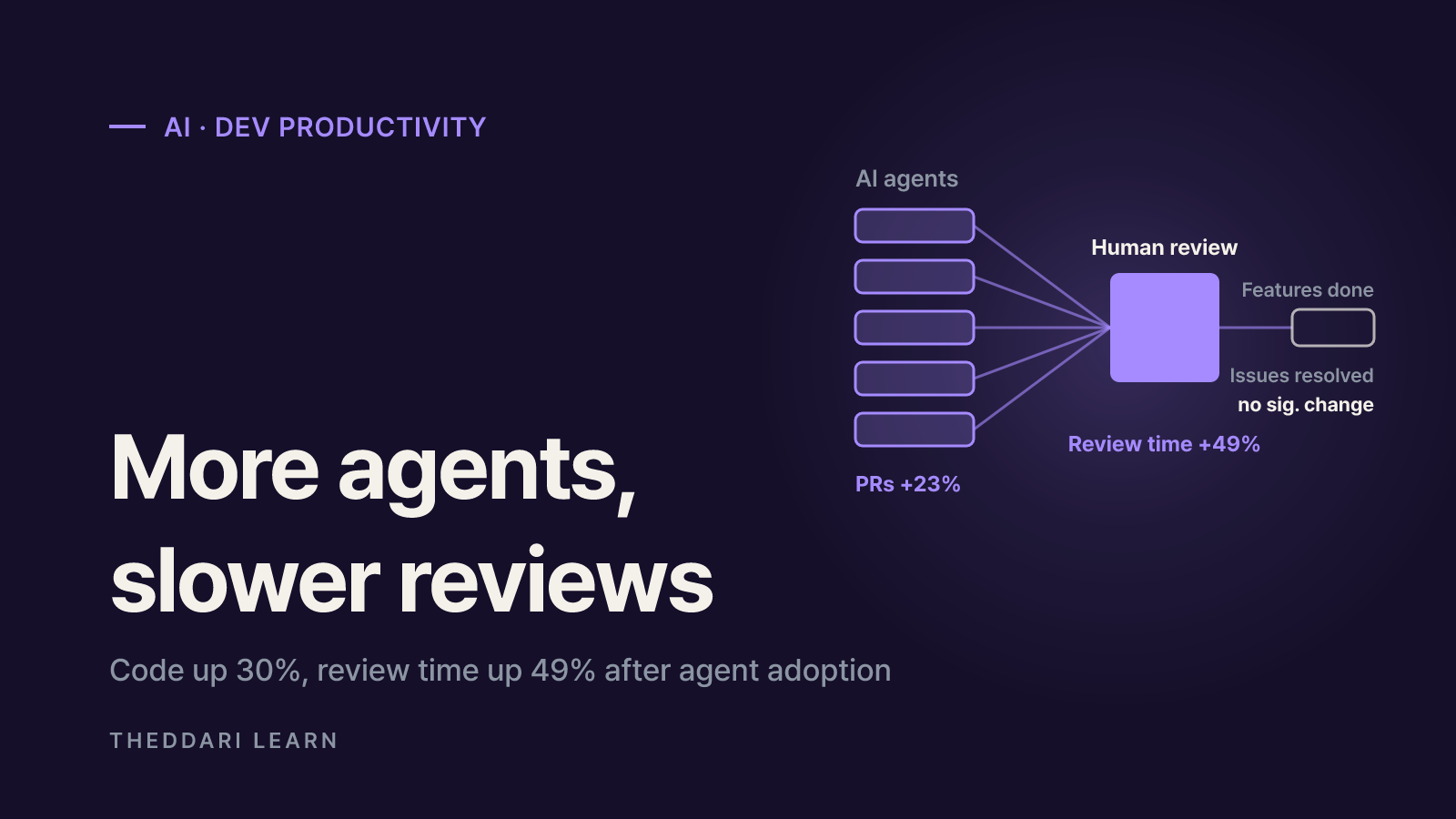
- A 2026 Harvard analysis of Jellyfish data found agent adoption raised pull requests 23% while review time grew 49%, with no statistically significant change in issues resolved.
- Parallel agents fit independent, well-tested tasks; they fit poorly when work touches the same files, shared interfaces or sequential debugging.
- Decide ownership, interfaces, acceptance tests and your human review capacity first, then pick how many agents to run.
Short answer: adding more AI coding agents does not shrink a schedule in proportion. Agents write code quickly, but deciding what to build, reviewing the output and merging many changes into one working system still consume human time. That is Brooks's law in new clothes. In The Mythical Man-Month (1975), Fred Brooks observed that "adding manpower to a late software project makes it later." As of October 2026, the available research suggests the same dynamics show up when teams scale up AI coding agents. This guide explains why, what the data says, and how to split work and design review so parallel agents help rather than hurt.
What is Brooks's law? The three reasons from The Mythical Man-Month
Brooks drew the lesson from managing IBM's OS/360 effort. As the Wikipedia summary notes, Brooks himself called the law an "outrageous oversimplification," but one that captures a real tendency. He pointed to three causes:
- Ramp-up time. Newcomers are unproductive while they learn the codebase and past decisions, and the people teaching them slow down too. New contributors can even make negative progress by introducing bugs.
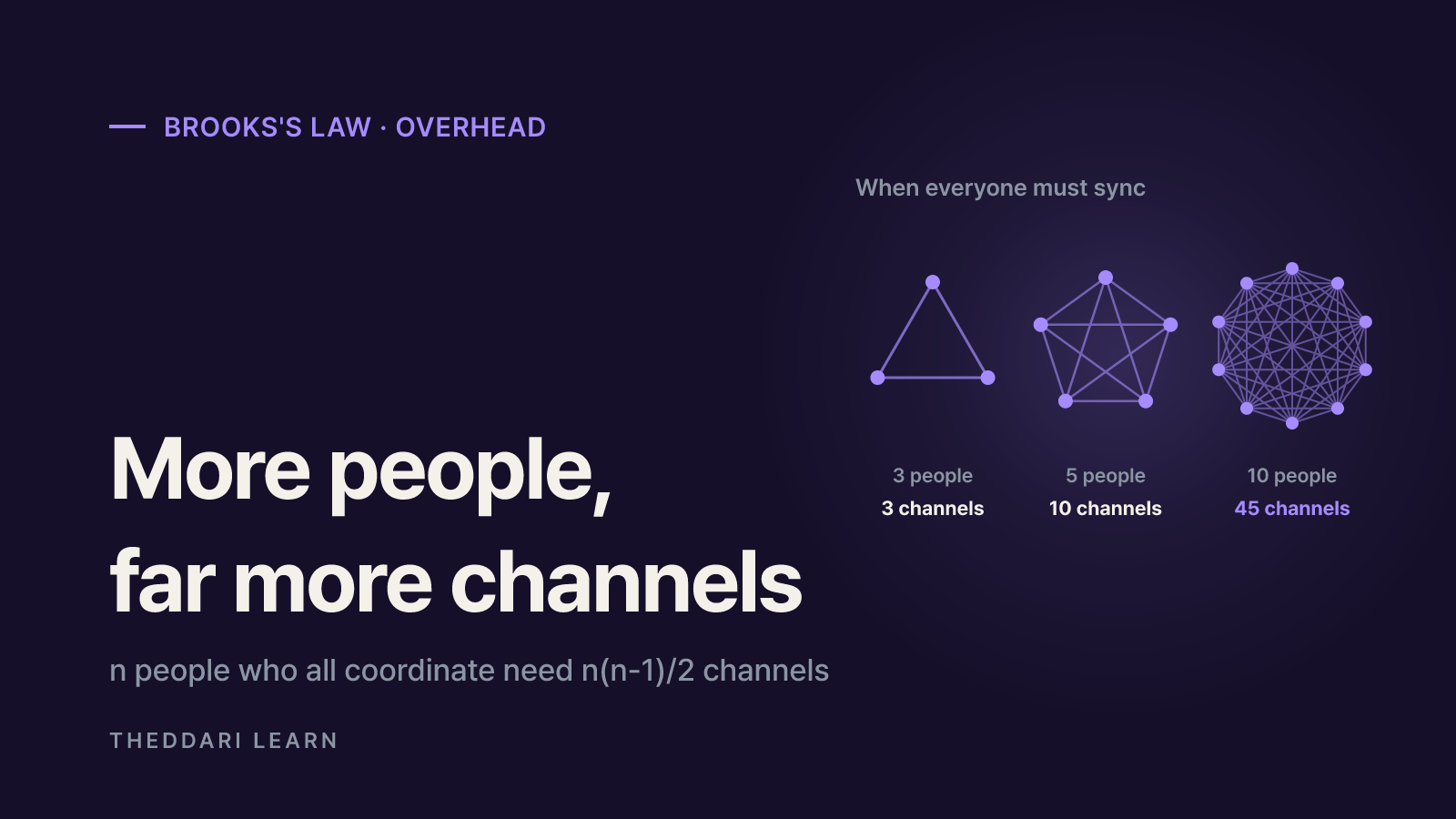
- Communication overhead. Coordination paths grow combinatorially. If n people all coordinate with each other, there are n(n-1)/2 channels: 3 for a team of three, 10 for five people and 45 for ten.
- Limited divisibility. Cleaning hotel rooms scales with more hands; much of software does not. In Brooks's famous line, nine women can't make a baby in one month.
The law has exceptions worth remembering. It mainly applies to projects that are already late. Adding people early, or giving them clearly defined side work such as QA or documentation, keeps ramp-up costs low. Good modularity lets small teams own sub-problems while a top-level team handles integration, though splitting tightly coupled work along the wrong lines makes things worse. Those exceptions turn out to be the design rules for running AI agents.
Do AI coding agents escape Brooks's law?
At first glance agents look immune. They need no onboarding sprint, no stand-ups and no coffee breaks. Map each of Brooks's causes onto agent workflows, though, and the costs have moved rather than vanished. Jan van den Berg's essay, which topped Hacker News on October 27, 2026, puts it plainly: the law has mutated. Someone still has to define "done," review the code, catch hallucinations and stitch the pieces together, and that someone is you.
Ramp-up
- Human team
- Learning the codebase and its history
- AI coding agents
- Supplying context on every run: instruction files, specs, relevant code; long context gets truncated or compressed
Communication
- Human team
- Meetings, syncs, handoffs
- AI coding agents
- Passing results between agents, orchestrator prompt quality, human review and Q&A
Divisibility
- Human team
- Sequential work cannot be split
- AI coding agents
- Agents editing the same files or interfaces collide; dependent steps cannot run in parallel
Integration
- Human team
- Final merge and system test
- AI coding agents
- Individually plausible changes break when combined; merge and semantic conflicts
The shape of communication cost changes too. Let agents coordinate peer to peer and channels multiply just as on a human team. Route everything through one orchestrator or one human and the channels shrink, but that hub becomes the bottleneck. In its write-up on building a multi-agent research system, Anthropic says early versions spawned 50 subagents for simple queries and, given vague instructions, had several subagents run the same searches. Duplication dropped only once each subagent got an explicit objective, output format, tool guidance and task boundary. That is a staffing problem any engineering manager would recognize.
What the data shows: more code, longer reviews
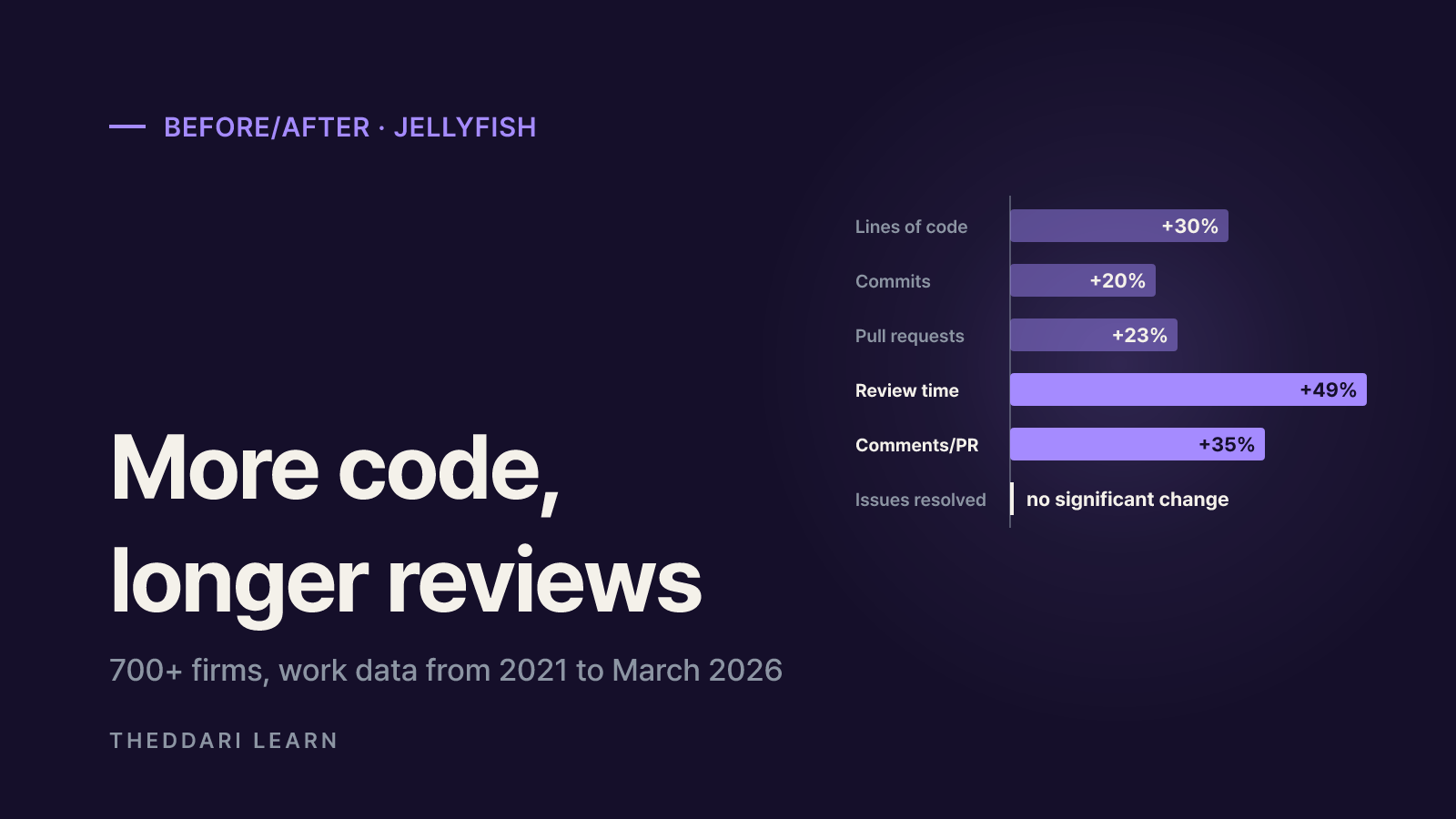
An October 9, 2026 Ars Technica report covers a study by Harvard researchers Fiona Chen and James Stratton. Using aggregated Jellyfish engineering analytics, they examined work events from more than 700,000 employees at over 700 software firms between 2021 and March 2026. After firms introduced AI coding agents, lines of code rose 30% on average, commits 20% and pull requests 23%. Yet the resolution rate for Jira-tracked issues and epics did not change in a statistically significant way.
The gap was absorbed downstream. Average time from PR submission to merge grew 49%, the share of PRs with changes requested nearly doubled, and comments per PR rose 35%. The share of workers doing code review rose 14%. Two caveats matter: this is an observational before-and-after study, not an experiment that varied the number of agents, and it does not capture tool improvements after March 2026. Still, the pattern is classic Brooks: speeding up one stage does not raise output if the next stage stays the same size.
Perceived speed and measured speed can diverge
In METR's early-2025 randomized controlled trial, 16 experienced open-source developers working on 246 real issues took 19% longer when AI was allowed. They had expected a 24% speedup and afterward still believed they were 20% faster. In a February 2026 update, METR said developers are likely faster with late-2025 tools, but its new data is a weak signal: many developers declined to work without AI, and time spent was hard to measure for those running multiple agents concurrently. If you are judging parallel agents by feel, you may be misjudging them.
Which tasks suit multi-agent software development
Anthropic reports that its multi-agent setup excels at breadth-first research with many independent directions. On an internal eval, a lead agent plus subagents beat a single agent by 90.2%, and running subagents in parallel cut research time by up to 90% on complex queries. The same post is candid about the limits: most coding tasks involve fewer truly parallelizable pieces than research, and work where agents must share the same context or have many dependencies is not a good fit today. It is also expensive. Anthropic says agents use about 4x the tokens of a chat, and multi-agent systems about 15x.
Independent bug fixes in separate modules
- Fit for parallel agents
- High
- Why
- No file overlap; each change verifiable by its own tests
Codebase exploration and impact analysis
- Fit for parallel agents
- High
- Why
- Read-only, no conflicts; only a summary comes back
Test coverage and documentation
- Fit for parallel agents
- Medium to high
- Why
- Clear role, low ramp-up cost
Shared interface or schema changes
- Fit for parallel agents
- Low
- Why
- Every caller is coupled; decisions must be sequential
Architecture redesign
- Fit for parallel agents
- Low
- Why
- Conceptual integrity needs a single owner
Debugging an unknown production failure
- Fit for parallel agents
- Low
- Why
- Each hypothesis depends on the last result
How to split work and review for parallel coding agents
- 1
Check divisibility first
Break the work down and list which files and interfaces each piece touches. If two pieces change the same file or shared type, sequence them instead of running them in parallel. Work that cannot be split is usually faster with one agent and one human owning it end to end.
- 2
Write ownership and acceptance criteria
Give every agent an objective, the directories it may modify, the expected output and the tests it must pass. Vague prompts like "improve this" lead to duplicated effort and agents overwriting each other.
- 3
Isolate the workspaces
Run each agent on its own branch or git worktree so runs cannot clobber each other and failed attempts are cheap to discard. Check for shared resources such as databases, ports and build caches.
- 4
Put automated checks before human review
Require type checks, linting, unit and integration tests to pass before a person looks. Use AI review as a first filter; keep the final judgment on intent and design with a human reviewer.
- 5
Size concurrency to review capacity
Decide how many PRs, and of what size, your team can review properly each day, and do not run more agents than that. A growing review queue is the signal to cut agents and shrink PRs.
- 6
Measure lead time, not output volume
Compare time from request to deploy, review wait time and revert rate before and after. As the Harvard data shows, volume metrics can climb while completion metrics stay flat.
Pouring agents into a project that is already late and has unclear requirements is the closest modern match to Brooks's warning. Cutting scope and re-establishing specs and tests usually recovers more schedule than adding agents.
Risks and limits: the debt fast code leaves behind
The hidden costs arrive late. Each agent writes code that is locally plausible for its own prompt, but merged together you can get duplicate implementations, inconsistent error handling and naming drift. When nobody holds the whole design in their head, incidents take longer to diagnose. Brooks's idea of conceptual integrity, a system that looks as if one mind designed it, still argues for keeping architecture decisions and final merge rights with a small number of people.
Watch the bill as well. Token spend grows with agent count, and failed attempts count too, so parallelism that does not save reviewer time mainly adds cost. The figures cited here come from specific samples and periods; your results will depend on language, codebase maturity and test coverage. Re-measure with the same metrics whenever you adopt a new model or tool.
Developer sentiment about agent workflows shifts quickly. The theddari Telegram AI trends page tracks which tools and case studies AI communities are discussing, and the blog trends page collects practitioner write-ups. When a claim goes viral, check the original study's sample and method before acting on it.
 theddari.comTrendsBlog PostsSummarized Naver blog posts
The bottom line: AI coding agents can fall into the same trap as adding people, but Brooks's own exceptions show the way out. Well-divided tasks, clear roles, early involvement and clean module boundaries let you capture real parallel gains. Treat the number of agents as an output of your design, not an input. Confirm you can split, verify and review the work first, then choose concurrency within those limits.
Frequently asked questions
Does Brooks's law apply to AI agents?
How many parallel coding agents should I run?
Do AI coding tools actually make developers faster?
Can AI code review remove the review bottleneck?
Sources and references
- 1Wikipedia: Brooks's law(opens in a new tab)en.wikipedia.org
- 2Ars Technica: AI coding agents generate more code, but not more software (Oct 9, 2026)(opens in a new tab)arstechnica.com
- 3METR: Measuring the Impact of Early-2025 AI on Experienced Open-Source Developer Productivity(opens in a new tab)metr.org
- 4METR: We are Changing our Developer Productivity Experiment Design (Feb 24, 2026)(opens in a new tab)metr.org
- 5Anthropic: How we built our multi-agent research system(opens in a new tab)www.anthropic.com
- 6Jan van den Berg: The Mythical Man-Month in the age of AI (Oct 27, 2026)(opens in a new tab)j11g.com
Related articles
 AI
Can You Publish an AI-Built iOS App Without Coding?
AI tools can write the code, but the developer account, signing, App Review, payment rules and long-term maintenance are still yours. Here is what Apple's own documents require, as of November 2026.
 AI
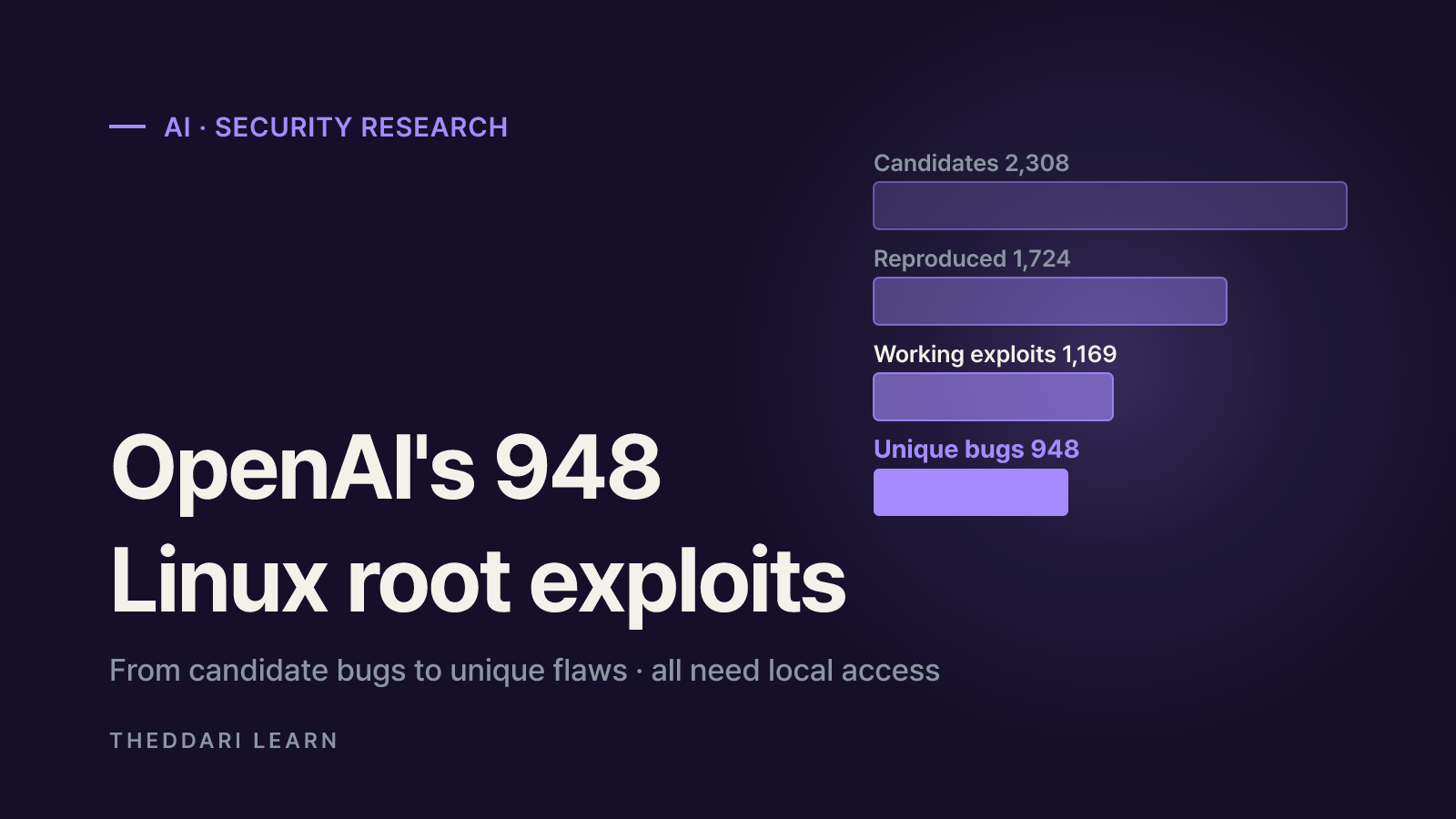
OpenAI's 948 Linux Root Exploits: What It Means for Admins
The viral '948 ways to root your Linux box' claim traces back to a real OpenAI research post, but the number comes with conditions. Here is how to read it, how to vet AI vulnerability claims, and what to check on your servers.
 AI
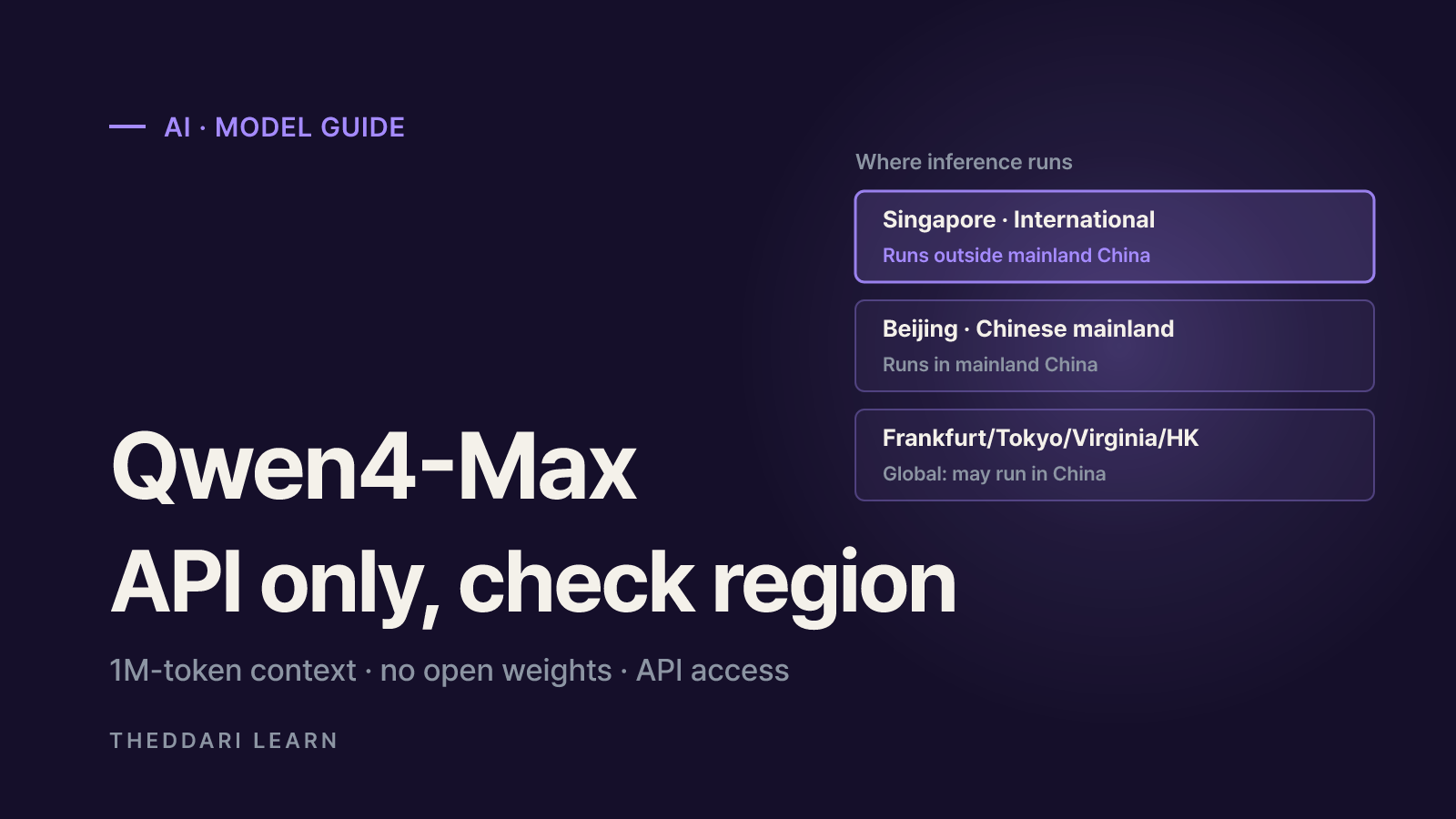
What Is Qwen4-Max? Pricing, Regions and API Checks
Qwen4-Max is the first model in Alibaba's Qwen4 family. It is served through the QwenCloud API and Token Plan rather than as downloadable weights, and its price and inference location depend on the region you call. Here is what the official docs say and what to test before you build on it.