Contents7 sections
The short answer to AI agents vs agentic AI is that the two terms usually describe different layers of the same idea. An AI agent is a system: a language model wrapped with tools, memory and a control loop so it can actually carry out a task. Agentic describes behavior: the degree to which a system pursues a goal on its own, splitting it into steps, acting, checking the results and changing plans when something fails. As of October 2026, though, there is no industry-standard definition, and vendors and researchers draw the line in different places. This guide compares five widely cited sources side by side and gives you a checklist for testing whether a product labeled agentic really behaves that way.
AI agents vs agentic AI in one sentence
Grammar is a useful shortcut. Agent is a noun; agentic is an adjective. So AI agent tends to answer the question "what is this thing?" while agentic answers "how does it behave?" That is why a coding tool can be called an AI agent and described as agentic in the same press release without contradiction. One label names the component; the other rates its autonomy.
The confusion comes from two opposite habits. Some writers use the terms interchangeably. Others treat them as a ladder, presenting agentic AI as the next level above AI agents. Which reading is right depends entirely on the definition the author has adopted, which is why it pays to know the main definitions rather than memorize a single rule.
What it refers to
- AI agent (common usage)
- A software system that calls tools to complete work
- Agentic AI (common usage)
- A property of goal-driven autonomy, or a whole system that has it
Goal scope
- AI agent (common usage)
- A defined task, such as answering support tickets
- Agentic AI (common usage)
- A higher-level outcome spanning many steps
Planning
- AI agent (common usage)
- Picks the next action within set bounds
- Agentic AI (common usage)
- Decomposes goals and revises plans from intermediate results
Structure
- AI agent (common usage)
- Often a single agent
- Agentic AI (common usage)
- Often several agents and tools under coordination
Memory
- AI agent (common usage)
- Mostly context for the current task
- Agentic AI (common usage)
- Many definitions stress memory that persists across sessions
Typical examples
- AI agent (common usage)
- Support bots, scheduling, document summaries
- Agentic AI (common usage)
- Research automation, multi-agent coding, robot coordination
Treat the table as a summary of tendencies, not a rulebook. In particular, some definitions make single-agent versus multi-agent the defining split, while others accept that a single agent can be fully agentic.
How five sources define the terms
Anthropic: workflows and agents inside agentic systems
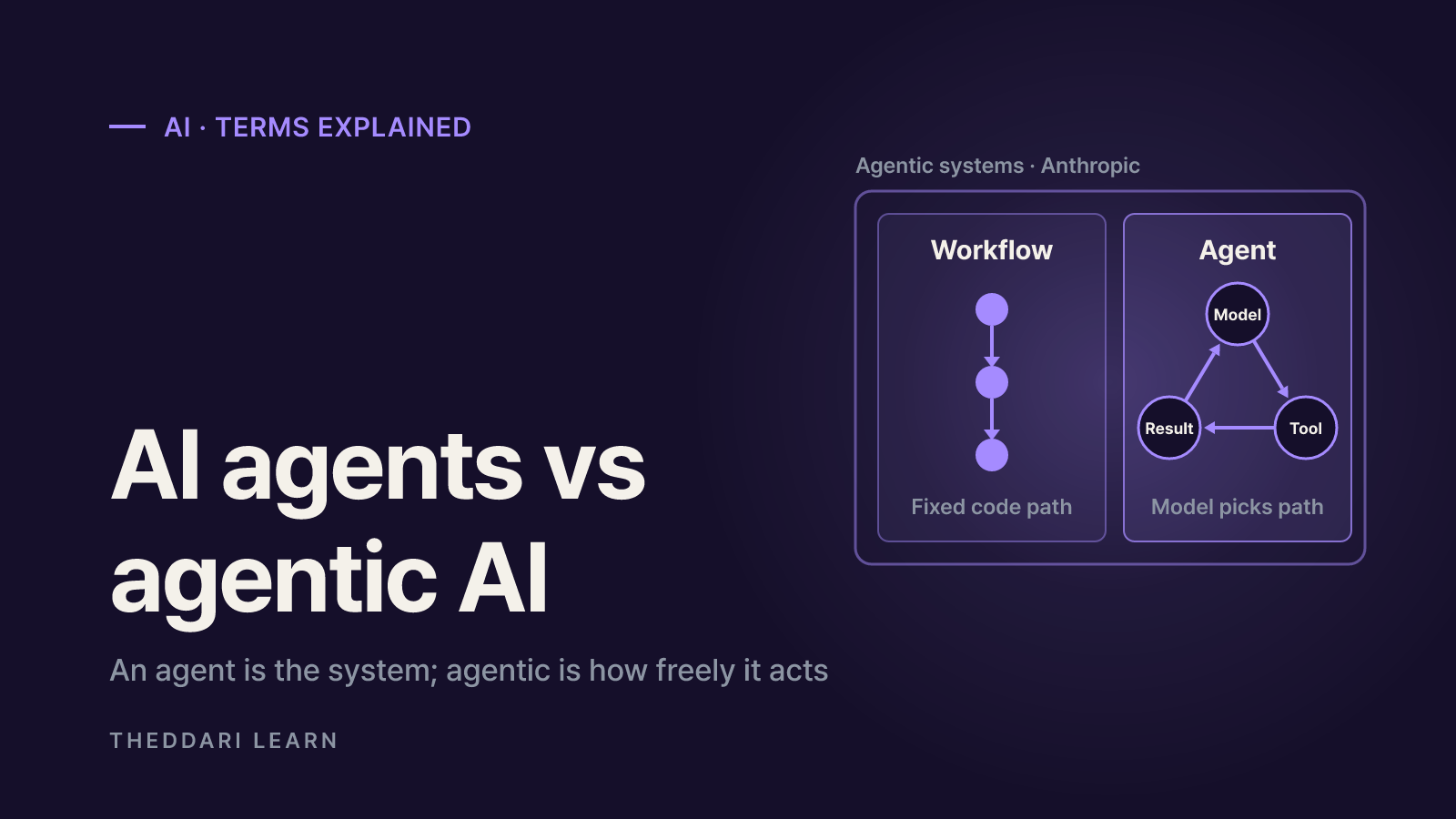
In Building effective agents, published December 19, 2024, Anthropic groups all of these designs under agentic systems and then splits them in two. Workflows orchestrate models and tools through predefined code paths. Agents are systems where the model dynamically directs its own processes and tool usage, keeping control over how it accomplishes the task. Under this framing, agentic is the broad category and an agent is its most autonomous form, which is the reverse of the "agentic AI sits above agents" ladder.
AWS: traditional AI, software agents, then agentic AI
The AWS Prescriptive Guidance comparison table uses three tiers. Software agents, such as chatbots, task schedulers and monitoring agents, have medium autonomy and operate independently within predefined bounds. Agentic AI, with examples like AI assistants, autonomous developer agents and multi-agent LLM orchestrations, is described as highly autonomous, proactive, acting on delegated goals and using memory and self-correction. Here agentic AI is an evolution of the software agent.
A 2025 review paper: single agents vs collaborating systems
The review AI Agents vs. Agentic AI by Sapkota, Roumeliotis and Karkee (submitted May 2025, revised to v5 on September 30, 2025, and published in Information Fusion) defines AI agents as modular, LLM-driven systems for task-specific automation. It reserves agentic AI for architectures marked by multi-agent collaboration, dynamic task decomposition, persistent memory and coordinated autonomy. Its application examples follow the same split: customer support, scheduling and data summarization for agents; research automation, robotic coordination and medical decision support for agentic AI. Many search results that call agentic AI "a team of agents" echo this view.
The skeptical view: an old idea with a new name
Not everyone accepts the new vocabulary. In Agentic AI and Multiagentic: Are We Reinventing the Wheel? (June 2025), Vicent Botti argues that agentic AI is often a buzzword for what AI research has long called intelligent agents, and multiagentic for multi-agent systems. The core properties of agency, namely autonomy, reactivity, proactivity and social ability, were set out in the 1990s. The paper's point is practical: using the established terms connects new LLM tools to decades of work on coordination, negotiation and trust.
The market view: Gartner's agent washing warning
In a June 25, 2025 press release, Gartner predicted that over 40% of agentic AI projects will be canceled by the end of 2027 because of escalating costs, unclear business value or inadequate risk controls. It described agent washing, the rebranding of AI assistants, RPA and chatbots without substantial agentic capabilities, and estimated that only about 130 of the thousands of agentic AI vendors are real. The same release forecast that 33% of enterprise software applications will include agentic AI by 2028, up from less than 1% in 2024. These are analyst estimates and forecasts, not measured outcomes.
Anthropic (Dec 2024)
- How it sees AI agents
- Systems where the model directs its own process and tools
- How it sees agentic AI
- Umbrella covering both workflows and agents
AWS guidance
- How it sees AI agents
- Software agents acting within predefined bounds
- How it sees agentic AI
- An evolution combining autonomy, asynchrony and delegated goals
Sapkota et al. (2025)
- How it sees AI agents
- LLM-driven, task-specific modules
- How it sees agentic AI
- Multi-agent collaboration with persistent memory
Botti (2025)
- How it sees AI agents
- The classic intelligent agent
- How it sees agentic AI
- A buzzword for existing concepts
Gartner (Jun 2025)
- How it sees AI agents
- Tools for tasks that need decisions
- How it sees agentic AI
- A market crowded with agent washing
Six questions to test an agentic claim
Because the definitions diverge, labels tell you little. These questions turn the features the sources agree on into checks you can apply to any product demo or vendor document.
- 1
Who decides the next step?
If developers fixed the sequence in advance, the system is closer to what Anthropic calls a workflow. If the model chooses the next action and tool based on what just happened, it is closer to an agent. Both can be useful; they differ in how much control is handed over.
- 2
Which tools, with which permissions?
Read-only search is very different from editing files, sending email or moving money. Wider permissions add convenience and also raise the cost of a wrong action.
- 3
What happens when a step fails?
Ask whether the system simply stops on an API error or unexpected output, or whether it diagnoses the problem and tries another route. Observing results and replanning is the heart of agentic behavior.
- 4
What does it remember?
Find out whether context lasts only for one conversation or persists across sessions. Persistent memory helps continuity, but you also need to know what is stored and how to delete it.
- 5
Where can a human step in?
Look for approval checkpoints, stopping conditions such as a maximum number of iterations, and a way to halt a run. Anthropic recommends these guardrails and extensive testing in sandboxed environments.
- 6
Can you see the reasoning trail?
A trace of which tool was called, when and why, is what lets you debug and audit the system. Output without a visible process makes errors hard to diagnose.
If most answers come back as "it runs a fixed sequence," you may be looking at existing automation with a new label. That is not automatically bad: predictable automation is often the better fit for stable, well-defined tasks.
Costs and risks behind AI agents explained simply
More autonomy brings bigger trade-offs. Anthropic says agentic systems often trade latency and cost for better task performance, and that an agent's autonomy means higher costs and the potential for compounding errors: a small mistake in one step becomes the input to the next. Its advice is to find the simplest solution possible, noting that for many applications a single well-optimized model call with retrieval and examples is enough.
The Sapkota et al. review lists hallucination and brittleness as key challenges for single agents, and emergent behavior and coordination failure for agentic systems, where one agent's error can spread through others that consume its output. Gartner's reasons for project cancellations, namely rising costs, unclear value and weak risk controls, point the same way. Before adopting anything marketed as agentic, map out what could go wrong, how far the damage could reach and how you would roll it back.
Keeping up as the vocabulary shifts
Agent terminology has shifted with almost every major product launch, so a single source rarely tells the whole story. Pair official documentation and research papers with a view of what practitioners are actually discussing. On theddari, the Telegram AI trends page tracks topics that come up often in AI-focused channels, and the blog trends dashboard shows keywords that bloggers are covering. Volume of discussion signals attention, not accuracy, so treat it as a pointer to what to read next rather than as a verdict on any technology.

A workable mental model: an AI agent is the system that does the work, and agentic describes how independently it plans toward a goal and corrects itself. Keep in mind that Anthropic uses agentic as the wider category, the 2025 review narrows it to multi-agent architectures, and some researchers would retire the word entirely. When reading, check whose definition is in play. When choosing a tool, test who decides the next step, how permissions and stop conditions are designed and whether you can inspect the decision trail; those answers are a more reliable guide than any label.