Contents7 sections
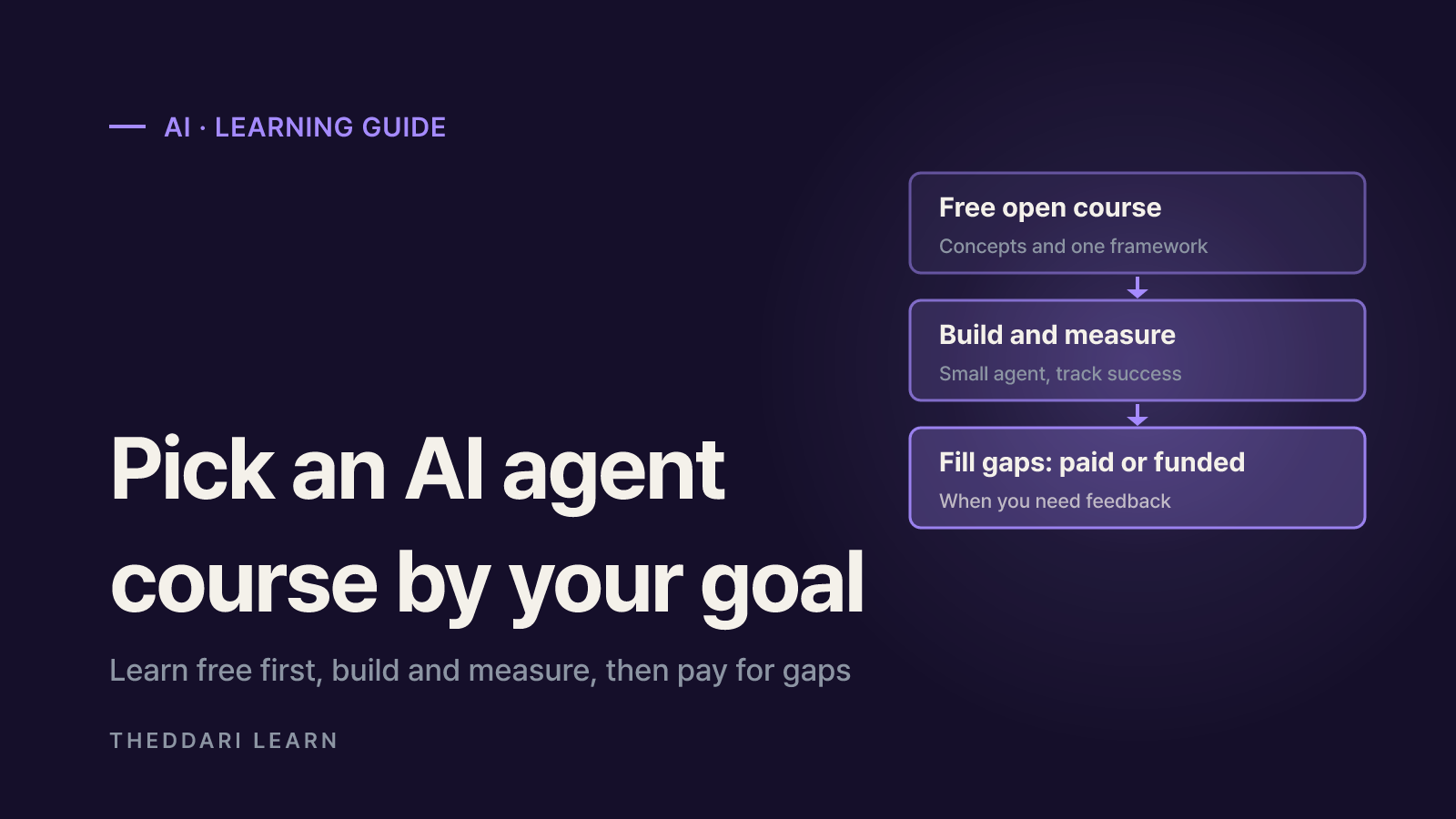
The best AI agent course for you depends less on the brand and more on what you plan to do with agents. If you want to use agent features inside existing tools, product documentation and short no-code tutorials are often enough. If you want to build agents in code, a sensible path is basic Python, then a free open course, then paid help only where you get stuck. If you are changing careers, a longer structured program may make sense. This guide reflects official course pages checked in November 2026 and focuses on how to choose, what a good curriculum covers, and how to spot inflated marketing.
Start with your goal, not the course catalog
Searches like "learn to build AI agents" mix very different needs. Two courses with similar titles can target completely different learners, so place yourself in one of these groups first.
Use agents at work (no-code)
- What you learn
- Configuring agent products, connecting workflows, writing instructions
- Prerequisites
- None in particular
- Typical path
- Official product docs, short tutorials
Build agents in code
- What you learn
- Tool calling, frameworks, RAG, evaluation, security
- Prerequisites
- Basic Python and LLM concepts
- Typical path
- Free open course, then paid help if needed
Switch into a developer role
- What you learn
- All of the above plus team projects, deployment, portfolio
- Prerequisites
- Varies by program
- Typical path
- Bootcamp or funded intensive program
No-code use is about setting up an existing service safely: permissions, data access and spending limits matter more than algorithms. Building agents in code means understanding when a model calls a tool, how you validate the result and what happens when something fails. Without programming basics, that material is hard to follow. It is also worth asking whether your task needs an agent at all; a fixed workflow is often simpler and cheaper.
A quick readiness check for coding courses
- Have you written Python functions and called an external API?
- Can you create a virtual environment, install packages and store an API key in an environment variable?
- Can you explain, at a basic level, how an LLM processes messages and tokens?
- Have you set a budget and a spending cap for model API usage during practice?
Free vs paid AI agent course options compared
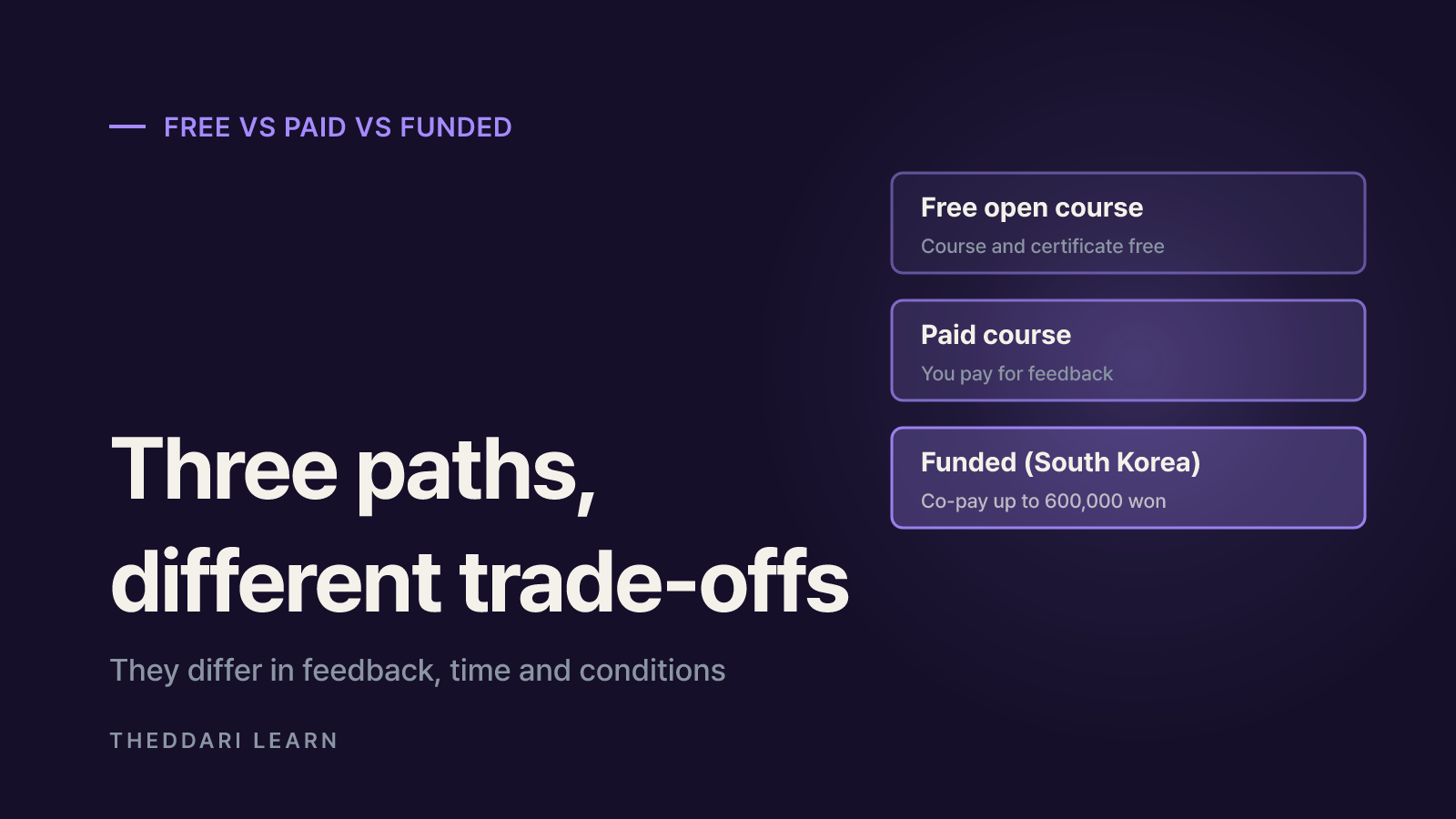
The options differ in time commitment, feedback and eligibility, not just price. The table below is based on official pages checked in November 2026. Paid course prices vary widely by provider, so no single figure is given.
Free open course
- Example
- Hugging Face Agents Course
- Cost and conditions
- Course and certificate free; basic Python and LLM knowledge expected
- Time
- About 1 week per chapter at 3-4 hours a week
- What you get
- Concepts, framework labs, benchmark-based final project
Free open course
- Example
- Microsoft AI Agents for Beginners
- Cost and conditions
- Open on GitHub under the MIT license; Azure account needed to run samples
- Time
- 18 lessons, any order
- What you get
- Design patterns, protocols, production and security lessons
Paid course
- Example
- Online platforms, independent instructors
- Cost and conditions
- Varies; model API costs may be extra
- Time
- Varies
- What you get
- Schedule, Q&A, code review if included
Government-funded (South Korea)
- Example
- K-Digital Training
- Cost and conditions
- At least 90% of tuition covered once per 5-year card period; co-pay up to 600,000 won
- Time
- Average 6 months, 5 days a week, 8 hours a day
- What you get
- Company projects (30% or more of the program), team experience
Free open courses: confirm the fundamentals first
The Hugging Face Agents Course starts with agent fundamentals (tools, thoughts, actions and observations) and moves on to smolagents, LlamaIndex and LangGraph. Bonus units cover fine-tuning for function calling and agent observability and evaluation. The certification process is completely free with no deadline, and each chapter is designed for one week at roughly 3-4 hours. In the final unit, your agent must score 30% or higher on a subset of the GAIA benchmark to earn the certificate of completion, and the course warns that this unit needs more advanced coding.
Microsoft's AI Agents for Beginners is an open repository of 18 lessons covering tool use, agentic RAG, planning and multi-agent patterns, protocols such as MCP and A2A, context engineering, memory, production deployment, local agents and securing agents. Translations are available in many languages. The official samples use Microsoft Agent Framework with Microsoft Foundry and require an Azure account, so if you prefer another stack, read the concept lessons and rebuild the examples yourself.
Paid courses and bootcamps: pay for feedback, not repackaged content
Most of the value in a paid course comes from people: someone to answer questions, review your code, keep you on schedule and work with you on a project. If the syllabus closely mirrors free open material and there is no review or Q&A, you are paying for packaging. Also check whether model API costs are included and whether the course is pinned to a library version that may soon be outdated.
Government-funded training: read the obligations too
Funded programs depend on where you live. For residents of South Korea, the Work24 guide to K-Digital Training (last updated May 7, 2026) describes an intensive program averaging 6 months, with company projects making up at least 30%. It covers at least 90% of tuition once within the 5-year validity of the national training card, with a co-pay of up to 600,000 won. Trainees who drop out without completing cannot rejoin the program, and monthly training allowances are not paid if attendance falls below 80%. Readers elsewhere should check their own national or state workforce programs rather than assuming similar terms.
What a good curriculum covers: tools, evaluation and security
Getting an agent to work once in a demo is different from building one you can trust. When you read a syllabus, look for these three areas as hands-on work, not just slides.
Tool integration
Agents decide which tools to call, such as search, a calculator, a database or an external API. A good course has you write tool definitions (name, description, input schema) and handle failures and bad outputs. Coverage of standard protocols such as MCP is a sign the material is current.
Evaluation and observability
Agents can take a different path each time, so without measurement you cannot tell whether a change helped. Look for building a test set of tasks, measuring success rates, tracing each step to see where things went wrong, and logging cost and latency. The Hugging Face observability bonus unit and Microsoft's production lessons address this area.
Security and permissions
The OWASP Top 10 for LLM Applications 2025 lists prompt injection (LLM01), excessive agency (LLM06) and unbounded consumption (LLM10) among its key risks. These matter more for agents because agents can write files, send messages and spend money. Choose a course that practices least-privilege tool access, human approval steps, defenses against hidden instructions in web pages or documents, and cost caps. A single security lecture at the end is not enough.
How to spot an overhyped AI agent training offer
- Income or job guarantees: ask how the figure was calculated, over what period and for which students. No evidence, no purchase.
- No public syllabus or sample projects: you cannot judge what you will learn.
- Unverifiable instructors: look for public code, talks or shipped products, not follower counts.
- Vague refunds or constant upsells: refund terms should state periods and percentages in writing.
- "Anyone can become a developer with no-code": this usually blurs using tools with engineering skills.
- Claims of government funding: verify the exact program name and type on the official government portal.
A low-cost learning path to try first
- 1
Check the basics
Confirm you can write Python functions and call an API, and review how LLMs work. Put a spending limit on any API key you use for practice.
- 2
Take one free course end to end
Work through the Hugging Face fundamentals or Microsoft lessons 1-6 on tool use, RAG and trustworthy agents. Stick with one framework instead of sampling several.
- 3
Build and measure a small agent
Pick one real task, connect one or two tools with read-only access first, and record success rates on a small test set.
- 4
Pay only for what is missing
If you lack feedback, structure or team experience, choose a paid or funded program that solves that specific gap.
While you study, it helps to follow which agent tools people are discussing. theddari's AI Telegram trends and blog trends pages are a quick way to scan current topics; confirm anything interesting in the official documentation.
 theddari.comTrendsBlog PostsSummarized Naver blog posts
In short: define your goal, use a free open AI agent course to learn the fundamentals, build something small and measure it, and spend money only on the gaps you discover. Whatever you choose, confirm that tool integration, evaluation and security are taught hands-on and that costs and conditions match the official source.