Contents7 sections
Day trading US stocks from Korea is less about picking the right ticker than about how many times you pay the same costs. A Korean resident who trades US-listed shares through a Korean brokerage pays a commission on every buy and every sell, an FX spread whenever won and dollars are exchanged, and small US regulatory fees on each sale. On top of that, Korea taxes the year's net gain on overseas stocks at 22% after a KRW 2.5 million deduction. This guide reflects rules and fee rates checked as of November 2026. The commission and FX percentages below are illustrative assumptions used to show the arithmetic, not any specific brokerage's price list.
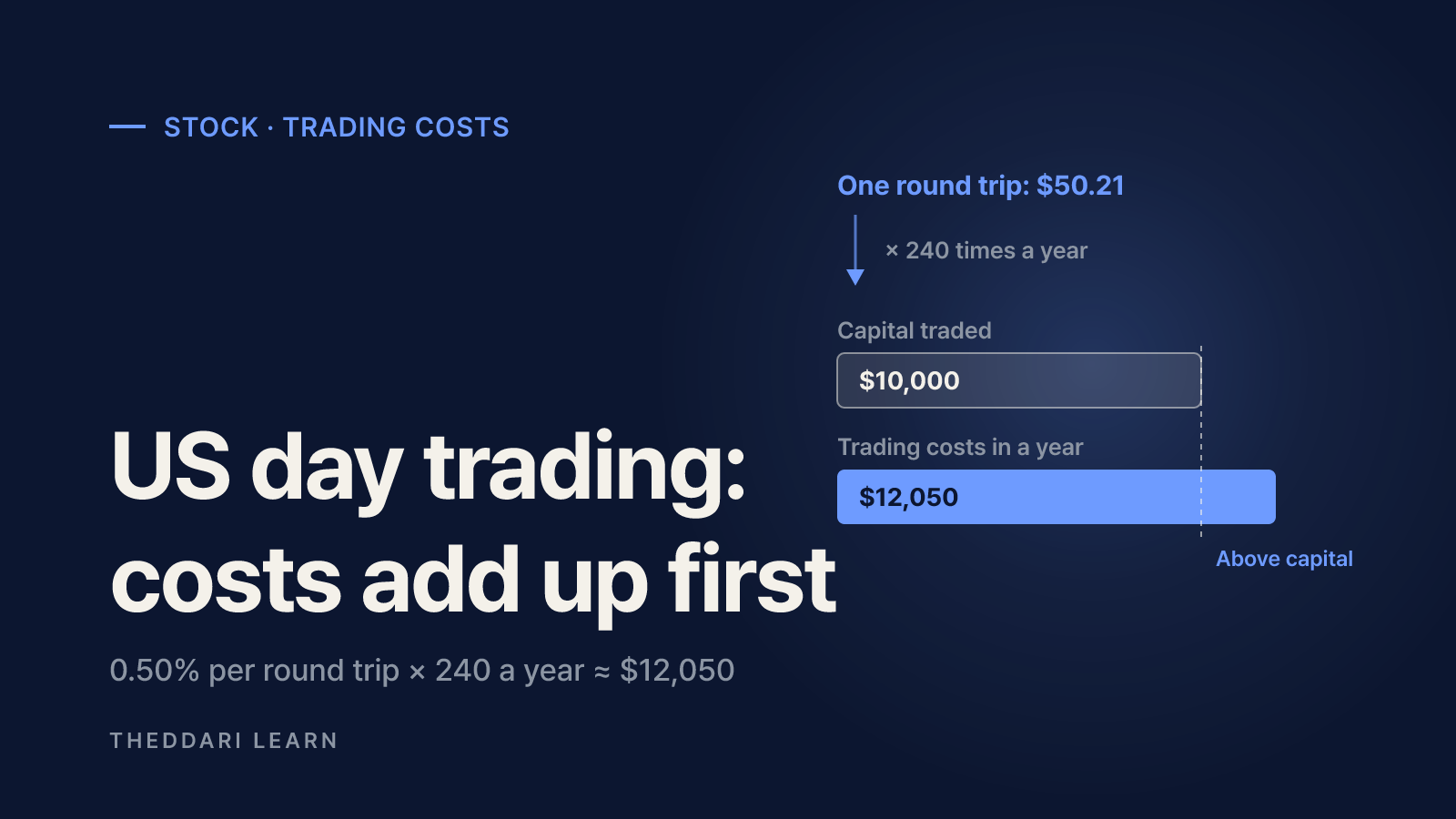
The short answer: if a round trip costs around 0.5%, repeating it every trading day can push a year of costs above the amount you are trading. Whether short-term trading leaves anything behind depends on two checks, made in order. First, does your average round-trip return beat your round-trip cost? Second, after netting the whole year and applying Korean tax, is there still a gain? If you are not a Korean tax resident, the tax section does not describe your situation; US investors, for example, face entirely different rules.
What costs come with day trading US stocks from Korea?
Four recurring costs matter. The first is the brokerage commission, charged as a percentage of trade value on both the purchase and the sale. A 2024 explainer from the Korea Council for Investor Education, an investor-education body, put Korean brokerages' overseas stock commissions at roughly 0.25% to 0.5% per trade and FX conversion costs at roughly 0.2% to 1.0%, noting that both vary by country and broker. Promotions can bring current rates lower, so rerun the numbers with your own account's schedule.
The second is the FX spread. Korean brokerages generally let you hold a US dollar balance or place orders in won that are converted automatically. With a dollar balance you pay the spread mainly when you move money in or out. With automatic conversion, a conversion may happen on every buy and every sell, which multiplies the cost by your trade count.
The third is the SEC Section 31 fee, charged on sales only. The SEC's fiscal 2026 fee advisory set the rate at $20.60 per million dollars from April 4, 2026; it was $0.00 per million through April 3, 2026. The fourth is FINRA's Trading Activity Fee (TAF). FINRA's fee adjustment schedule lists $0.000195 per share sold in 2026, capped at $9.79 per trade, rising to $0.000232 per share in 2027. A Robinhood fee notice states that the TAF is temporarily paused by FINRA from October 1 through December 31, 2026. How a Korean brokerage rounds and passes through these regulatory fees is set by each firm.
Brokerage commission
- When it applies
- Buy and sell
- Basis
- Trade value × broker rate
- Where to check
- Your broker's overseas stock fee schedule
FX spread
- When it applies
- Won↔dollar conversion
- Basis
- Amount converted × spread
- Where to check
- Your broker's FX discount terms
SEC Section 31 fee
- When it applies
- Sales only
- Basis
- $20.60 per $1 million sold (from April 4, 2026)
- Where to check
- SEC advisory, broker fee notice
FINRA TAF
- When it applies
- Sales only
- Basis
- $0.000195 per share, max $9.79 (2026; paused Oct-Dec)
- Where to check
- FINRA fee schedule
Korean capital gains tax
- When it applies
- Filed the following May
- Basis
- (Annual net gain − KRW 2.5 million) × 22%
- Where to check
- National Tax Service, Hometax
Round-trip cost on a $10,000 trade
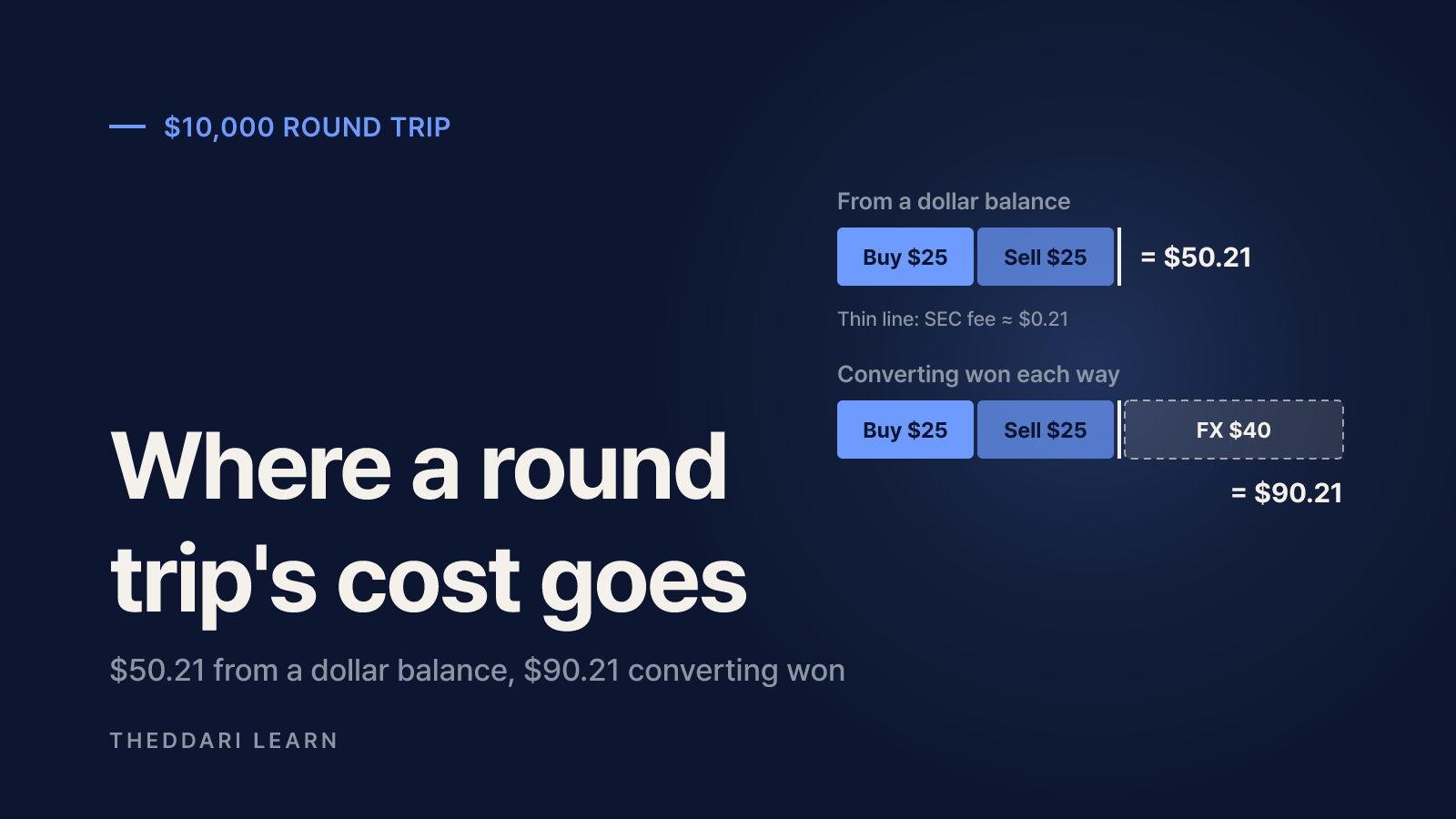
Take a simple case: buy 100 shares at $100, a $10,000 position, and sell them the same day at the same price. Assume a 0.25% commission each way, the low end of the range in the investor-education explainer, and a 0.2% FX spread each way if you trade in won. Because the price did not move, the result shows nothing but cost.
Buy commission
- Calculation
- $10,000 × 0.25%
- Amount
- $25
Sell commission
- Calculation
- $10,000 × 0.25%
- Amount
- $25
SEC fee
- Calculation
- $10,000 × 20.60 ÷ 1,000,000
- Amount
- about $0.21
FINRA TAF
- Calculation
- 100 shares × $0.000195 (paused Oct-Dec 2026)
- Amount
- about $0.02 or $0
Total, trading from a dollar balance
- Calculation
- Commissions + regulatory fees
- Amount
- about $50.21 (0.50%)
Extra cost with automatic won conversion
- Calculation
- $10,000 × 0.2% × 2
- Amount
- $40
Total, converting won each way
- Calculation
- $50.21 + $40
- Amount
- about $90.21 (0.90%)
The regulatory fees amount to cents. Almost all of the cost comes from the brokerage commission and the FX spread, which is why the first lever for a frequent trader is the account's own commission rate and how currency conversion is handled, not the SEC fee.
How fast it adds up over a year
Now repeat the same $10,000 round trip 20 times a month, or 240 times a year. Trading from a dollar balance, costs come to 240 × $50.21 ≈ $12,050. Converting won each way, they reach 240 × $90.21 ≈ $21,650. Either way, a year of costs exceeds the $10,000 being recycled. Real balances change as you win and lose, but the structure holds: the same money is charged again every time it turns over.
The 0.25% commission and 0.2% FX spread are assumptions for illustration. Whatever your actual rates are, the cost structure is the same: round-trip cost multiplied by the number of round trips per year.
How Korea taxes US stock gains
According to Korea's National Tax Service, overseas shares sold by a resident who has kept an address or residence in Korea for five years or more up to the sale date are subject to capital gains tax. This surprises many first-time investors because small shareholders selling Korean listed shares on the exchange generally do not pay capital gains tax, while overseas shares are taxable regardless of size.
The tax is assessed on the calendar year. Gains and losses from January 1 to December 31 are netted, the KRW 2.5 million basic deduction is subtracted, and 22% is applied: a 20% national rate plus local income tax equal to 10% of that, or 2%. You file and pay in May of the following year. Since sales made on or after January 1, 2020, gains and losses on overseas stocks can be combined with taxable Korean shares, such as listed shares held by major shareholders or unlisted shares, and the KRW 2.5 million deduction then applies once to the combined total.
KRW 2.5 million
- Taxable after deduction
- KRW 0
- Tax at 22%
- KRW 0
KRW 3 million
- Taxable after deduction
- KRW 0.5 million
- Tax at 22%
- KRW 110,000
KRW 10 million
- Taxable after deduction
- KRW 7.5 million
- Tax at 22%
- KRW 1.65 million
Currency conversion for tax purposes works differently from what you might expect. The investor-education explainer states that the gain is converted at the exchange rate on the buy and sell settlement dates, regardless of whether, or at what rate, you actually converted money. Same-day trades usually settle on the same date, so the rate effect is close to zero. Swing trades held for days can produce a taxable won gain even when the dollar result is flat, or a won loss when the dollar result is positive. Check your brokerage's capital gains statement to see how commissions were treated as deductible expenses.
Break-even math for short-term trading
Break-even works at two levels. The first is per trade: in the example, your average round trip must earn more than 0.50%, or 0.90% if you convert won each time, just to cover costs. Because winners and losers are mixed, the useful test is whether average win × win rate − average loss × loss rate exceeds the round-trip cost. The second is per year after tax: once annual net gains exceed KRW 2.5 million, 22% of the excess goes to tax, so a KRW 10 million pre-tax gain leaves KRW 8.35 million.
- 1
Find your round-trip cost rate
Add the buy and sell commission rates from your fee schedule. If you trade in won, add the FX spread for both conversions. Regulatory fees are tiny relative to sale value, though rounding to the cent can make them proportionally larger on very small sales.
- 2
Multiply by your trade count
Round-trip cost rate × trade size × round trips per year gives an annual cost. Write it next to your trading capital to see the cost as a share of the money at risk.
- 3
Check your record, not your memory
From recent trade history, calculate win rate, average win and average loss, then compare the expected result per trade with your round-trip cost rate. Remembering only the big winners distorts this comparison.
- 4
Finish with after-tax figures
If the year's net gain exceeds KRW 2.5 million, apply 22% to the excess to get the after-tax result, and note the May filing window.
Costs that do not appear on the fee schedule
The bid-ask spread acts as a cost on every trade, and it can widen in thinly traded stocks and in pre-market or after-hours sessions. Outside regular hours, orders may fill partially, at worse prices, or not at all, and market orders can execute far from the last quoted price. Since US regular hours fall overnight in Korea, fatigue and rushed order changes add their own risk. Price swings tend to be sharpest around scheduled economic releases and earnings reports. The theddari economic calendar and earnings calendar list those dates so you can plan order types or step aside; they show timing, not direction.

Pre-trade cost checklist
- Confirm your commission rate for US stock buys and sells, and when any promotional rate ends.
- Know whether you trade from a dollar balance or with automatic won conversion, and what FX discount applies.
- Multiply your round-trip cost rate by expected round trips per year.
- Compare average profit per trade from your own records with that round-trip cost rate.
- Build in 22% Korean tax on annual net gains above KRW 2.5 million and the May filing deadline.
- If you also hold taxable Korean shares or use several brokerages, account for netting and the single combined deduction.
In short, before asking which stock to trade, run two calculations: round-trip cost rate × number of trades, and annual net gain minus the KRW 2.5 million deduction, taxed at 22%. Commission promotions and US regulatory fee rates change during the year, so recheck your brokerage's fee schedule and the official tax guidance before you start and again before year-end.