Contents6 sections
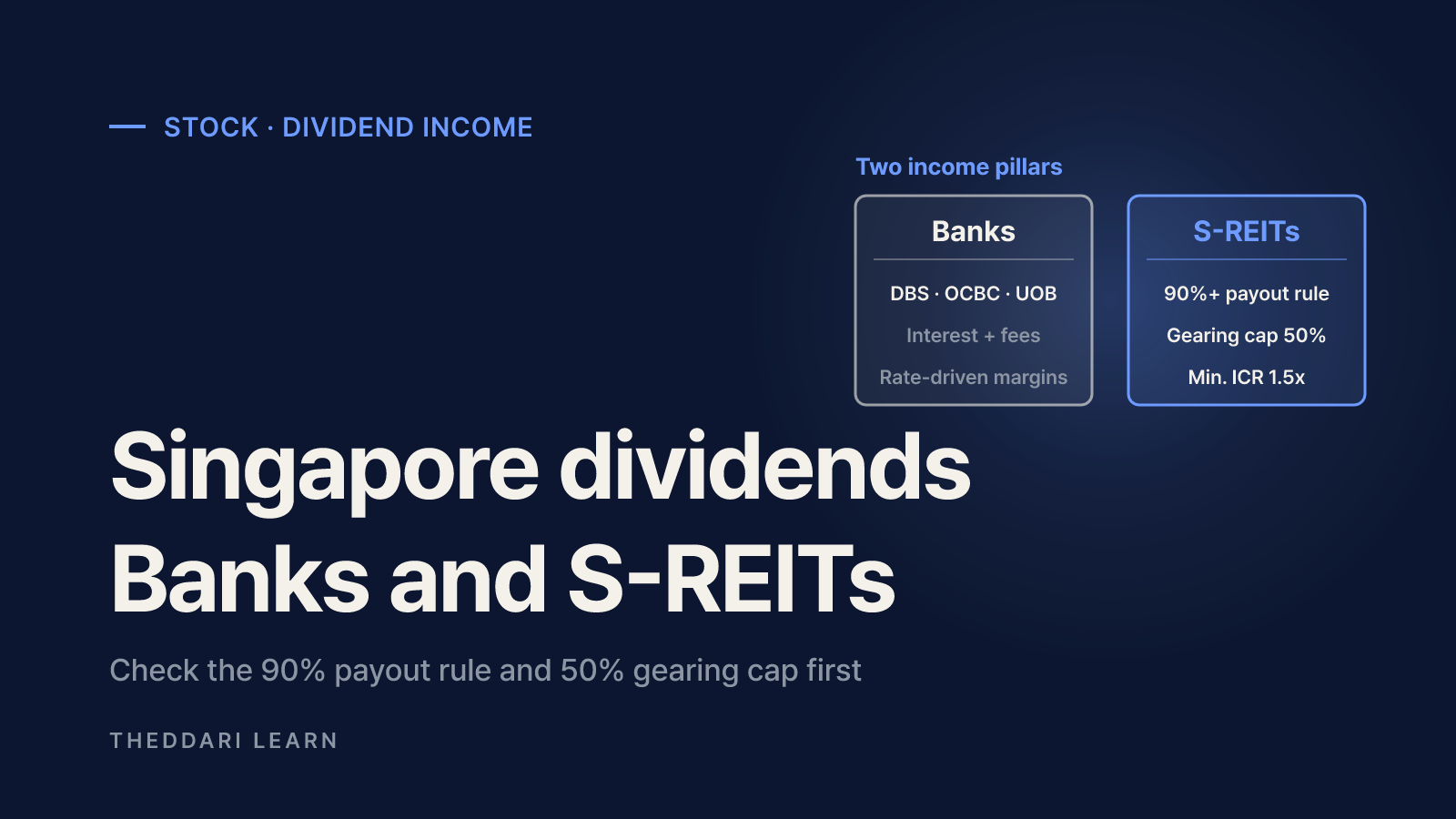
Most Singapore dividend stocks portfolios are built around two pillars: the large local banks and Singapore-listed REITs (S-REITs). The reasons are structural. Singapore uses a one-tier corporate tax system, so dividends from Singapore-resident companies are generally not taxed again when you receive them, and S-REITs must pay out at least 90% of taxable income to enjoy tax transparency. That combination produces large cash payouts, but they can still be cut. This guide, based on IRAS, MAS and MoneySense material checked in October 2026, explains how the income is generated, how it is taxed and what can reduce it.
Interest in the topic has jumped after interviews with Singapore retirees living off bank and REIT dividends went viral. Those stories depend on when the investor started, how much capital they had and their tax position, so treat them as context rather than a template.
Why Singapore dividend stocks lean on banks and S-REITs
Bank stocks: margins and capital drive the payout
Financials make up a large share of the Singapore market, and DBS, OCBC and UOB are the names income investors usually start with. A bank pays dividends out of net profit: interest income from lending, fee income from wealth management and cards, minus credit costs. When SORA (Singapore's overnight benchmark rate) and US rates fall, net interest margins tend to compress. When the economy weakens, provisions for bad loans rise. Payout frequency and payout ratio differ by bank, so read each bank's results presentation rather than relying on last year's yield.
S-REITs: rental income passed through a trust
An S-REIT pools money to own income-producing property such as malls, offices, logistics warehouses, data centres, hotels and hospitals. MoneySense groups them into commercial, retail, industrial, hospitality and healthcare REITs. Distributions are paid after manager fees, property management fees and trustee fees. Units trade on SGX like shares, which gives small investors access to large assets in bite-size amounts.
Source of payout
- Singapore bank stocks
- Net profit after credit costs
- S-REITs
- Rental income after interest and fees
Payout rule
- Singapore bank stocks
- Board decision, shaped by capital rules
- S-REITs
- At least 90% of taxable income for tax transparency
If rates fall
- Singapore bank stocks
- Margins may shrink
- S-REITs
- Financing costs may ease
Main risks
- Singapore bank stocks
- Credit losses, lower rates, slowdown
- S-REITs
- Gearing, refinancing, vacancies, lease expiry
Metrics to check
- Singapore bank stocks
- Net interest margin, capital ratios, payout ratio
- S-REITs
- Gearing, ICR, occupancy, lease expiry profile
Because banks and REITs can react differently to rate changes, holding both can smooth income. Do not assume that always works: a recession can hurt both at once.
How Singapore taxes dividends and REIT distributions
- One-tier dividends: IRAS says dividends paid by a Singapore-resident company under the one-tier system are generally not taxable for shareholders (co-operatives are the exception), because the company's tax is final.
- S-REIT distributions to individuals: exempt, unless received through a Singapore partnership or as part of a trade, business or profession.
- Foreign non-individual investors: qualifying non-resident non-individuals, such as foreign companies with no Singapore permanent establishment, face a reduced 10% withholding rate on taxable S-REIT distributions. IRAS confirms the concession was extended to 31 December 2030 under Budget 2025. Individuals, resident or not, are paid without this deduction.
Singapore not taxing the payout does not mean you pay nothing. Your country of residence decides that. As one example, the Korea Council for Investor Education explains that Korean residents have the gap between foreign withholding and Korea's 14% rate, plus 10% local tax, collected by their Korean broker. With no Singapore withholding, that means 15.4% in total, and annual interest and dividend income above KRW 20 million triggers comprehensive taxation. Investors elsewhere should check how their own system treats foreign dividends and whether foreign tax credits apply at all when no tax was withheld at source.
An SGX listing does not automatically mean one-tier treatment. Shares of foreign-incorporated companies, or parts of a REIT distribution classed as other income, can be taxed differently. Check the tax breakdown on each distribution notice.
Checklist for building a Singapore dividend portfolio
- 1
Set the goal and the SGD exposure
Decide whether you want cash income or total return, and how much of your net worth you are willing to hold in Singapore dollars.
- 2
Review the banks
Read recent results for net interest margin trends, capital ratios, payout ratio and dividend frequency. Track reporting dates with the earnings calendar.
- 3
Read the REIT numbers
From each REIT's results, note aggregate leverage, interest coverage ratio, average debt maturity, share of fixed-rate debt, occupancy and weighted average lease expiry.
- 4
Diversify by sector and geography
Mix retail, industrial, logistics and healthcare exposure. REITs with overseas assets add that country's rate and currency risk.
- 5
Watch the rate calendar
Fed meetings and MAS policy statements move both banks and REITs. Use the economic calendar to know when they land, not to predict the outcome.
- 6
Calculate after-tax, after-fee income
Subtract home-country tax, FX spreads and commissions from the headline yield, then compare the result with income options in your own market.
To see which tickers investor communities are discussing, the stock Telegram trends page can help, but buzz is not a substitute for the checks above.
S-REIT risks to check before you invest
MAS leverage and interest coverage rules
From 28 November 2024, MAS applied a single 50% aggregate leverage limit and a minimum interest coverage ratio of 1.5 times to every REIT, at all times. Previously, a 2.5x ICR applied only to REITs wanting to raise gearing from 45% to 50%. For financial periods ending on or after 31 March 2025, REITs must also disclose sensitivity analyses for a 10% drop in EBITDA and a 100-basis-point rise in rates, and explain improvement plans if ICR falls below 1.8 times. Those disclosures are one of the best early warnings an income investor can get.
Other risks MoneySense highlights
- Income risk: distributions can fall when leases renew at lower rents or occupancy drops.
- Refinancing risk: REITs retain little cash, so maturing debt may be refinanced at higher cost or funded through rights issues and placements that dilute distributions per unit.
- Concentration risk: a REIT relying on a few properties or tenants is exposed to any one of them failing.
- Land lease expiry: much Singapore property is leasehold, and value can decline as the remaining term shortens.
- Currency risk: non-SGD investors see dividends and capital values move with the exchange rate.
- Manager incentives: externally managed REITs may earn acquisition and divestment fees on top of base and performance fees, so check whether deals serve unitholders.
In short, Singapore offers light local tax and clear payout rules, which is why banks and S-REITs anchor so many income portfolios. Your real return still depends on home-country tax, currency moves and balance-sheet strength. Rank candidates by gearing, interest coverage, lease profile and bank earnings quality before you rank them by yield, and spread holdings across banks and REIT sectors so a single rate move does not hit everything at once.