Contents7 sections
Qwen-Image 2.1 Turbo is an official, openly downloadable checkpoint from Alibaba's Qwen team that generates and edits images in 8 denoising steps. It is an accelerated version of Qwen-Image-2.1 rather than a new architecture, and it ships under a research-only license. The GGUF and "uncensored" files trending next to it on Hugging Face are third-party builds, not Qwen releases. This guide summarizes what the official model card and the most visible quantization repos stated as of October 2026. Software versions move quickly, so treat the settings below as a starting point to verify, not a fixed recipe.
What is Qwen-Image 2.1 Turbo?
The base model, Qwen-Image-2.1, is a unified text-to-image and image-editing model whose visual generation component has 7B parameters across 32 single-stream DiT layers. Qwen highlights native transparent (RGBA) output, editing with up to 10 reference images, local edits marked with circles, painted annotations or masks, identity preservation for people and products, and improved typography. Its published examples use 40 inference steps per image.
Turbo keeps that 7B architecture and is distilled for 8 steps. According to the card, the recommended sampling schedule is saved inside the checkpoint and loaded automatically, classifier-free guidance defaults to 1, and prefix KV caching reuses the text and reference-image context across steps. It loads with QwenImage21Pipeline in Diffusers, but it needs a recent Diffusers build that can read pipeline-configured sigmas and transformers 5.17.0 or newer.
Visual generator
- Qwen-Image-2.1
- 7B, 32 DiT layers
- Qwen-Image-2.1-Turbo
- Same 7B architecture
Steps in official examples
- Qwen-Image-2.1
- 40
- Qwen-Image-2.1-Turbo
- 8 (saved schedule)
Guidance
- Qwen-Image-2.1
- Set per example
- Qwen-Image-2.1-Turbo
- CFG 1 by default
Tasks
- Qwen-Image-2.1
- Text-to-image, editing, RGBA
- Qwen-Image-2.1-Turbo
- Text-to-image, editing
License
- Qwen-Image-2.1
- Qwen Research License
- Qwen-Image-2.1-Turbo
- Qwen Research License
Resolution presets and the step-count trap
Both cards list roughly 2-megapixel presets, such as 2048×2048 for 1:1, 2752×1536 for 16:9 and 1536×2752 for 9:16. The Turbo-specific catch is sampling: changing num_inference_steps alone does not override the saved 8-step schedule. Passing explicit sigmas does, but Qwen states that other schedules have not been evaluated for this checkpoint. More steps are not automatically better here, so judge the default output first.
Open weights, research-only license
Calling it an open image generation model is accurate for access but not for usage rights. The repository's LICENSE is the Qwen Research License Agreement, dated September 20, 2026. It grants a royalty-free license to use, copy, modify and redistribute the materials for non-commercial purposes only, defined as research or evaluation. Commercial use requires a separate license from Qwen.
- Redistribution must include a copy of the agreement, prominent notices on modified files and a specific attribution line in a Notice file.
- If you use the model or its outputs to build an AI model that you distribute, you must display "Built with Qwen" or "Improved using Qwen" in the documentation.
- You may not use "Qwen" as the primary name of a derivative; descriptive phrasing such as "fine-tuned from Qwen Image" is allowed.
- The agreement is governed by Chinese law with exclusive jurisdiction in Hangzhou courts, and it disclaims any warranty about the safety of outputs.
Quantized files do not escape these terms. AtomicChat's Turbo GGUF and abenzerps' Qwen-Image-2.1 quants are both tagged qwen-research. AtomicChat's uncensored repo is tagged Apache-2.0, but only because it modifies the Qwen3-VL-8B text encoder, whose upstream license is Apache-2.0; the same card notes that the Turbo denoiser it pairs with remains under the Qwen Research License. An Apache tag on one component does not make the whole pipeline commercially usable.
How Qwen image GGUF quantization changes the output
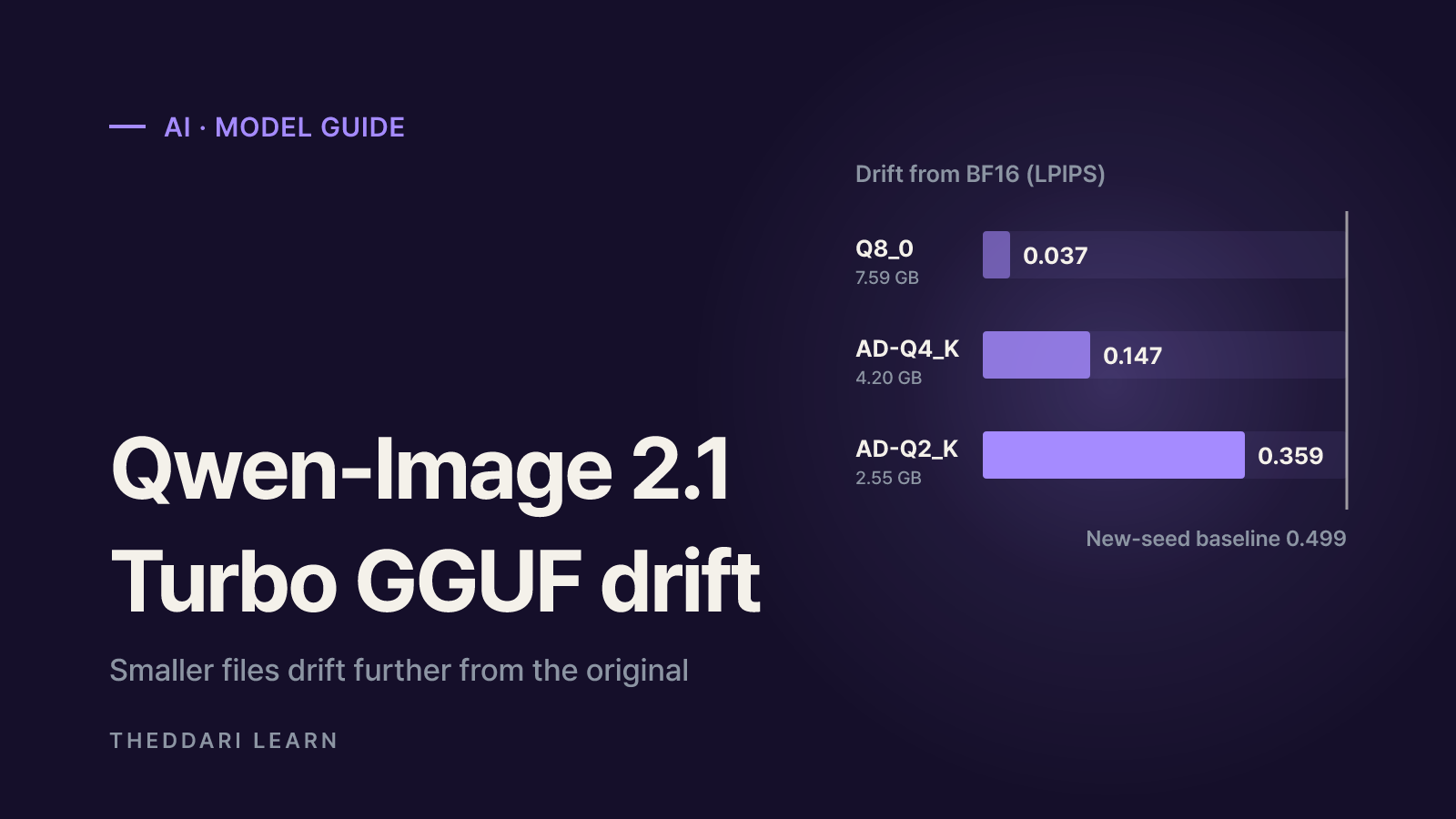
Quantization stores weights at lower precision to cut file size and memory, at the cost of output that may no longer match the original. As of October 2026 Qwen does not publish GGUF files for Turbo; the official model tree listed 37 third-party quantizations. AtomicChat published one of the more transparent comparisons: 48 prompts with 2 seeds each, rendered at 1024×1024 on an A100 with stable-diffusion.cpp, with the text encoder and VAE held at BF16. It reports LPIPS, a perceptual distance where 0 means identical. Changing only the seed produced an LPIPS of 0.499, a useful yardstick for a completely different picture.
BF16
- Size
- 14.23 GB
- LPIPS
- 0
- vs. new seed
- 0%
- Chinese text LPIPS
- 0
Q8_0
- Size
- 7.59 GB
- LPIPS
- 0.037
- vs. new seed
- 7%
- Chinese text LPIPS
- 0.037
AD-Q6_K
- Size
- 6.71 GB
- LPIPS
- 0.044
- vs. new seed
- 9%
- Chinese text LPIPS
- 0.052
AD-Q5_K
- Size
- 5.40 GB
- LPIPS
- 0.076
- vs. new seed
- 15%
- Chinese text LPIPS
- 0.080
AD-Q4_K
- Size
- 4.20 GB
- LPIPS
- 0.147
- vs. new seed
- 29%
- Chinese text LPIPS
- 0.166
AD-Q3_K
- Size
- 3.60 GB
- LPIPS
- 0.206
- vs. new seed
- 41%
- Chinese text LPIPS
- 0.267
AD-Q2_K
- Size
- 2.55 GB
- LPIPS
- 0.359
- vs. new seed
- 72%
- Chinese text LPIPS
- 0.421
Three takeaways stand out. Q8_0 stays close to the original, while drift grows noticeably from 4 bits down. Images containing lettering degrade before photographs do, which matters if you want posters or UI mockups. And the conversion method matters at the same bit width: a plain, uniform Q4_K file (4.05 GB) measured 0.187, and a plain Q2_K reached 0.475, almost as far as a new seed. These are one publisher's numbers; the card notes that aesthetics and prompt adherence were not measured.
A GGUF file is only the denoiser
A Turbo GGUF contains the denoiser only. You also need the Qwen3-VL-8B text encoder and the VAE. In abenzerps' ComfyUI bundle, the encoder is 17.53 GB at BF16 or 9.35 GB at int8, and the VAE is 676 MB, so the encoder can outweigh a 4-bit denoiser. AtomicChat also found that encoder precision moves the picture: a Q8_0 encoder shifted images by an LPIPS of 0.037, while a plain Q4_K_M encoder shifted them by about 0.17. File totals are not peak VRAM; measure memory on your own runtime, resolution and offload settings.
Match the Turbo sigma schedule
AtomicChat warns that stable-diffusion.cpp falls back to Qwen-Image-2.1's default schedule unless you pass --sigmas, which produces different images because Turbo was not distilled for it. Use 8 steps, CFG 1, the euler sampler and the checkpoint's sample_sigmas list, and a build from October 6, 2026 or later, when a custom-sigma bug was fixed. If a quantized model looks poor, rule out the schedule before blaming the bit width.
Uncensored forks: what changes and what the risks are
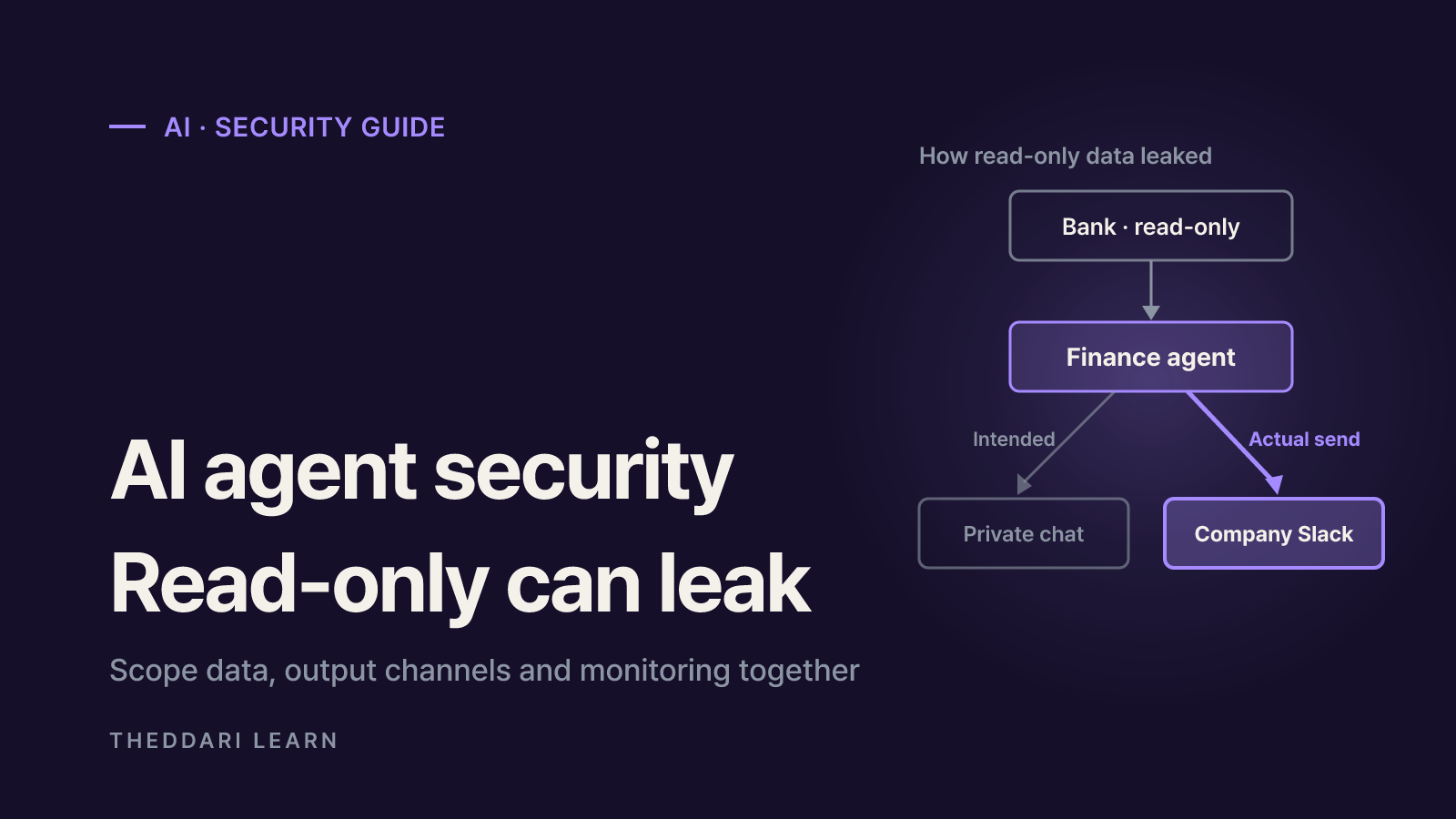
Several trending repos carry "Uncensored" in their names, but they modify different things. AtomicChat's uncensored GGUF explains that the pipeline has three parts: a safety checker, the text encoder and the denoiser. The open weights ship with no safety checker; moderation exists only in Qwen's hosted service. The repo removes the refusal direction from the text encoder only. As a chat model, refusals fell from 88.9% to 1.2% on its English test set, yet on images 0 of 45 sensitive prompts changed outcome. The card also discloses two internal quality gates that did not pass.
The abenzerps repository is based on Qwen-Image-2.1, not Turbo, and says it quantizes the original upstream base weights with no built-in safety checker. Turbo's 8-step settings therefore do not apply, and the label does not necessarily mean the weights were retrained. Read the card and compare its published SHA256 checksums before trusting any claim in a file name.
No built-in filter means responsibility for outputs sits with you. Sexual content involving minors and intimate or degrading images of real people without consent are illegal in many jurisdictions, and the model cards themselves prohibit them. Any public deployment needs its own access controls and policy enforcement.
Checklist before local image generation
- 1
Decide your purpose
Confirm whether your use is research or evaluation. Commercial projects fall outside the Qwen Research License without a separate agreement.
- 2
Verify the source
Check whether the repo belongs to the official Qwen organization, whether it is based on Turbo or the base 2.1 model, which license tag it carries and whether checksums and source revisions are published.
- 3
Assemble all three components
Pair the denoiser with a Qwen3-VL-8B text encoder and the Qwen-Image-2.1 VAE, and confirm your runtime, such as ComfyUI-GGUF or stable-diffusion.cpp, supports this architecture.
- 4
Choose bit width by task
Favor Q8_0 or 6-bit files when in-image text matters, consider 4-bit when memory is tight and expect visible drift at 3 bits and below.
- 5
Test defaults first
Run 8 steps, CFG 1 and the Turbo sigmas on a fixed seed, then change one variable at a time so you can separate quantization, encoder and schedule effects.
Open-model releases spawn forks and opinions within days. theddari's Telegram AI trends and blog trend dashboard help you follow the conversation around releases like this, but settings and license terms should always be confirmed against the original model card.

This AI-written guide is general information and not investment advice. It does not recommend any model, file or related company. Figures reflect the model cards as published in October 2026; check the original license text and the laws where you live before relying on it.