Contents7 sections
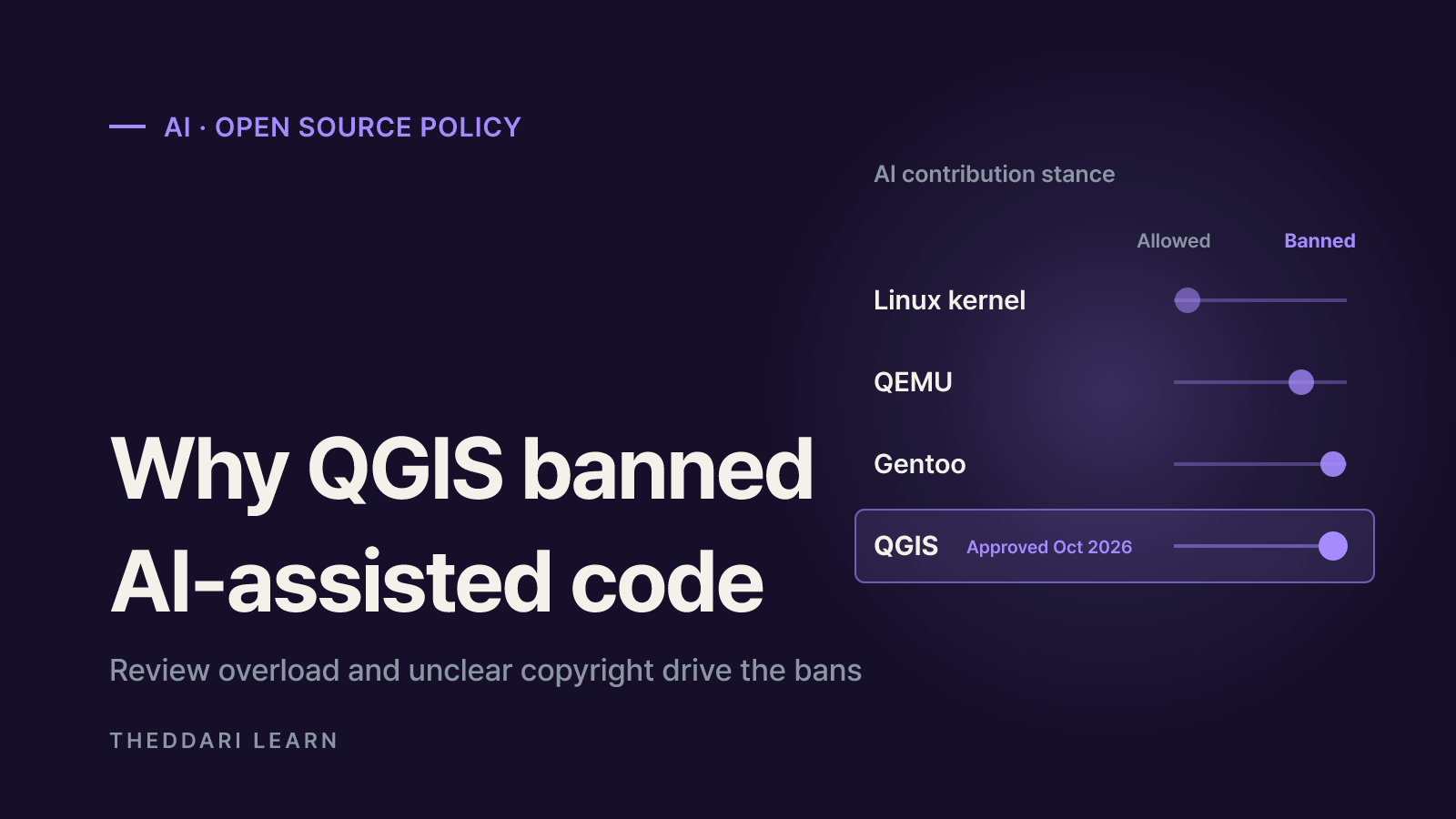
Open source AI contributions are being restricted for two practical reasons. First, AI tools let anyone produce pull requests faster than volunteer maintainers can review them. Second, contributors cannot easily certify the copyright and license status of AI output, which many projects require before accepting code. As of October 2026, the clearest recent example is QGIS, the open-source geographic information system: it approved version 2.0 of QEP 408, which bars LLM, AI and agent-assisted code from the qgis/qgis repository. This guide explains the decision, compares it with QEMU, Gentoo and the Linux kernel, and lists what to check before you contribute. All sources were read on October 13, 2026.
What the QGIS AI moratorium actually says
The policy is two sentences long. No LLM, AI or agent-assisted code contributions are allowed in the qgis/qgis repository, and if the project later discovers that a contributor used an AI, LLM or agent-based workflow, the contributor faces code reversion and sanctions on their contributor rights. The document is labeled version 2.0, dated September 24, 2026, and attributed to the QGIS project contributors. It replaces an earlier AI tool policy dated January 31, 2026, which participants described as a human-in-the-loop approach rather than a ban.
The change went through pull request #387 in the QGIS Enhancement Proposals repository. Although the PR title refers to QEP428, it edits the existing QEP 408 policy file. It opened for discussion on September 24, moved to voting on October 5, and was declared approved and merged on October 7, 2026. The rule targets code entering the core repository. It does not restrict people who use QGIS, nor does it stop anyone from building AI-related software elsewhere.
Sep 16
- Stage
- Mailing list proposal
- What happened
- A core developer proposed a total moratorium on LLM-based contributions plus a proof-of-life check for new contributors
Sep 23
- Stage
- Steering committee view
- What happened
- A PSC member backed a ban and asked for it to go through the QEP process
Sep 24
- Stage
- PR #387 opened
- What happened
- Discussion began on a strict not-allowed version 2.0
Oct 5
- Stage
- Voting
- What happened
- Discussion period ended and the proposal moved to a vote
Oct 7
- Stage
- Approved and merged
- What happened
- Approval declared based on the votes cast; policy file merged
Why QGIS chose a hard stop
In the QGIS developer mailing list thread, the proposer argued that gentle policies had not worked and that the project should default to no AI now and loosen later, rather than start loose and tighten afterward. In the PR, a project member summarized three reasons. AI use by external contributors placed heavy pressure on maintainers who were already stretched. The volume of AI-produced PRs exceeded what humans could seriously review, leading to either a growing backlog or code merged without full review. And QGIS depends on a human network: organizations trust it partly because they can hire and work with real contributors.
Participants also questioned how the earlier policy performed. One contributor noted that a planned classification label was never created and that of roughly 50 PRs tagged AI Assisted, about 40 were closed without merging. The proposer replied that the earlier process did not happen in practice and that the project had lost at least one high-value contributor. A beginner who had submitted two AI-assisted regression fixes supported the ban, writing that LLMs create an illusion of competence and that contributors who lean on them learn little and never grow into reviewers.
How open source AI contributions policies compare
Projects do not agree on either the rule or the reason. QGIS emphasizes review capacity and community trust. QEMU and Gentoo put more weight on copyright, licensing and quality. The Linux kernel accepts AI assistance but makes a human fully responsible. The table summarizes each project's official text as read on October 13, 2026; any of these can change.
QGIS
- Position on AI contributions
- No LLM, AI or agent-assisted code in qgis/qgis; reversion and sanctions if discovered
- Main rationale
- Maintainer load, quality, community trust
- Exceptions or conditions
- Specific uses may be reopened later through separate proposals
QEMU
- Position on AI contributions
- Declines contributions believed to include or derive from AI-generated content
- Main rationale
- Contributors cannot credibly certify the DCO; unsettled copyright and license status
- Exceptions or conditions
- Researching APIs or algorithms, static analysis and debugging are outside the policy if output is not included
Gentoo
- Position on AI contributions
- Content created with assistance of natural language processing AI tools is forbidden
- Main rationale
- Copyright, quality, ethics
- Exceptions or conditions
- Packaging AI-related software is still allowed
Linux kernel
- Position on AI contributions
- AI assistance permitted
- Main rationale
- Existing GPL-2.0-only licensing rules still apply
- Exceptions or conditions
- Only humans add Signed-off-by; human reviews and takes responsibility; Assisted-by tag
QEMU and the Developer Certificate of Origin
QEMU's code provenance page requires every patch to carry a Signed-off-by line certifying the Developer Certificate of Origin 1.1, which states that you have the right to submit the work under the indicated open source license. QEMU says the copyright and license status of AI output is ill-defined, that training data commonly includes material under restrictive terms, and that even open source training data may carry licenses incompatible with QEMU. Because it is unclear how a contributor could comply with the DCO, QEMU declines contributions where AI use is known or suspected. Using AI for research, static analysis or debugging is not covered, provided the output is not part of the contribution.
Gentoo's ban versus the kernel's disclosure model
The Gentoo Council policy, voted on April 14, 2024, expressly forbids contributing content created with the assistance of natural language processing AI tools. It cites emerging copyright rules that could weaken Gentoo's own copyright claims and copyleft guarantees, the cost of reviewing plausible-looking but wrong output, and ethical concerns such as training practices, energy use and spam. The Linux kernel's AI Coding Assistants guide takes the opposite route. AI agents must not add Signed-off-by tags because only humans can certify the DCO. The human submitter reviews all AI-generated code, ensures license compliance and takes full responsibility, and records tool use with an Assisted-by tag.
Why the AI generated code license question is still open
Open source licenses rest on copyright. A project can enforce copyleft terms only if contributors hold rights in what they submit and license those rights to the project. That is why Gentoo warns that generated material could both create infringement risk and weaken the project's ability to rely on copyleft. In the United States, the Copyright Office has been publishing a multi-part report on copyright and AI: Part 2 addresses whether generative AI outputs can be protected, and a pre-publication Part 3 covers training data. Interpretations differ by jurisdiction and are still developing, so some projects prefer a conservative rule over waiting for courts and legislators.
Licensing is not the whole story, though. A QGIS steering committee member suggested keeping rationale out of the policy entirely to avoid endless arguments about nuance, and the reasons most often cited in the PR were review capacity and trust rather than law. When you read any project's AI rule, identifying what the maintainers worry about most will tell you how narrow or broad the exceptions are likely to be.
Open questions: scope and enforcement
- Scope: commenters asked whether the words assisted and used cover LLM autocomplete, older machine-learning ranking in IDEs, design brainstorming or translation tools.
- Review and security: some asked whether using an LLM as a mock reviewer or for security audits is also barred; others proposed handling that in a separate discussion.
- Non-code text: one participant urged extending the rule to issues, documentation and PR descriptions, while another noted that submitted security advisories were already being written with AI.
- Enforcement: maintainers cannot inspect contributors' machines, so the stated test is whether you honestly wrote the code yourself. That relies on self-reporting, yet discovery carries serious consequences.
The proposer described the policy as a starting point: shut the door, then open it a little for specific uses such as autocomplete or translation once each has been discussed. Read it as an operating rule chosen by a volunteer community to protect its review capacity, not as a technical verdict on AI coding assistants.
What to check before contributing
- 1
Find the written policy
Look in CONTRIBUTING files, developer documentation, the project wiki and any enhancement-proposal repository. QGIS keeps its rule in the QEP repository, QEMU in its code provenance page and the kernel in its process documentation.
- 2
Note the version, date and scope
Record which repository and which kinds of contribution (code, docs, issues) the rule covers. Different repositories in the same organization can have different rules.
- 3
Separate allowed and disallowed uses
Some projects allow research and debugging but reject AI output in the patch; others restrict assistance broadly. If your case is unclear, ask on the mailing list or issue tracker first.
- 4
Only submit code you can explain
Even where AI is allowed, Signed-off-by is a human statement of responsibility. If you cannot justify each change in review, do not send it.
Debates like this spread quickly through developer channels. The theddari AI Telegram trends and blog trends pages can help you see which related topics are being discussed, but always confirm exact wording and dates against the project's own documents.
 theddari.comTrendsBlog PostsSummarized Naver blog posts
This AI-written guide is general information based on public documents read on October 13, 2026. It is not legal advice and not investment advice. Project AI policies can change, so check the latest official text before contributing and consult a qualified professional in your jurisdiction about copyright questions.