Contents9 sections
The Pearl token (ticker PRL) is the native coin of Pearl, a layer-1 blockchain whose miners prove work by doing the matrix multiplications that GPUs already run for AI models. It reached #1 on CoinGecko's trending list on October 15, 2026, but trending only measures search interest. This guide uses CoinGecko data timestamped 12:20 UTC on October 15, 2026, plus the project's own documentation, to explain what Pearl is, what its numbers actually say, and what to verify before you trade it.
What is the Pearl token?
Pearl Research Labs' network page describes a protocol in which "every GPU cycle powering AI systems" can simultaneously produce a native digital currency. The official GitHub repository calls Pearl an L1 based on Proof-of-Useful-Work, where mining happens as a by-product of arbitrary matrix multiplication. The same company also sells an AI inference service through its main website, so the coin sits inside a broader AI infrastructure business.
How proof of useful work differs from Bitcoin mining
Bitcoin miners repeat hash calculations whose only purpose is winning the right to add a block. Pearl's pitch is to replace that otherwise wasted computation with math that AI workloads perform anyway, so one GPU pass yields both a model output and a block proof. That is an elegant idea on paper. Whether it keeps the network secure and economically balanced at scale is something only real usage over time will show.
- Code lineage: the repository says the node, wallet and light client were forked from btcd, btcwallet and neutrino, open-source Bitcoin software.
- Signatures: the repo includes an XMSS post-quantum signature implementation.
- Mining: a vLLM-based GPU miner requires the CUDA toolkit, which points to data-center GPU operators rather than hobbyists.
- License: the code is published under the ISC license.
Is anyone actually using it?
On May 15, 2026, Together AI announced a partnership with Pearl Research Labs and launched a Gemma-4-31B-it-pearl inference endpoint discounted by more than 25%. Together AI said the discount is offset by the future value of PRL mined during the same computation. That is a real integration, but note the dependency: the discount is funded by the coin's price, so a falling PRL price would shrink the room for discounts.
What CoinGecko trending actually measures
According to CoinGecko's API documentation, the trending list shows the top 15 coins by search popularity on CoinGecko over the last 24 hours, refreshed every 10 minutes. It is an attention metric, not a ranking of volume, quality or safety. Searches spike for many reasons: big rallies, crashes, new listings, airdrop rumors and controversies.
By the time a coin trends, much of the move has often already happened. On October 15, 2026, PRL was up about 550% over 60 days and sat roughly 16% below the $2.10 all-time high it set the day before.
Pearl token numbers as of October 15, 2026
The figures below come from CoinGecko's pearl-2 API data, last updated 12:20 UTC on October 15, 2026. Prices move constantly, so treat them as a snapshot.
Price
- Value
- About $1.75
- What it tells you
- -8.0% in 24h, +24.6% in 7 days
Market cap (rank)
- Value
- About $606M (#102)
- What it tells you
- Circulating supply x price
Fully diluted value
- Value
- About $3.68B
- What it tells you
- Max supply x price
Circulating / max supply
- Value
- About 346M / 2.1B PRL
- What it tells you
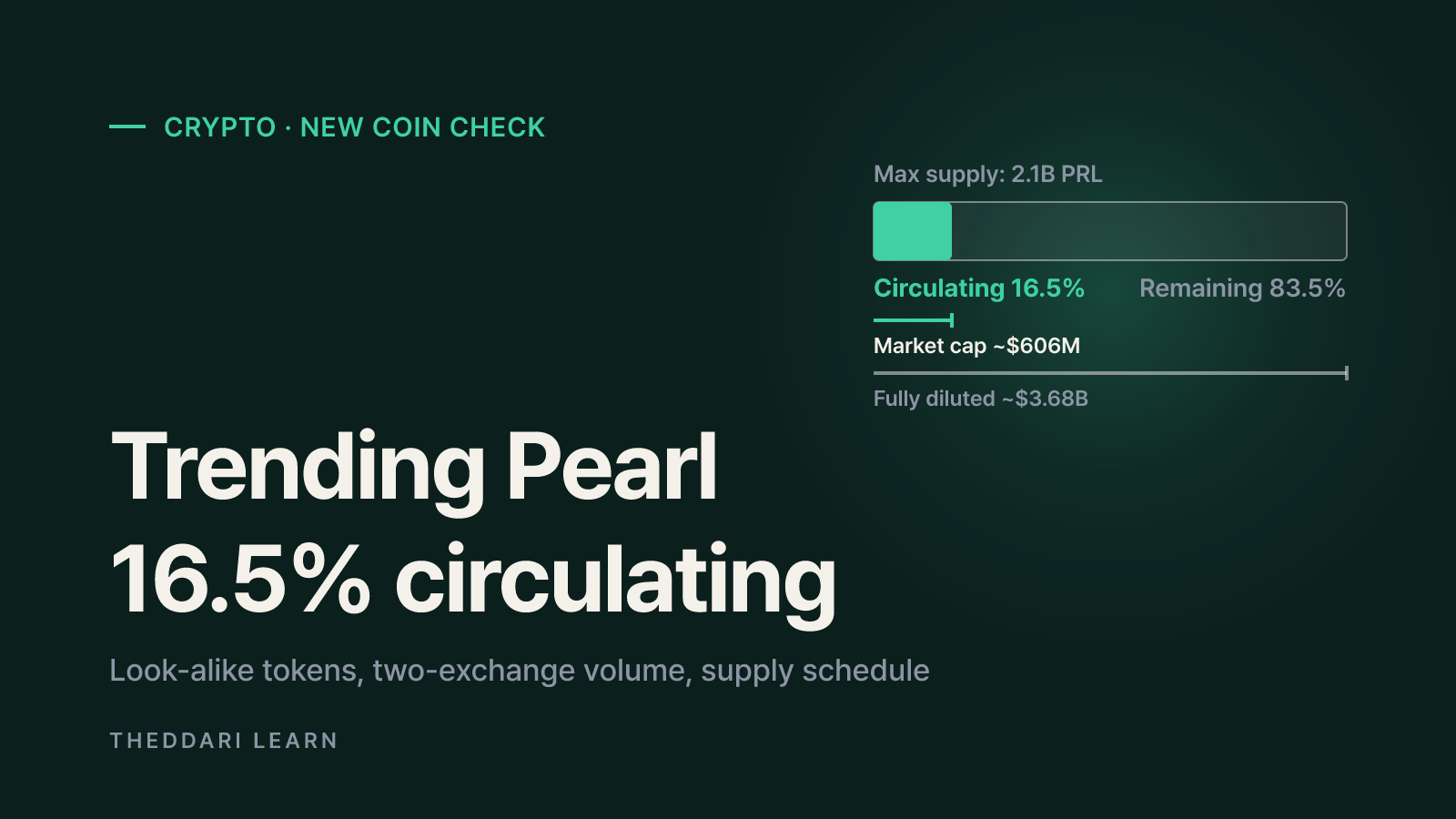
- About 16.5% circulating
24h volume
- Value
- About $9.76M
- What it tells you
- About 1.6% of market cap
All-time high
- Value
- $2.10 (Oct 14, 2026)
- What it tells you
- About 16% below the high
All-time low
- Value
- About $0.14 (Jul 23, 2026)
- What it tells you
- More than 10x in under three months
30d / 60d change
- Value
- +198% / +550%
- What it tells you
- A sharp short-term run
The number that matters most is the 16.5% circulating ratio. If the price held where it is, the remaining 83.5% of supply would need matching demand as it enters the market through mining. A top-110 market cap can look reassuring until you compare it with fully diluted value.
How to avoid buying the wrong Pearl
CoinGecko's search results return several assets for "pearl". The coin's page uses the ID pearl-2 precisely because the name was already taken. Picking by name alone in an exchange or wallet can land you in a completely different asset.
Pearl (ID pearl-2)
- Ticker
- PRL
- How to tell
- Native L1 coin of Pearl Research Labs, no contract address
PearlBridge Bridged WPRL (Ethereum)
- Ticker
- WPRL
- How to tell
- Wrapped token on Ethereum, extra bridge risk
Kona Pearl
- Ticker
- PEARL
- How to tell
- Unrelated project
Girl with a Pearl
- Ticker
- PEARL
- How to tell
- Unrelated project
Stargate Bridged Pearl (Avalanche)
- Ticker
- PEARL
- How to tell
- Bridged token of a different project
Because PRL lives on its own chain, CoinGecko lists no contract address for it. If someone sends you a "Pearl contract address" on Ethereum or BNB Chain, assume it is either the wrapped version or an impersonator until proven otherwise.
Pre-trade checklist for the Pearl token
- 1
Identity: match the ID and ticker
Confirm that CoinGecko ID pearl-2, ticker PRL and the official domain pearlresearch.ai all link to each other, and that the exchange's asset page points to the same domain.
- 2
Project: read the primary sources
Open the whitepaper on the network page and the GitHub commit history and issues. In October 2026 the repo showed 6,818 commits and 361 stars. Development activity is context, not proof of value.
- 3
Supply: find the issuance schedule
Only about 16.5% of the 2.1B max supply circulates. Read the whitepaper's issuance section for block rewards, any halving schedule and whether there was a premine or team allocation. We could not verify those details for this guide.
- 4
Liquidity: see where volume really trades
Use CoinGecko's Markets tab. On October 15, 2026, SafeTrade's PRL/USDT pair (about $5.39M) and BigONE (about $4.02M) made up roughly 96% of reported volume, and no pair showed a CoinGecko trust score.
- 5
Trading costs: check spreads and price gaps
Spreads that day were about 0.58% on SafeTrade PRL/USDT and 0.87% on BigONE, but about 4.66% on SafeTrade's PRL/BTC pair. Also check whether deposits and withdrawals are open.
- 6
Jurisdiction: confirm you can legally use the venue
Smaller offshore exchanges may not be licensed where you live, which can limit legal recourse if withdrawals freeze. Check your local regulator's guidance before sending funds.
Key risks to weigh
- Exchange concentration: with most volume on two venues, a withdrawal halt or delisting at either could move the price sharply.
- Ongoing supply: a low circulating ratio means mined coins keep arriving, and GPU miners paying for power and servers have a reason to sell.
- Young technology: proof of useful work is a relatively new consensus design. Attack resistance and long-run economics still need real-world evidence.
- Volatility: an asset that rose more than tenfold in three months can fall just as fast.
- Scams: trending coins attract fake tokens, fake airdrops and fake wallet apps. Use only links from the official site, the official X account (@prlnet) and the official GitHub.
Related tools on The Ddari
Coins listed on only a handful of offshore exchanges often trade at different prices from venue to venue. You can follow cross-exchange price gaps on the arbitrage page, and see which coins crypto Telegram channels are talking about on the trends page. Like CoinGecko trending, mention counts show attention, not a reason to buy.

Bottom line: Pearl is a technically interesting attempt to merge AI compute with mining, but as of October 15, 2026 it also showed clear warning signs: only 16.5% of supply circulating, volume concentrated on two exchanges, and a price history measured in months. Check identity, issuance and liquidity before the trending rank, and treat anything you cannot verify as unknown rather than as good news.