Contents6 sections
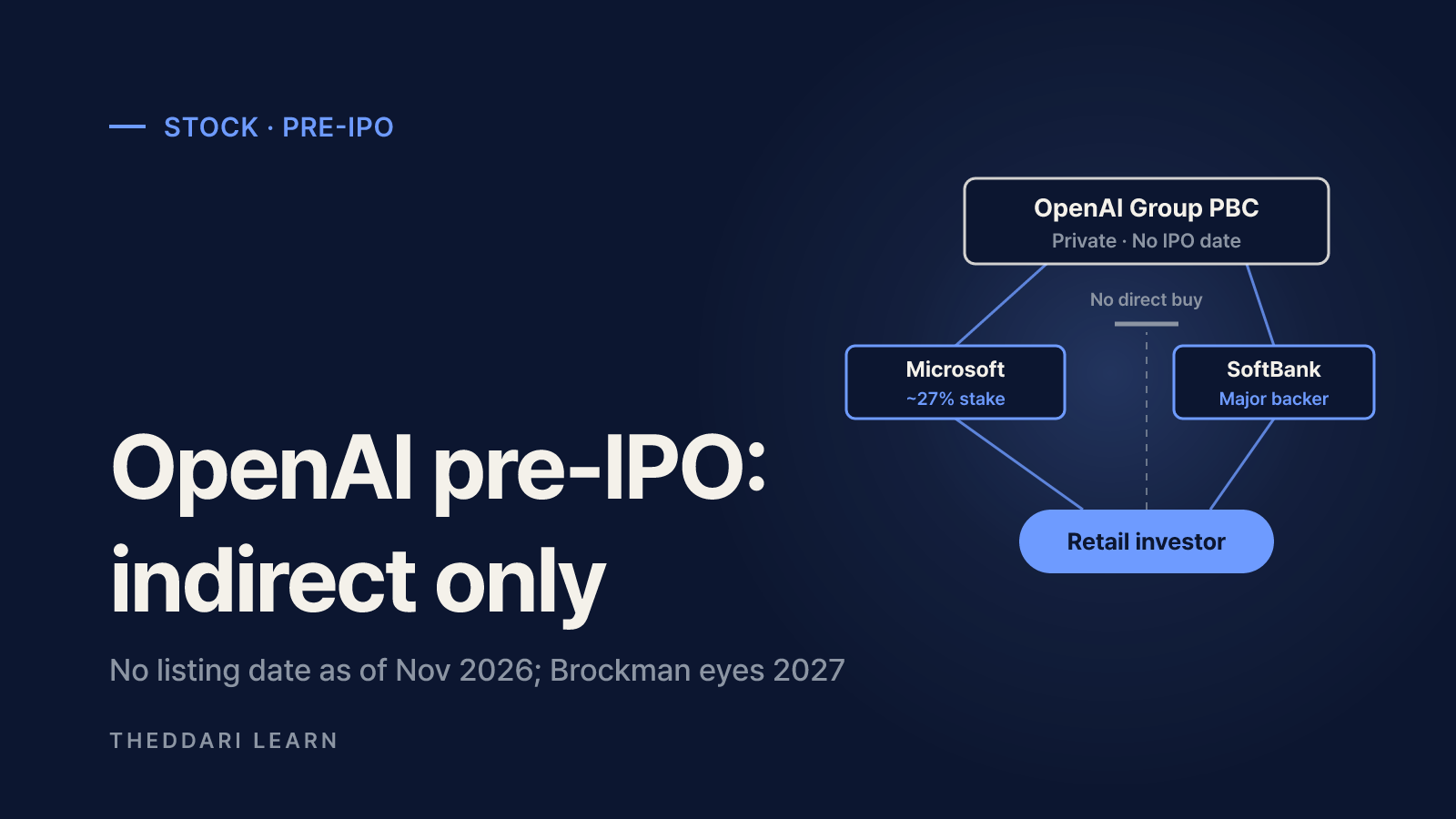
There is no OpenAI IPO date yet. As of November 6, 2026, OpenAI remains a private company. It confidentially filed a draft prospectus with US regulators in June 2026, and on November 4 president Greg Brockman, asked at a Wall Street Journal conference whether OpenAI would be ready to list next year, replied "I think so" (The Next Web). That is a readiness signal, not a schedule: no listing date, price range, share count, or exchange has been announced. Until that happens, individual investors cannot buy OpenAI stock directly. What they can do is get indirect exposure, each route with real trade-offs.
This guide covers how to track the IPO from primary sources, the realistic ways to gain exposure before a listing, and the red flags of fake pre-IPO offers. It is written mainly for US-based retail investors, with notes for people investing from other countries.
Where the OpenAI IPO stands right now
Here is the publicly reported timeline. Separate what the company has confirmed from what anonymous sources have told the press.
Oct 28, 2025
- What happened
- Recapitalization completed: the for-profit became OpenAI Group PBC, controlled by the nonprofit OpenAI Foundation
- Type of information
- Company announcement
June 2026
- What happened
- Draft IPO prospectus filed confidentially with US regulators
- Type of information
- Confirmed by the company
After June 2026
- What happened
- Bloomberg reports OpenAI is weighing a 2027 debut, with Sam Altman holding out for a $1tn valuation
- Type of information
- Anonymous-source reporting
Second half of 2026
- What happened
- Reports of a roughly $30bn funding round at about a $1.4tn valuation
- Type of information
- Anonymous-source reporting
Nov 4, 2026
- What happened
- Brockman says he thinks OpenAI will be ready to list in 2027; no date set
- Type of information
- On-the-record remark
The 2025 restructuring matters because it created an entity that can actually go public. OpenAI converted its for-profit arm into a public benefit corporation, OpenAI Group PBC, which the nonprofit OpenAI Foundation continues to control. At the time, the Foundation's equity stake was valued at about $130 billion (OpenAI). Public shareholders would therefore be buying into a company with a stated mission and a controlling nonprofit, so voting rights and board structure deserve close reading in any prospectus.
How to verify IPO news yourself
- 1
Start with official statements
Treat the OpenAI newsroom and its official accounts as the primary source. Stories citing people familiar with the matter indicate direction, not a confirmed calendar.
- 2
Watch for a public S-1
A US listing requires a public registration statement on SEC EDGAR. It will show the share count, price range, risk factors, and governance. Before it appears, every valuation number is an estimate.
- 3
Confirm the exchange and ticker
The exchange and ticker are only fixed shortly before pricing. Anyone sharing an 'OpenAI ticker' today is guessing or running a scam.
- 4
Track related earnings dates
Microsoft and SoftBank Group often discuss their OpenAI stakes on earnings calls. Use the earnings calendar to see when those reports land.
How to invest in OpenAI before an IPO: four indirect routes
Each route differs in how closely it tracks OpenAI's value and in what extra risk it adds.
Public shareholders (e.g., Microsoft)
- Who can use it
- Anyone with a brokerage account
- How closely it tracks OpenAI
- Low to moderate
- Main drawbacks
- Core business drives the stock
SoftBank Group (Tokyo-listed)
- Who can use it
- Accounts with Japanese market access or the US OTC ADR
- How closely it tracks OpenAI
- Moderate
- Main drawbacks
- Holding company with other assets and heavy debt
Secondary platforms and SPVs
- Who can use it
- Mostly accredited investors
- How closely it tracks OpenAI
- High, if a deal closes
- Main drawbacks
- Transfer limits, fees, little disclosure, illiquid
Listed funds holding private stakes
- Who can use it
- Often any brokerage account
- How closely it tracks OpenAI
- Low to moderate
- Main drawbacks
- Small position size, premiums to NAV
1) Microsoft: the largest public shareholder
After the October 2025 restructuring, Microsoft said it holds an investment in OpenAI Group PBC valued at about $135 billion, roughly 27% on an as-converted diluted basis (Microsoft). In the same agreement OpenAI committed to buy an incremental $250 billion of Azure services. So Microsoft is tied to OpenAI twice: through equity value and through cloud revenue. Even so, the OpenAI stake is a slice of Microsoft's total market value, and the stock mostly trades on Azure, Office, and overall earnings.
2) SoftBank Group: a leveraged proxy
SoftBank is another major OpenAI backer, and its stock reacts to OpenAI news. When Bloomberg reported in June 2026 that the listing could slip to 2027, SoftBank shares fell as much as 13% (The Next Web). But SoftBank is an investment holding company with many other stakes and significant borrowing, so its share price also reflects those assets and its debt load. Its main listing is in Tokyo, which adds currency risk for dollar-based investors.
3) Secondary platforms and SPVs
Pre-IPO marketplaces match buyers with employees or early investors selling private shares, and special purpose vehicles pool money to buy a stake. In the US these are generally limited to accredited investors under SEC rules, meaning you must meet income or net-worth thresholds. Private companies can restrict or block transfers, so a listed offer may never close. With an SPV you own a piece of an entity that owns the shares, typically paying management fees and carried interest, and you usually cannot sell before an exit. Our pre-IPO price tracker can help you compare private-market indications, but a quoted price is not the same as an executable trade.
4) Listed funds with private holdings
Some exchange-traded closed-end funds and interval funds advertise small positions in private AI companies, including OpenAI. They are easy to buy, but the OpenAI weight may be small, the private stake is valued by the fund rather than a market, and shares can trade at a large premium to net asset value. Read the latest holdings report before buying.

Red flags in 'pre-IPO OpenAI shares' offers
High-profile private companies attract impersonation scams, especially while the listing date is unknown. Stop before sending money if you see any of these:
- A claim that the IPO date or price is already confirmed through inside sources
- Cold outreach via social media ads, Telegram, or WhatsApp groups
- Tokens or coins sold as 'OpenAI equity' — a token is not company stock unless the issuer says so
- Promises of fixed, risk-free returns or a set multiple after listing
- Requests to wire funds to an offshore entity or personal account without verifiable paperwork
Legitimate private-share deals involve investor verification, document review, and often company approval. A seller who skips those steps and pushes for fast payment is very likely not offering a real transaction. You can check a salesperson's registration on FINRA BrokerCheck before engaging.
Risks that remain after a listing
An IPO does not remove investment risk. Large tech debuts can open far from the offer price, and lock-up expirations can add supply months later. OpenAI also spends heavily on compute, so read the prospectus for margins and cash burn, not just revenue growth. Brockman said business customers now account for most of OpenAI's sales, a sign the business mix is still shifting quickly. To keep up with AI industry chatter, see our AI Telegram trends.
What to do while you wait
- Make sure your brokerage supports IPO access or, at minimum, trading on the listing day.
- When the public S-1 appears, read risk factors, governance and voting rights, profitability, and lock-up terms first.
- If you already own Microsoft or SoftBank for OpenAI exposure, check how much of each company's value actually comes from that stake.
- Ignore any pre-IPO pitch you cannot verify through official sources and a registered broker.
- Investors outside the US should confirm how their home country taxes foreign capital gains before trading.
Bottom line: as of November 6, 2026, the OpenAI IPO is in preparation but undated. Public shareholders are the easiest route to exposure but track OpenAI loosely, while routes closer to direct ownership bring eligibility limits, fees, and illiquidity. The public S-1 is the moment real numbers arrive; until then, treat every valuation figure and every pre-IPO pitch with skepticism.