Contents8 sections
Short answer: there is no official OpenAI coin that we could find. As of October 2026, the official OpenAI pages reviewed for this guide do not announce any cryptocurrency or token issued by OpenAI. In fact, OpenAI's own policy treats tokenized interests in its equity as transactions it does not endorse. So if a post, a Telegram group or a direct message is promoting an 'OpenAI token' or 'pre-IPO OpenAI shares on-chain', start from the assumption that the name alone proves nothing. This guide does not label any specific token a scam; it gives you a process to check any token for yourself.
What OpenAI says about an OpenAI coin or token
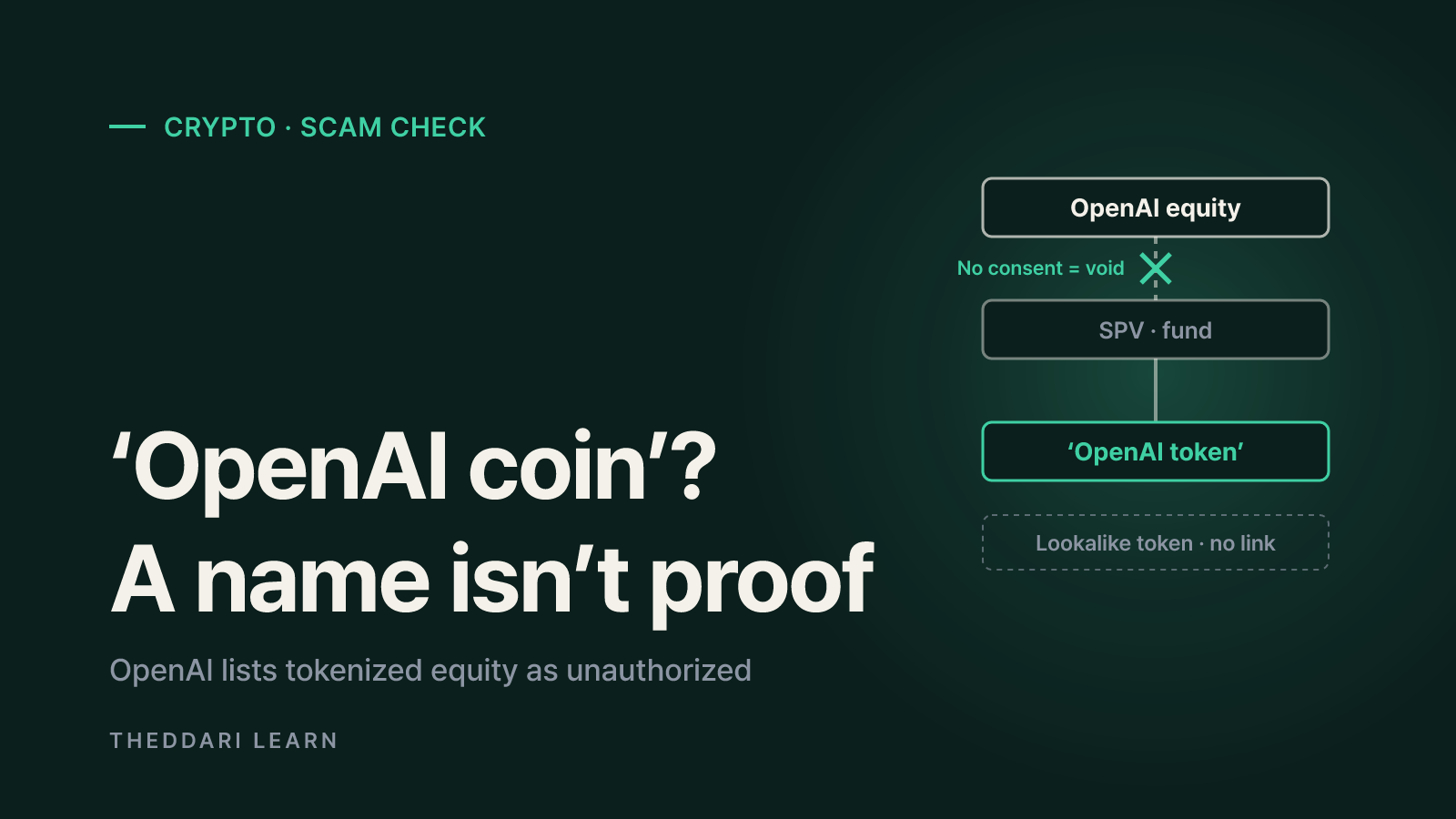
On July 16, 2025, OpenAI published a policy page titled Unauthorized OpenAI Equity Transactions. It states that all OpenAI equity is subject to transfer restrictions and cannot be transferred, directly or indirectly, unless the seller first obtains OpenAI's written consent. Any attempted transfer that skips this step is void. The page then lists the kinds of unauthorized exposure it has seen marketed: direct sales of equity, investments in special purpose vehicles (SPVs) that hold OpenAI equity, tokenized interests in OpenAI equity or such an SPV, and forward contracts or other claimed economic interests.
OpenAI adds that it does not endorse or participate in these transactions, that they may also violate US federal or state securities laws, and that a sale designed to get around its restrictions will not be recognized and may carry no economic value for the buyer. To be precise, the page does not say every offer is fraudulent; it says not every offer is problematic, but buyers usually cannot tell which ones are. That uncertainty is the risk you would be buying.
The Robinhood 'OpenAI tokens' episode
Shortly before that policy appeared, Robinhood announced a promotion giving eligible EU users 5 euros worth of tokens tied to OpenAI and SpaceX. According to CNBC, OpenAI responded on X: "These 'OpenAI tokens' are not OpenAI equity. We did not partner with Robinhood, were not involved in this, and do not endorse it," adding that it had not approved any equity transfer. Robinhood said the tokens offered indirect exposure through its ownership stake in an SPV, and US users could not access them. The lesson is simple: even when a large, regulated platform is involved, a token linked to a company is not the same thing as shares in that company.
Fake AI tokens vs. tokenized pre-IPO shares
People searching for an OpenAI coin usually run into two very different things. One is an impersonation token or memecoin that simply borrows a famous name. The other is a product claiming to give exposure to a private company's equity. The first usually has no connection to the company at all. The second may have some link to real shares, but whether that link is authorized is the central question.
What it claims
- Impersonation token / memecoin
- An 'official' AI company coin or airdrop
- Tokenized pre-IPO exposure
- Indirect exposure to private company shares
Link to the company
- Impersonation token / memecoin
- Usually none beyond the name and logo
- Tokenized pre-IPO exposure
- Often several layers: SPVs, forwards, funds
What to check
- Impersonation token / memecoin
- Whether the company announced any token
- Tokenized pre-IPO exposure
- Terms, proof of underlying holdings, company consent
Main risks
- Impersonation token / memecoin
- Worthless asset, liquidity pulled, wallet-draining sites
- Tokenized pre-IPO exposure
- Void transfer, no exit, opaque pricing
OpenAI's stated position
- Impersonation token / memecoin
- No official token found (checked October 2026)
- Tokenized pre-IPO exposure
- Tokenized interests listed as unauthorized
In both columns, the word OpenAI in the name guarantees nothing. Anyone can deploy a token with any name and ticker, and decentralized exchanges let anyone open a trading pair without review. A token showing up on a price screen tells you it exists, not who issued it.
Red flags regulators keep seeing
The SEC's June 2024 pre-IPO investment scams alert notes that fraudsters often pitch companies tied to trending themes such as crypto assets or artificial intelligence. It lists claims that an IPO is imminent or will happen this year, unfounded comparisons with famous companies, promises of no fees that hide large undisclosed markups, and claims of limited supply or below-IPO prices. In some cases the sellers never owned the shares and used investor money for themselves.
FINRA's August 18, 2026 guide, Know the Risks of Pre-IPO Funds and Potential Fraud, explains that most pre-IPO opportunities in well-known private companies are indirect purchases through funds, sometimes several layers removed from the stock. Because many private companies must approve share transfers, an unapproved deal may be void and the fund may never own the shares. FINRA says scams almost always involve urgency, exclusive access, steep discounts or claimed ties to a well-known firm, and suggests asking a simple question: why would a stranger offer this to you?
Regulators outside the US see the same pattern. On January 13, 2026, South Korea's Financial Supervisory Service raised its consumer alert on 'imminent listing' pre-IPO stock fraud from caution to warning, citing fake buy-back guarantees and scammers coaching victims on how to answer their bank's fraud-check calls.
- 'Last allocation before the OpenAI IPO' or 'official airdrop' urgency
- Buy-back promises, principal guarantees or official-looking guarantee letters
- A contract address shared only in DMs or private groups, never by the company
- Requests to connect your wallet or wire money to a personal account first
- A website that does not clearly name the fund manager or seller

Sudden chatter about a new AI token on Telegram is a common way these pitches spread. The theddari crypto Telegram trends page can show where a keyword is being discussed, but treat volume as a reason to verify, not as evidence that a token is legitimate.
How to verify an OpenAI token before you buy
- 1
Go to the official source yourself
Type openai.com into your browser or find OpenAI's verified accounts instead of clicking links you were sent. If there is no announcement of a token, there is nothing linking the asset you were offered to the company.
- 2
Match the contract address and chain
Many tokens can share the same name. A comparison only works if the real issuer has published an address and network. Without that reference, treat a same-named token as a different asset, and use a block explorer to review the deployer wallet, holder concentration and whether liquidity is locked.
- 3
Read what rights the token gives you
If it claims to represent equity, look for voting rights, dividends, conversion at an IPO, redemption terms and who holds the underlying shares. A product that cannot explain whether the company consented runs straight into the transfer restrictions OpenAI describes.
- 4
Check the seller's registration
In the US, look up firms and individuals on FINRA BrokerCheck and the SEC's adviser database. In South Korea, use the FSS FINE portal's licensed-institution search. FINRA's guidance is clear that legitimate investment money goes to a registered firm or regulated custodian, never to an individual's account.
Legitimate private investing vs. a scam
Not every private-company investment is illegal. In the US, legitimate private placements usually come with investor eligibility checks and written offering documents, while broadly advertised unregistered offerings to the general public may be unlawful, as the SEC alert explains. An offer that asks nothing about your income or net worth and lets anyone in with a small amount deserves a closer look. If you want to follow pre-IPO companies in general, comparing public information is a reasonable habit, but it is separate from verifying whether a specific purchase route is lawful.
If you already sent money or connected a wallet
Revoke any token approvals you granted to the site through your wallet's permission settings or a block explorer, and consider moving remaining assets to a fresh wallet. If you typed in a seed phrase, treat that wallet as compromised. Save transfer receipts, chat screenshots, the counterparty's wallet addresses and transaction hashes, then report to the channels in the FAQ below. Be wary of 'recovery services' that contact you afterward asking for fees. In short, when you meet a token carrying OpenAI's name, the questions that matter are not about price: was it officially issued, what rights does it actually carry, and who is really selling it?