Contents7 sections
The Nvidia export controls story centers on Megaspeed, a Singapore-headquartered data center company suspected of helping move restricted Nvidia AI chips to Chinese firms through Southeast Asia. As of November 13, 2026, the investigations reported in the press target Megaspeed and people connected to it; no charge or penalty against Nvidia itself has been announced. The stock still fell sharply because the allegations arrived alongside Jensen Huang's resignation, raising questions about governance, a large customer relationship and possible tighter rules on exports routed through the region. This guide separates confirmed facts from reported claims, explains how U.S. penalties work and lists what NVDA shareholders can verify next.
How the alleged Singapore route works
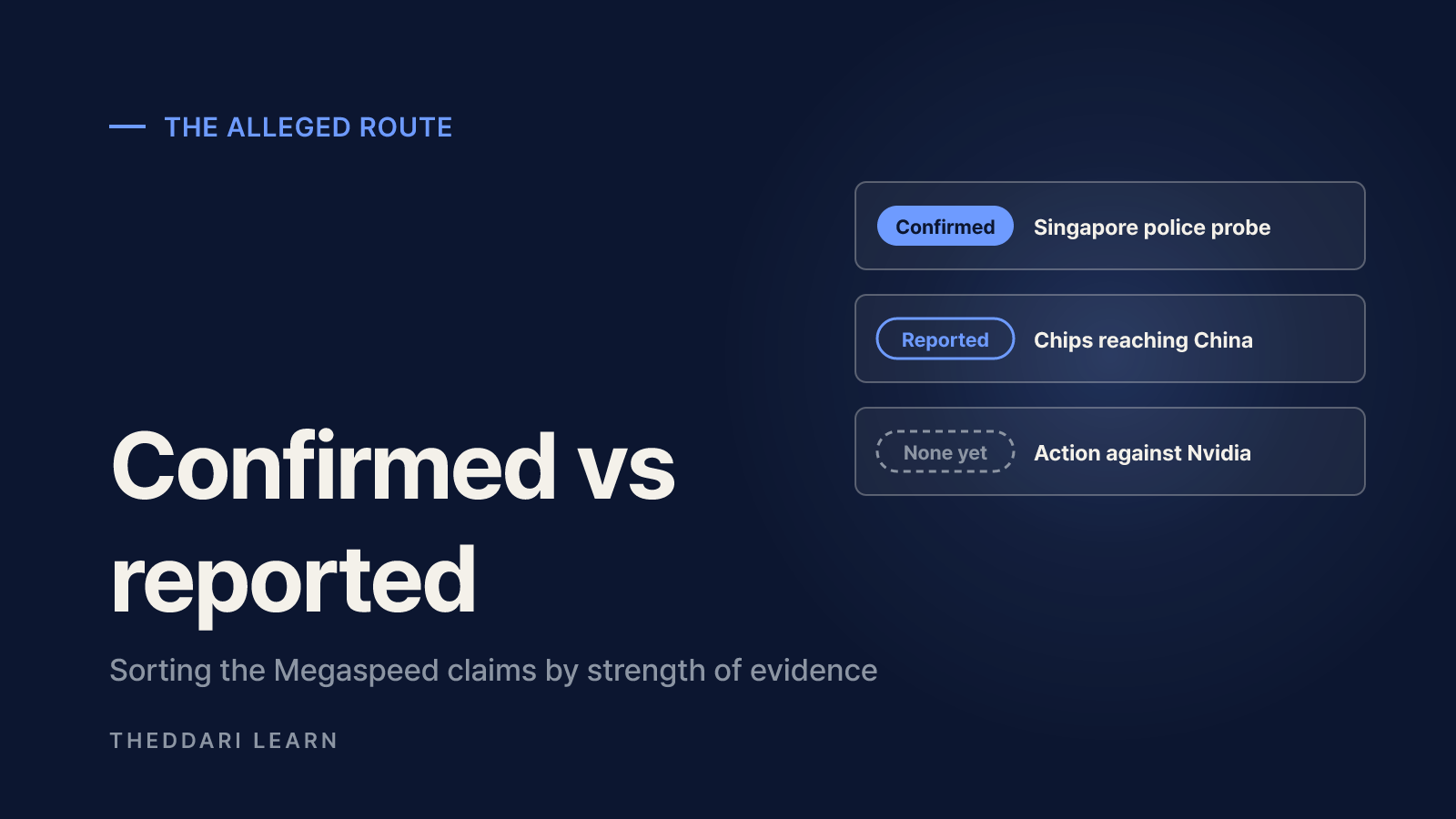
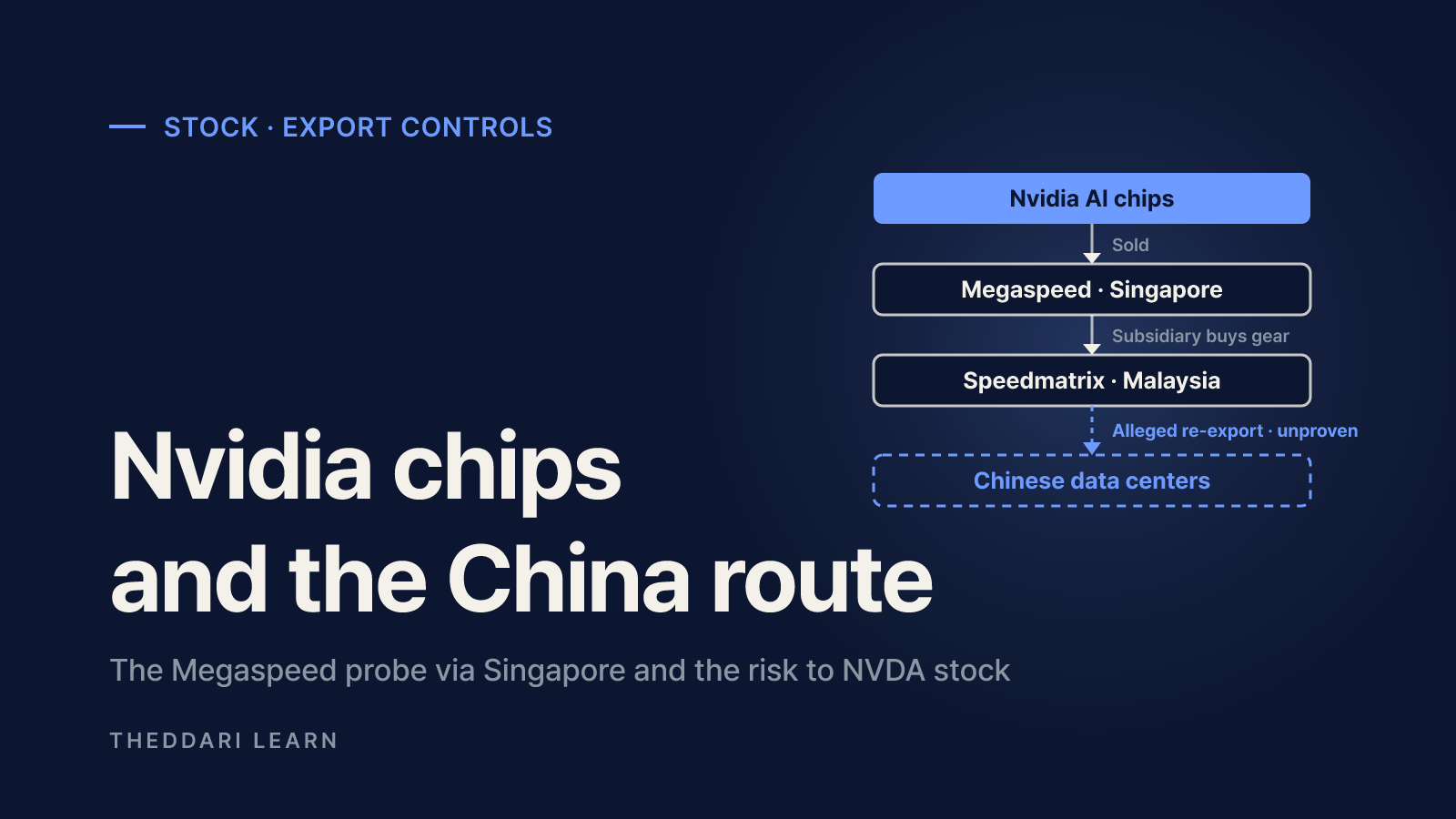
According to CNBC's overview, Megaspeed lists Singapore as its main office and operates data centers in Southeast Asia, describing itself as an Nvidia Cloud Partner in Asia-Pacific. Singapore filings show its assets jumped to about $3 billion in 2024 from $33 million a year earlier, with 2024 revenue of $294 million. Its Malaysian subsidiary Speedmatrix, based in Johor, bought at least $4.8 billion of advanced AI equipment, including systems with Nvidia chips, between June 2024 and February 2026, according to trade records cited by The New York Times.
The allegation is that some of that hardware was then re-exported to data centers serving Chinese companies. The Information reported that at least $7.5 billion of Nvidia chips reached Chinese firms through these connections; CNBC said it could not independently verify that figure. A U.S. trade official reportedly found unopened boxes of Nvidia chips at a Speedmatrix site in 2025, but officials did not have conclusive evidence of diversion at the time. Megaspeed said in December 2025 that inspections by the Commerce Department's Bureau of Industry and Security (BIS), Malaysia's trade ministry and Nvidia found no violations.
Singapore police probe of Megaspeed
- Status as of Nov 13, 2026
- Confirmed; opened October 2025
- Basis
- CNBC, Straits Times
U.S. export-control scrutiny
- Status as of Nov 13, 2026
- Reported; Megaspeed says it cooperated with BIS inspections
- Basis
- CNBC
$7.5B of chips reaching Chinese firms
- Status as of Nov 13, 2026
- Reported only; not independently verified by CNBC
- Basis
- CNBC
Action against Nvidia itself
- Status as of Nov 13, 2026
- None announced
- Basis
- No agency or company release
Jensen Huang resignation
- Status as of Nov 13, 2026
- Confirmed Nov 12, 2026
- Basis
- Nvidia press release
Singapore's position matters too. The Singapore Police Force has said, as reported by The Straits Times, that the country does not enforce foreign unilateral export controls but does not condone businesses using their Singapore ties to evade other countries' controls. Between February 2025 and July 2026 it charged four people and four companies with fraud against server suppliers. In Singapore, the legal hook is domestic law such as fraud, not the U.S. Export Administration Regulations.
Nvidia export controls: what the rules cover
The U.S. has restricted sales of its most advanced AI chips to China since 2022. CNBC notes that the Nvidia H100 has required a license for China since August 2022. U.S. controls can reach not only direct shipments from the United States but also re-exports from a third country and transfers within a country when the item is subject to U.S. rules. That is why a structure in which a Singapore or Malaysian entity buys the chips and a Chinese company ends up using the hardware is a core enforcement concern.
Renting compute is a different case. A company can keep GPUs in a Malaysian data center and sell remote access, and that path is generally described as outside the current hardware-focused rules. Physically moving the chips to a Chinese end user without a license is the scenario the controls target. When reading new reports, the first thing to pin down is which of those two paths a source is actually describing.
Penalties under ECRA
The BIS penalties page says violations of the Export Control Reform Act of 2018 can bring criminal penalties of up to 20 years in prison and up to $1 million per violation. As of January 15, 2025, the maximum administrative penalty is $374,474 per violation or twice the transaction value, whichever is greater, adjusted annually for inflation. BIS can also deny export privileges, which bars others from dealing with the denied party in covered exports, and can issue Temporary Denial Orders for up to 180 days when a violation appears imminent or ongoing.
Those penalties fall first on whoever committed the violation. Whether a seller bears any responsibility depends on facts such as what it knew and how it screened the customer, and no such finding exists here. Multiplying statutory maximums into a loss estimate for Nvidia would not be grounded in the record.
How the allegations can hit NVDA stock
The Guardian reported that on November 12, 2026 Nvidia shares fell 13% at the open after the resignation announcement, then pared losses to about 7% in morning trading. More than $320 billion of market value was erased that day and more than $600 billion over the week, leaving the company valued at about $3.9 trillion. That move reflected the founder's exit and succession uncertainty as much as the export question. The channels are easier to judge separately.
Enforcement
- How it can affect the stock
- Wider probe, fines or settlement, internal-control criticism
- What to watch
- BIS and DOJ releases; legal proceedings in filings
Customer restrictions
- How it can affect the stock
- Lost sales if a customer is cut off
- What to watch
- Entity List additions; regional commentary on calls
Tighter rules
- How it can affect the stock
- Slower licensing for Southeast Asia shipments
- What to watch
- Commerce rule changes; licensing delay reports
Governance
- How it can affect the stock
- Higher uncertainty discount during CEO search
- What to watch
- Permanent CEO pick; board investigation outcome
Policy relations
- How it can affect the stock
- Weaker standing in Washington on China sales
- What to watch
- Congressional hearings; official statements
Avoid over-reading the Singapore revenue line. For the quarter ended July 27, 2025, Singapore was billed about $10.2 billion, or 22% of revenue, yet more than 99% of Singapore-billed revenue from export-controlled data center products came from U.S.-based customers, according to The Straits Times. Nvidia has not broken out Singapore revenue since then and has never disclosed Megaspeed's share. Regional percentages alone cannot measure diversion.
Separate the shock from the lasting risk
An initial sell-off often prices uncertainty itself. Lasting risk shows up in measurable events: an agency decision, a rule change or revised guidance. The new board chair said operations, customer commitments and the product roadmap are expected to continue without interruption, which is a company expectation rather than a guarantee. If your exposure is through leveraged ETFs or options, daily swings can magnify losses.
What NVDA shareholders should check next
Nvidia's CEO transition release names CFO Colette Kress as interim CEO while she keeps the CFO role, and director Harvey C. Jones as the board's first-ever chair. The board will consider internal and external candidates. Third-quarter fiscal 2027 results are still scheduled for Tuesday, November 17, at about 1:20 p.m. Pacific, with the earnings call at 2 p.m. Pacific.
- 1
Start with primary company documents
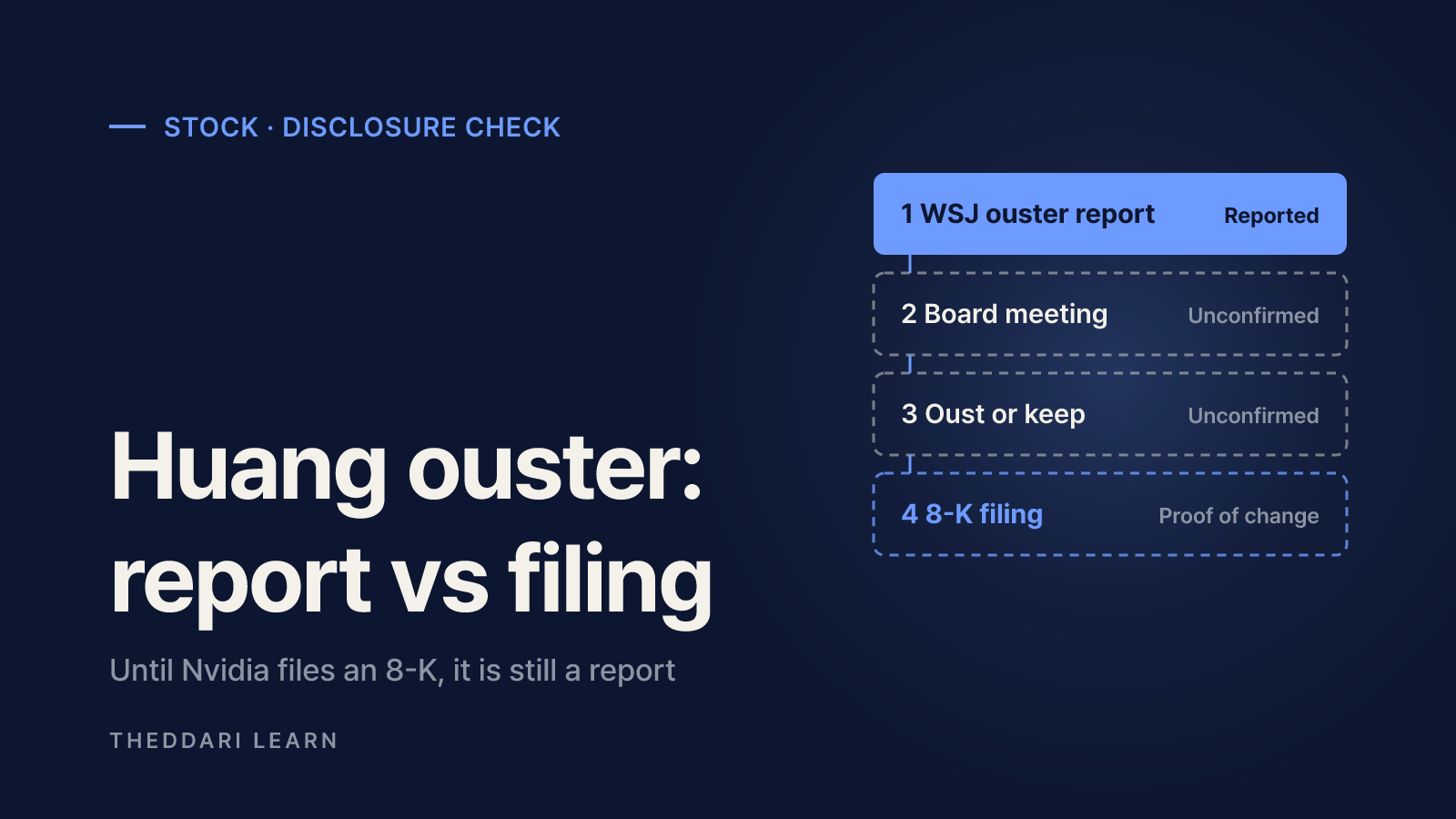
Read Nvidia's investor relations releases and its Form 8-K filings. Officer changes are disclosed there, but reasons and investigation details may not be. Quote the filing, not a summary of it.
- 2
Listen for three things on the earnings call
Note regional revenue commentary, any change in export-control risk language, and whether management addresses customer orders or guidance in light of the leadership change. Record whether analysts ask about Megaspeed or Southeast Asian customers.
- 3
Track agency actions separately
Check for BIS Entity List additions, Temporary Denial Orders or Justice Department charges. Cross-check statements from Singapore police and Malaysia's trade ministry. Treat anonymous-source reporting as unconfirmed until an official document appears.
- 4
Compare risk factors in the next 10-Q
Look for new language on export-control inquiries, government requests or customer matters in the risk factors and legal proceedings sections, and compare it with the prior quarter. No change is also useful information.
The theddari earnings calendar keeps report dates and times in one place, and the stock Telegram trend board shows which headlines traders are reacting to. Neither predicts price direction; confirm schedules with the company before acting.

What is still unconfirmed
Much of this story relies on anonymous sources. Claims about intelligence links, estimates of how many chips reached China and accounts of the U.S. investigation come from different outlets citing different people, and Singapore's Ministry of Home Affairs has publicly disputed parts of the coverage. CNBC also reported that Malaysia's trade minister said his ministry had seen no evidence that Speedmatrix broke Malaysian law and had not opened an investigation.
- Confirmed: the CEO resignation and interim appointment, Singapore's Megaspeed investigation, and the statutory penalty limits
- Reported only: the scale of chips reaching China, alleged intelligence ties, and the state of U.S. probes
- Not yet public: any action against Nvidia, and Megaspeed's share of Nvidia revenue
For now, the Nvidia China Singapore allegations are less a finding of liability against Nvidia than a customer-compliance controversy that collided with a leadership crisis. The lasting impact on the stock will be visible in official enforcement steps, rule changes and the numbers Nvidia reports. When the next headline lands, ask who confirmed it and in what document, and decide in advance how much volatility fits your holding period and risk tolerance.