Contents8 sections
- What the Nvidia insider selling report actually says
- What is a Form 4 filing, and who has to file one?
- Insider trading check: finding and reading a Form 4 on EDGAR
- 10b5-1 plan sales vs. discretionary sales
- Size the sale against remaining holdings
- Why insider selling is a weak signal for Nvidia stock
- Frequently asked questions
- Sources and references
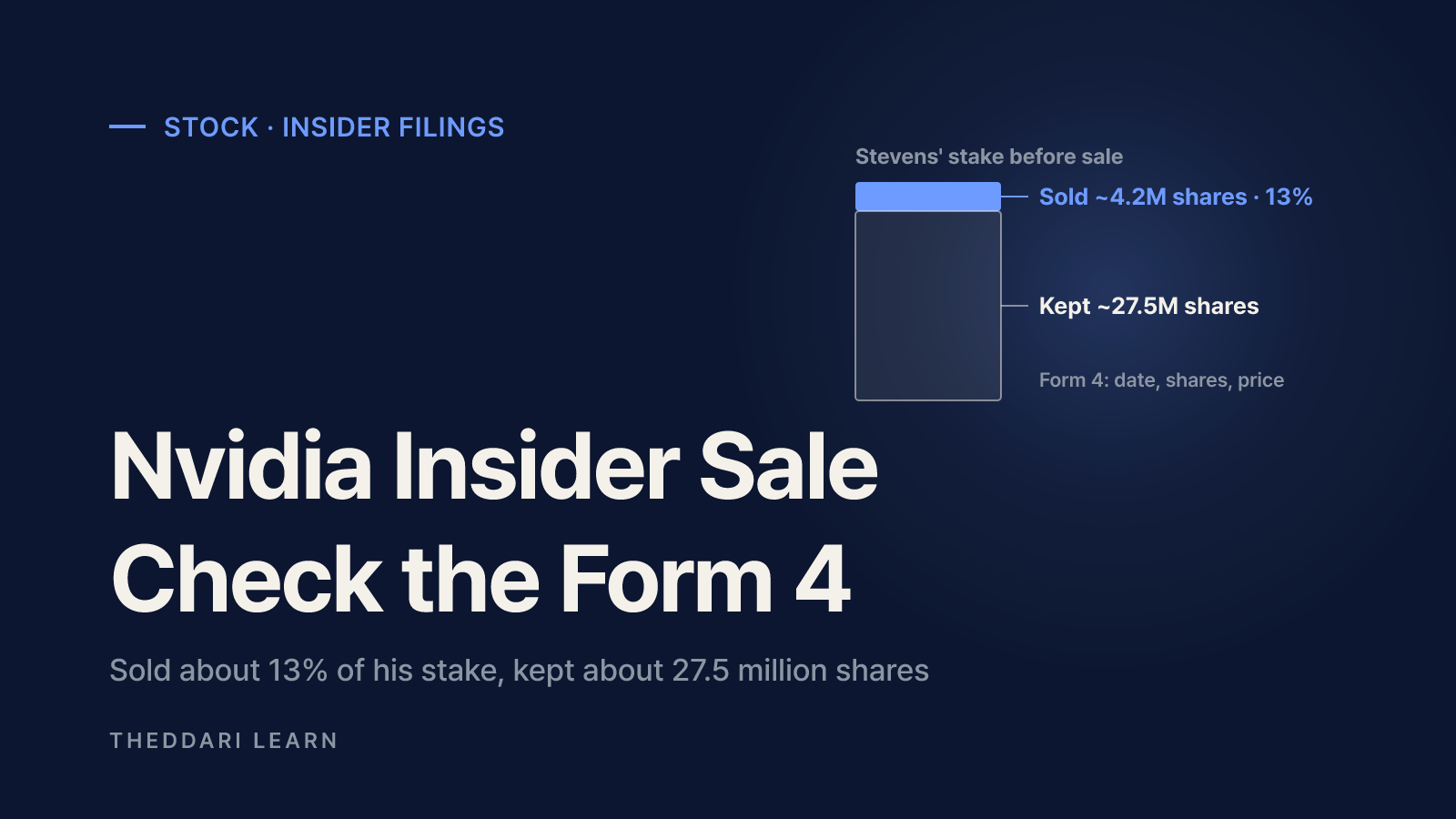
If you saw headlines about Nvidia insider selling, you can check the facts yourself in the director's SEC Form 4 filings. A Moneywise report published on Yahoo Finance on November 13, 2026 says Nvidia board member Mark Stevens sold roughly 4.2 million shares, worth about $946 million, between August 31 and September 18, 2026, and that no prearranged trading plan was flagged. This guide, based on US rules as of November 2026, shows how to pull up the filings on EDGAR, read the transaction table, tell a 10b5-1 plan sale from a discretionary one, and judge how much a sale actually means.
What the Nvidia insider selling report actually says
The report breaks the sales into three batches, citing SEC filings. Dollar amounts are rounded.
Aug 31 – Sep 2, 2026
- Price range
- $220–$226
- Reported proceeds
- ~$411 million
Sep 3 – Sep 4, 2026
- Price range
- $227–$234
- Reported proceeds
- ~$236 million
Sep 18, 2026
- Price range
- ~$220
- Reported proceeds
- ~$300 million
Total (~4.2M shares)
- Price range
- —
- Reported proceeds
- ~$946 million
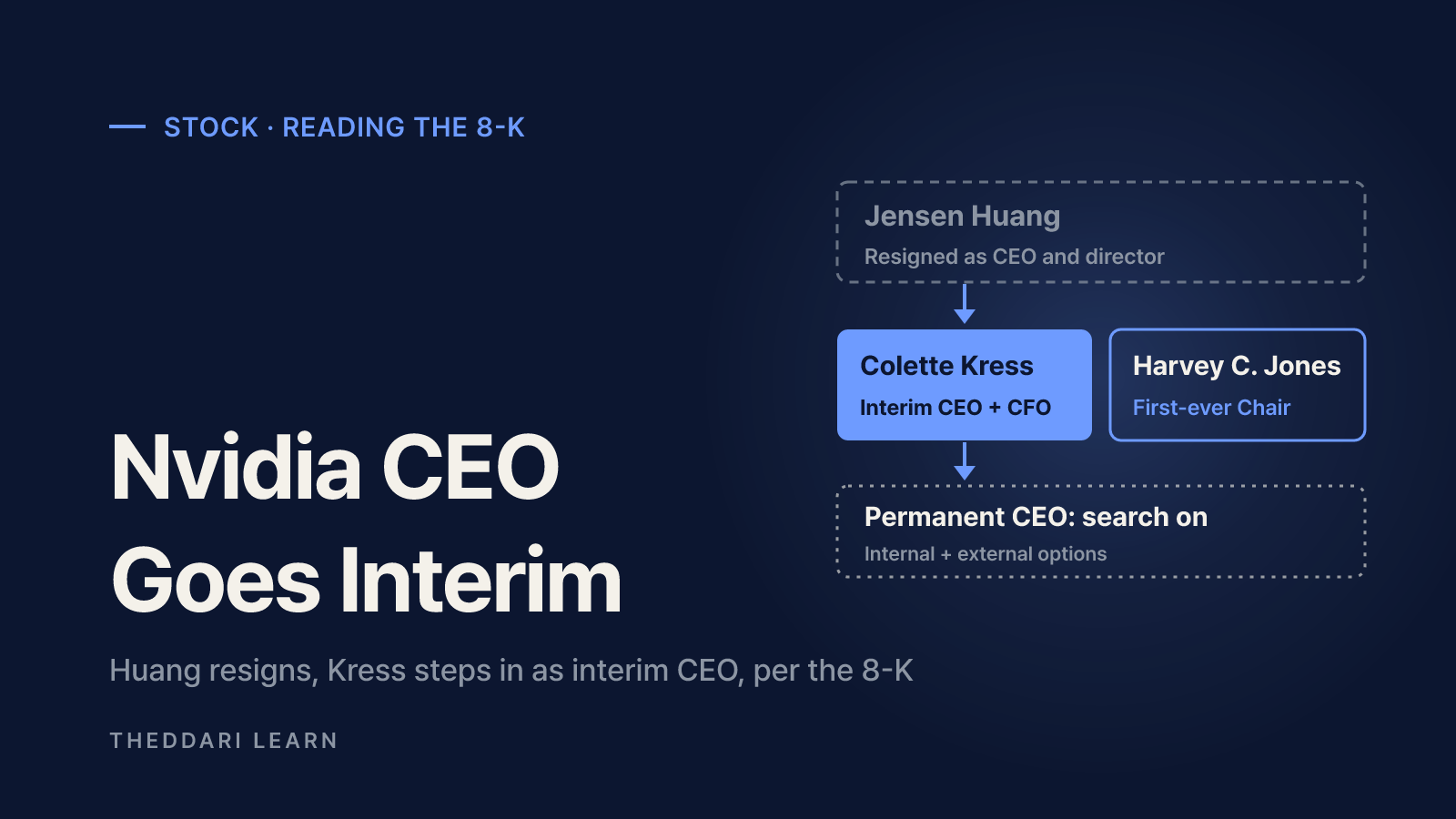
The same article notes that Stevens still holds about 27.5 million shares, that Nvidia traded around $163 on November 13, and that the board announced Jensen Huang's resignation and named Colette Kress interim CEO on November 12. Keep one distinction in mind: a Form 4 proves when, how many and at what price. Any link between the September sales and the November news is an inference from the calendar, not something the filings establish.
What is a Form 4 filing, and who has to file one?
Section 16(a) of the Securities Exchange Act requires directors, officers and holders of more than 10% of a listed company's stock to report their holdings. Under 17 CFR 240.16a-3, insiders file Form 3 when they first become insiders, Form 4 for changes in ownership, and Form 5 annually.
- Deadline: a Form 4 must be filed before the end of the second business day after the trade is executed.
- Plan trades: if the trade runs under a qualifying 10b5-1 plan and the insider does not choose the execution date, the date the broker reports the fill counts as the trade date, capped at the third business day after the trade.
- Form 5 gaps: certain exempt transactions may be reported on Form 5 within 45 days after the fiscal year ends, so Form 4s alone can miss some activity.
- Company websites: issuers with a website must post Forms 3, 4 and 5 by the end of the next business day and keep them up for at least 12 months.
In practice, open-market sales by US insiders become public within days. The Stevens sales were disclosed in September; the November coverage re-read those filings in a new context.
Insider trading check: finding and reading a Form 4 on EDGAR
- 1
Search the company on EDGAR
Open SEC EDGAR company search, enter Nvidia or the ticker NVDA, and filter the filing type to 4. You can also search by the insider's name to see every filing where they are the reporting owner. No account is needed.
- 2
Confirm the reporting person
At the top of the form, check the reporting owner's name and relationship to the issuer: director, officer or 10% owner. Shares held through a family trust or entity appear as indirect holdings.
- 3
Read the transaction table
In the non-derivative table, read the transaction date, transaction code, number of shares, acquired or disposed, price, shares owned after the transaction, and direct or indirect ownership. Open-market sales are usually coded S and purchases P. When fills happen across a range, the form shows a weighted average price and a footnote gives the range.
- 4
Look for the 10b5-1 indication
Since the 2022 amendments, Form 4 includes a way to indicate that a trade was made under a 10b5-1 plan. If it is marked, look in the footnotes for the plan's adoption date. If it is not, as the report says for Stevens, treat the sale as likely discretionary.
- 5
Add up related filings
A single selling program often spans several Form 4s. To match a headline number, collect every filing for the period and total the shares and proceeds.

10b5-1 plan sales vs. discretionary sales
Rule 10b5-1 says a trade is made on the basis of material nonpublic information if the trader was aware of it. It also gives an affirmative defense for trades made under a written plan adopted before the trader learned the information. The rule was tightened in December 2022.
When the decision is made
- 10b5-1 plan sale
- At plan adoption: amounts, prices and dates or a formula are fixed
- Discretionary sale
- At the time of each sale
Cooling-off for directors and officers
- 10b5-1 plan sale
- Later of 90 days or 2 business days after the 10-Q/10-K, max 120 days
- Discretionary sale
- None under the rule (company blackout windows still apply)
Certification
- 10b5-1 plan sale
- Must certify no awareness of MNPI and good faith at adoption
- Discretionary sale
- No plan requirements
Overlap limits
- 10b5-1 plan sale
- Generally no overlapping plans; single-trade plans once per 12 months
- Discretionary sale
- Not applicable
Information content
- 10b5-1 plan sale
- Lower: schedule set in advance
- Discretionary sale
- Higher: reflects a current decision
Changing a plan's amount, price or timing counts as terminating it and adopting a new one, which restarts the cooling-off period. That is why the adoption date and any modifications matter. A discretionary sale is not illegal by default either; selling inside the company's open trading window and reporting on time is routine.
Size the sale against remaining holdings
A $946 million headline sounds dramatic, but the better measure is the share of the position sold. From the reported figures, Stevens held roughly 4.2 million + 27.5 million = about 31.7 million shares before selling, so he sold about 13%. His average price works out to roughly $946 million ÷ 4.2 million ≈ $225 per share.
- Percentage sold: the shares owned after each transaction are printed right on the Form 4.
- Pattern: compare with prior years. Does this insider sell around the same time each year, or is this unusual?
- Clustering: check whether several executives sold at once. The report mentions sales by other Nvidia executives, some under prearranged plans.
- Timing: line the sales up against earnings dates on the earnings calendar. Sales right after results often fall in a normal trading window.
Why insider selling is a weak signal for Nvidia stock
Insiders sell for many reasons that have nothing to do with the company's outlook: taxes, diversification, buying a home, gifts and estate planning. A long-tenured director with a very concentrated position has obvious reasons to trim. The report itself says the lack of a plan is not necessarily a red flag.
Beware hindsight math. Revaluing shares sold near $225 at the November 13 price of about $163 makes the timing look prescient, but nobody knew the future price in September. Inferring intent from outcomes goes beyond what the filings show.
A practical routine for any insider-selling headline: pull the original Form 4s on EDGAR and match dates, shares and prices; check the 10b5-1 indication and the plan adoption date; compute the percentage of holdings sold; then add context such as other insiders' trades and the earnings calendar. The filing is the record of fact. Interpretation should come only after all four checks.