Contents7 sections
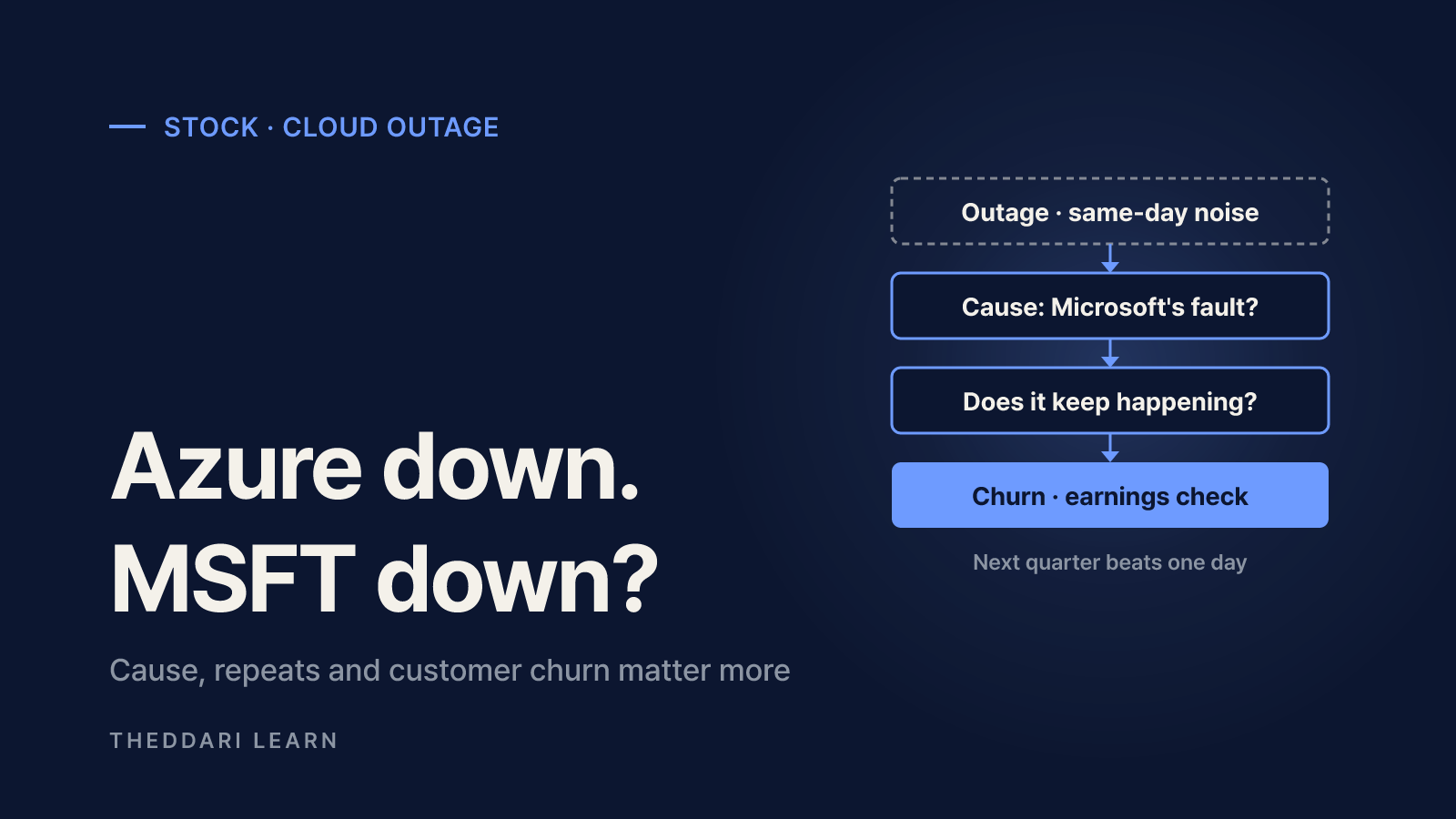
An azure outage can jolt Microsoft (Nasdaq: MSFT) shares for a day, but past incidents show that one outage rarely decides where the stock goes. What tends to matter for longer is whether Microsoft caused the failure, whether the same kind of failure keeps happening, and whether customers respond by moving workloads or cutting contracts. This guide uses official Microsoft documents and news coverage checked as of November 13, 2026, and is written for anyone holding or watching MSFT.
On November 12, 2026 (US time), an "Ask HN: Microsoft/Azure Outage?" thread climbed Hacker News, and US Google Trends showed spikes for "microsoft down?", "internet outage" and "microsoft stock". At the time of writing we had not found an official post-incident review explaining the cause or scope of that event, so this article does not guess at it. Instead, it lays out what to check and how to judge the market reaction.
How an outage can reach the stock price
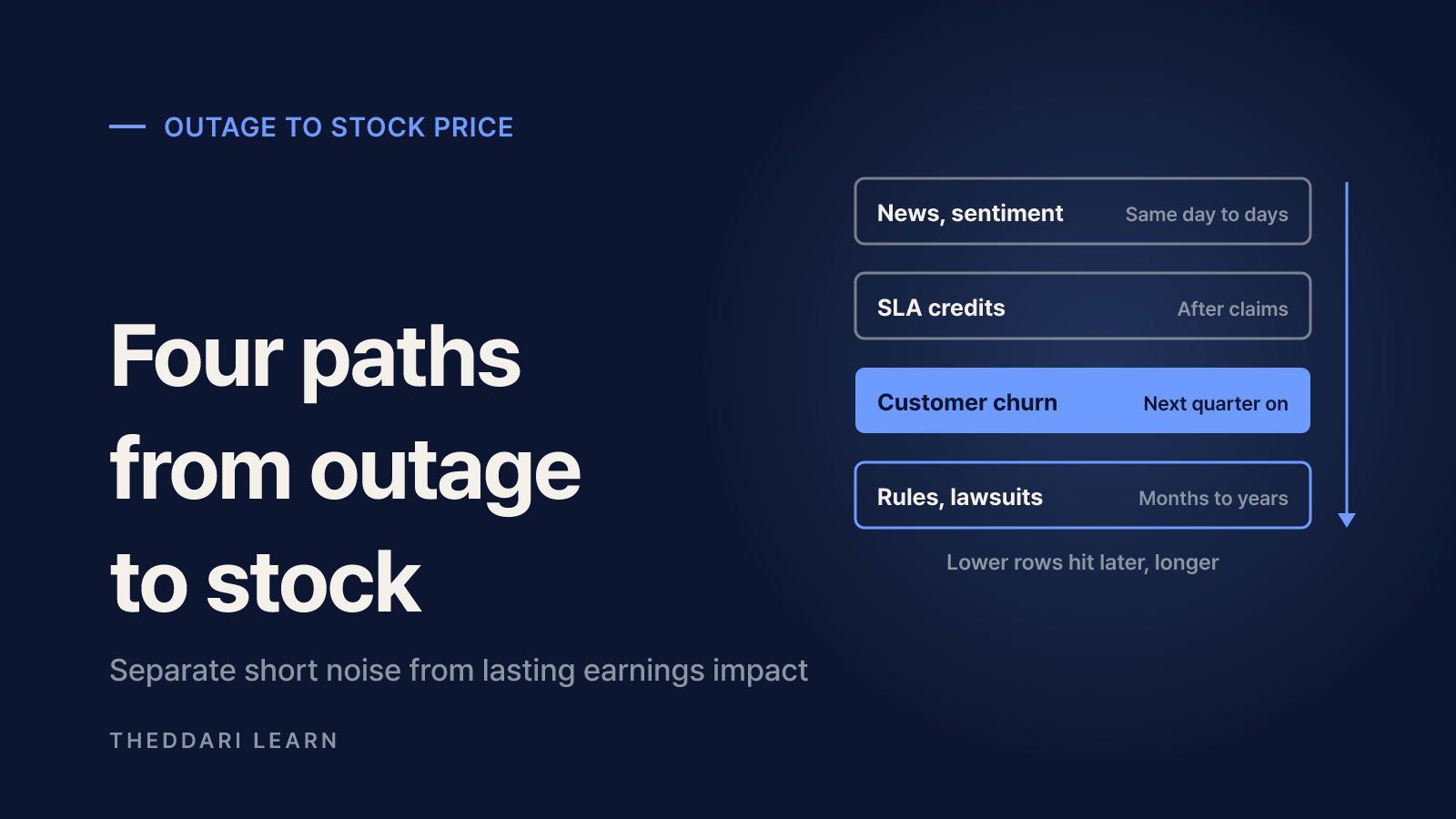
If a cloud outage moves a share price, it usually travels through one of four channels. The first two tend to be short and small; the last two play out over quarters and show up in reported numbers.
Headline and sentiment
- When it shows
- Same day to a few days
- Where to check
- MSFT vs. Nasdaq-100 and cloud peers
SLA service credits
- When it shows
- After customer claims
- Where to check
- The SLA terms for each service
Customer trust and churn
- When it shows
- Next quarter onward
- Where to check
- Cloud revenue growth, earnings call remarks
Regulation and lawsuits
- When it shows
- Months to years
- Where to check
- Company filings, regulator statements
Microsoft publishes its uptime and connectivity commitments for Azure, Dynamics 365, Office 365 and Intune in the Service Level Agreement for Online Services, with a new edition posted regularly (we checked the November 2026 edition). Credit levels, claim deadlines and exclusions vary by service, so compare any "payout" estimate you read with the actual document.
Past azure outage cases and what they showed
Three incidents that drew heavy investor attention illustrate a simple point: who caused the failure, and what else happened that day, changes how you should read the stock move.
Azure Front Door, Oct 29, 2025
- Cause (official account)
- Customer config changes across two control-plane versions produced incompatible metadata that crashed edge servers
- What to watch when reading the stock
- Earnings came out after the close the same day, so effects overlap
AWS, Oct 20, 2025
- Cause (official account)
- Increased error rates launching EC2 instances at a rival cloud
- What to watch when reading the stock
- Not Microsoft's failure; covered as a sector-wide story
CrowdStrike, July 2024
- Cause (official account)
- Faulty update from a security vendor; about 8.5 million Windows devices affected
- What to watch when reading the stock
- Windows showed the symptoms, but another company caused it
Azure Front Door, October 2025
According to Microsoft's post-incident review YKYN-BWZ, customers using Azure Front Door and Azure CDN saw connection timeouts and DNS errors from 15:41 UTC on October 29 to 00:05 UTC on October 30, 2025. Beyond Azure services such as the Azure Portal and Azure SQL Database, parts of Microsoft 365, Dynamics 365 and Entra ID were hit. Front Door had also failed on October 9, and Microsoft said the two incidents had different defects but shared a configuration-propagation risk.
CNBC reported that the outage began hours before Microsoft's quarterly earnings release, took down its Xbox and investor relations pages, and disrupted key systems at Alaska Airlines. For shareholders the takeaway is methodological: when an outage and an earnings report land on the same day, you cannot credit the price move to the outage alone.
Follow-up commitments are part of the story
In the same review, Microsoft said it had cut data-plane recovery time from about 4.5 hours to about one hour, and was working toward roughly 10 minutes. Whether such repair items get finished, and whether the same failure type comes back, is better evidence about long-term customer trust than any single trading day.
What to check when you see "Microsoft down"
- 1
Check official status pages
Look at the Azure status page and the Microsoft 365 Status account first. Per Microsoft Learn, the public page is reserved for broad multi-service or multi-region issues, portal-access failures, and issues whose scope is not yet known; most notices go privately to affected customers through Azure Service Health.
- 2
Identify who caused it
Separate a Microsoft defect from a problem at a security vendor, network carrier or another cloud. The CrowdStrike case shows that Windows can display the symptoms of someone else's bad update.
- 3
Log scope and timing
Write down which services (Azure, Microsoft 365, Xbox), which regions, and the start and recovery times. Crowd-sourced report counts describe user experience, not official scope.
- 4
Wait for the PIR
For broad incidents, a post-incident review appears on the Azure status history page with root cause, timeline, and repair items with target dates.
- 5
Check the calendar
See whether earnings or major macro releases fall on the same day. The theddari economic calendar lists scheduled macro events you can line up against the outage window.

How not to over-read a one-day move in Microsoft stock
- Use a benchmark. Put the MSFT move next to the Nasdaq-100 and cloud peers such as Amazon and Alphabet before calling it an outage effect.
- Match outage time to trading hours. An incident outside the regular US session shows up at the next open, and other news may arrive in between.
- Separate one-offs from patterns. Two Front Door failures in one month, as in October 2025, raise sharper reliability questions than a single event.
- Keep market share in view. CNBC, citing Canalys, put Q1 2025 cloud infrastructure share at AWS 32%, Azure 23% and Google Cloud 10%. A rival's outage becomes a sector story, so do not assume Azure automatically gains.
- Wait for numbers. A real impact would appear as slower cloud revenue growth, management explanations on the earnings call, or reports of large customers leaving.
Loss or compensation figures that circulate on social media during an outage often have no traceable source. If a number is not in a PIR, an SLA document or a company filing, leave it out of your analysis.
To see which narratives spread after an outage, the theddari stock Telegram trends page can help you gauge sentiment. Popularity is not verification, though, so treat it as context only.
Checklist: will this outage show up in results?
- Did the official cause statement confirm Microsoft was responsible?
- Have you noted the PIR repair items and their target dates?
- Has the same service failed in a similar way in recent months?
- Do you know the next earnings date and which metrics you will watch, such as cloud revenue growth and management remarks?
- Did you compare the outage-day move with the index and peers?
In short, an Azure outage can add short-term noise to Microsoft stock, but it rarely answers the investment question on its own. Confirm cause, recurrence and customer response from official sources, then test the story against the next earnings report. That sequence keeps a scary headline from turning into a rushed decision.