Contents8 sections
- What happened in the November 13 FAA ground stop
- How a nationwide ground stop affects airline stocks
- What past airline meltdowns cost: Delta 2024 vs. Southwest 2022
- Delta, Southwest and JetBlue: where the impact could differ
- Checklist before the next trading session
- Common mistakes when reading the airline stock reaction
- Frequently asked questions
- Sources and references
An FAA ground stop hits airline stocks through canceled flights, refunds and recovery costs, and the size of that hit depends far more on how long the cleanup takes than on how many hours departures were frozen. On Friday, November 13, 2026, the Federal Aviation Administration said it had issued a nationwide ground stop for all U.S. airports after communication issues affected multiple Air Route Traffic Control Centers. This guide, current as of November 14, 2026, lays out what is confirmed, how a disruption like this flows into airline earnings, what Delta and Southwest disclosed after their own meltdowns, and what holders of DAL, LUV and JBLU can check before drawing conclusions. The cause and the full duration were still under investigation at the time of writing.
What happened in the November 13 FAA ground stop
A ground stop keeps departing flights on the ground at specific airports, a region, or, very rarely, the entire country. Aircraft already in the air continue to their destinations. Most ground stops are local and weather-related; a nationwide order is unusual.
- Timing and wording: According to NBC News, the alert went out at 3:54 p.m. ET and cited "extraordinary circumstances" and "reasons of safety," telling all departing traffic to stay on the ground until further notice. Inbound international flights were to be handled case by case.
- Official explanation: The FAA attributed the order to communication issues at multiple en route centers and said technicians were investigating. Its statement is labeled preliminary and subject to change.
- Scale: Flightradar24 counted 4,042 U.S.-bound flights in the air when the alert was issued. A Dartmouth aviation logistics professor told NBC there are about 25,000 U.S. domestic flights a day and estimated 3,000 to 4,000 were held up over the first two-plus hours. Another expert estimated 300,000 to 400,000 stranded passengers. These are estimates, not official counts.
- Security: The Homeland Security secretary described it as a telecommunications outage with no indication yet of anything nefarious, while officials cautioned that the assessment could change.
- Precedent: The best-known nationwide stops came after the September 11, 2001 attacks and in January 2023, when the NOTAM system failed.
How a nationwide ground stop affects airline stocks
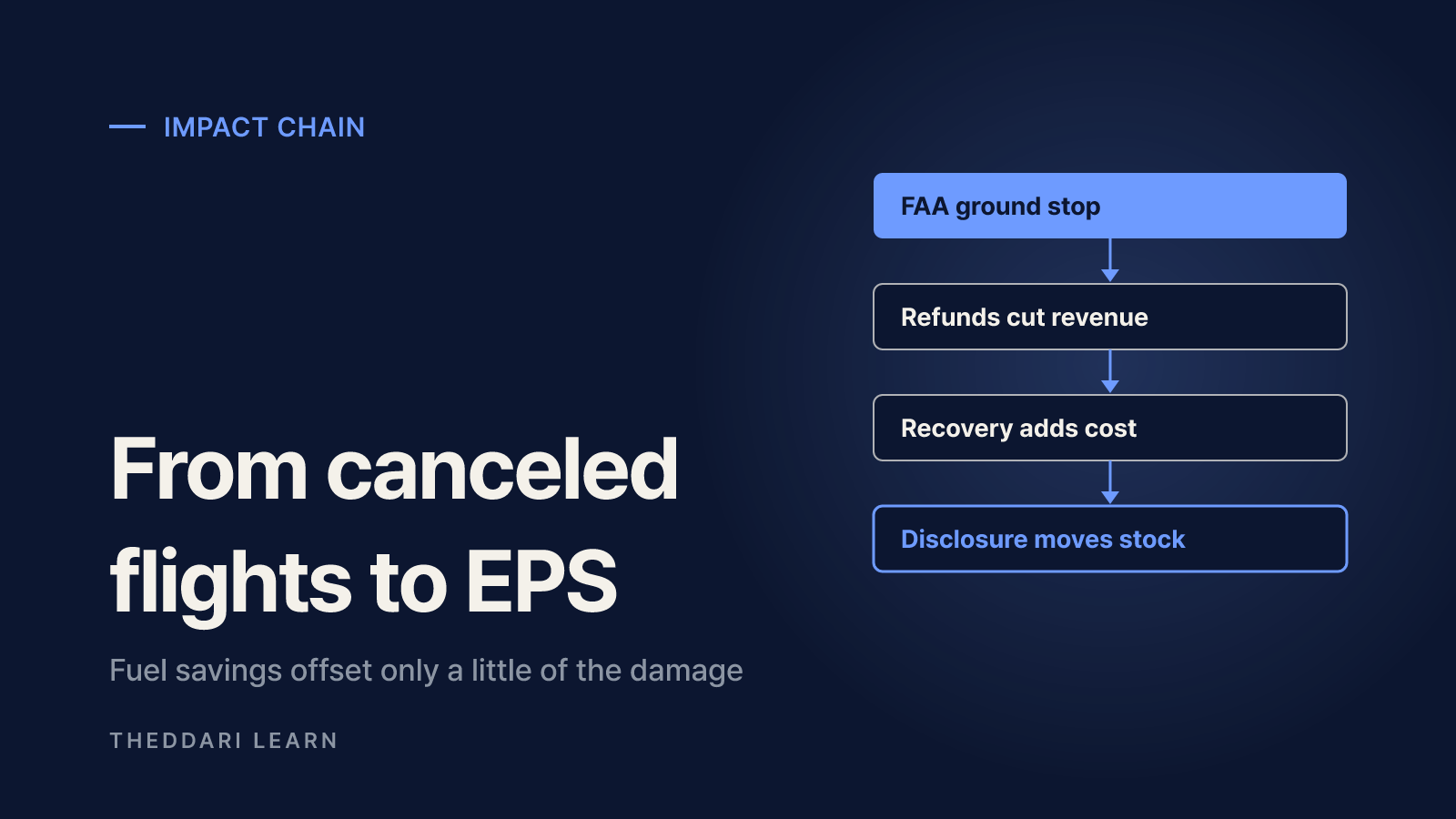
There are three main channels from a disruption to the income statement, plus a fourth step where the market actually prices it.
- 1
Cancellations reduce revenue
Tickets on flights that never operate are refunded or rebooked. Refunds come out of the quarter's revenue, and cash or loyalty-point compensation reduces it further. During busy periods, full planes leave little room to rebook, which pushes more passengers toward refunds.
- 2
Recovery adds cost
Hotel and meal reimbursements, crew overtime and hotels, and ferrying aircraft back into position all add expense. Federal duty-time limits mean a broken day can knock crews out of the next day's schedule too.
- 3
Fuel savings offset a little
Flights that don't operate don't burn fuel. In past cases, that saving has been small next to the lost revenue and recovery costs.
- 4
Disclosure moves the stock
Investors get real numbers when a company files an 8-K or reports quarterly results. Before then, the stock tends to price uncertainty; afterward, it prices the gap between the disclosed figure and expectations.
If the cause is identified quickly and schedules normalize within a day or two, the hit may be a small slice of a full quarter. If the investigation drags on, or confidence in the air traffic control network leads to continued flow restrictions, the impact grows.
What past airline meltdowns cost: Delta 2024 vs. Southwest 2022
The causes were different, but the costs these airlines reported are the best public yardstick for what mass cancellations do to the numbers. The table uses only figures from company releases.
Trigger
- Delta, July 2024
- CrowdStrike-caused IT outage
- Southwest, December 2022
- Winter storm, then crew-recovery breakdown
Cancellations
- Delta, July 2024
- About 7,000 over five days
- Southwest, December 2022
- More than 16,700 from Dec. 21 to 31
Revenue impact
- Delta, July 2024
- About $380 million lower
- Southwest, December 2022
- About $410 million lower
Cost impact
- Delta, July 2024
- Non-fuel expense up $170 million; fuel down $50 million
- Southwest, December 2022
- Net operating expense up about $390 million
Earnings impact
- Delta, July 2024
- EPS down 45 cents; operating margin down 2.3 points
- Southwest, December 2022
- About $800 million pre-tax ($620 million after tax)
Spillover
- Delta, July 2024
- Legal claims to recover damages
- Southwest, December 2022
- Estimated $300 million to $350 million more lost revenue in Q1 2023
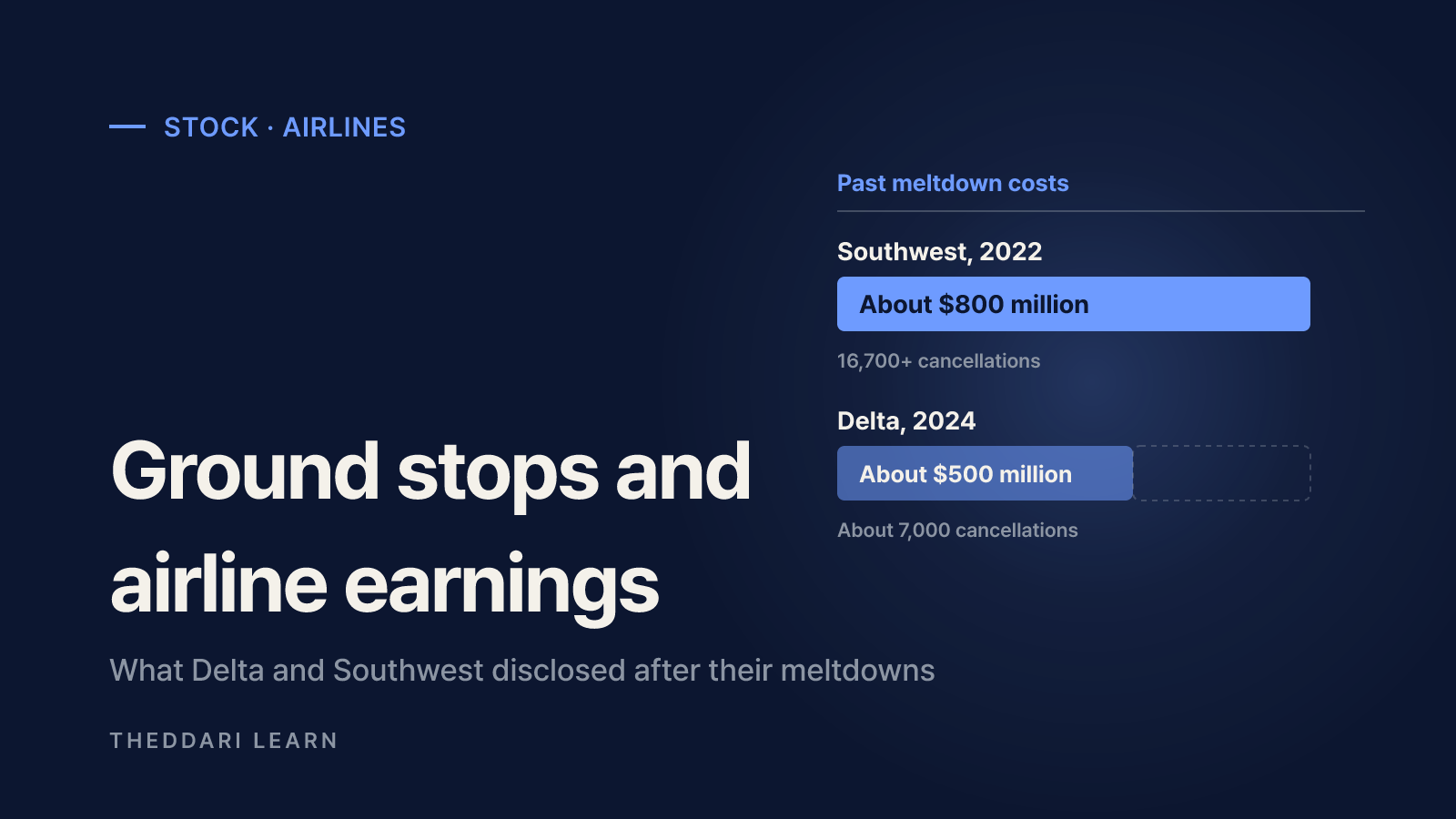
Delta's September quarter 2024 release puts the revenue hit at about $380 million, extra non-fuel expense at $170 million and fuel savings at $50 million, which nets to roughly $500 million. Southwest's fourth quarter 2022 release reports about $800 million pre-tax and warns of slower bookings in the following quarter. The lesson: when a disruption damages customer trust, costs can leak into the next quarter.
Both cases were single-airline failures that lasted days. The November 13 ground stop was an FAA communications problem that stopped every carrier at once, so plugging those dollar figures straight into today's situation would likely overstate things. Use them to understand which line items get hit, not as a forecast.
Delta, Southwest and JetBlue: where the impact could differ
A hub-and-spoke network with a large international and premium business. Delta said premium and loyalty-led diversified revenue made up 57% of total revenue in the third quarter of 2024. Some international and partner revenue can hold up during a domestic departure freeze. After its 2024 outage, Delta's recovery speed this time will be closely compared.
Its network relies heavily on point-to-point flying rather than hubs, so delays can cascade from city to city. In December 2022 its crew-scheduling tools could not keep up, and cancellations snowballed past 16,700. How quickly crew schedules are rebuilt is the metric to watch.
A mid-sized carrier generally known for its exposure to congested Northeast airports such as New York and Boston. Congested airports can take longer to recover once a stop lifts because of gate and slot constraints. For a smaller airline with thinner profits, the same per-flight cost weighs more heavily on earnings.
Because every competitor stopped at the same moment, the share-loss effect, where customers abandon one airline for another, is probably smaller than in 2022 or 2024. On the other hand, if the episode raises broader doubts about U.S. air traffic control reliability, it could weigh on the whole sector. Check each company's latest 10-K for exact network and revenue mix.
Checklist before the next trading session
- When the stop lifted vs. when schedules normalized: Track both separately in FAA notices and airline operations updates.
- Cancellations by airline: Comparing cancellations over the two days after the stop lifts shows who recovers fastest.
- Root cause: A one-off equipment fault and a structural weakness that could recur carry very different risk for the sector.
- Company disclosures: Watch for 8-Ks, investor updates or changes to quarterly guidance.
- Holiday travel: Thanksgiving falls on November 26, 2026; check whether any knock-on effects reach that peak period.

The earnings calendar above shows when each airline reports next, which is usually where the first hard number appears. For the running news flow and market chatter after the event, the stock channel tracker is a useful companion.
Common mistakes when reading the airline stock reaction
- "It was only a few hours": The recovery period after the stop drives cancellations more than the stop itself.
- Copying past losses: Delta's roughly $500 million and Southwest's roughly $800 million came from multi-day, single-airline failures.
- Reading too much into after-hours trading: The order landed minutes before Friday's close, news can change over the weekend, and thin after-hours volume exaggerates moves.
- Treating speculation as fact: Hacking theories or blame aimed at a specific vendor are unconfirmed until official investigators say otherwise.
- Ignoring other drivers: Fuel prices, demand, labor costs and rates often move airline stocks more than a single event.
Bottom line: how much this ground stop matters for DAL, LUV and JBLU will come down to recovery speed, cancellation counts by airline and whatever cost estimates the companies disclose. Past disclosures show the mechanics, but the cause this time sits with the FAA's network, which changes the comparison. Anchor your read on official statements and company filings rather than headlines.