Contents8 sections
- What the Nvidia board investigation statement actually says
- How an independent board investigation usually works
- Possible outcomes and corporate governance risk
- A precedent worth knowing: McDonald's and its former CEO
- Filings and dates NVDA shareholders should track
- Common mistakes when reading NVDA stock and CEO risk
- Frequently asked questions
- Sources and references
The Nvidia board investigation announced on November 8, 2026 is not, on its face, a disciplinary case against Jensen Huang. In a short statement, the board said it is starting an independent investigation in light of reporting that its founder and CEO has been the target of a foreign intelligence effort. For NVDA shareholders, the useful questions are who runs the probe, what outcomes would trigger which SEC filings, and what management says at the November 17 earnings call. This guide covers what was public as of November 9, 2026, using Nvidia's own releases and SEC materials.
The same day, Nvidia published an email Huang sent to employees. It includes a personal apology and states that, regarding the national security concerns raised in news reports, the board has opened an independent investigation that he supports and will cooperate with fully. This guide leaves the personal matters aside and focuses on governance and disclosure, the parts that bear on the company and its shareholders.
What the Nvidia board investigation statement actually says
The statement is brief, but each sentence carries information investors can use. The most important detail is that the probe is overseen by independent directors, not by management, with outside counsel attached.
Date
- What Nvidia said
- Board statement on Nov 8, 2026
- Why it matters
- Released alongside the CEO's employee email
Trigger
- What Nvidia said
- Reports that the CEO was targeted by a foreign intelligence effort
- Why it matters
- Frames it as a security review, not a misconduct finding
Who oversees it
- What Nvidia said
- A committee of independent directors
- Why it matters
- Directors without ties to the CEO lead the work
Support
- What Nvidia said
- Outside independent counsel
- Why it matters
- Separation from the company's in-house legal team
Board's view
- What Nvidia said
- No reason to believe national security or Nvidia secrets were compromised
- Why it matters
- Yet it will examine all available information
CEO's position
- What Nvidia said
- Supports the review and will cooperate
- Why it matters
- Cooperation shapes how credible the findings are
Next step
- What Nvidia said
- Further updates as appropriate
- Why it matters
- No timeline or scope published
The board also said it has confidence in Huang and his leadership team. Pairing an investigation with a vote of confidence suggests the board is not currently planning a leadership change. That is a starting position, though, not a conclusion.
How an independent board investigation usually works
Details vary by company, but board-led investigations at US public companies tend to follow a similar arc. Nvidia has not disclosed how it is running each stage, so treat the following as a general map rather than a description of this case.
- 1
Form a special committee
The board picks directors with no business or financial ties to the person or issue involved. Nvidia has confirmed this step.
- 2
Hire outside advisers
The committee selects outside counsel and, if needed, security or forensic specialists. Reporting to the committee rather than to management is what makes it independent.
- 3
Preserve and review records
Emails, device data and access logs are secured and reviewed. In a national security context, contact with government agencies may run in parallel.
- 4
Interview people
Investigators interview relevant people, including the executive at the center. How fully that person cooperates affects how complete the findings can be.
- 5
Report and decide
The committee reports to the full board, which decides on any action. Companies usually publish a summary, not the full report.
Signals of a credible process
- Whether the committee members are named
- Whether outside counsel reports directly to the committee
- Whether the scope stays on the reported foreign effort or extends to policy compliance more broadly
- Whether the final announcement explains the basis for its conclusions and any new controls
Possible outcomes and corporate governance risk
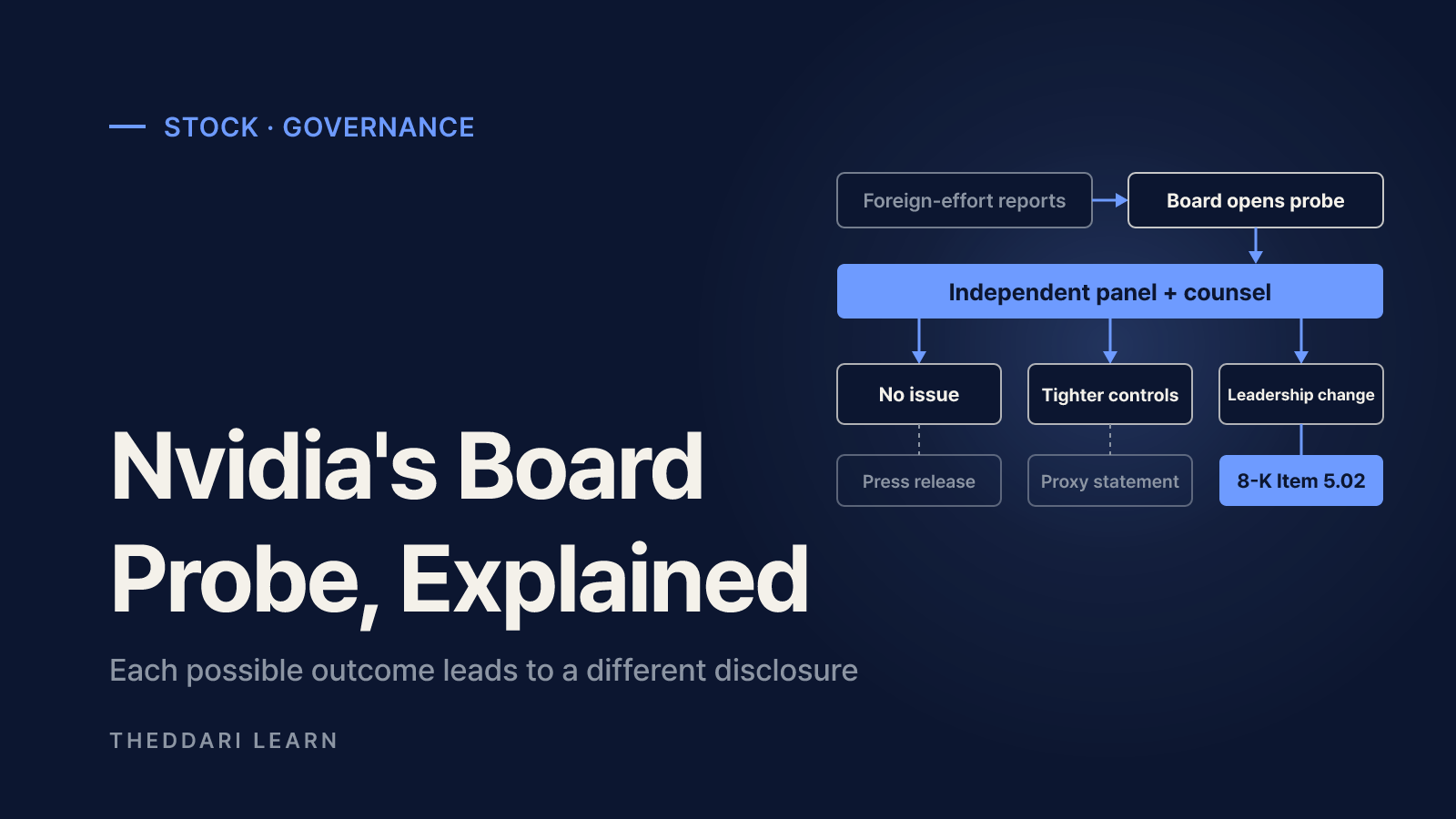
It is too early to know how this ends. What investors can do is map each plausible outcome to the disclosure it would likely produce.
No issue found
- Typical form
- Probe closes with no action
- Likely disclosure
- Press release, possibly a voluntary 8-K Item 8.01
- What to check
- Whether the scope and basis are explained
Controls tightened
- Typical form
- Security policy updates, stronger board oversight
- Likely disclosure
- Press release, next proxy statement
- What to check
- Whether new rules also apply to the CEO
Leadership change
- Typical form
- Role change, resignation, termination or pay adjustment
- Likely disclosure
- 8-K Item 5.02 within four business days
- What to check
- Succession plan, severance terms, interim leadership
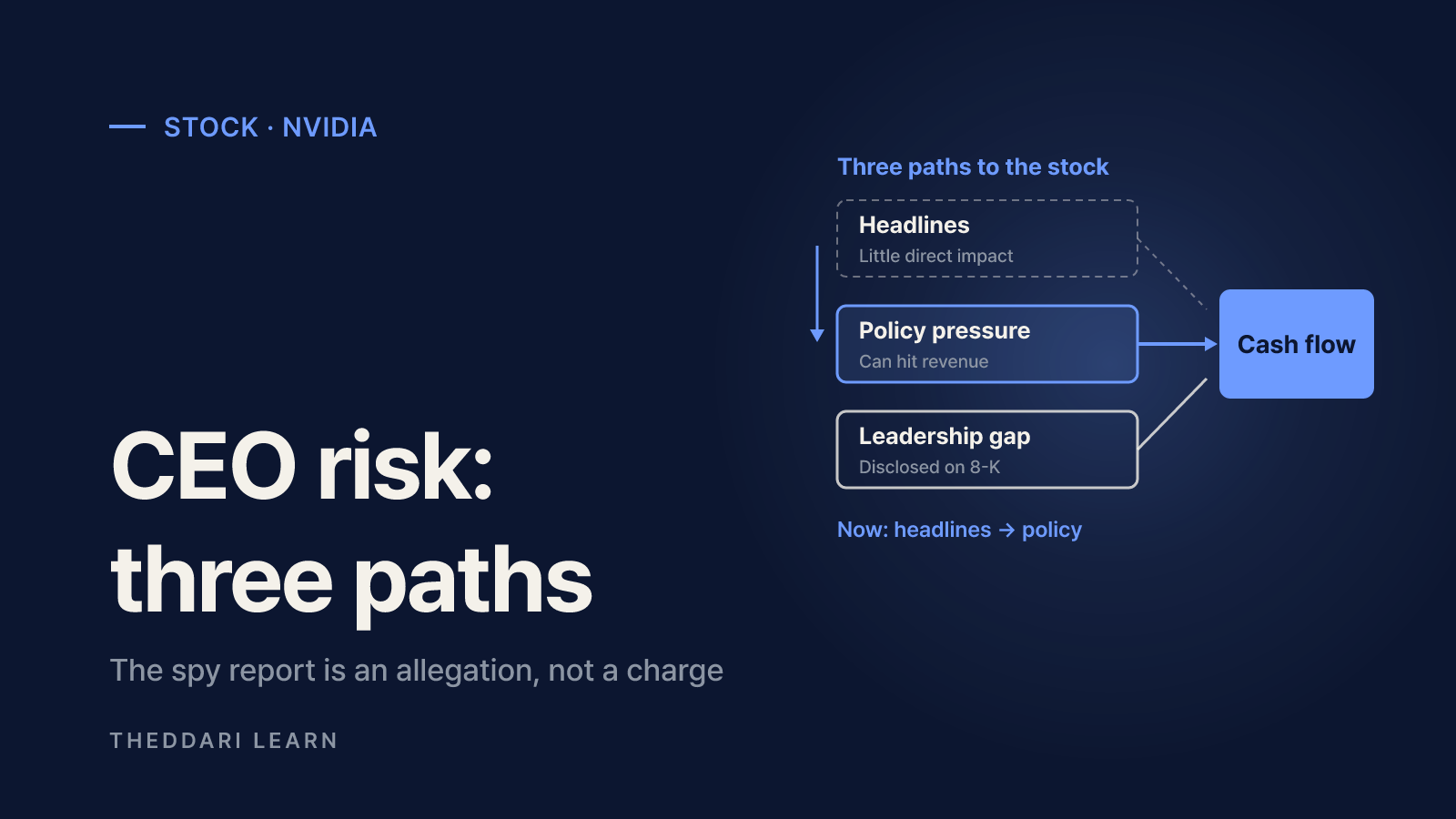
For a company led by its founder for decades, CEO key person risk sits at the center of corporate governance risk. Even a clean result leaves a question about how clearly the board explains succession planning and CEO oversight. A harder outcome, handled with transparent succession and prompt filings, can resolve uncertainty faster than a vague one.
During an open investigation, claims like "he is about to step down" or "the findings are in" spread quickly. Until they appear in a company release or an SEC filing, treat them as unverified.
A precedent worth knowing: McDonald's and its former CEO
The McDonald's case shows why the filings after an investigation matter as much as the headline. According to the SEC, McDonald's terminated CEO Steve Easterbrook in November 2019 for violating company policy, but the separation agreement treated the termination as without cause, letting him keep substantial equity pay. A later internal investigation in July 2020 found additional violations he had not disclosed.
- In January 2023 the SEC found the former CEO misled investors by concealing the extent of his conduct during the internal review, and imposed a five-year officer and director bar plus a $400,000 civil penalty.
- McDonald's was also cited for not disclosing that it used discretion in treating the exit as without cause in a separation agreement valued at more than $40 million. No penalty was imposed, citing its cooperation and its recovery of the compensation.
- Two lessons: the honesty of the person under review shapes the reliability of the findings, and the fine print on severance and board discretion deserves a close read.
The Nvidia matter starts from a different place, reports of an outside intelligence effort, so the comparison is about how to read post-investigation disclosures, not about predicting the outcome.
Filings and dates NVDA shareholders should track
The SEC's guide to reading an 8-K describes Form 8-K as a current report for material events, with most items due within four business days. These are the items most relevant here.
Item 5.02
- Covers
- Departure or appointment of the CEO and other top officers; pay changes
- Relevance now
- Filed if leadership or compensation changes
Item 5.05
- Covers
- Changes to or waivers of the code of ethics for top officers
- Relevance now
- May be posted on the company website instead
Item 7.01 / 8.01
- Covers
- Regulation FD disclosures and other events
- Relevance now
- Possible route for voluntary updates on findings
Item 2.02
- Covers
- Quarterly results
- Relevance now
- Check whether results materials mention the probe
The next fixed date is Nvidia's fiscal third-quarter 2027 report (the quarter ended October 25, 2026). Per Nvidia's notice, the call is on Tuesday, November 17, at 2 p.m. PT (5 p.m. ET). Q&A is limited to analysts and institutional investors, but whether the topic comes up, and how much management will say, is informative in itself.

Theddari's earnings calendar tracks the report date, and the stock Telegram trends page shows what chatter is circulating. Use the latter to gauge sentiment, not to confirm facts.
Common mistakes when reading NVDA stock and CEO risk
- Reading an investigation as a verdict. The board said it sees no reason to believe secrets were compromised. Opening a probe is not a finding.
- Reading confidence as closure. A statement of confidence reflects the board's view at the start. Conclusions come later.
- Mixing personal news with governance issues. What matters to shareholders is policy compliance, information security and the accuracy of disclosures.
- Separating earnings from the probe. Listen for changes in how management talks about customers, government relationships and its own focus.
- Judging only the first price move. Governance issues often play out in stages: findings, succession and pay disclosures.
In short, Nvidia has set up the probe with the standard safeguards, an independent committee and outside counsel, and its board has said it backs the current leadership. Shareholders can track three things in order: any disclosure of the committee's makeup and scope, what is said around the November 17 results, and whether a Form 8-K under Item 5.02 or a voluntary update appears. Keeping confirmed facts separate from reports and rumors is the most useful discipline while the review is open.