Contents7 sections
NVDL is the GraniteShares 2x Long NVDA Daily ETF, which aims to deliver twice the daily percentage change of Nvidia (NVDA) stock before fees. NVD is its mirror image, the GraniteShares 2x Short NVDA Daily ETF, aiming for -2x the daily move. Both trade on Nasdaq, and both fund pages (NVDL, NVD) state plainly that investors should not expect 2x or -2x Nvidia's return over any period longer than one day. This guide, checked against issuer and regulator pages in November 2026, explains how the funds work, why long holds drift away from the headline multiple, and what Korean residents must clear before they can place an order.
If you searched for Nvidia stock and saw NVDL or NVD quotes alongside it, the key idea is simple: these are not 'Nvidia times two' in a buy-and-hold sense. They are swap portfolios that reset their exposure every trading day. That daily reset is what makes them useful for short-term trades and what makes them risky to forget about.
What are NVDL and NVD?
Full name
- NVDL
- GraniteShares 2x Long NVDA Daily ETF
- NVD
- GraniteShares 2x Short NVDA Daily ETF
Daily target
- NVDL
- +200% of NVDA's daily move
- NVD
- -200% of NVDA's daily move
Inception
- NVDL
- December 13, 2022
- NVD
- August 21, 2023
How exposure is built
- NVDL
- Total return swaps, collateralized by T-bills and cash
- NVD
- Total return swaps, collateralized by T-bills and cash
Rebalancing
- NVDL
- Daily
- NVD
- Daily
Holds Nvidia shares?
- NVDL
- No
- NVD
- No
According to GraniteShares, neither fund owns Nvidia stock. Instead, each fund enters total return swaps with bank counterparties that pay or receive Nvidia's return on a notional amount equal to about 200% of the fund's assets. The remaining cash sits in short-term U.S. Treasuries and cash as collateral. That structure adds two risks on top of Nvidia's own price risk: counterparty risk if a swap bank fails to pay, and rebalancing risk if the fund cannot adjust its swaps at expected prices.
How the daily reset works
Near each close, the fund resizes its swaps so the next day starts at exactly 2x (or -2x) of its new asset value. After a gain, a long fund adds exposure; after a loss, it trims exposure. In effect it buys after rallies and sells after drops, which is why choppy markets steadily wear down the fund's value. Traders call this volatility decay or beta slippage.
Why NVDL does not deliver 2x over weeks or months
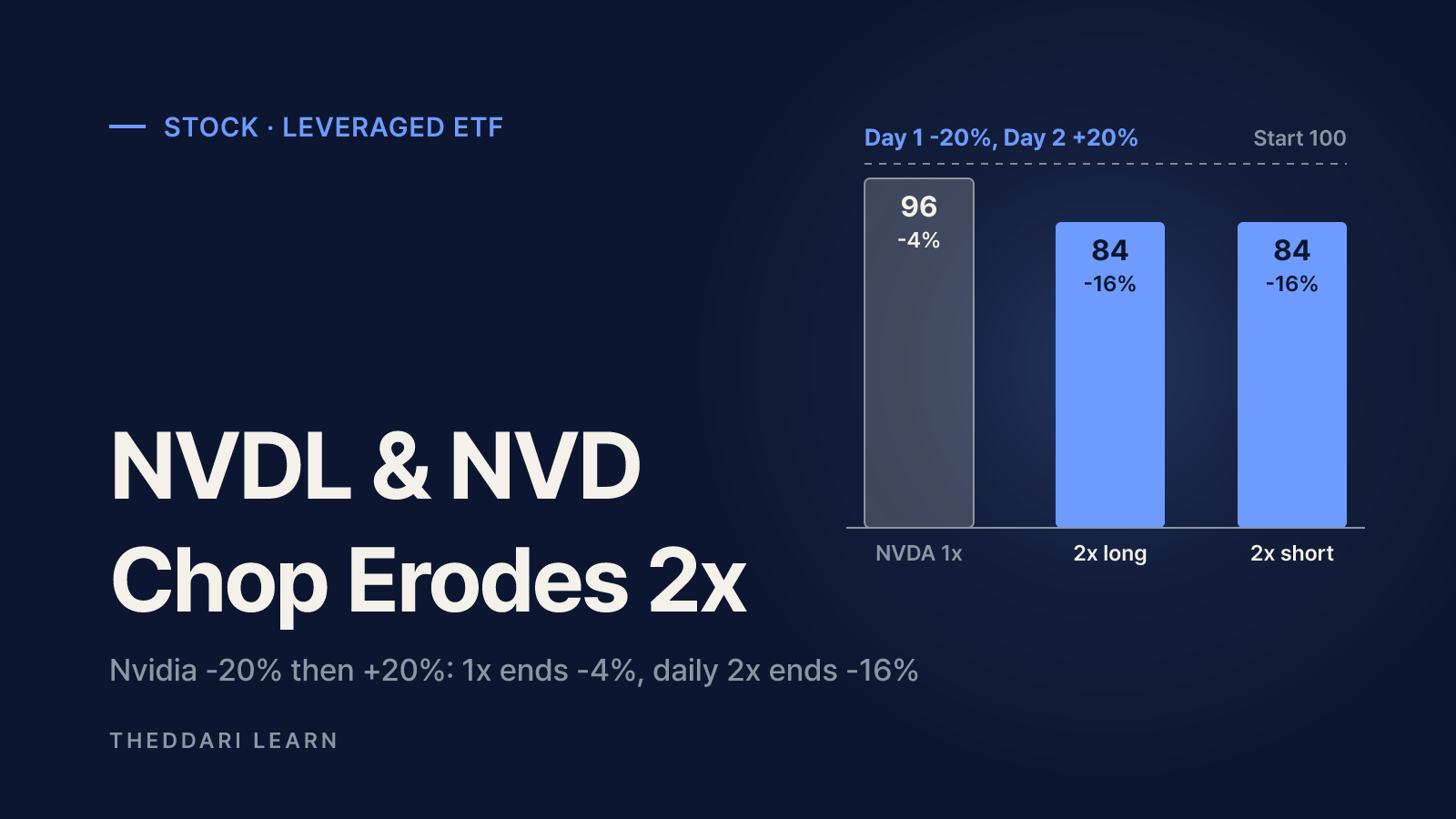
Korea's Financial Services Commission used a clean example in an August 2026 release: if an asset drops 20% and then rises 20%, a 1x product goes from 100 to 80 to 96, a 4% loss. A daily 2x product falls 40% and then rises 40%, going from 100 to 60 to 84, a 16% loss. The leveraged loss is four times the underlying loss, not two times.
Day 1 -20%, Day 2 +20%
- NVDA (1x)
- 100 → 80 → 96 (-4%)
- 2x long (NVDL-style)
- 100 → 60 → 84 (-16%)
- 2x short (NVD-style)
- 100 → 140 → 84 (-16%)
Day 1 +10%, Day 2 -10%
- NVDA (1x)
- 100 → 110 → 99 (-1%)
- 2x long (NVDL-style)
- 100 → 120 → 96 (-4%)
- 2x short (NVD-style)
- 100 → 80 → 96 (-4%)
Three days of +5%
- NVDA (1x)
- 100 → 115.8 (+15.8%)
- 2x long (NVDL-style)
- 100 → 133.1 (+33.1%)
- 2x short (NVD-style)
- 100 → 72.9 (-27.1%)
These figures ignore fees and swap costs. The second row shows that both the long and the short fund can lose money while Nvidia barely moves. The third row shows the flip side: a steady trend can push results beyond 2x. Path and volatility matter as much as direction. GraniteShares itself warns that NVD will lose money if Nvidia is flat over time and may lose money even if Nvidia declines.
Extra risks for the inverse fund
A -2x fund can, in theory, be wiped out if Nvidia rises about 50% in one session, and the issuer's risk language says investors could lose their full principal within a single day. Nvidia has historically made large moves after quarterly results, so check the date on the theddari earnings calendar before holding either fund through a report. NVD's document list also includes a November 2024 reverse split supplement, a common step for inverse funds whose share price erodes over time.
Costs, premiums and distributions to check
- Expense ratio and waivers: the fact sheet lists the management fee, gross expense ratio and net ratio after any contractual fee waiver. Waivers have end dates, so costs can rise later.
- Swap financing costs: the embedded cost of swaps generally comes out of fund performance rather than the headline fee, one reason returns lag an exact 2x even in a single day.
- Premium or discount to NAV: you trade at the market price, not NAV. The fund pages publish premium and discount history.
- Distributions: the issuer says payouts can vary or stop and may include return of capital.
- Currency: non-U.S. investors also carry dollar exchange-rate risk on top of Nvidia's move.
Fees and swap costs look small on any one day but compound every day. Pull current numbers from the issuer's fact sheet right before trading instead of relying on figures quoted in forums or older articles.
Buying NVDL or NVD from Korea: rules as of November 2026
For investors who live in Korea, NVDL and NVD count as overseas-listed single-stock leveraged and inverse products. Korea extended its domestic investor protection rules to these products in May 2026 and tightened them again in July and August 2026. Based on the FSC release of July 24, 2026 and the August explanatory note, the requirements for individual retail investors are:
Basic education
- Detail
- One-hour leveraged ETF/ETN course from the Korea Financial Investment Institute
- Effective
- December 2025 for overseas products
Advanced education
- Detail
- Single-stock leveraged and inverse course, extended from one to two hours on August 7 (three hours in total), with a passing score of 60
- Effective
- July–August 2026
Base deposit
- Detail
- More than 30 million won held in cash only; stocks, ETFs and bonds no longer count
- Effective
- July 31, 2026
Cash recognition
- Detail
- Sale proceeds count only after settlement (T+2); loans against sale proceeds are excluded
- Effective
- July 31, 2026
Scope
- Detail
- Applies to new and additional purchases; selling is unrestricted; no relaxation based on trading history
- Effective
- July 31, 2026
Margin
- Detail
- Margin loans and unsettled purchases are prohibited
- Effective
- Since 2020
Some Korean brokers also require a Korea Exchange mock-trading course and a registered completion number before the order screen unlocks, and product classification can vary slightly by firm, so read your broker's leveraged ETP notice. Major U.S. data releases that can move Nvidia overnight Korea time are listed on the theddari economic calendar.
Tax for Korean residents
Profits from selling U.S.-listed ETFs such as NVDL are taxed in Korea as overseas stock capital gains. Per Samsung Securities' tax guide, gains realized from January to December are netted against overseas stock losses from the same year, an annual 2.5 million won deduction applies, and the remainder is taxed at 20% plus a 10% local surtax, for 22% in total. Gains are converted at settlement-date exchange rates, so currency moves are included, and the return is filed in May of the following year. Investors outside Korea should check their own country's tax rules.
Checklist before you trade
- Is your intended holding period a day to a few days, matching the issuer's stated use?
- Have you run the flat-market example above against your position size?
- For Korean residents: is your cash deposit above 30 million won and is your education number registered?
- Do you have a stop-loss and a maximum position size, knowing a single day can erase a large share of the investment?
- Have you checked earnings and macro dates? Community chatter on the theddari Telegram stock trends page can show sentiment but is not evidence.
- Have you set aside cash for capital gains tax due the following May?
In short, NVDL and NVD amplify a short-term view on Nvidia. They make sense to compare only after you understand the daily reset, the swap structure, volatility decay, the issuer's own warnings and, for Korean residents, the cash deposit, education and 22% tax rules that come with them.