Contents8 sections
- Micron strike timeline: what actually happened
- Why Micron's Taiwan fabs matter for memory chip supply
- Supply scenarios: how big would a disruption have to be?
- How it could reach semiconductor stocks
- Signals to watch next
- Risks and limits when reading strike headlines
- Frequently asked questions
- Sources and references
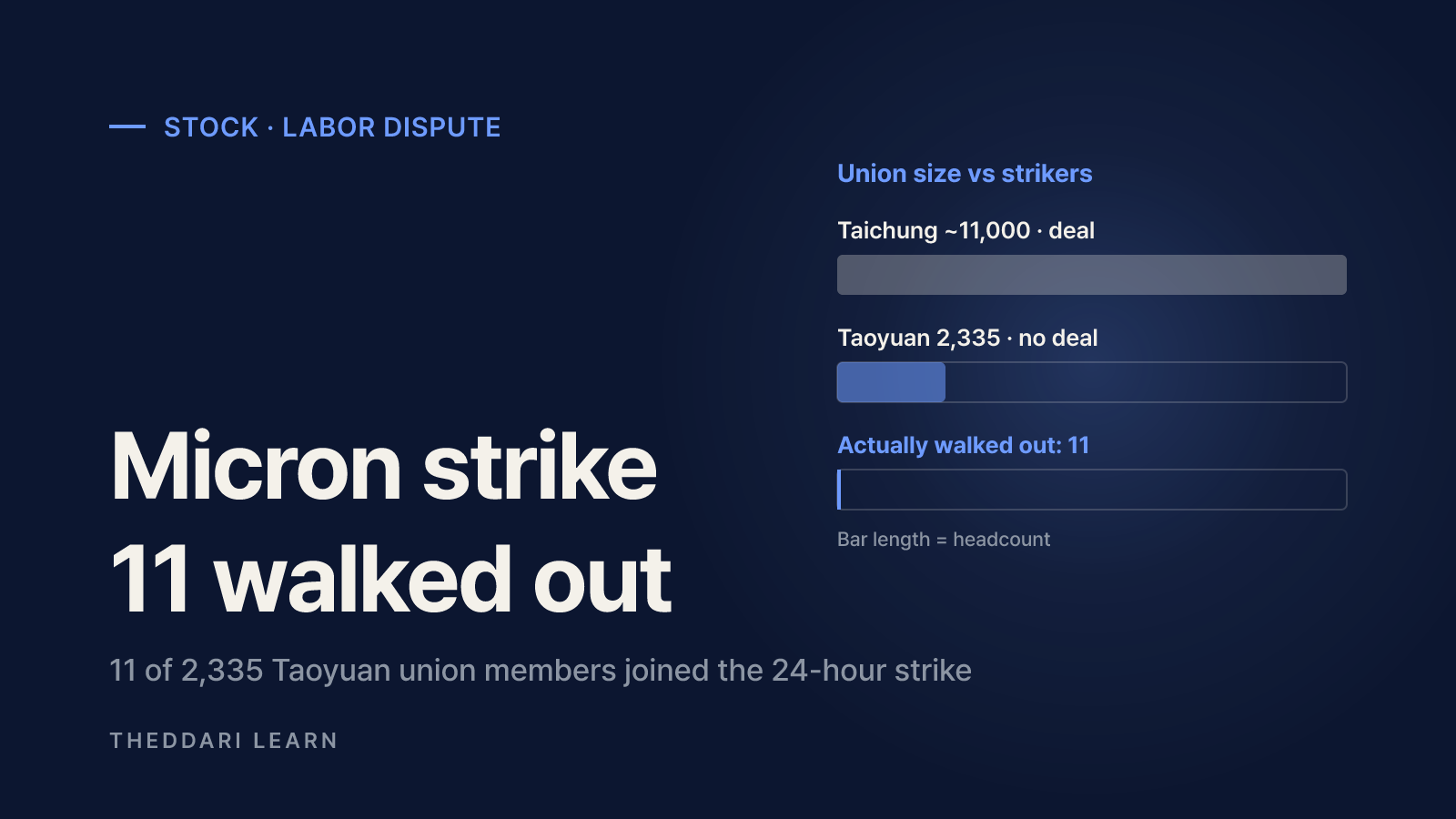
Short answer: as of October 27, 2026, the Micron strike in Taiwan was a 24-hour warning action by 11 union officials at the Taoyuan site, and there is no report that memory production stopped. The planned walkout was widely covered as a threat to AI memory supply, but the day before it began, Micron reached a deal with the union at its much larger Taichung site. What investors should watch now is not the one-day strike itself, but whether the unresolved Taoyuan dispute escalates.
This guide lays out the timeline from Taiwanese and international reporting, explains why Taiwan matters for Micron's DRAM and high-bandwidth memory (HBM) output, and walks through how a real disruption could feed into memory prices and into Micron (MU), Samsung Electronics and SK Hynix shares. All dates are Taiwan local time.
Micron strike timeline: what actually happened
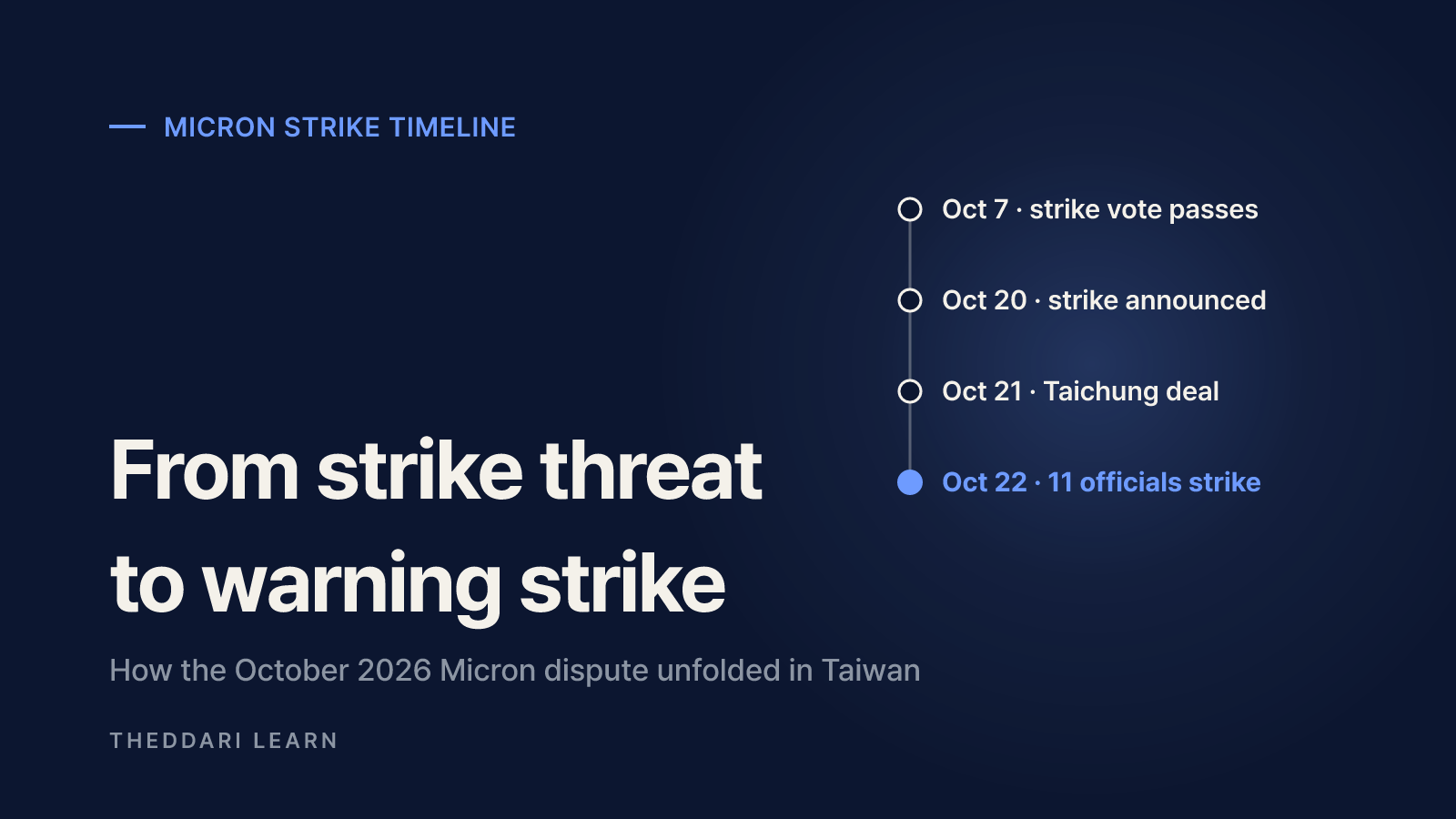
The dispute is about how AI-era profits are shared. Memory makers have posted record earnings on demand for AI data center chips, and Micron's Taiwan unions want a long-term mechanism that hands 15% of operating profit to employees. They argue the current Incentive Pay Plan (IPP) is not transparent (Focus Taiwan).
Oct 7
- Event
- Taoyuan union wins strike authorization (1,994 of 2,012 voting members in favor)
- Why it matters
- Legal industrial action becomes possible
Oct 20
- Event
- Taoyuan union announces an Oct 22 solidarity strike
- Why it matters
- Headlines about a looming Micron strike spread
Oct 21
- Event
- Micron and the Taichung union sign an agreement and cancel mediation
- Why it matters
- Risk at the largest site eases
Oct 22, 9 a.m. to Oct 23, 9 a.m.
- Event
- 11 Taoyuan union officials hold a 24-hour warning strike
- Why it matters
- Union says it is not meant to disrupt output
Oct 23
- Event
- Strike ends; nearly 70% of Taoyuan members reportedly reject a new bonus offer
- Why it matters
- Dispute remains open
Scale matters. Micron employs about 3,000 people in Taoyuan and 12,300 in Taichung, with 2,335 and roughly 11,000 union members respectively (Focus Taiwan). AFP reported that more than 2,000 Taoyuan employees had originally planned to stop work, yet only a handful actually walked out (The Straits Times).
What the Taichung deal includes
Micron Taiwan chairman Donghui Lu said the Taichung agreement adds a new quarterly profit-sharing bonus linked to earnings, structural salary adjustments, higher shift allowances, three extra days of paid leave and a pension contribution rate raised from 8% to 10%. The payout formula was kept confidential, and the Taoyuan union said it had been shut out of the talks.
DIGITIMES reported on October 23 that the warning strike had ended and that nearly 70% of Taoyuan union members rejected a new bonus offer (DIGITIMES). The walkout paused; the dispute did not end.
Why Micron's Taiwan fabs matter for memory chip supply
Micron is one of three companies, alongside Samsung and SK Hynix, that dominate the global DRAM market. Taiwan News reported that more than 60% of Micron's DRAM wafers are made in Taiwan (Taiwan News), while AFP put the share of Micron's chips made there at around 50-60%. The two figures use different bases (wafers versus chips), but both point to Taiwan as the core of Micron's DRAM production.
Taiwan is also tied to HBM, the stacked DRAM used in AI accelerators. HBM takes more process steps than standard DRAM and is harder to yield, so a prolonged disruption would likely hit HBM delivery schedules harder than commodity memory.
Why even a one-day strike gets attention
Chip fabs are designed to run 24/7, and many process steps cannot simply be paused. Still, if management has time and staff to prepare, a one-day warning strike does not necessarily mean a full shutdown or damaged wafers. The real effect depends on how many people participate, which operations are hit, and the company's contingency plans (Tom's Hardware).
Supply scenarios: how big would a disruption have to be?
It helps to separate the headline from the size of the action. The table below is a framework based on reported facts, not a forecast.
1. Symbolic warning strike (so far)
- Conditions
- A few officials, one day
- Memory supply effect
- Negligible
- Possible market reaction
- Short-lived headline volatility
2. Wider Taoyuan strike
- Conditions
- Most members join for several days or more
- Memory supply effect
- Some delay in DRAM wafer starts possible
- Possible market reaction
- Supply worries lift memory price expectations
3. Taiwan-wide prolonged strike
- Conditions
- Taichung deal unravels, broad walkout
- Memory supply effect
- DRAM and HBM shipment delays possible
- Possible market reaction
- Higher price expectations and Micron earnings concerns at once
Today the situation sits in scenario 1. Scenario 2 would require most Taoyuan members to actually stop work. Scenario 3 would require the Taichung union, which already signed a deal, to change course, and there is no evidence of that so far.
How it could reach semiconductor stocks
There are three channels. First, Micron's own output and costs: lost production hits revenue, and wider profit sharing raises labor costs. Second, industry supply: if the memory market is already tight, a disruption at one of three major suppliers can lift DRAM price expectations and spark hopes of a windfall for Samsung and SK Hynix. Third, industry-wide pay pressure: Samsung reportedly averted a strike by agreeing to pay chip employees bonuses equal to 10.5% of operating profit (The Straits Times). If profit sharing becomes the norm, cost structures change for every memory maker.
These channels can cancel each other out. Supply fears can support pricing, while higher pay compresses margins. That is why a simple rule like "Micron strike means rival stocks go up" is unreliable.

Check upcoming memory maker report dates on the earnings calendar. Whether the new bonus terms show up as a real cost will be visible in cost of goods sold, operating margin and management commentary.
Signals to watch next
- 1
Taoyuan negotiations
Watch Taiwanese reporting for whether the union accepts a revised offer, schedules more action, and how many members would join. A handful of officials and thousands of members are very different events.
- 2
Company statements on output
See whether Micron mentions production impact or shipment delays. If it does not, keep the strike headline separate from actual supply.
- 3
Memory price indicators
Track DRAM contract and spot price trends. Prices also reflect AI server demand, inventories and rival capacity additions, not just labor news.
- 4
Rival pay deals
Follow bonus and profit-sharing talks at Samsung and SK Hynix to gauge industry-wide labor cost pressure.
- 5
Market chatter
The stock Telegram trends page shows how much attention Micron and memory topics are getting. Attention is not confirmation, so verify against primary reporting.
Risks and limits when reading strike headlines
- A planned strike and the actual turnout can differ widely: plans for 2,000-plus workers became 11 officials.
- The Taichung payout ratio is undisclosed, so the cost impact cannot be estimated precisely.
- Taiwan production shares differ by source and basis (more than 60% of wafers vs around 50-60% of chips).
- Memory prices and chip stocks are often driven more by demand cycles than by a single labor event.
- Talks are ongoing, so later reports may change the picture described here.
Bottom line: the Micron Taiwan union dispute is symbolically important as what DIGITIMES called the island's first strike in the semiconductor industry, but its supply impact through October 27, 2026 has been limited. For supply worries to become real, participation or duration would need to grow sharply. Keep an eye on the Taoyuan union's next move, memory price data, and macro releases on the economic calendar that can amplify volatility in memory stocks.