Contents6 sections
Meta Muse Wonder is a new family of AI models that Meta announced on its AI research blog on October 12, 2026. It is built less for casual chat and more for agents that act on your behalf over long tasks, and it ships in two versions: Muse Wonder and the larger Muse Wonder Full. This guide is based on Meta's official pages as checked on October 13, 2026, and covers what was announced, where each model is available, what it costs in US dollars, and which claims deserve a closer look before you build on it.
What Meta Muse Wonder is designed to do
Meta calls the Muse Wonder series its most capable models to date and says they deliver state-of-the-art results on personal and professional agentic tasks. It is the step after the Muse Spark line, and Meta says it was trained at its gigawatt-scale Prometheus data center following a 14-month ground-up rebuild of the company's AI stack. Meta frames the launch as a leap toward "personal superintelligence." That phrase describes the company's ambition rather than a measurable capability, so it is best read as positioning.
The four capabilities Meta highlights
- Domain expertise: applying legal, financial and health knowledge to everyday problems such as understanding a lease. Meta cites evaluations including Harvey's Legal Agent Benchmark.
- Active Memory: carrying important context about you across conversations and pulling up the details that matter for the current task.
- Active Focus: sticking with a hard goal by trying alternative approaches and working through blockers, while asking for clarification and checking in before important actions. Meta measures this with FocusBench and SWE-Marathon.
- Frontier coding: tracking requirements, editing across a codebase and running repeated test-and-fix cycles, from small apps to complex software.
The developer model page adds advanced computer use, meaning agents that see and operate browsers, desktop apps and mobile apps, plus long-running tasks that are split across sub-agents with error recovery. Both models have a 1 million token context window. Meta's demos include building a playable 3D kitchen game from images, planning a running route around personal constraints, ordering custom merchandise from Instagram photos and producing a wedding seating chart with complex rules.
Muse Wonder vs Muse Wonder Full: access and pricing
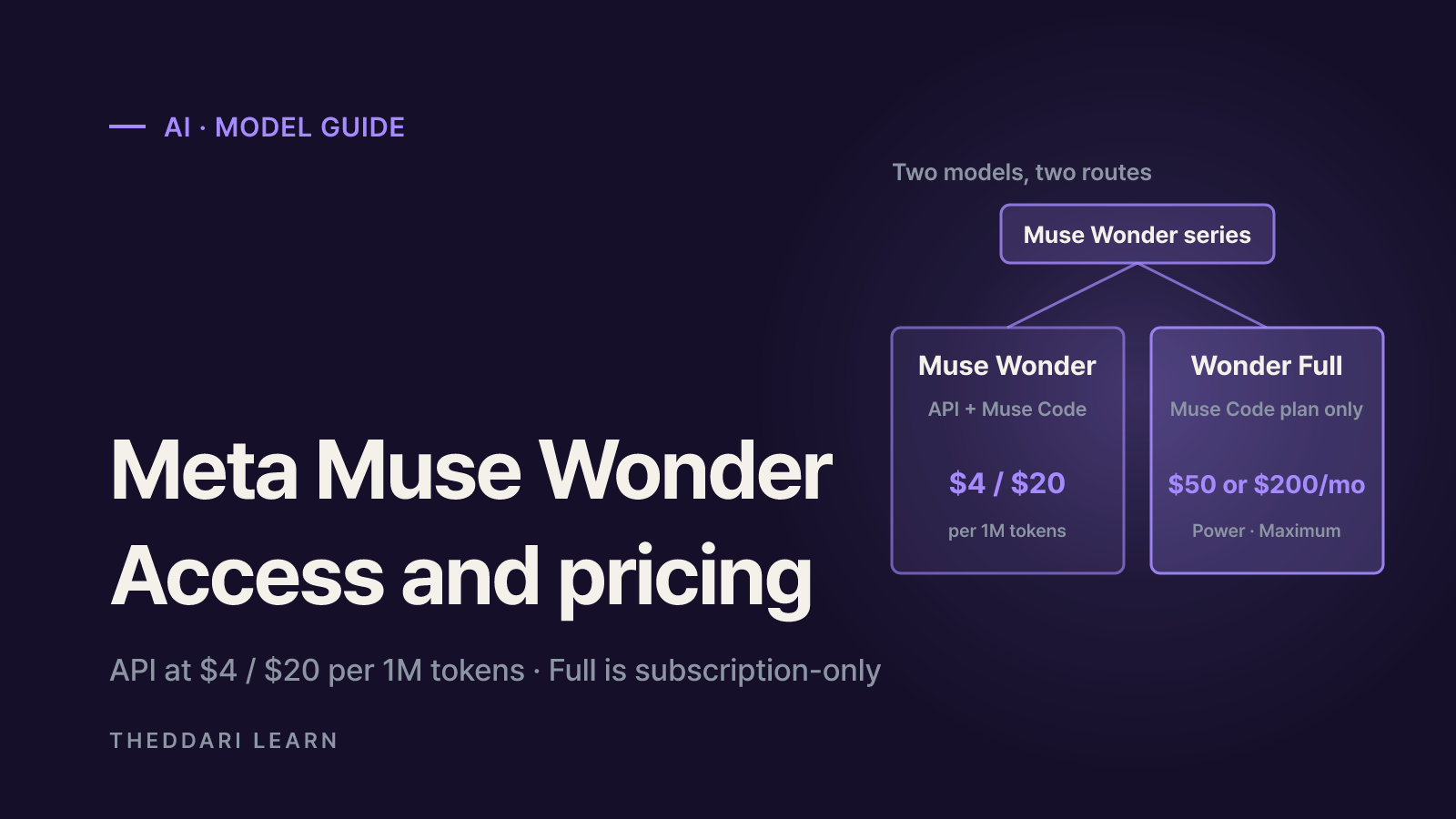
The biggest practical difference is how you pay. The table below reflects Meta's developer pages and its launch post for developers as of October 2026.
Model ID
- Muse Wonder
- muse-wonder-1.0
- Muse Wonder Full
- muse-wonder-full-1.0
Where to use it
- Muse Wonder
- Meta Model API and Muse Code
- Muse Wonder Full
- Muse Code subscription only
Price (USD)
- Muse Wonder
- $4.00 input, $0.20 cached input, $20.00 output per 1M tokens
- Muse Wonder Full
- No per-token price; included in Power ($50/mo) and Maximum ($200/mo) plans
Context window
- Muse Wonder
- 1M tokens
- Muse Wonder Full
- 1M tokens
Meta's description
- Muse Wonder
- Performance comparable to Full
- Muse Wonder Full
- Meta's most advanced model yet
Muse Code is Meta's terminal coding agent for macOS and Windows, with plans at $5 (Everyday), $15 (High), $50 (Power) and $200 (Maximum) per month. Maximum is new with this launch and offers 80 times the Everyday usage limit, with the same five-hour and weekly resets. The Meta Model API itself is labeled a public preview and accepts existing OpenAI-compatible client code once you change the base URL and set the model name.
How it compares with Muse Spark on price
On the same Meta Model API price list, Muse Spark 1.3 costs $1.25 input and $4.25 output per million tokens. That makes Muse Wonder 3.2 times pricier on input and about 4.7 times pricier on output. Spark also has a much cheaper "contributor" tier whose data is used to improve Meta's products; the price list shows no contributor tier for Wonder. For most teams, routing only hard tasks to Wonder and keeping routine calls on a cheaper model is the more realistic setup.

How to read Meta's benchmark claims
Meta says the series achieves state-of-the-art results for personal and professional agents, memory and coding. The published table supports parts of that claim, but it needs context.
- It is not first everywhere. On the Artificial Analysis Index in Meta's own table, Claude Opus 5.5 (max) scores 58, Muse Wonder Full (max) 56 and Muse Wonder (max) 52. On ProgramBench, Opus 5.5 posts 70.5 against 59.0 for Full.
- There are clear strengths. On long-horizon coding, Full scores 79.0 on DeepSWE 1.1 versus 74.2 for Opus 5.5, and 57.5 on SWE-Marathon versus 46.3. Meta says these two results come from independent third-party runs.
- Some rows are Meta's own metrics. The Personal Superintelligence Index is described in the table as an internal composite, which outsiders cannot easily audit.
- Settings vary. Most scores use "max" reasoning effort, and some rows note "xhigh" effort or separate partial and binary scoring. Your default settings may not match.
- Full is measured inside a product. Because Full has no public API, outside evaluations run through Muse Code, so they may reflect the model plus Meta's agent harness rather than the model alone.
A short pilot beats any leaderboard. Pick five to ten tasks you actually run, give the same instructions to your current model and to Muse Wonder, and log output quality, time taken and real token cost.
Risks and open questions for personal agents
Meta acknowledges that a personal agent acts for the user and may handle messages, calendars and private documents. It says it trained the family for robustness to adversarial instructions and careful handling of private information, and that Muse Wonder has its strongest safeguards yet against chemical, biological, radiological and nuclear (CBRN) and cyber misuse. However, the full report with additional safety evaluations is only described as coming soon, so as of October 13, 2026 there is limited material for outside review.
- Permissions: computer use is powerful, so require human approval for hard-to-reverse actions such as payments, sending messages or deleting files.
- Memory: Active Memory carries context across conversations. Check what is stored and how to delete it in the settings of whichever product you use.
- Expert topics: legal, financial and health answers do not replace a qualified professional. Verify contracts and medical information against the source.
- Availability: Meta's pages list no open-weights plan and no country list for the API, and the Muse consumer app rollout has no date. If data residency or local deployment matters, confirm contract terms first.
Launch-week coverage of new AI models often repeats vendor numbers without context. To follow how developers and researchers react over the coming weeks, you can track discussion in our AI blog trends and the blog dashboard, and always compare any quoted score against Meta's original table.
Quick checklist before you try it
- Pick the route: use Muse Code for coding and long agent sessions, or call muse-wonder-1.0 through the Meta Model API to build it into your own app.
- Meter the cost: at $20 per million output tokens, run a small test to see real usage, and decide whether Full is worth a $50 monthly plan.
- Cross-check claims: treat Meta's table as vendor-reported and compare it with independent evaluations and your own tests.
- Set guardrails: add approval steps for risky actions and review how memory is stored and removed.
- Watch for updates: the full safety report, the Muse app rollout and regional availability are still pending.