Contents9 sections
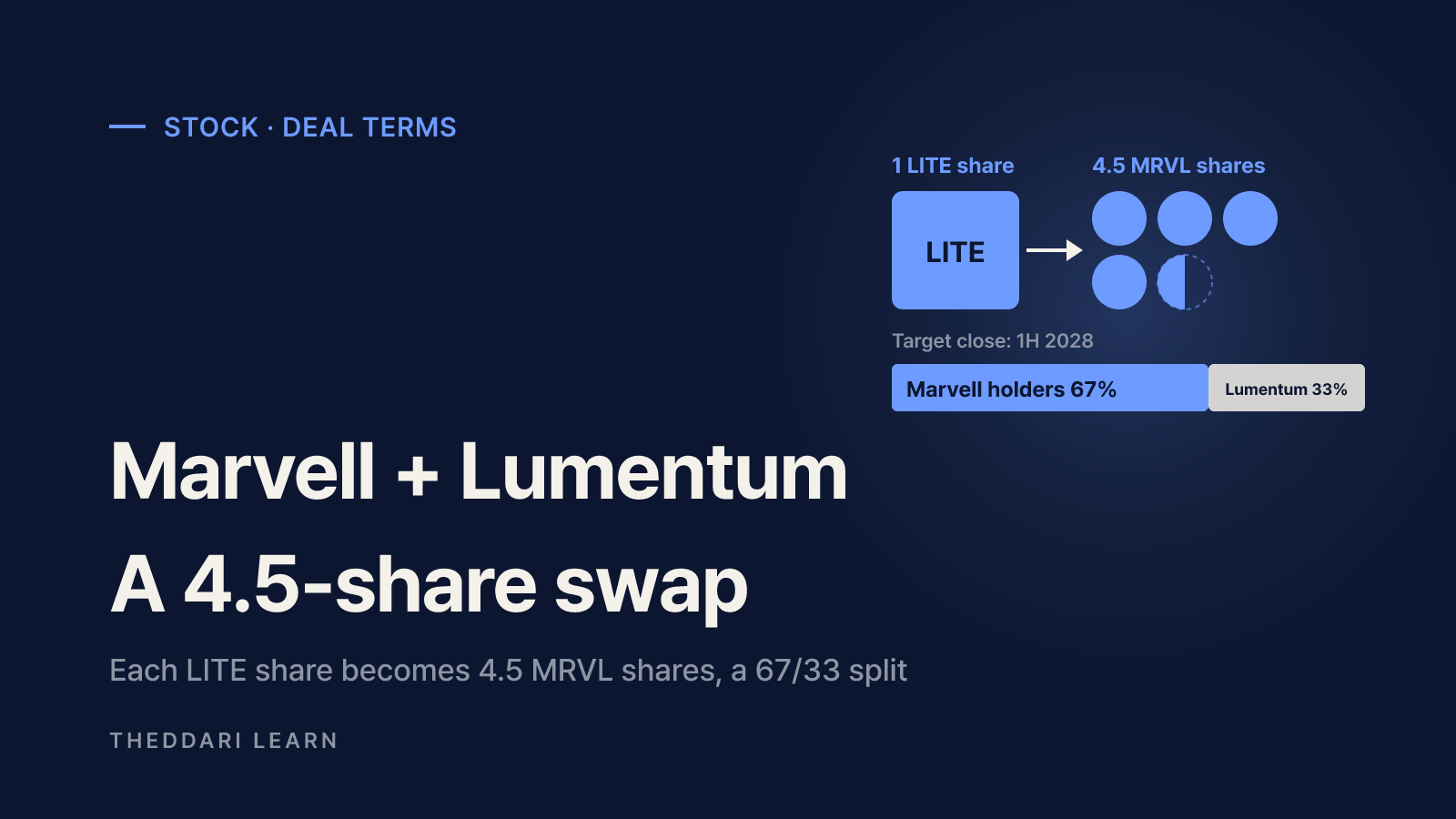
The Marvell Lumentum acquisition is a signed, all-stock merger announced on November 2, 2026. Marvell Technology (NASDAQ: MRVL) will acquire optical-components maker Lumentum (NASDAQ: LITE), and each Lumentum share will convert into 4.500 Marvell shares at closing (Marvell press release). This guide uses the press releases and the merger-agreement summary available as of November 8, 2026 to walk through what holders of each stock should check: the terms, the optical networking synergy case, and the regulatory timeline and break fees.
The short version: nothing has closed yet. Both shareholder groups vote, regulators review, and the companies are aiming for the first half of calendar 2028. Until then, MRVL and LITE trade as separate stocks.
Marvell Lumentum acquisition terms at a glance
Both companies published the same headline terms (Lumentum press release). All values below are as announced on November 2, 2026.
Consideration
- What was announced
- 100% stock
- Why it matters
- No cash, except for fractional shares
Exchange ratio
- What was announced
- 4.500 MRVL shares per LITE share, fixed
- Why it matters
- Dollar value floats with MRVL
Implied value
- What was announced
- About $1,132 per LITE share
- Why it matters
- Based on October 28, 2026 closes
Premium
- What was announced
- About 23.9%
- Why it matters
- Versus the last day before deal speculation
Enterprise value
- What was announced
- About $115 billion
- Why it matters
- Includes Lumentum's debt
Pro forma ownership
- What was announced
- About 67% Marvell / 33% Lumentum
- Why it matters
- Fully diluted basis
Leadership
- What was announced
- Matt Murphy stays chairman and CEO
- Why it matters
- Three Lumentum directors join Marvell's board
Target close
- What was announced
- First half of calendar 2028
- Why it matters
- After votes and regulatory approvals
Working backward from the announced numbers, Marvell's reference price was roughly $1,132 ÷ 4.5 ≈ $251.6, and Lumentum's unaffected price was roughly $1,132 ÷ 1.239 ≈ $914. These are back-of-the-envelope figures derived from the release, not quoted closing prices.
Why a fixed exchange ratio matters
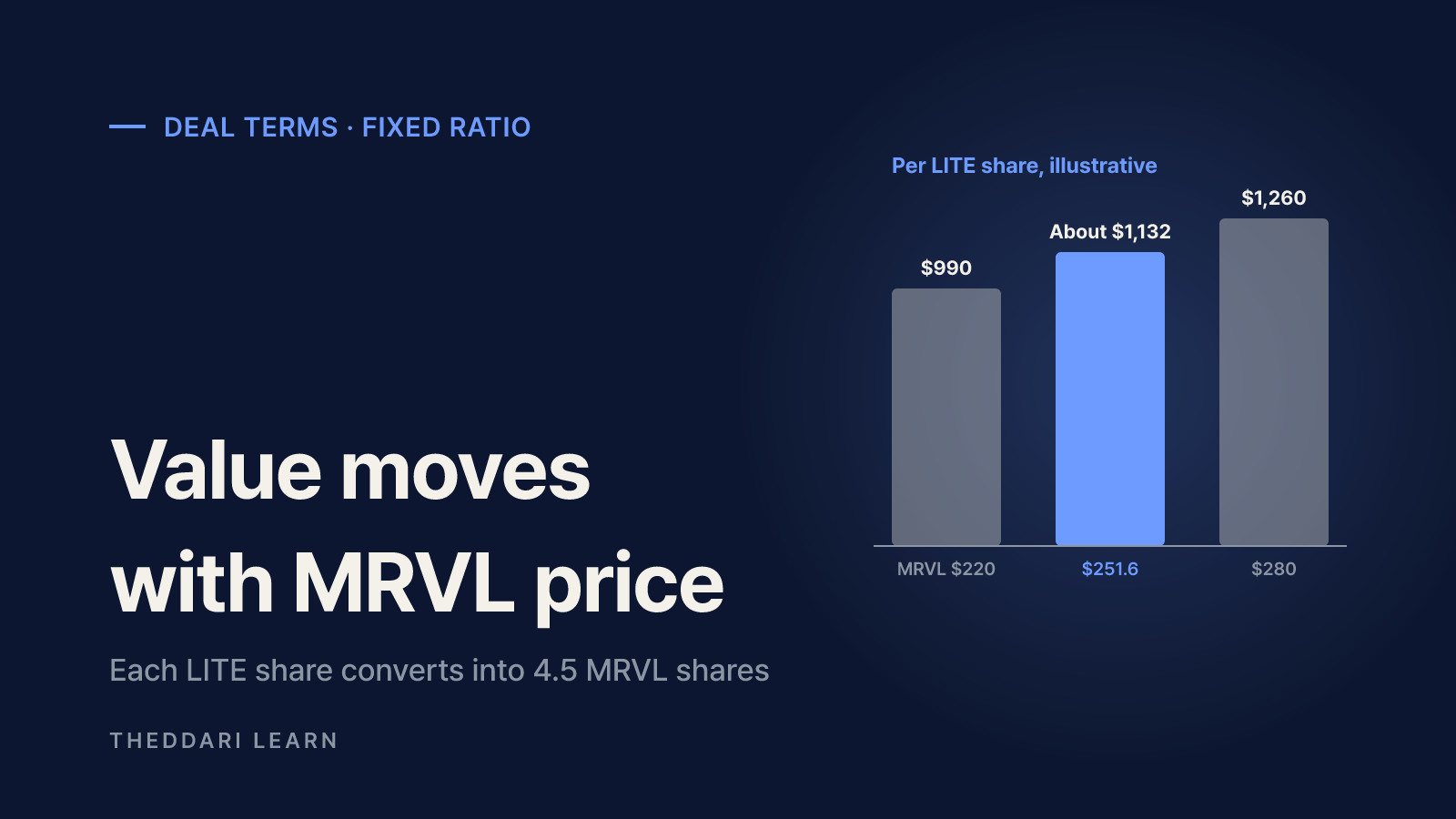
A fixed ratio means Lumentum holders are promised a number of shares, not a number of dollars. On closing day each LITE share is worth 4.5 times whatever MRVL trades at. The table below is a hypothetical illustration, not a price forecast.
$220
- Value per LITE share (×4.5)
- $990
- Versus announced value
- Lower
$251.6 (implied reference)
- Value per LITE share (×4.5)
- About $1,132
- Versus announced value
- Same
$280
- Value per LITE share (×4.5)
- $1,260
- Versus announced value
- Higher
Holders of Lumentum's Series A convertible preferred stock can take Marvell common stock on the same as-converted basis or elect a new Marvell Series B preferred with matching terms. Most retail investors own common shares, so the 4.5 ratio is the number to track.
What LITE holders should check
After a stock deal is announced, the target usually trades close to, but below, the value of the shares it will receive. That gap is the merger arbitrage spread, and it tells you how much risk and waiting time the market is pricing in.
- Spread math: 4.5 × MRVL price − LITE price. A positive number is the discount the market demands for deal risk and time.
- Time to close: The target is more than a year away. A spread that looks wide can be thin once annualized, and you carry Marvell's share-price swings the whole time.
- Adjustments: Check in the S-4 whether splits or special dividends during the pendency would adjust the ratio.
- Your vote: Lumentum holders vote on adopting the merger agreement. Watch for the joint proxy statement/prospectus and its record date.
- Topping bids: Lumentum would owe Marvell a $2.9 billion termination fee to switch to a superior proposal, which raises the bar for a rival bidder.
In practice, LITE now behaves like a bundle of 4.5 MRVL shares plus a bet that the deal closes. Marvell's own earnings can move LITE more than Lumentum's quarterly results. You can find upcoming report dates on the TheDdari earnings calendar.
What MRVL holders should check
For Marvell shareholders the trade-off is dilution in exchange for Lumentum's laser and transceiver business. After closing, legacy Marvell holders are expected to own about 67% of the combined company.
- Dilution and votes: Marvell needs stockholder approval both to issue the new shares and to amend its charter to increase authorized shares.
- EPS accretion: Management expects the deal to add to non-GAAP EPS in year one post-close. Non-GAAP excludes items like deal amortization, so read GAAP results alongside it.
- Synergy delivery: The companies cite line of sight to more than $1 billion in annual run-rate cost synergies. Watch for a timeline and progress updates in quarterly calls.
- Customer reaction: Marvell sells optical DSPs and other parts to many module makers. Owning Lumentum could make some customers see Marvell as a competitor; the release lists customer relationships among the deal risks.
On the same day, Marvell said preliminary fiscal Q3 2027 revenue was in line with the midpoint of its prior guidance and narrowed the range from plus or minus 5% to plus or minus 2%, a signal that the base business was on track when the deal was announced.
The optical networking synergy case
The strategic pitch is that AI data centers are moving from copper to optical links. As bandwidth needs grow, electrical signaling alone struggles to connect chips, racks and buildings efficiently, so more of the link has to be optical.
Core tech
- Marvell brings
- Electrical and optical interconnect, switching
- Lumentum brings
- High-performance lasers, optical transceivers
Chips and materials
- Marvell brings
- Leading-edge CMOS, silicon photonics, custom XPUs
- Lumentum brings
- Indium phosphide and compound semiconductor fabs
Other
- Marvell brings
- Advanced packaging, high-volume production
- Lumentum brings
- Optical circuit switching (OCS)
Together, the companies say they can co-design the full electrical-to-optical signal chain and ship pre-validated optical solutions faster. They put the combined total addressable market at $550 billion. Treat that as the companies' own market definition, not a revenue forecast.
Every synergy claim here is a forward-looking statement. The press release itself flags integration difficulty, employee retention, customer relationships and transaction costs as risks. Whether management reports measurable progress each quarter matters more than the headline figure.
To see how the deal is being discussed among Korean retail investors, the stock Telegram trends page tracks mention volume. Chatter measures attention, not the odds that regulators sign off.
Regulatory approvals, deadlines and break fees
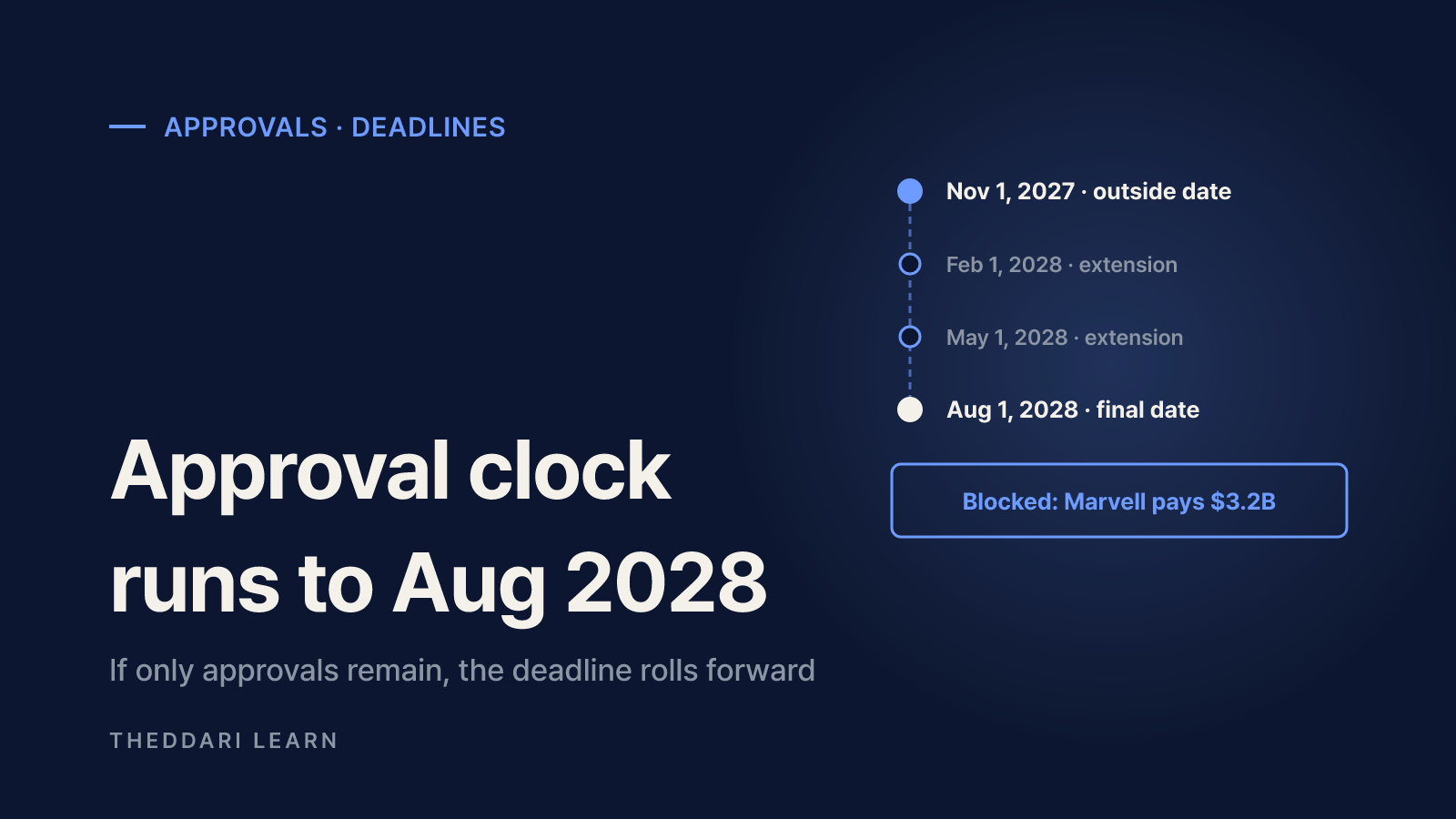
Closing requires both stockholder votes, expiration of the Hart-Scott-Rodino waiting period, other required regulatory approvals, an effective Form S-4 and Nasdaq listing approval for the new shares. The merger agreement spells out the deadlines and who pays if it fails (BTW Media summary of the filing).
| Item | Detail |
|---|---|
| Outside date | November 1, 2027 |
| Automatic extensions | February 1, May 1 and August 1, 2028 if only regulatory conditions remain |
| Regulatory reverse fee | $3.2 billion from Marvell to Lumentum |
| Marvell termination fee | $5.8 billion (e.g., board changes recommendation, superior proposal) |
| Lumentum termination fee | $2.9 billion (matching triggers) |
| Remedy cap | Marvell need not accept remedies materially adverse to the combined business |
Regulators can demand divestitures, IP licenses, or supply and pricing commitments to rivals. Marvell controls regulatory strategy, but it is not obligated to accept a remedy that would be materially adverse to the combined company. In plain terms, if an agency asks for too much, Marvell can let the deal lapse and pay the $3.2 billion fee instead.
The public releases do not list which countries must approve. Lumentum manufactures in several countries outside the U.S., so foreign antitrust and investment-screening reviews could drive the timeline. When the S-4 is filed, read its required-approvals section first. The economic calendar helps separate macro-driven price moves from deal news.
How to follow the filings
- 1
Read the 8-K and merger agreement
Pull both companies' November 2, 2026 Form 8-K filings and Exhibit 2.1 from SEC EDGAR to confirm the ratio and termination terms.
- 2
Watch for the Form S-4
It will contain the background of the deal, fairness opinions, expected tax treatment and the list of required approvals. Shareholder meetings follow once it is effective.
- 3
Track regulatory milestones
Look for HSR waiting-period expiration or a second request, and announcements that foreign reviews have started or cleared.
- 4
Check the vote results
Lumentum votes on the merger agreement; Marvell votes on the share issuance and charter amendment. A failed vote on either side can end the deal.
- 5
Monitor the outside date
As November 1, 2027 approaches, see whether the deadline rolls forward in three-month steps and whether remedy talks are under way.
Bottom line for both sets of holders
- LITE holders: you are owed 4.5 MRVL shares, not cash. Weigh the spread, the long wait and the downside if the deal breaks.
- MRVL holders: you give up about a third of the company for Lumentum's optics business and a $1 billion-plus cost synergy target. Separate non-GAAP promises from GAAP results.
- Both: the first-half 2028 target can slip to August 1, 2028, and heavy regulatory demands could lead Marvell to walk away and pay $3.2 billion.
- Primary documents to follow, in order: press release, 8-K and merger agreement, S-4, vote results, regulator decisions.