Contents6 sections
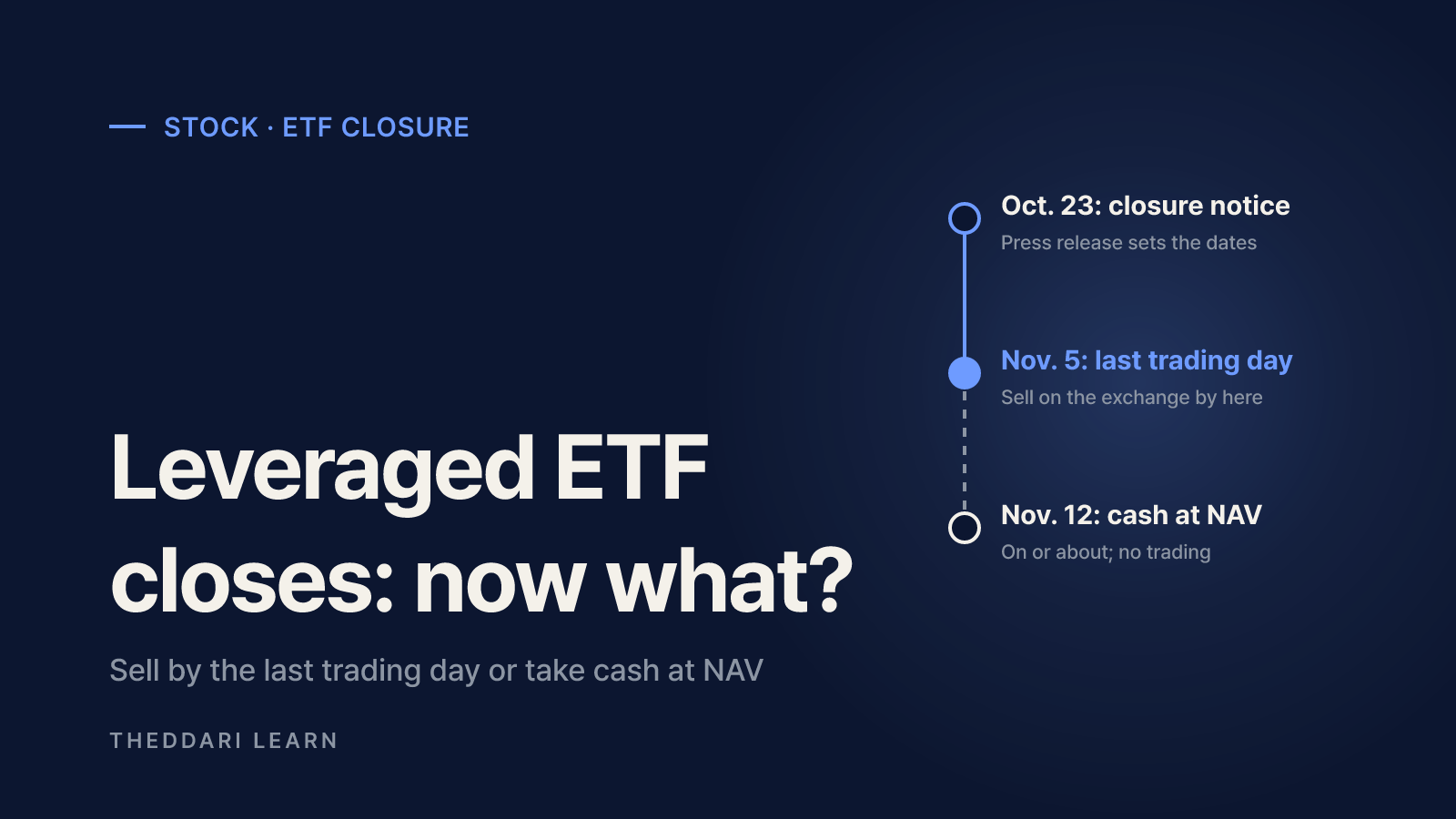
In a leveraged ETF liquidation, shareholders have two exits: sell on the exchange before the last trading day, or hold and receive cash equal to the fund's net asset value (NAV) on the liquidation date. The closure itself does not wipe out your stake, but it does lock in whatever gains or losses the fund has produced. As of October 2026, a live example is Tradr's pair of 2x SK Hynix ETFs, which are closing roughly three months after launch. This guide walks through their timeline, compares selling with waiting for cash, covers the tax questions, and explains why single-stock leveraged funds carry closure risk on top of price risk. Dates are U.S. Eastern Time and apply to these U.S.-listed funds.
What happened to the SK Hynix leveraged ETFs
The funds are the Tradr 2X Long SK hynix Daily ETF (SKHA) and the Tradr 2X Short SK hynix Daily ETF (SKHN), run by Tradr, the leveraged and inverse brand of AXS Investments. SKHA seeks 200% of the daily move in SK Hynix's Nasdaq-listed American depositary receipts (ADRs); SKHN seeks -200%. They began trading on July 28, 2026, a few weeks after the ADR listing on July 10. In an October 23, 2026 press release, Tradr said a plan of liquidation had been approved for both.
| Milestone | Date (U.S. Eastern Time) |
|---|---|
| Board approves plan of liquidation | Prospectus supplement dated Oct. 20, 2026 |
| Public announcement | Press release, Oct. 23, 2026 |
| Last day of creations, redemptions and exchange trading | Nov. 5, 2026, on Cboe BZX |
| Liquidation date | On or about Nov. 12, 2026 |
| Payment basis | Cash at NAV to shareholders of record on the liquidation date |
The funds were small. According to Korea JoongAng Daily, SKHA had net assets of about $480,000 and SKHN about $778,000 as of Friday, October 23, roughly $1.26 million combined and more than 60% below their combined peak. Citing Bloomberg, the paper linked the closures to cooling appetite for the AI trade. Only Tradr's two funds are affected; SK Hynix-linked products from other issuers were not part of the announcement.
Why ETFs close so quickly
An ETF has to earn enough in fees to cover swaps, listing, audit and administration costs. With about a million dollars in assets, that math rarely works. The SEC's fund liquidation bulletin lists poor performance, declining assets and lack of investor interest as common reasons. Charles Schwab notes that leveraged and inverse ETFs and low-asset funds are the most prone to closure, and that funds which close tend to do so within their first few years. In other words, a fund can shut down for business reasons even when nothing is wrong with the underlying company.
Leveraged ETF liquidation: what happens step by step
Exchange-traded funds usually announce a liquidation through a press release and a prospectus supplement. The SEC says the notice generally gives the date the fund stops accepting new purchases, the date trading or redemptions stop, and the liquidation date when remaining assets are distributed pro rata. For SKHA and SKHN, the sequence looks like this.
- 1
Read the issuer's notice
Get the last trading day and liquidation date from the issuer's supplement or press release rather than a headline. Note that later dates are marked on or about and can shift slightly.
- 2
Trade normally through November 5
Shares trade on Cboe BZX through the close on November 5. Normal brokerage charges apply. The issuer says it cannot assure a market for the shares after that date.
- 3
Wind-down week
Between the last trading day and liquidation, AXS may raise cash or hold other highly liquid assets to prepare an orderly liquidation. During this time the funds may not track their 200% or -200% objectives.
- 4
Cash at NAV
On or about November 12, each fund ceases operations and pays shareholders of record cash at that day's NAV. Tradr says remaining holders incur no fund transaction fees. Your broker's crediting date may lag the fund's payment date.
The ETF.net filing summary describes the same schedule and confirms there is no trading on Cboe BZX after November 5. Schwab says most final distributions arrive within three to five business days of delisting, though some have taken a week or longer.
Sell before the last trading day or wait for cash?
Price received
- Sell on the exchange
- Market price, usually the bid
- Hold to liquidation
- NAV on the liquidation date
Costs
- Sell on the exchange
- Commission plus bid-ask spread
- Hold to liquidation
- No fund transaction fee, per Tradr
Cash timing
- Sell on the exchange
- Standard one-business-day settlement
- Hold to liquidation
- After liquidation; broker crediting may lag
Market exposure
- Sell on the exchange
- Ends when you sell
- Hold to liquidation
- Continues to liquidation; 2x exposure not assured
Tax treatment
- Sell on the exchange
- Capital gain or loss on sale
- Hold to liquidation
- Generally treated like a sale
Neither path is automatically better. Selling trades a small, known cost for certainty and faster access to cash. Holding avoids the spread but leaves you exposed to NAV changes and waiting time. Thinly traded funds can see wide quotes near the end, so check the live bid, ask and size, and consider a limit order. If you hold these through a non-U.S. broker, confirm its own order cut-offs and any restrictions on delisting securities.
Volatility may also rise before the last trading day: SK Hynix was reported to be releasing third-quarter earnings on October 28, 2026. You can check the date on the theddari earnings calendar and see how the story is being discussed on the Telegram stock trends board. Both tools help you track schedules and chatter; neither predicts price direction.

Taxes on ETF liquidation proceeds
Tradr's supplement says liquidation proceeds are generally treated as received in exchange for shares, creating a capital gain or loss based on your tax basis, and that withholding may apply in certain circumstances. Schwab adds that in a taxable account, a gain on shares held for a year or less is generally short-term and taxed at ordinary income rates. Rules differ for IRAs and other tax-advantaged accounts and for non-U.S. residents, so check with your broker or tax adviser rather than assuming the treatment.
Single-stock leveraged ETF risk beyond the closure
The most striking detail is that both directions lost money. Korea JoongAng Daily reported that since the funds launched, the SK Hynix ADR rose about 5%, yet SKHA fell more than 5% and SKHN fell 42%. The ADR also swung widely, closing at $137.02 on October 23, about 31% below its September 9 record of $198.63. Large up-and-down swings erode returns when a fund compounds a 2x target every day.
The SEC's leveraged and inverse ETF bulletin gives a simple example. An index falls 10% from 1,000 to 900, then rises 10% to 990, a 1% two-day loss. A 2x fund falls from 1,000 to 800, then rises to 960, a 4% loss, even though it hit its target each day. The SEC adds that single-stock ETFs remove diversification, so holders face more volatility and risk than owners of the stock itself.
Tradr's own risk statement says a fund seeking 2x daily performance would lose all of its money if the underlying security moved more than 50% against it in a single trading day. Closure risk sits on top of that price risk.
Checklist for spotting closure risk early
- Assets under management: small and shrinking funds are the most likely to close. Check the issuer's daily net assets.
- Fund age: young funds have not yet proven demand and close more often.
- Competing products: several funds tracking the same stock split the money, and the smallest may be cut first.
- Holding period: daily-reset funds are built for short-term trading; over weeks, returns can diverge sharply from the stated multiple.
- Notice channels: know where your issuer and broker post supplements and corporate-action notices.
To sum up: when a leveraged ETF is liquidated, you either sell before the last trading day or collect cash at NAV, and either way your result up to that point becomes final. If you hold SKHA or SKHN, note November 5, 2026 as the last trading day and about November 12 as the liquidation date, then confirm your broker's cut-offs, crediting timeline and tax reporting. When evaluating any single-stock leveraged ETF, weigh its size and survival odds alongside its price risk.