Contents6 sections
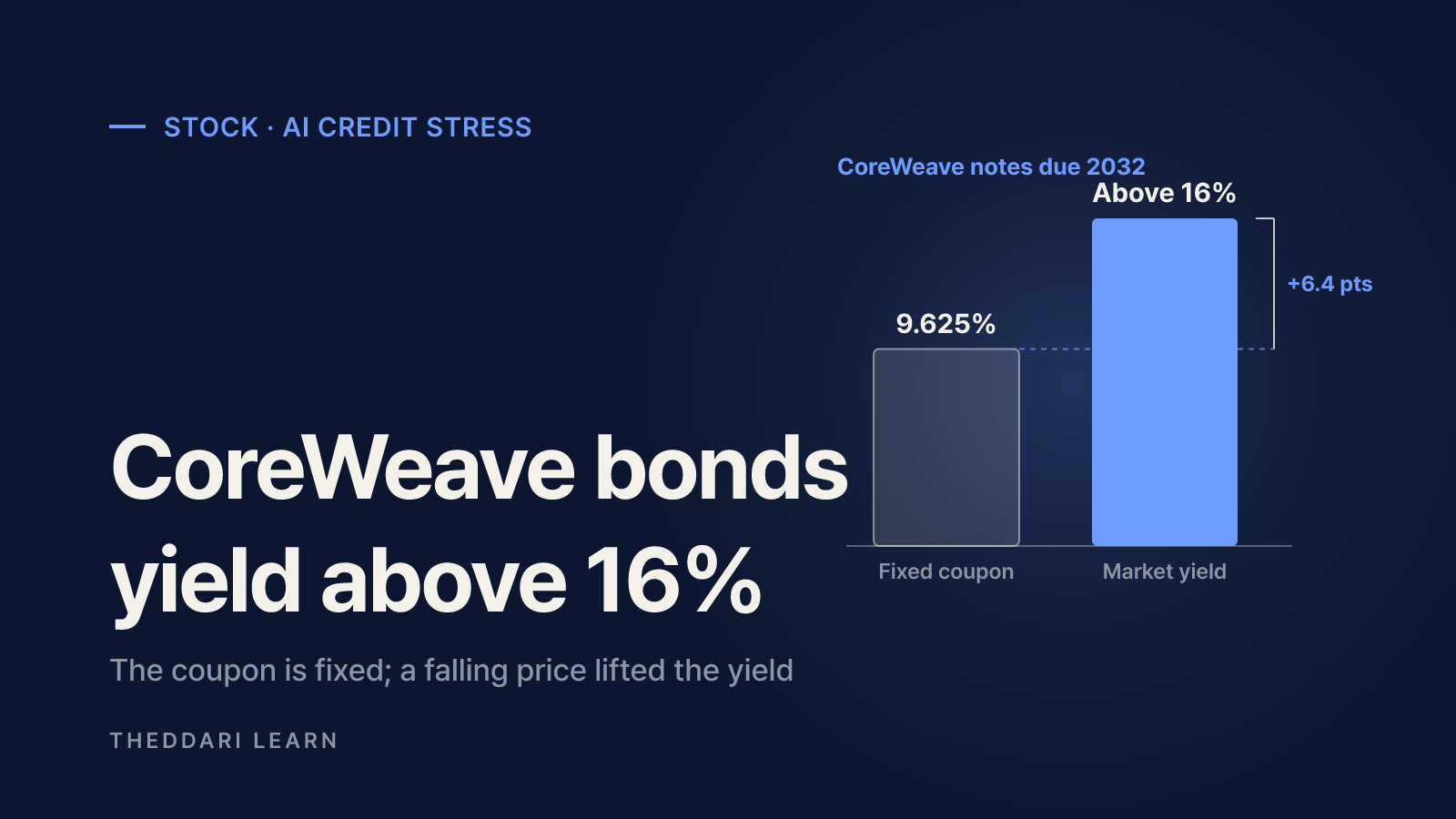
A CoreWeave bond yield above 16% does not mean CoreWeave is paying 16% interest. It means the price of its existing debt has fallen far enough that a new buyer now demands more than 16% a year to take the risk. According to CNBC's November 6, 2026 report, the yield on CoreWeave's 2032 bond with a 9.625% coupon climbed above 16%, while its five-year credit default swaps spiked past 1,289 basis points before easing to around 1,155. This guide, based on reporting available through November 10, 2026 and SEC investor education material, explains what "AI credit stress" means and how to use bond-market signals to judge the risk in debt-funded AI infrastructure companies. It focuses on reading the credit market rather than on CoreWeave's business model.
What a CoreWeave bond yield above 16% actually tells you
Every bond has two rates worth knowing. The coupon is fixed at issuance and determines the cash interest paid on face value. The yield to maturity is the annual return a buyer earns by purchasing at today's price and holding to maturity, assuming every payment arrives. The SEC's corporate bond bulletin describes price and yield as opposite ends of a seesaw. In its example, a 10-year bond with a 4% coupon trading at 90% of face value has a 5.31% yield to maturity, because the buyer collects the same coupons plus the gain from being repaid at par.
CoreWeave's 2032 notes work the same way. The company still owes $96.25 a year per $1,000 of face value. What changed is the market price, which has dropped well below par, lifting the yield for new buyers above 16%. The gap between yield and coupon, roughly 6.4 percentage points (16 minus 9.625), is the market's way of pricing doubt about whether every payment will be made. A separate CNBC report on November 9 said some CoreWeave bonds maturing in 2031 also yielded above 16%, so the repricing is not confined to a single issue.
2032 notes coupon
- Reported level (Nov 2026)
- 9.625%
- How to read it
- Contractual interest CoreWeave pays
2032 notes yield
- Reported level (Nov 2026)
- Above 16%
- How to read it
- Return demanded by a buyer at today's price
5-year CDS (Nov 5)
- Reported level (Nov 2026)
- Above 1,289 bps
- How to read it
- Cost to insure against default, over 12.89% a year
5-year CDS (Nov 6)
- Reported level (Nov 2026)
- About 1,155 bps
- How to read it
- Down about 8% in one day; volatile
Nvidia 5-year CDS
- Reported level (Nov 2026)
- About 139 bps
- How to read it
- Up 76% in a month but low in absolute terms
Oracle 5-year CDS
- Reported level (Nov 2026)
- About 298 bps
- How to read it
- Between large tech issuers and CoreWeave
What is AI credit stress?
AI credit stress is an informal label, used repeatedly in November 2026 coverage, for lenders and credit-default-swap traders demanding more compensation from companies that borrow to build AI data centers and buy GPUs. CNBC quoted Jefferies strategist Christopher Wood, who argued that the most plausible end to the AI capex arms race is that "the credit card will be taken away." CNBC added that this is not happening yet, but the interest rate on that credit card is clearly rising.
Why the pressure built in early November
- Politics: after the midterm elections, investors weighed tougher data center rules in states such as Ohio, Texas and Georgia that hold much of the planned capacity. Goldman Sachs estimated moratoriums could affect 45% of planned U.S. capacity.
- Cash flow: Goldman said hyperscalers collectively posted negative free cash flow in the third quarter as capital spending exceeded operating cash flow.
- Supply of debt: Goldman counted $296 billion of hyperscaler bond issuance this year and forecast $440 billion next year, plus $300 billion of project-level debt. Bank of America sees AI-related credit issuance reaching $685 billion in 2027.
- Neocloud economics: unlike Amazon or Microsoft, leading neoclouds are unprofitable and rely heavily on a small number of customers, a point Partners Group's Anastasia Amoroso raised on CNBC.
The stress is not uniform. CNBC noted that CDS on Nvidia, Broadcom and Amazon rose 76%, 49% and 44% in a month, yet stayed low in absolute terms, and that "a large increase from a low starting point does not imply the same credit risk." A cash-rich investment-grade chipmaker and a high-yield, debt-funded cloud provider can both be called AI stocks while sitting in very different places in the credit market. CNBC also stressed that AI debt financing is not collapsing: Goldman tallied five AI bond deals worth $67 billion since October 29.
How to read bond signals for AI infrastructure risk
- 1
Measure the coupon-to-yield gap
Put the coupon and the current yield side by side. A gap of several percentage points means the bond trades at a deep discount. How fast that gap opened tells you how quickly sentiment shifted.
- 2
Strip out rates with the credit spread
A rising yield mixes two effects: higher market rates and higher company-specific risk. Subtract the yield on a Treasury of similar maturity to get the credit spread. If Treasuries are flat but the spread widens, the market is worried about the issuer, not about rates. Comparing with a broad high-yield index spread shows whether the company is priced worse than the junk-bond average.
- 3
Read CDS by level, not just by change
CDS is the price of default insurance. Above 1,000 bps, protection costs more than 10% a year, which implies the market sees meaningful default risk. A 70% jump from the low 100s is a mood shift, not the same level of danger.
- 4
Map the maturity wall and the expensive debt
Timing matters as much as size. CNBC reported that at the end of June CoreWeave had $5.5 billion in cash and $35 billion of debt, including $1.3 billion at a 15% rate on a facility due March 2028 and $3.2 billion on an August 2030 facility at 11%. Costly debt coming due soon makes the refinancing environment critical.
- 5
Check ranking and terms
The SEC explains that secured, senior unsecured and subordinated debt are repaid in that order, with shareholders behind all of them. In the prospectus, look for covenants, call provisions and payment-in-kind (PIK) clauses that let an issuer pay interest in more bonds. Two bonds from the same company can carry different yields because of these terms.
Earnings releases are the main event that updates these signals. CoreWeave was scheduled to report third-quarter results on November 10, with analysts expecting revenue of about $3.55 billion, up roughly 160% year over year, according to LSEG data cited by CNBC. The theddari earnings calendar helps track reporting dates, and the economic calendar shows U.S. data releases that move Treasury yields and therefore spreads. Both are scheduling tools, not forecasts of where bond prices will go.

What the bond market means for CRWV shareholders
In a bankruptcy, bondholders have priority over shareholders, as the SEC bulletin notes. When senior creditors mark down a company's bonds, equity holders, who stand last in line, usually feel larger swings. CNBC reported that CoreWeave and Nebius shares had lost about half their value in a month, and Deutsche Bank's Jim Reid observed that debt and equities were moving more in sync.
The most direct channel to shareholders is funding cost and dilution. Morningstar analyst Luke Yang told CNBC that CoreWeave is unlikely to go bankrupt in the near future and has funds to deliver existing contracts, but growth over the next five years requires more capital, and a beaten-down stock makes equity raises unattractive. Borrowing at higher rates squeezes earnings; issuing shares dilutes existing owners. Freedom Capital Markets' Paul Meeks described the risk of a "doom cycle," in which creditor worry forces more expensive borrowing, which in turn feeds creditor worry.
There is a counter-case. CEO Michael Intrator said he does not anticipate any impact on existing customer commitments or backlog from the political shift, and some analysts expected earnings to bring relief. Corporate bonds also trade less frequently than stocks and have less price transparency, according to the SEC, so a handful of trades can exaggerate a move. No single indicator settles the default question or the stock's direction.
For hands-on checks, FINRA's market data pages show recent corporate bond trades, and CoreWeave's 10-Q and 10-K filings on SEC EDGAR list each facility's rate and maturity. Market chatter about neoclouds spreads quickly in stock-focused Telegram channels, which theddari's tracker summarizes, but verify any figure against the original filing or report before relying on it.
The bottom line: a CoreWeave bond yield above 16% shows the credit market pricing debt-funded AI infrastructure as high risk. Reading it properly means looking at the coupon-to-yield gap, the spread over Treasuries, the absolute CDS level, near-term maturities and the bond's legal terms together. The next checkpoints are the capital spending, interest expense and financing plans disclosed with earnings, and which way bond prices and CDS move afterward.